Tchibo’s own product page for this frother (order number 172027) showed “Currently unavailable” on 15 September 2026. It nevertheless displayed €64.99, a strikethrough price of €89.99 and a 30-day lowest price of €49.00. Our price box shows approx. €49 (on Amazon.de). We cannot document when this value was last checked against a retailer, because the Amazon catalogue contained no price field when it was retrieved on 7 September.
We have not had the frother in our hands. What is written here comes from Tchibo’s operating manual with print code 96922AB from March 2022, from the product page and from the manufacturer texts in the Amazon catalogue. Where these sources contradict each other, both statements are given.
Type 364472 and the newer Tchibo model
Amazon lists the item with model number 364472 and part number 625519. The same 364472 appears in the manual as the type, and this very manual is what Tchibo offers for download on the product page of the cream white version. According to the manual, the device was made exclusively for Tchibo GmbH in Hamburg.
The number is worth a look because Tchibo now sells a different device under the same product name. In the shop category on 15 September there were exactly two items, a black and a white induction milk frother at €89.99 each, type 657097 (black) and 663064 (white). For this newer device Tchibo gives approx. 21 centimetres in height, approx. 11.5 centimetres in diameter and approx. 1,300 grams, and its manual also gives a minimum fill of approx. 90 millilitres. If these values show up in a data sheet for the cream white model, they belong to the newer one according to our comparison.
Design: base and jug
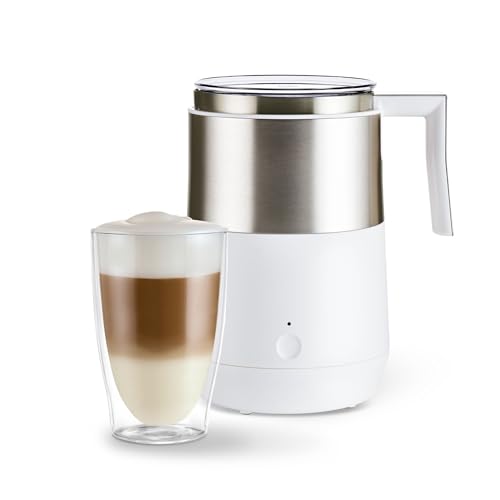
At the bottom is the base. At the back of it sits a storage spigot on which, according to Tchibo, the whisk insert you are not currently using waits so that it does not get lost. According to the component overview in the manual, the base holds a temperature sensor and a spigot; on the outside it has ventilation openings, the mains cable and, instead of a display, a single on/off switch with an indicator light above it.
On top goes the milk jug with handle and pouring spout. In the jug base there is another spigot onto which you fit the whisk insert, the fill marks are on the inside, and a transparent lid closes the top, through which, according to the product page, you keep an eye on the froth. Of the two whisk inserts, the ribbed one is intended for milk froth, the smooth one for milk that should only get warm.
Tchibo names stainless steel and plastic as materials. In the product photo the jug above the base is silver-coloured, base and handle are white, and the round switch sits at the front of the base with a small dot above it.
The product page gives a height of approx. 20 centimetres and a diameter of approx. 13 centimetres. A diameter describes the round body; in the photo the handle sticks out to the side and adds to the width. Anti-slip silicone feet sit under the base.
Connection values according to the manual: 500 watts, 220 to 240 volts at 50 hertz, protection class I. Devices of this class have a protective earth conductor, so the plug belongs in a properly installed socket with earthing contacts.
The sources do not quite agree on operation. The manual speaks of the on/off switch, while the product page and the Amazon text advertise “one-button operation with touch interface”. Neither makes clear whether the button switches mechanically or responds to touch; the sources agree that there is exactly one.
In detail: induction and a fixed end point
According to Tchibo, the device generates a magnetic field inside, whose energy passes into the base and is converted into heat there; a separate induction hob is not needed. Physically the same principle is behind it as with an induction hob. A coil builds up an alternating magnetic field, eddy currents arise in the electrically conductive base above it, and they heat the material. The heat therefore arises in the jug base itself, unlike with a hotplate, which warms the base from below.
The same physics leads to a warning in the manual. Metal objects such as spoons do not belong in the base: if it is switched on, it heats metal lying directly on the induction surface.
Tchibo promises on the product page that the milk does not burn on. Our assessment of this: even with induction the base remains the hottest spot, because the heat arises there. Two processes from the manual work against that. The device whisks the milk while it heats it, and as soon as the milk has reached approx. 60 to 70 °C, heating and whisking stop by themselves.
This end point cannot be adjusted. Our guide How to froth milk advises not taking milk above about 65 degrees for froth; well above that, according to the guide, the protein structure that keeps the froth stable begins to break down. The upper end of the Tchibo window is 5 degrees above the 65-degree mark. You only get warm milk below 60 degrees if you stop the run by hand, and without a temperature display on the device.
After a hot run the fan keeps running for some time and then switches off. Reheating straight away is not possible: once the milk has reached its end temperature, the milk and the jug must first cool down. A start attempt in this phase brings only repeated flashing of the light, a few signal tones and the fan starting up.
One switch for hot, cold and pause
Before first use you remove all packaging material, check that all parts are present, and clean the jug, whisk inserts and lid. According to the manual, a slight smell can arise during the first heating, which Tchibo describes as harmless; you are to ensure sufficient ventilation.
To fill, you take the jug off the base and remove the lid, fit the suitable insert onto the spigot, pour in milk at most up to the matching MAX marking, fit the lid firmly and put the jug back. The lid matters. You should not reach in while the device is in operation, and you may only use it with the lid firmly in place, because according to the manual hot milk can cause scalding.
When you insert the mains plug, a signal tone sounds and the indicator light flashes slowly red: ready for operation. For hot froth or warm milk, one press of the switch is now enough; if the device was switched off and the light is not flashing, you press twice. After two signal tones the light stays red, and the device whisks and heats at the same time. At the end there are four signal tones, after which the light flashes slowly again and you can take the jug off.
You start cold froth by holding the switch pressed for approx. 2 seconds, with the device switched off after a short press to switch it on. The light shows red briefly and then changes to blue, the device whisks without heating, and after approx. 1 minute it is done. You choose hot or cold at the switch, and whether froth is produced at the insert.
During a run, one press of the switch stops everything. A long signal tone sounds and the light flashes red. To continue, you press again, briefly for heating and whisking, long for whisking without heating.
Jug and lid get hot in use. You should not touch the hot surfaces, only hold the jug by the handle and the lid only by the rim, and let both cool down before cleaning. You may only take the jug off the base once the whisking and heating process has ended or the device is switched off. If the light flashes quickly red, the device has overheated according to the troubleshooting table and must cool down.
The manual describes two safety cut-outs specifically. If the device is switched on without milk, it switches off after a few seconds, and against overload it switches off after a maximum of 8 minutes of use. The section on switching off also contains the sentence “The device switches off automatically after 3 minutes”, and the Amazon text advertises a switch-off “after approx. 3 minutes”. Whether this means the time after the end of a run or an upper limit for the run itself, the manual leaves open; regularly, a hot run ends by temperature. Only the pulled mains plug disconnects the device completely from the power.
How much milk fits in the jug?
According to the manual, approx. 250 millilitres for frothing and approx. 475 millilitres for heating, with a capacity of 500 millilitres. The product page and the Amazon text put it slightly higher: approx. 260 millilitres of milk for frothing, up to 500 millilitres for heating.
What counts when filling, according to the manual, are the lines in the jug. Inside there are two MAX markings, printed as symbols in the manual: the one with the smooth ring belongs to the smooth insert, the one with the ribbed ring to the ribbed one. That the froth mark sits lower follows from the quantities, because frothed milk needs room upwards.
At the bottom a MIN marking limits the fill, tied to a condition: the spigot in the jug base must be covered with milk. Tchibo classes this under material damage, because with too little milk the device can overheat, and with too much the milk can boil over. Tchibo has not published how many millilitres belong up to the MIN mark for this model. The yardstick for the lower limit is therefore the spigot rather than the size of your cup.
Cleaning and setting up according to the manual
You clean the jug immediately after every heating and whisking run so that the milk does not dry on. To do so you first pull the mains plug and let the device cool down sufficiently, take the jug out of the base, remove the lid and take the whisk insert off the spigot. You wash the jug, lid and the insert used “in warm water with a little washing-up liquid”; these parts are also dishwasher-safe. The product page sums this up as “partially dishwasher-safe”. Finally you dry all parts carefully, especially the jug, to avoid marks.
Base, plug and mains cable must not be exposed to moisture and are also to be protected from dripping and splashing water. The base must never be immersed in water or other liquids, and no water may get to the electrical parts. If needed, you wipe it with a slightly damp cloth. Harsh chemicals as well as aggressive or abrasive cleaning agents are taboo when cleaning.
For operation, the device should stand freely, “never directly against a wall or in a corner, in a cupboard, by a curtain or similar”, on a firm, level surface that is easy to clean and easy to reach, and on which it can neither slip nor tip over. It needs sufficient distance from heat sources such as hobs or ovens, does not belong near a washing or sink basin, and you do not use it outdoors or in damp rooms. You lay the mains cable so that it is not a trip hazard and does not hang down from the surface, so that nobody pulls the device down by it by accident. The socket must be easily accessible so that you can quickly pull the mains plug if necessary.
Because Tchibo cannot rule out entirely that some varnishes, plastics or furniture polishes attack and soften the material of the anti-slip feet, you put a non-slip mat under the base if appropriate.
Above all the automatic switch-offs stands a sentence from the safety notes: “Never operate the milk frother unattended.”
What Tchibo leaves open for the 364472
A device weight is missing in the manual and on the product page; the Amazon catalogue gives 4.39 pounds, converted around 2.0 kilograms, and leaves open whether the packaging is included in the weighing. Also missing are the width including handle, the duration of a hot run (the product page merely advertises froth “in just a few seconds”), the length of the cooling pause until the next one, a noise value in decibels, the power consumption when switched off and the cable length. Of what exactly the jug, inserts and lid are made and whether the jug is coated inside remains open, as do a maximum dishwasher temperature and any descaling instructions. The manual does not mention plant-based drinks, giving only milk as the intended use, and how much froth or how many cups a run yields is not quantified. Around the purchase, the complete scope of delivery, spare part prices, the country of production and the year of market launch are undocumented; only the manual is dated.
Tchibo, Severin or WMF?
Three devices from our milk frothers category come into question as alternatives: two Severin models with temperature selection and the WMF Stelio, which costs almost the same.
| Model | The difference | Price | Our rating | Choose this if |
|---|---|---|---|---|
| Tchibo Induktions-Milchaufschäumer Cremeweiß (this one) | fixed end temperature, separate inserts for froth and warm milk | approx. €49 | 8.3 | approx. 60 to 70 °C at the end is enough for you and you do not want to pay extra for temperature selection |
| Severin SM 3587 | 13 programmes via OLED display, including cashew, soy and lactose-free, 45 to 65 °C selectable | approx. €114 | 9.4 | you want to froth soy drink or lactose-free milk with its own programme |
| Severin SM 3586 | up to 350 ml of froth and 700 ml of hot milk, chocolate function, 45 to 65 °C selectable | approx. €99.99 | 8.9 | you need more milk at once or want to make cocoa from chocolate in the jug |
| WMF Stelio | 150 ml of froth and 250 ml of hot milk, jug only to be wiped damp according to WMF | approx. €45.99 | 8.6 | you mostly make one cup and look after the jug by hand anyway |
The prices are guide values from our price boxes, as of September 2026 for the three alternatives and without a documented date for the Tchibo. The rating is our editorial assessment of the manufacturer data; it says nothing about the froth quality of the four devices. The best-of list compares all devices in the category.
When the Tchibo suits and when one of the others does
Temperature first. If you want milk at different warmth depending on the drink, or generally cooler than 60 degrees, you need a temperature selection, and both Severin models have one. The cheaper one, the SM 3586, costs around €51 more than the Tchibo in our catalogue and takes more milk per run. It prepares cocoa from chocolate pieces directly in the jug.
You can get the WMF Stelio around €3 cheaper than the Tchibo, but it is designed for smaller quantities. For us, care is the deciding point. According to WMF’s care table, the jug is only wiped with a damp cloth, the dishwasher and rinsing under running water are not intended for it, and it is non-stick coated inside. If you want to put the jug with the other dishes after frothing, the Tchibo serves you better.
Programmes tuned to a specific type of milk are offered among the four devices only by the SM 3587, at €65 more than for the Tchibo. What Tchibo says about plant-based drinks in its own jug is in the questions below.
That leaves the newer Tchibo model. In the Tchibo shop it is around €41 above our guide value for the 364472. Measured against the shop price that Tchibo displayed for the cream white model on 15 September, the gap shrinks to €25 (€89.99 instead of €64.99), and at that price we would reach for the newer device, if only because Tchibo showed it as available the same day. What speaks for the 364472 is above all a purchase price close to our guide value.
The wrong choice is the Tchibo, in our assessment, for households that regularly froth more than approx. 250 millilitres of milk hot at once in the morning, that is, more than the froth mark holds. Before every further hot run comes the cooling pause from the section In detail. According to Severin, the SM 3586 takes up to 350 millilitres of froth milk, so in such cases you need fewer runs.