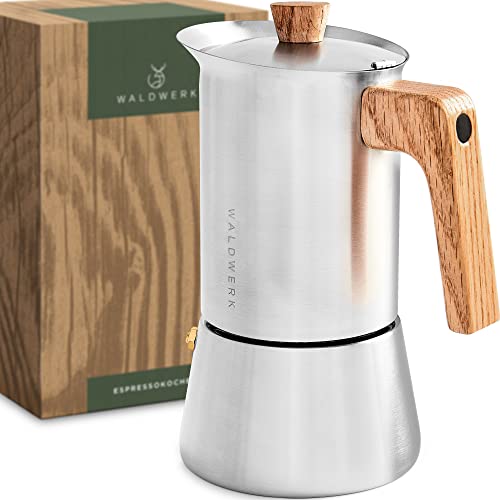
In its own shop waldwerk.kitchen, Waldwerk lists exactly one moka pot, article number WW_EK300, and two things on it are made of wood: the handle and the knob on the lid. The rest is a stainless steel moka pot. On Amazon.de it costs approx. €39.99 (as of September 2026). The brand also sells a coffee grinder, a French press, a milk jug and an electric milk frother there.
Our catalogue contains 17 moka pots. Ten are cheaper than the Waldwerk, six are more expensive, and with 8.1 points twelve rank ahead of it. The score is our editorial assessment; we have not had the pot in our hands. You can find all pots in the category under moka pots, and the best moka pots list presents the eight with the highest scores.
Stainless steel 304 on top, 430 below, oak on handle and knob
The exploded diagram on the product page breaks the pot down into five parts: the upper chamber with lid and spout, the filter plate, the gasket ring, the funnel insert with riser tube, and the water chamber with valve. For two of them Waldwerk names the steel grade. The upper chamber is stainless steel 304, the water chamber stainless steel 430.
On the Amazon product photo the upper chamber is a smooth cylinder, and the lower chamber widens slightly towards the base. The pot does not have the eight facets of the Italian design. The handle sticks out to the right. The shop description speaks of oak handles in the plural, the manufacturer’s image and the Amazon listing of solid oak. Waldwerk describes the spout as specially shaped so that nothing drips when you pour.
The shop labels the pot “100% Plastikfrei” (100% plastic-free). The gasket ring, however, is made of silicone, a synthetic elastomer, and anyone who takes the label literally counts it.
The manufacturer’s image gives the pot’s dimensions as 19.5 centimetres high and 10 centimetres in diameter, measured at the base of the water chamber. The Amazon catalogue, which is also the source of the only weight figure, lists 19.0 by 13.0 by 10.0 centimetres at around 715 grams. The 13 centimetres is probably an overall dimension across the handle that sticks out to the side, because the body is round in the photo.
On the valve, two texts from the same manufacturer contradict each other. The exploded diagram in the shop labels it “Edelstahlventil für Druckablass” (stainless steel valve for pressure release), while the Amazon listing speaks of a brass safety valve. On the Amazon product image that we show on this page, a gold-coloured part is visible on the left of the lower chamber, half hidden behind the packaging, roughly where stovetop pots carry their valve. That fits the Amazon statement better, but it only shows the colour of the part, not its material.
In detail: why the water chamber is made of 430 steel
An induction hob does not get hot itself. The coil under the glass plate builds up an alternating magnetic field, and heat arises only in a pan base that can be magnetised. Stainless steel 430 is a ferritic chromium steel without nickel and attracts a magnet. Stainless steel 304 contains around 18 per cent chromium and 8 per cent nickel, is austenitic, practically non-magnetic and is harder to rust.
We therefore read the split in the Waldwerk pot like this: magnetic steel at the bottom, where the cooking zone has to act, and the more corrosion-resistant steel at the top, where the coffee stays after brewing. Morgenheld also names grades 304 and 430 for the FLOW, but does not assign them to a component. Aluminium is not magnetic; according to Bialetti, the Bialetti Moka Express runs on induction only with the manufacturer’s adapter plate.
According to the product image, Waldwerk approves the pot for gas, glass-ceramic, electric and induction. The Amazon listing says Ceran instead of glass-ceramic; the same type of hob is meant.
Stainless steel has one disadvantage compared with aluminium: it conducts heat many times worse. The heat comes in through the base and travels more slowly into the walls. On a gas hob we would not set the flame wider than the base of the pot, so that it does not lick up the side towards the oak handle.
Is a 300 millilitre pot enough for two people?
For two, yes. Waldwerk writes “300ml = 1-6 Tassen” (1 to 6 cups) on a product image, and the Amazon catalogue lists the size as 6 cups. That works out at 50 millilitres per cup, so for two people three small mocha cups each, or one large cup that you stretch with hot water.
You should read the lower limit of one cup with caution. Step one of the manufacturer’s instructions is to fill the chamber with water up to the valve. A pot that is filled to the same mark every time delivers roughly the same amount every time, and “one cup” then means one large one. Other manufacturers include a reducer insert for the funnel for smaller amounts. For Waldwerk none is listed in the shop, and as an extra the Amazon listing mentions only the manual. If you fill in less water anyway and the funnel full, the ratio to the grounds shifts and the mocha becomes correspondingly stronger.
The Morgenheld FLOW in the 6-cup version has the same fill quantity.
Brewing according to the four-step graphic
Online, Waldwerk has reduced the preparation to a single graphic. Fill the chamber with water up to the valve, put the filter in place and add the coffee grounds, bring the moka pot to the boil on the hob, and enjoy the espresso after a few minutes. Grams, grind size and minutes are not on it.
What we would do with any stovetop pot of this design, because it follows from the principle: grind the coffee medium-fine, much coarser than for an espresso machine, fill the funnel loosely to the rim and do not tamp the grounds. The reason is pressure. In the pot, it is only the steam above the water that pushes the liquid through the riser tube and the coffee grounds. If the grounds are too fine or pressed too firmly, the pressure builds up until the valve releases it. We would take the pot off the hob as soon as the coffee in the upper chamber starts to bubble, because then only steam with remnants of water follows.
The word espresso on the graphic is generous. An espresso machine works at around 9 bar on the coffee grounds, a stovetop pot at a fraction of that. What comes out is a concentrated mocha, not espresso in the technical sense.
The steps one by one are in our guide to moka pots, and the guide to grind size explains how fine medium-fine is on your grinder. The brew calculator works out the amount of grounds for a full fill.
The gasket: tab yes, supply no
With the gasket ring, Waldwerk has thought of cleaning. It has a tab that you use to pull it out of the upper chamber. Pots without such a tab require you to lever the ring out of its groove with a blunt knife once coffee grounds have got underneath.
There is no supply from the manufacturer: on 24 September 2026 the shop carried no spare part, and the category for second-grade goods is empty. This is where the Waldwerk differs most clearly from its neighbours in our catalogue: for the 6-cup Moka Express, Bialetti carries in its own shop a set of silicone gasket and filter for €7.99, and Morgenheld for the FLOW three gaskets including a sieve for €7.95 in its shop. With the Barista Royal, a second gasket ring comes in the box. If the ring on the Waldwerk goes hard or cracks, your only option for now is to ask the manufacturer.
The second wear issue is limescale. With hard tap water it builds up in the water chamber, around the valve seat and in the riser tube of the funnel, which is exactly where the steam pressure has to pass. How hard your water is is published by your water supplier. What the hardness means for the coffee and for scale formation is in our guide to water hardness and coffee.
What Waldwerk does not state
The product page has hardly any running text, and the technical data are in the product images. There is no manual to download, and the shop’s FAQ page is empty. That leaves open:
- whether the pot may go in the dishwasher
- how the oak should be cared for
- which safety and care instructions the printed manual contains
- what material the funnel insert and filter plate are made of
- in which country the pot is made
- how often the gasket should be replaced and what its inner and outer dimensions are
- how heat-resistant the oak handle is
- what else is in the box besides the manual
- since when the pot has been on the market
For care, we draw our own conclusion from this. We would wash the pot by hand and not soak the handle. The reason lies in the material: wood absorbs water, swells and contracts again as it dries. If this is repeated often, cracks can appear, and the joint between wood and metal can loosen.
Waldwerk or one of the three other pots?
| Model | The difference | Price | Our score | Take this one if |
|---|---|---|---|---|
| Waldwerk Espressokocher Holzgriff (this one) | Handle and lid knob of oak, stainless steel 304/430 | approx. €39.99 | 8.1 | you cook on induction and wash up by hand anyway |
| Morgenheld FLOW 6 cups | same steel grades, ABS handle, dishwasher-safe according to the manufacturer | approx. €39.95 | 8.2 | the pot is to go in the dishwasher |
| Barista Royal moka pot 6 cups | Stainless steel, dishwasher-safe according to the manufacturer, spare gasket included | approx. €44.99 | 8.5 | you want a spare gasket included straight away |
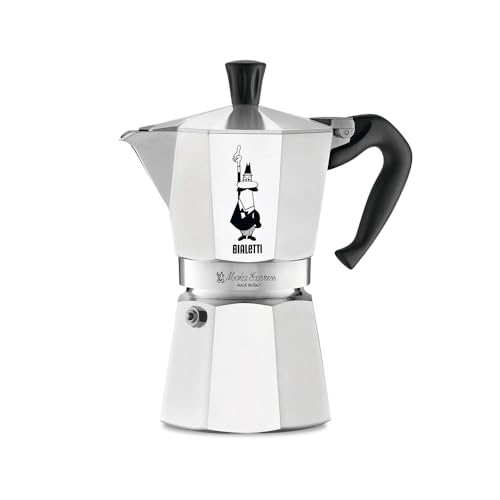
| Bialetti Moka Express | Aluminium, on induction only with an adapter plate | approx. €28.87 | 9.4 | you cook on gas or electric and want to buy replacement gaskets |
The prices are the guide values from our price boxes and change constantly. The scores are based on the manufacturer’s statements for the four pots, not on measurements.
Who the Waldwerk suits and when another pot is better
You buy the Waldwerk for the wood. For the handle and knob of the Moka Express, Bialetti names thermoplastic, and Morgenheld names wood-look ABS plastic for the FLOW.
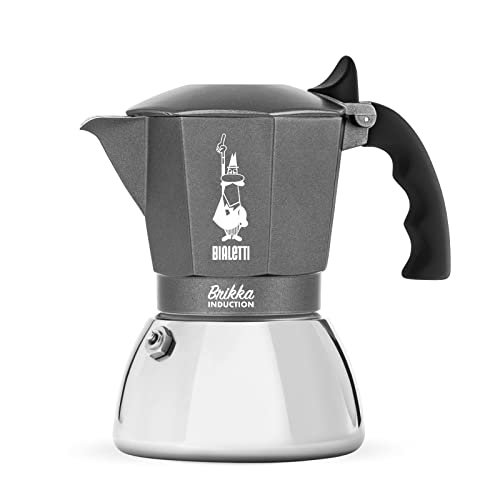
If you cook on gas or electric, you do not need the stainless steel, and the Moka Express costs €11.12 less. On an induction hob the sums tip the other way: with the adapter plate that Bialetti carries in its own shop for €19.90, the Moka Express comes out €8.78 above the Waldwerk, and the plate has to go under the pot every time you brew. Without a plate, Bialetti’s Moka Induction manages, though in our catalogue only as a 2-cup pot. Bialetti gives around 90 ml for it on the page for the decorated version, while the Amazon catalogue title of the pot in our catalogue speaks of 100 ml. According to the manufacturer, its boiler is steel on the outside and an aluminium alloy on the inside. It costs approx. €26.14, €13.85 less than the Waldwerk, but holds only about a third of it, and its handle and knob are also made of thermoplastic material.
If you put everything in the dishwasher after breakfast, you should skip the Waldwerk. The Morgenheld FLOW costs 4 cents less, the Barista Royal €5 more, and for both the manufacturers approve the machine.
If you drink a single cup alone in the morning, a pot without a reducer insert is the wrong size. The Groenenberg moka pot in the 4-cup version holds 200 ml according to the Amazon catalogue, comes with a reducer sieve and a spare ring and costs approx. €32.99, €7 less than the Waldwerk.