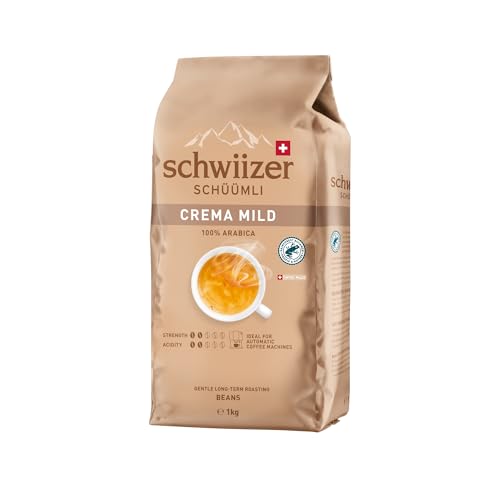
The Schwiizer Schüümli Crema Mild is an Arabica blend from Switzerland, sold as whole beans in a kilo bag. It costs approx. €21.99 (as of September 2026), the same on Amazon.de as in the Migros-Shop.de.
We have not drunk it. What is written here comes from the pack, from the Migros-Shop.de and from the Amazon catalogue. In several places these sources disagree, on the manufacturer’s name, on the flavour notes and most clearly on the roast level.
Delica, Café Royal and a Migros shop
The product page in the Migros-Shop.de names Delica AG as the manufacturer and Schwiizer Schüümli as the brand. The Amazon catalogue lists Café Royal instead. The two belong together: Café Royal is a coffee brand of Delica, and on its own page for coffee beans it points to the Migros-Shop.de as a partner shop.
Delica AG in its present form came into being on 1 June 2021, when five companies of Migros Industrie became one: Chocolat Frey, Delica, Midor, Riseria and Total Capsule Solutions. The main site is Buchs in the canton of Aargau, and by its own account around 1,900 people work for the company. As its coffee site Delica lists Birsfelden in the canton of Basel-Landschaft, where roasted coffee and capsule systems are made. This statement covers the whole coffee business and is not specific to this variety. The Amazon catalogue text says that experienced Swiss master roasters refined the beans.
The beans were grown elsewhere. According to the ingredients in the shop, it is Arabica from Central and South America and Asia, so a blend from several growing regions and not a single origin.
The variety name is not the same everywhere either. In the shop the product is called Schwiizer Schüümli Mild Bohnen, and on the bag CREMA MILD is printed large. The pack photo in the shop and the Amazon image show the same design with the same symbols, on Amazon in the English version, which reads STRENGTH and ACIDITY instead of Stärke and Säure. The EAN of the shop item is 7617014128045, and Amazon lists the model number 802066.
Is the Crema Mild really light roasted?
Light appears only in the Amazon catalogue, in the title and in one of the bullet points. On the front of the bag, and likewise on the pack photo in the Migros-Shop.de, it says gentle long-term roasting instead, and on the English pack Gentle Long-Term Roasting. You will look in vain for a roast level in words there, and the description text in the shop does not even mention the roasting method.
That is still not a contradiction, because the two statements describe different things. Long-term roasting says something about the duration, light something about the result. The colour of the bean is decided at the point where the roaster ends the roast, and a long roast can end light or dark.
What matters for you is at the grinder. Light roasted beans are denser and harder than dark ones and release their soluble compounds more slowly. They therefore usually need a finer setting than a dark espresso roast, otherwise the brew runs through too quickly and the cup turns out thin and sour.
If you want a bean where the roaster itself states the light roast level, you will find one in our catalogue from Lavazza: the Tierra for Planet is listed on the manufacturer’s product page as a light roast.
What strength 2 and acidity 2 tell you
Acidity 2 out of 5, strength level 2 out of 5: that is how the two values appear in the Migros-Shop.de, and the pack shows them as rows of five bean symbols, two of which are filled in each. Delica does not explain what the scales measure anywhere we could find. A strength figure usually describes the roast intensity, that is how much roast aroma and bitter compounds reach the cup, and not the caffeine content.
The acidity figure is more revealing. Chlorogenic acids make up a large part of the acidity in green coffee, and they break down during roasting, the more so the longer and hotter the roast. Light roasts therefore generally retain more acidity than dark ones. A light roast with acidity 2 out of 5 falls outside this pattern.
Two readings fit the figures, and neither is documented. The long roasting time can break down acidity without the bean turning dark, which would fit the long-term roasting on the bag. Or the scale only ranks within the brand’s own range and is not meant as an absolute statement at all.
On flavour there are two descriptions, and they only partly overlap. The Migros-Shop.de speaks of a distinctly mild and creamy taste and a fruity and floral aroma. The Amazon catalogue instead lists cereal, mandarin and walnut, and in the title also harmonious and gentle. Fruity appears in both texts, floral only in the shop, cereal and walnut only on Amazon.
The figure can hardly be compared with other brands. Lavazza counts up to 10 for the Tierra for Planet and gives it a 6. Melitta lists the BellaCrema Speciale on one and the same product page once with strength 2 and once with strength 3 out of 5.
Which preparation suits this bean?
The bean-to-cup machine, as it says on the pack. The Amazon text adds that the variety was developed especially for bean-to-cup machines and is gentle on the grinder. One technical explanation for this would be oil: dark roasts drive more fat to the bean surface, and over time this fat builds up in the bean hopper and in the grinder. A lighter roast brings less of it.
For three preparation methods the Migros-Shop.de gives a grind size: fine for the bean-to-cup machine and the portafilter machine, medium for the filter machine. If you previously had a dark roast in the machine, when switching we would set the grinder one to two steps finer and then continue in single steps until the brew no longer runs through too quickly. How to adjust grind size, amount and temperature in turn is shown in the guide Setting up a bean-to-cup machine.
The manufacturer says nothing about milk drinks anywhere. From the technology it can be inferred that an Arabica with a low strength figure holds up less against a lot of milk than a strong blend with Robusta: the milk dilutes the roast aromas, and if you read strength 2 as roast intensity, this variety brings little of it. If you mostly make cappuccino and latte macchiato, you are better off looking at the Melitta BellaCrema Speciale, which Melitta expressly recommends for milk foam specialities.
In the portafilter machine the bean can also be used finely ground, and the shop expressly gives the grind size for it. If you read strength 2 the way the figure is usually meant, that is as roast intensity (the caveat on this is above, under the scales), an espresso with a lot of roast bitterness is not to be expected here. If the bean is as light as Amazon writes, it also tends to need a higher brewing temperature in the portafilter machine so that the shot does not run into the cup sour and under-extracted. On a machine without adjustable temperature you reach the limits of this sooner.
From our point of view the filter machine is the most straightforward choice. It demands no fine adjustment, and you decide the dose yourself. How much bean you need for your pot is worked out for you by the brew calculator.
Which bean is the alternative?
| Variety | Roast and origin | Price per kg | Our rating | Choose this if |
|---|---|---|---|---|
| Schwiizer Schüümli Crema Mild (this one) | Gentle long-term roasting according to the pack, light according to the Amazon catalogue; 100% Arabica from Central and South America and Asia | approx. €21.99 | 8.2 | your bean-to-cup machine mainly makes black café crema and you want a Rainforest Alliance seal on the pack |
| Melitta BellaCrema Speciale | Gentle roast according to Melitta, made in Germany, green coffee from non-EU countries | approx. €16.99 | 8.5 | you mostly make milk drinks and the kilo price matters more to you than a seal |
| Lavazza Tierra for Planet | Light according to Lavazza, organic, 100% Arabica from Africa and South America | approx. €23.49 | 8.4 | you prepare in the portafilter machine or the moka pot and are looking for an organic label |
| 360° Rundum Ehrlich Bio Honduras | Long, gentle roast, low in acidity according to the supplier, organic, 100% Arabica from the highlands of Honduras | approx. €35.59 | 9.3 | you want a single, traceable origin and are willing to spend clearly more per kilo for it |
The Melitta BellaCrema Speciale costs €5 less per kilo than the Crema Mild, the Tierra for Planet €1.50 more and the comparison winner from 360° Rundum Ehrlich €13.60 more. What the table is not good for: it says nothing about which of the four beans you will like, because we have not drunk any of them. The rating is our editorial assessment based on manufacturer data, catalogue data and price, and the prices are as of September 2026.
Seal and bag
On the front of the pack is the frog seal of the Rainforest Alliance, with the inscription RAINFOREST ALLIANCE, PEOPLE & NATURE, and the Migros-Shop.de shows the label as a badge on the product page. The Amazon catalogue text says the beans come from Rainforest Alliance certified production, sustainably and fairly grown. If the seal is your reason for buying, ask Delica for the certificate number; we have not verified the seal. The Crema Mild does not carry an organic label, incidentally, whereas in the table above two of the three alternatives do.
Amazon describes the bag as an aroma-protection pack. The product photo shows a tall bag with a side gusset, and the catalogue lists it at around 25.2 by 13.8 by 9.6 centimetres, converted from inches. These are the outer dimensions. As a guide they are enough for a shelf in the pantry, and as soon as you take beans out and roll up the bag, it gets flatter.
After every use we would squeeze the air out of the bag, close it firmly and store it cool, dark and dry, but not in the fridge, because cold beans draw moisture from the room air when you take them out. In our view only the amount for a few days belongs in the bean hopper of the bean-to-cup machine, because the beans are constantly exposed to air there.
What a cup costs
We work with 9 grams of beans for one cup of café crema from the bean-to-cup machine. The amount is our assumption; how much your machine actually grinds depends on the strength setting. On that basis the kilo lasts for a good 110 cups, and a cup costs about 20 cents. At four cups a day, for two people say, about €24 a month goes on beans.
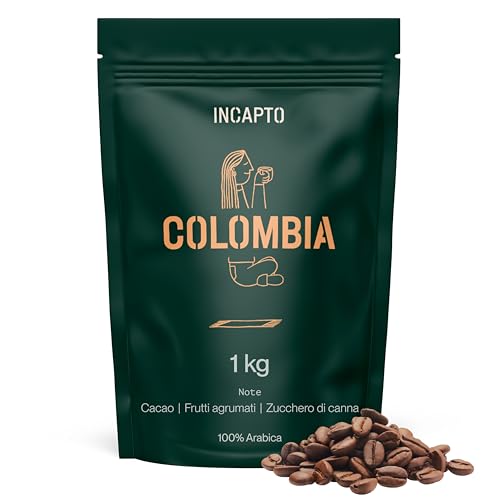
In the coffee bean comparison the Crema Mild is therefore in the upper third of kilo prices: six of the 23 beans cost more, 16 less. At the lower end is the Gimoka Classico at €13.63, which is €8.36 below the Crema Mild, and at the upper end the Incapto Single Origin Colombia at €35.95.
What the manufacturer does not state
On 25 September 2026 we found the following points neither on the pack photos nor in the Migros-Shop.de, at Delica, at Café Royal or in the Amazon catalogue:
- roasting time and roasting temperature behind the long-term roasting
- the growing countries of the blend and their shares
- the roasting location of this variety
- a legend of what the strength and acidity scales measure
- the caffeine content
- a certificate number or the certified share of the blend for the Rainforest Alliance
- a roast date
- whether the bag has an aroma valve
- storage instructions for the opened bag
- a usable brewing recommendation with dose and water temperature: the field cup size in the shop is set to 12 ml, and the field for portafilter espresso machines is empty
- a statement on milk drinks
- since when the variety and the brand have existed
- a website of its own for the Schwiizer Schüümli brand
For the buying decision the missing legend for the two scales weighs most heavily. Strength and acidity are the only figures with which Delica describes the flavour, and without a definition they can only be read within the brand.
Who is it suitable for?
The first threshold is strength. If you want to stay with the brand and only change direction, you will find two sister varieties in the Migros-Shop.de at the same kilo price. The Schwiizer Schüümli Crema is listed there at strength 3 and acidity 3, the Schwiizer Schüümli Espresso at strength 4 and acidity 2, described as slightly nutty with a hint of fine dark chocolate. Because the same manufacturer rates all three, these figures can genuinely be read against each other. The Espresso is therefore the switch at no extra cost if strength 2 is too little for you.
The second threshold is quantity. According to our search there is no pack smaller than the kilo, and with the 9 grams per cup from the cost calculation the bag is empty after just under eight weeks at two cups a day, and after around four weeks at four cups. If you use on average fewer than two cups a day, it will therefore sit open in the cupboard for two months or longer. After opening, roasted beans continuously release aroma compounds into the air, even in a well-closed bag. For such a household we therefore consider the Crema Mild the wrong pack size, even if strength and acidity are exactly what you are looking for.