The Melitta BellaCrema Speciale is a kilo of whole beans for bean-to-cup machines, and Melitta gives it exactly one purpose: milk drinks, explicitly including plant-based alternatives. On strength the manufacturer contradicts itself, and the roast-level graphic on the bag does not quite match the advertising copy. We have not drunk the bean and have not opened a pack. What follows comes from Melitta’s product page (retrieved 24 September 2026), from the pack photos there and from the Amazon catalogue.
What the product page and bag say
The product designation is roasted coffee in whole beans, the weight 1,000 grams. In our price box the kilo stands at approx. €16.99, whereas the Amazon catalogue listed €17.99 on 7 September 2026.
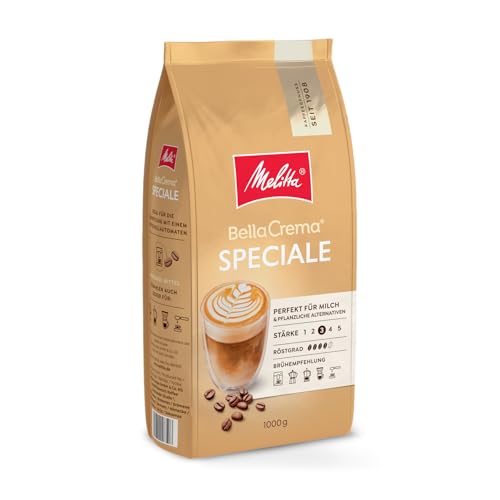
On the product page, Melitta gives the variety the epithet Der Genießer (the connoisseur) and describes it in a single sentence: a gentle roast coaxes a remarkable aroma out of the mild coffee beans. That is advertising copy, and we pass it on as such. The technical data below it are more revealing. Under machine use it says bean-to-cup machine, under recommended for only milk-foam specialities. In the flavour notes field, where the BellaCrema La Crema has full-bodied, nutty, fruity, the Speciale has no flavour but an intended use: perfect for milk and plant-based alternatives. The same sentence is printed large on the front of the bag.
A flavour word appears only on the back. According to the pack photo on the manufacturer’s page, Melitta speaks there of a creamy taste that lets you relax and invites you to take a break. The same back carries the only sentence on origin that the bag offers: made in Germany, with green coffee from non-EU countries.
For searching in retail, the numbers help. In the Melitta shop the variety runs as item 6786222_DE with the EAN 4002720008508, on Amazon under model number 81-850. The catalogue gives the pack dimensions as approx. 29.4 by 14.0 by 8.0 centimetres.
Strength 2 or strength 3? Melitta says both
At the top of the product page, a dot display shows the strength, with two of five dots filled. The technical data say strength: 2. In the description section of the same page, however, it says STRENGTH 3/5, and on the front of the bag the 3 is highlighted in the row of numbers 1 to 5. On Amazon the 3/5 is even in the product name, while two bullet points of the same listing speak of strength 2.
Which value is the maintained one cannot be decided from the outside.
Melitta lists eight varieties in the BellaCrema range. In the technical data the 2 appears for exactly two, the Speciale and the Crema Dolce. La Crema, Bio, Decaf and the 2026 Selection are at 3, the Intenso at 4, and the BellaCrema Espresso alone at 5 (retrievals of 14 and 24 September 2026). According to the technical data, the Speciale therefore shares the lowest level of the range with the Crema Dolce. According to the description text and the bag, it is level with the La Crema.
For your purchase this means: if you weigh the Speciale against the La Crema by the number, you compare, depending on the source, a 2 with a 3 or a 3 with a 3. On top of that, every roaster sets its own strength scale. A Melitta 2 cannot be reconciled with the strength figure on another supplier’s bag.
In detail: four roast-level beans and a gentle roast
Below the strength scale, Melitta prints a second row on the bag, headed roast level. The advertising copy speaks of a gentle roast and the Amazon catalogue of a mild roast level, but the graphic shows something different: of the five bean symbols, according to the pack photo on the manufacturer’s page, counted in the enlargement, four are filled and one is only outlined. On the La Crema bag there are three. By Melitta’s own graphic, the Speciale is therefore roasted further than the La Crema, although it sits one strength level lower in the technical data.
That need not be a contradiction, because roast level and strength describe different things. The roast level says how far the bean is roasted and shows in its colour. As roasting progresses, part of the chlorogenic acids is broken down and more roast bitter compounds form. A strength scale, by contrast, is the roaster’s own classification, into which the blend and the intended effect in the cup can also feed. On such a scale, a darker roasted bean can quite well sit lower than a lighter one.
For milk drinks the darker direction is plausible. The fat and protein in milk dampen bitterness, so cappuccino and latte tolerate a stronger roast better than a black Caffè Crema. With plant-based drinks a second point comes in: soy drink easily curdles in hot, acidic coffee because acid and heat make the protein coagulate, and a bean roasted further brings less acid. We draw this connection from roasting chemistry.
Bean-to-cup machine according to the data sheet, five symbols on the bag
The technical data know one machine type, the bean-to-cup machine, and the side of the bag repeats this in capital letters: IDEAL FÜR DIE ZUBEREITUNG MIT EINEM KAFFEEVOLLAUTOMATEN (ideal for preparation with a bean-to-cup machine). On the front, however, under brewing recommendation there are five unlabelled pictograms. We read them as bean-to-cup machine, moka pot, French press, pour-over with cup and espresso machine with portafilter. On the side there is also the addition Gemahlen auch lecker für (ground, also delicious for), with symbols for French press, pour-over and portafilter machine and a fourth that is cut off at the edge of the picture.
On grind size, bag and catalogue diverge. For the ground bean, Amazon names two methods, manual filtration and French press, and coarse as the optimal grind size. On the side photo of the bag, the curvature hides the first letter of the entry; what stays legible is ahlgrad: Mittel (grind size: medium).
In a bean-to-cup machine this hardly matters, because there you adjust the built-in grinder, and the guide Setting up a bean-to-cup machine explains how to feel your way to a new bean. If you grind yourself, the two entries serve as a guide for one preparation each: coarse for the French press, medium for pour-over. Neither fits a portafilter machine. There the coffee grounds need a fine grind, and the grinder must hit it in small steps, because even one step shifts the flow time.
How long does the kilo last, and what does a cup cost?
According to Melitta’s dosing recommendation, the kilo lasts for 125 to 166 large cups. With the approx. €16.99 from our price box, a cup then costs around 10 to 14 cents.
The recommendation of 6 to 8 grams of ground coffee per large cup appears in the FAQ for Melitta’s Molino coffee grinder and applies to coffee in general, not specifically to this variety. The calculation: 1,000 grams divided by 8 gives 125 cups, divided by 6 gives 166.
A bean-to-cup machine doses according to its own setting, via aroma level or ground coffee quantity. If yours grinds 10 grams per brew, you get 100 brews and just under 17 cents per cup; at 12 grams, 83 brews and around 20 cents. With our brew calculator (German page only) you can recalculate this for your cup size.
With one large cup a day, the bag by this calculation stays open for four to five and a half months, with two cups for two to just under three months.
Storage according to Melitta’s guidelines
As long as the bag is closed, the beans sit in a protective atmosphere according to the product page. The air in the bag is replaced by a protective gas that displaces the oxygen.
For the time afterwards, Melitta has a paragraph in the Molino FAQ that applies to roasted coffee in general. It begins with the reasoning that roasted coffee is a delicate natural product that can quickly lose its aroma if stored incorrectly. Four recommendations follow. The opened pack should not be stored together with other strongly smelling foods. The coffee should be protected from sunlight, heat and moisture, because these factors, too, can affect the aroma negatively. The storage place should be cool, dry and odour-free. And the beans should not be decanted but kept in the original packaging.
The Amazon listing also advises leaving the coffee in the pack and closing it with an aroma clip, but counts only the 1,000 grams of beans as the scope of delivery. A storage jar on the worktop therefore contradicts both sources.
Our assessment on the bean hopper of a bean-to-cup machine: it sits in the housing, often under a transparent lid, and therefore where light and the machine’s heat reach. We would fill in only as much as runs through in two or three days and leave the rest in the bag.
What Melitta does not state about the Speciale
Some gaps run through all sources, that is the product page, bag photos and Amazon catalogue. None of them names a single growing country, and nothing is found on growing altitude or processing either. For the roast there is neither a duration nor a temperature, and the criteria by which Melitta assigns the strength levels are stated nowhere. The Melitta page has no roast level in words, that is light, medium or dark. Caffeine content and nutritional values are not stored online, nor is a roast date or best-before date, and not even the Molino FAQ gives a time limit for the opened bag. Whether the bag has an aroma valve or can be resealed is not revealed by the texts or the photos, and nothing at all is stated on the packaging material and its recycling. Melitta shows no seal for this variety, whether organic or Fairtrade. There are no brewing parameters for the bean-to-cup machine, such as a ground coffee quantity per espresso, and in the download area of the product page there are currently no files, so neither data sheet nor manual. When the variety came onto the market also remains open. Amazon gives 30 October 2022 as the release date, which need not prove either the market launch or the start of the listing.
The Speciale next to three alternatives
Three varieties from our catalogue between which a buyer of the Speciale realistically wavers. The first row is the one reviewed.
| Variety | Roast and origin | Price per kg | Our rating | Choose this if |
|---|---|---|---|---|
| Melitta BellaCrema Speciale (this one) | Strength 2 in the technical data, 3 out of 5 in the description text; four of five roast-level beans on the bag; roasted in Bremen according to the Amazon catalogue | approx. €16.99 | 8.5 | you brew almost only milk drinks in your bean-to-cup machine, including with plant-based drink |
| Melitta BellaCrema La Crema | Strength 3 out of 5, three of five roast-level beans on the bag, roasted in Germany according to the Amazon bullet point | approx. €15.89 | 8.6 | you drink black Caffè Crema as well as cappuccino |
| Schwiizer Schüümli Crema Mild | light roast, 100 % Arabica, strength 2 out of 5 according to the seller’s Amazon bullet point | approx. €21.99 | 8.2 | you want a mild level and drink your coffee mostly black |
| 360° Rundum Ehrlich Bio Honduras | Honduran highlands above 1,300 metres, organic, and long, gentle roast according to the manufacturer | approx. €35.59 | 9.3 | the growing country and organic claim are worth double the kilo price to you |
The prices are the reference values from our price boxes and change constantly in retail. The rating is our editorial assessment of the available data and is based on no tasting. You can find all varieties with price and rating in the coffee beans comparison.
Speciale, La Crema or another: which suits when
The first fork is the milk. Melitta recommends the Speciale in the technical data only for milk-foam specialities; a mild Caffè Crema is added only in the Amazon catalogue. For the La Crema, Melitta recommends the same drinks on its own page and Caffè Crema in addition. If you brew cappuccino in the morning and a black crema in the afternoon, the La Crema is the variety the manufacturer itself lists for both, and according to our price box you pay approx. €1.10 less per kilo.
Plant-based drinks are the point where the Speciale stands out from the rest of the range in Melitta’s statements. In the technical data of the other seven BellaCrema varieties, the note on plant-based alternatives does not appear (status of the retrievals: September 2026). How good the foam turns out, however, depends mainly on the drink and the technique, both of which the guide How to froth milk explains.
Then the machine. Without a bean-to-cup machine you need a grinder of your own, because the bag contains whole beans, and with pour-over or French press you stay with what bag and catalogue show. For a portafilter machine we would rather reach for the BellaCrema Espresso, which costs approx. €1.00 more per kilo in our price box. It is at strength 5, and Melitta itself assigns it to this preparation.
If you want a low level and tend to drink black, you can look outside the range. The Schwiizer Schüümli Crema Mild is listed by its seller on Amazon with a light roast and strength 2 out of 5, intended for bean-to-cup machines. It costs approx. €5.00 more per kilo.
The Speciale is the wrong bean for anyone who wants to know where their coffee grew. The 360° Rundum Ehrlich Bio Honduras names growing country and altitude and, at approx. €35.59 per kilo, costs a good double, €18.60 more than the Speciale.