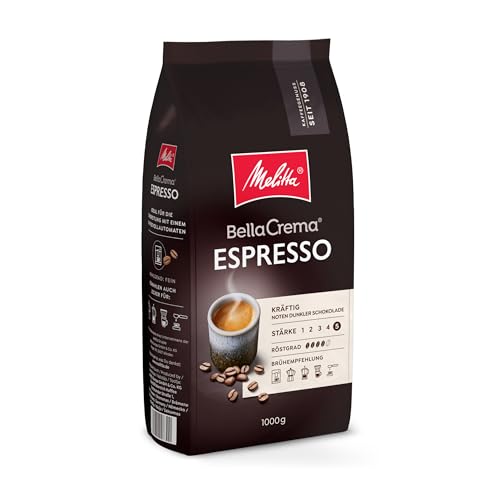
Melitta sells the BellaCrema Espresso as a kilo bag of whole beans, strength 5 out of 5, strong, notes of dark chocolate. The kilo costs approx. €17.99 on Amazon.de according to our price box, recorded in the Amazon catalogue on 7 September 2026. We have not drunk the bean, so nothing is said here about the taste in your cup. Four things can be checked: the technical data on melitta.de, the Amazon catalogue entry, the printing on the bag and the answers from Melitta’s own product FAQ. These four sources add up to a contradictory picture, above all on the question of which machine this roast is actually meant for.
What the technical data say
The data sheet on the product page is short. The legal designation reads roasted coffee, whole beans, the weight 1000 grams, the strength 5. Under machine use there is a single word, bean-to-cup machine. The blend is recommended for milk-foam specialities and espresso, and according to the same field it is not decaffeinated. There is also a packaging note that becomes important further down: packed under protective atmosphere.
On identification Melitta is more thorough. The food business operator is Melitta Europa, Coffee Business Unit, Dortmunder Straße 1, 28199 Bremen. The EAN is 4002720008300, and in the Melitta online shop the blend runs under article number 6771965_DE. On Amazon the same product is model 2200597-7 with part number 81-830. These numbers help when reordering, because BellaCrema bags are hard to tell apart at a glance on the shelf.
The Amazon catalogue also supplies the pack dimensions: 11.57 by 5.51 by 3.15 inches, converted roughly 29.4 by 14.0 by 8.0 centimetres. These are the outer dimensions of a filled bag lying flat. They are no basis for choosing the size of a storage tin, and a volume cannot be calculated from them at all, because a bag is not a box. The catalogue weight field says 2.2046 pounds, that is exactly one kilogram, and so matches the manufacturer’s statement. As release date Amazon gives 01.01.2023, an administrative date from the catalogue that says nothing about the roasting of this pack. It is roasted in Germany, according to the Amazon bullet points. The entry is filed there under food and drink, product group Grocery, and the manufacturer is Melitta Europa GmbH & Co. KG, Coffee Business Unit, so the same company that is entered on the product page as the food business operator.
What is printed on the bag
The product photo contributes two details that do not appear on the product page in this form. On the front there is a light panel with the line strong, notes of dark chocolate, below it a scale from 1 to 5 with the 5 circled. One line further down it says roast level, and there four of five bean symbols are filled in, the fifth remains an outline.
That is the interesting part. On this pack strength and roast level are two separate scales, and the blend reaches the top value only on strength. You see the roast level only on the bag; the technical data on melitta.de know only the strength. Anyone who reads the 5 as a very dark roast is therefore reading the wrong scale. The Amazon catalogue describes the roast level in a bullet point of its own as strong, for a particularly intense taste, without a number. The bag thus remains the only source that gives the roast level a number at all.
Below the roast-level line is a brewing recommendation, and below that a row of five appliance symbols. Two of them are unambiguous in the photo, a machine with a bean hopper and a stovetop pot. On the narrow side Melitta repeats the bean-to-cup recommendation in a sentence of its own and adds a second row of symbols for the case that the beans are ground. At the top right sits a seal with the year 1908, the year in which Melitta Bentz invented the coffee filter and to which the company traces its history.
In detail: what strength 5 means on the Melitta scale
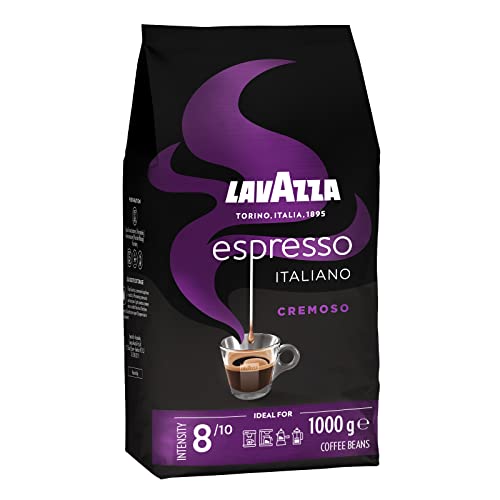
The scale belongs to Melitta and nobody else. It cannot be set against the intensity ratings of other roasters: Lavazza lists the Espresso Italiano Cremoso at 8 out of 10, and no ranking follows from 5 out of 5 against 8 out of 10.
The number becomes useful within Melitta’s own range. For seven blends of the range we looked up the strength values individually on the product pages: Espresso 5, Intenso 4, La Crema 3, Bio 3, Selection of the Year 2026 also 3, Crema Dolce 2 and Speciale 2, where for the Speciale Melitta shows a 2 in the technical data and a 3 in the product description. The Espresso is thus the strongest blend of the range, and three steps lie between it and the mildest.
When looking this up, the right page matters. On the overview page of the range Melitta renders the strength as a dot graphic without a text value, and an automated read-out attempt wrongly returned a 4 there for the Espresso. The product detail page is authoritative: the strength field says 5, and the banner above it says STRENGTH 5/5. Amazon even pulls the figure into the product name; the catalogue title is “Melitta BellaCrema Espresso, Kaffeebohnen, Stärke 5/5, 1KG”.
Where the power comes from, the manufacturer says in two places. The product text says the beans are roasted until they are bursting with power and spice. And in the reviews section of the product page the Melitta online team answers a customer question by saying that the blend contains a share of Robusta, which brings a firmer, golden-brown crema and a fuller body. This answer, however, stands only among the customer reviews, not in the technical data of the product page. On the recipe, Melitta writes in the same reviews section that it has been reworked so that the blends keep their proven BellaCrema taste.
This fits roasting theory, and this classification is ours: Robusta brings more caffeine and more bitter compounds than Arabica and stabilises the crema. An espresso roast with a Robusta share therefore holds up better in a cappuccino than a light-roasted pure Arabica blend that is drowned out by the milk. That is exactly what the recommendation for milk-foam specialities aims at.
Does the bean also work in a portafilter machine?
Yes, and Melitta says so itself, just not in the technical data. There the only machine use given is bean-to-cup machine. Yet in its own range category coffee for portafilter machines, which comprises seven products, the same blend appears, and it is also in the category coffee for bean-to-cup machines. Both are stated on melitta.de, both are manufacturer’s statements.
The Amazon bullet points go further. According to them the beans suit the bean-to-cup machine or, ground, hand filtration, portafilter, moka pot and French press. That gives you three sources with three answers, and the pack with its five brewing symbols is closer to the bullet points than to the data line.
Our reading: a bean has no approval for an appliance, it has a roast profile. A strong espresso roast with a Robusta share is made for pressure methods, that is bean-to-cup machine, portafilter and stovetop pot. In the hand filter and the French press the same roast quickly tips into roasty bitterness, because contact time and water quantity are quite different there. We would therefore not buy the blend for the hand filter, even though the bullet points list it.
If you tip it into a bean-to-cup machine, leave the grind adjustment screw alone at first. Melitta writes in the product FAQ that the grind size is set at the factory and should be adjusted after roughly 100 brews at the earliest, which the manufacturer equates to about a month. How to proceed afterwards is in the guide to grind size, and the guide to bean-to-cup machine settings explains the adjusting screws on the appliance itself. On a portafilter machine we would start with this roast at 18 grams in the double basket and 36 grams in the cup and work out the rest with the brew calculator.
What the kilo costs in use
Two price points for the same pack, and they come from two retailers. In the Amazon catalogue the kilo bag stood at €17.99 on 7 September 2026, and that is the value we use in our price box. In the Melitta online shop a single bag costs €22.49 on the same day, from three bags the kilo price falls to €19.49 and from eight to €18.49. The manufacturer’s shop therefore only pays off by the carton, and even then it stays above what retail asks. In the end the binding price is the one shown on the retailer’s page when you click.
For the cost per cup we take the value from our data sheet. A single espresso from a bean-to-cup machine typically draws about 8 grams; that is our calculation basis, not a manufacturer’s statement. A kilo thus lasts for about 125 brews, and a cup costs a good 14 cents. On a portafilter machine with 18 grams in the double basket it is about 55 brews at about 33 cents each.
For your supply that means: two cappuccinos a day use 16 grams, and the kilo lasts a good two months. Two double portafilter shots a day empty the same bag in four weeks.
What Melitta leaves open for this blend
Roasted coffee has no manual and no exploded diagram, and the data situation is thinner for every supermarket bean than for a machine. We looked for these points on melitta.de, in the product FAQ and in the Amazon catalogue without finding them:
- countries and regions of cultivation of the green coffees
- the Arabica and Robusta share in percent
- ingredients list, nutritional values and caffeine content
- roast date, best-before date and a use-within period after opening
- the roasting location more precisely than the word Germany from the Amazon bullet points
- a measurable roast-level figure, such as an Agtron value or a roasting time
- a dose in grams, a grind-size value and a brewing temperature for this blend
- information on acidity
- certifications for this blend; 4C Services and the Global Coffee Platform appear at Melitta on the company’s sustainability page
- packaging material of the bag and its recyclability
One contradiction remains unresolved here, and it concerns freshness. Melitta writes packed under protective atmosphere, the Amazon bullet points speak of vacuum packaging. These are two different processes: with protective atmosphere the oxygen in the bag is replaced by another gas, with vacuum the air is drawn out and the film lies against the beans. Which of the two is used here changes little about what you do at home, because with the first cut the protection is gone in both cases.
What else makes the shortlist
| Blend | Roast and origin | Price per kg | Our rating | Choose this one if |
|---|---|---|---|---|
| Melitta BellaCrema Espresso (this one) | Strong, strength 5 out of 5 according to Melitta, origin not stated | approx. €17.99 | 8.8 | the bean-to-cup machine is the main machine in the household and you want a bean that the manufacturer specifies for exactly that |
| Melitta BellaCrema La Crema | Strength 3 according to Melitta, country of cultivation likewise not stated | approx. €15.89 | 8.6 | someone drinks along who finds strong roasts too much, or you drink your coffee as a long cup (caffè crema) |
| Lavazza Espresso Italiano Cremoso | Medium, Arabica and Robusta from South America and South-East Asia | approx. €16.99 | 8.9 | you work with a portafilter machine or stovetop pot and want an Italian espresso roast |
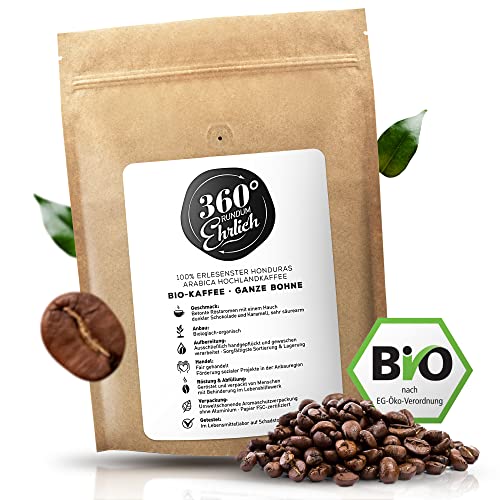
| 360 Grad Rundum Ehrlich Bio Honduras | Single origin Honduras, organic, low acidity | approx. €35.59 | 9.3 | you need country of origin and organic labelling in black and white and are willing to pay nearly double for it |
The table sets the per-kilo guide values from our price boxes side by side; they are not current retailer prices. The ratings are our editorial assessment from the coffee beans comparison and not a measured result. How one of these beans arrives in your cup it does not answer anyway, because machine, water and grind size are too different.
When this bean suits and when another does
Start with the machine. If a bean-to-cup machine stands in the kitchen and cappuccino and latte macchiato come out of it in the morning, with this blend you hit exactly the manufacturer’s recommendation, because milk-foam specialities appear word for word in its statements. For the long cup, that is caffè crema, Melitta sends you elsewhere within the same range.
The second switch is strength. Five out of five is the top value that Melitta awards in this range. Anyone who does not like strong roasts would be buying past their own taste here and is better served by the La Crema with its 3 or by the Speciale, for which Melitta lists 2 and 3 side by side.
The third point is the pack size, and it is often overlooked. A kilo is a supply decision over weeks, and there is no other size for this blend. Two people with two milk drinks each per day get through it in a good four weeks; anyone drinking one cup a day alone needs about four months. If you want to keep the supply small, buy single bags instead of cartons and leave the tiered prices in the manufacturer’s shop alone.
That leaves the question on which this bean loses. Anyone who wants to know which country, which altitude and which harvest their coffee comes from gets a house blend without country information. With supermarket roasts that is the rule. The comparison winner of our category costs around €17.60 more per kilo and in return discloses single origin Honduras and an organic control number, even if the supplier’s legal notice names a different number than the product page. What you get for the premium, for certain, is this documentation. Whether you like one of the two beans better in the cup, we cannot tell you; we have not drunk either of them.
Who is it suitable for?
This bean belongs in households where the same machine runs every morning and nobody feels like trying a new roastery every week. Melitta heads the product text with “Der Traumtyp” (The Dream Type) and addresses passionate coffee lovers, which says little about the product but a good deal about the intended audience: an everyday bean, not a collector’s item.
In the Amazon catalogue Melitta also advertises over 800 aromas, which are supposed to arise thanks to the individually set roasting time. Nobody can count these aromas; the number remains advertising language. For placing the target group it still serves: anyone who advertises with such a number is addressing someone who wants their coffee strong and needs no analysis data with it.
Two final figures that are not ours: in the Melitta online shop the blend stood at 4.71 out of 5 stars from 83 customer reviews on 07.09.2026, 89 per cent of them with the top mark. These are voices from the manufacturer’s own shop and not an independent survey, and they do not feed into our rating. The bag was available there immediately on the same day, with a stated delivery time of one to two working days.