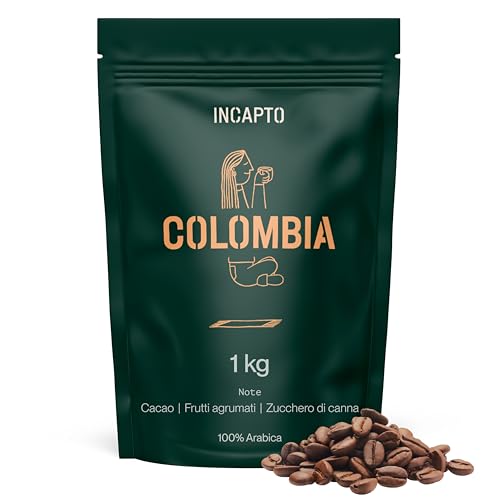
One kilo of whole beans, 100 per cent Arabica, listed in the Amazon catalogue since 16 December 2024, and the roaster’s product page says more than most do: region, two municipalities, growing altitude, variety, processing, plus a cupping score. That is why the Incapto Single Origin Colombia is our premium pick in our editorial rating. And that is why it is worth going through the details one by one, because two of them contradict each other.
Huila, Pitalito, Acevedo: the origin in plain language
In its product table Incapto gives Colombia as the country of origin and Huila as the region. The running text below it is more specific: the green coffee comes from the municipalities of Pitalito and Acevedo in the south of the department, grown at 1,400 to 1,800 metres. The variety is Castillo Supremo, and it was processed washed. The roaster describes the south of the country as an area that produces some of the most complex and aromatic coffees in Colombia.
In the table the processing is given as the Spanish Lavado, left untranslated like several neighbouring fields. EIGENTUM means finca (farm), VIELFALT means variety, ART means the botanical species. The German version of the shop is machine translated, and anyone reading it has to bear that in mind. Under EIGENTUM it says Cadefihuila.
On the harvest season, Incapto writes that Colombia harvests twice a year, with the main harvest in the north in the first half of the year and a secondary harvest in the south in the second. The roaster assigns this lot to the secondary harvest. Why altitude and processing end up in the cup at all is explained in the guide Coffee origin and flavour. By its own account, Incapto buys the green coffee directly from the producer on site, without intermediaries.
Medium roast, even though the Amazon title says espresso
Here two sources contradict each other, and the difference decides the purchase. The Amazon title lists the bean as espresso and as traditionally roasted coffee beans (Traditionell Geröstete Bohnenkaffee). On its own product page, by contrast, Incapto describes a medium roast level, which the roaster uses for most of its varieties, and states explicitly that the bean is roasted specifically for bean-to-cup machines.
The resolution lies in the translation. Traditionell geröstet stands for the Spanish Tueste Natural, and that does not denote a roast level but roasting without added sugar, as opposed to the torrefacto common in Spain. The manufacturer’s second statement fits this: no sugar, no additives. If you expect a dark Italian espresso roast from the Amazon title, you are therefore mistaken.
That the shop page and the Amazon listing mean the same product can be checked firmly. The article number of the kilo variant in the manufacturer’s shop is 8436591720409, and exactly this digit sequence is what the Amazon catalogue lists as model and part number. Roasting takes place daily and in small quantities, by hand according to Incapto, at the Ripollet plant. The company page names Barcelona as the roasting location; Ripollet lies in its metropolitan area. The company has existed since 2020, founded by Francesc Font, Bea Mesas and Joaquim Mach, and its range includes green coffees from more than nine countries of origin.
In detail: what 84 cupping points prove and what they do not
The scale of the Specialty Coffee Association runs to 100 points and is awarded in cupping, a standardised tasting by fixed criteria such as fragrance, acidity, body, balance and aftertaste. From 80 points a coffee counts as specialty in the trade, anything below it as commercial grade. Incapto enters 84 for this bean in the VERKOSTUNG (tasting) field, and the Amazon bullet point repeats the figure with the addition Specialty Coffee Association.
Four points above the threshold are, in our assessment, solid and not spectacular. Above all, though, they cannot be verified: who awarded the points, when that happened and under which protocol is not stated anywhere on the product page. As long as no assessing body stands behind it, the figure remains a statement by the seller. We have not re-measured or tasted anything.
Cocoa, citrus, cane sugar: the profile the roaster states
Three notes appear in short form on the page: cocoa, citrus fruit, cane sugar. In more detail, Incapto describes a floral fragrance, a base of cocoa and panela, a creamy body and a subtle citrus-lemon note. Panela is thickened cane sugar juice and an everyday product in Colombia, so caramel and malt notes are meant, not the sweetness of white sugar. The Amazon bullet point sums up the same profile as balanced acidity and sweetness.
In addition there is a percentage scale: acidity 60, body 60, intensity 80, bitterness 80, strength 60. Incapto does not explain anywhere how these values come about, and a methodology is missing. We therefore read them as a marketing scale and not as measured values. They remain useful all the same, because they make the roaster’s own range comparable: with acidity at 60, the roaster itself does not class its Colombian bean as low in acidity.
In the house classification the coffee is aromatic. Two lines further down, the same page says it is traditional. Both at once is impossible, and the shop’s comparison table lists it under aromatic; the other sentence is a leftover building block. What lies behind terms such as body and acidity is explained in the guide Coffee beans basics. All statements in this section come from the roaster, including its drinking recommendation: black, without milk.
What the kilo costs and how long it lasts
Incapto calculates with 120 coffees per bag and advertises from €0.25 a cup. Those 25 cents belong to the subscription price of €29.96 in its own shop, not to the Amazon offer. Calculated on the €35.95 of the catalogue price of 6 September 2026, you end up at around 30 cents a cup. 1,000 grams over 120 cups gives a good 8 grams per shot.
8 grams is in the order of magnitude of a single espresso. For a double espresso, our guide Espresso basics gives 18 grams as a common starting value, and the basket specification of the manufacturer takes precedence. If you weigh 18 grams into the basket of an espresso machine, you get about 55 shots and therefore around 65 cents per double shot. The calculation is ours, the starting figures come from the roaster and the catalogue. On the manufacturer’s basis of 120 cups, the bag lasts about two months at two cups a day; if you pull two double espressos a day, you are through it after just under four weeks.
This is the point where freshness matters. Incapto advertises in its own comparison table that the coffee is freshly roasted, with a visible roast date. For the pack delivered via Amazon there is neither a roast date nor a best-before statement. In the catalogue the product is filed under food and drink, with a weight of 2.2 pounds, that is, the full kilo.
What Incapto leaves open
A roaster that publishes municipality, growing altitude and variety raises expectations that the same page disappoints elsewhere. Still unknown are: harvest year, lot number and harvest date of the batch delivered; whether Cadefihuila is a single finca or an association of many producers; roasting time, roasting temperature and batch size behind the word handcrafted; nutritional values, caffeine content and an ingredient list that goes beyond 100 per cent Arabica; packaging material, aroma valve and resealability of the bag; storage advice for the opened pack; whether the goods offered on Amazon come directly from Ripollet or via a dealer; and any recommendation on dose, grind size, brewing temperature or extraction time.
Two of these points affect the purchase directly. For this bean Incapto shows none of the usual certifications, neither organic nor Fairtrade nor Rainforest Alliance. And the return and warranty terms for a purchase via Amazon are not set by the roaster itself but by the respective seller on the platform.
A warning for anyone reading up on the product page itself: under the tab HERKUNFT (origin) there is a paragraph about the Brazilian producer SanCoffee and a World of Coffee 2024 award. It belongs to a different bean and has nothing to do with Huila.
This bean or one of the other three?
| Variety | Roast and origin | Price per kg | Our rating | Choose this if |
|---|---|---|---|---|
| Incapto Single Origin Colombia (this one) | Medium roast, single origin Huila, variety Castillo Supremo, washed | approx. €35.95 | 9.0 | you want a single origin named down to the municipality and are prepared to budget for the premium |
| 360° Rundum Ehrlich Bio Honduras | Hand roasted, low-acidity profile, single origin Honduras, organic under the EU organic regulation (supplier’s statement) | approx. €35.59 | 9.3 | sharp acidity does not agree with you and a proper organic label belongs on the pack |
| Amazon Colombian Medium Roast | Medium roast, single origin Colombia, Rainforest Alliance certified according to the catalogue, origin statement only down to the country | approx. €14.19 | 7.9 | you mainly brew filter coffee and want the kilo for around 14 euros |
| J. Hornig Caffè Crema Bio | Arabica and Robusta, strength 4 out of 5, organic and Fairtrade according to the manufacturer | approx. €30.99 | 8.4 | you pull caffè crema from a bean-to-cup machine and expect dense crema |
What the table is not suited for: it sets side by side the prices per kilo that stood in the data sheets of these four beans in September 2026, and the rating is our editorial assessment from the data comparison, not a measurement result. It says nothing about taste.
Which preparation suits this bean?
Bean-to-cup machine and espresso machine, and according to Incapto also the moka pot. By the manufacturer’s statement the roast is designed for the bean-to-cup machine, and the roaster expressly names the other two routes alongside it. Armkaffeemaschine, as the German version puts it, is the machine translation of cafetera de brazo and means the espresso machine with portafilter.
In a bean-to-cup machine a limitation comes with it that is not down to the brand but to botany. 100 per cent Arabica without any Robusta gives less and thinner crema than a blend with Robusta. If thick, long-lasting crema is part of caffè crema for you, this is the wrong bean, and J. Hornig from the table is the right one.
In an espresso machine you have grind size, dose and extraction time in your own hands, and a medium roast demands more attention to these than a dark one. Less roast bitterness means that under-extraction shows up straight away as acidity, and you correct it through the grind size before you touch the temperature. Where to start is covered in the guide Coffee grind size, and you can work out the values for your cup size in the brew calculator.
Filter coffee does not appear in the roaster’s preparation notes. Technically there is little against it for a washed Arabica bean from this altitude; it is rather the classic filter profile. Only the roast is tuned towards the bean-to-cup machine, and in a hand filter the citrus note will then come through more clearly than the roast level would suggest.
That leaves the question of milk. The roaster recommends the bean for black coffee, and we would follow it. Cocoa and panela still hold up in a cappuccino, but the citrus note and the acidity, which Incapto itself places rather in the middle, disappear. Anyone who drinks a 300 millilitre milk coffee in the morning pays here for nuances that never reach their cup.
Who is it suited for?
For you if you drink espresso or coffee black, can do something with a medium roast and want to know which municipality and which altitude your bean comes from. In the coffee bean comparison it has the highest price per kilo among 23 varieties, and what you get for it is statements, not a proven taste advantage.
Not for you if one of three things applies. You need a certification shown on the pack: then the way leads to the 360° bean, to J. Hornig or, if it is to stay cheap, to the Amazon Colombian with Rainforest Alliance. You like dark, strong roasts of the Italian kind: then you are wrong on roast level, and the Amazon title misleads you. Or you pull four milk coffees a day: then the bag is empty after a month, and what you pay the premium for has been drowned out by the milk.
If you are torn between two candidates, the finder helps, and all 23 varieties are in the coffee bean comparison, the eight best rated in the best coffee beans list.


