Two bags of 500 grams each, whole beans, 100 per cent Arabica from Colombia: that is the Colombian Medium Roast, a bean from Amazon’s own brand, by Amazon. Our price box puts the kilo at approx. €14.19 on Amazon.de. In the Amazon catalogue the bean carries the date 30 October 2025, which may be the market launch or merely a revision of the listing.
We have not drunk the bean and have not opened a pack. Everything below comes from the listing, from the pack photo and from the Rainforest Alliance, whose frog logo can be seen on the pack photo. Where we calculate or interpret, we say so.
Grown in Colombia, roasted in Belgium
Two bags are delivered, and the catalogue gives the container type as bag. The ingredient list consists of three words: roasted coffee, whole beans. According to the listing, the coffee was grown in Colombia and roasted and packed in Belgium.
On the variety the matter is clear: no Robusta share. The item table gives the roast level as medium roast.
Strength is trickier, because two places in the same listing contradict each other. One bullet point reads “Strength: 4/5”. The pack photo, on the other hand, says “Strength Nº3” with the addition “Medium”. Whether the photo shows an older pack or the text counts differently cannot be settled from the outside. If you want to buy the bean for its strength, for milk drinks for instance, you should not rely on either number.
Amazon describes the taste in one sentence: rounded acidity, balanced sweetness, full body. The same formula appears in English on the label, and for the sweetness the item table adds “balanced softness” and gives “Colombian” as the flavour direction. The catalogue lists five languages: English, German, French, Spanish and Italian. Of these, English and German appear on the front of the pack photo.
In detail: what “medium roast” and a strength number mean
During roasting, the acids of the green bean break down as temperature and time rise, above all the chlorogenic acids. At the same time roast bitter compounds form, and with very dark roasts oil comes to the surface. A light roast accordingly keeps a lot of acidity, a dark one little. The medium roast sits in between: enough acidity for origin aromas to be preserved, enough roasting that the acidity does not turn sharp. There is no binding roast scale that everyone follows.
Strength scales are similar. Every brand defines its own: Dallmayr, for example, lists the Crema d’Oro on a ten-point scale (6 out of 10) and the prodomo on a five-point scale, and Amazon counts up to 5. What the number measures, Amazon does not disclose, and the seller at least does not link it to the caffeine content. A 4 out of 5 at a medium roast therefore does not mean that the bean is darker than the name says.
According to our guide to coffee beans basics, the idea that Robusta generally brings more crema in espresso does not hold across the studies. Pure Arabica and pure Robusta did not differ significantly in foam volume in a study from 1997. It looked different for blends with a great deal of Robusta (20 parts Arabica, 80 parts Robusta): in three laboratory studies they came out above pure Arabica in foam volume. How much Robusta a blend on sale contains is usually not stated. Whether you will get less crema from this bean in a bean-to-cup machine than from a blend therefore cannot be said.
Rainforest Alliance: what the seal regulates
In the bullet point on certification, Amazon writes: “The coffee we source for this product is certified by the Rainforest Alliance.” The rest of the point is promotional text about farming families and the rainforest.
What stands behind the seal is explained by the organisation itself. Independent auditors visit the farms and companies at regular intervals and check whether they meet the requirements of the relevant standard. In terms of content it covers five fields: healthy forests, better livelihoods for farmers, human rights, good environmental practice and climate resilience.
The seal therefore concerns cultivation and the supply chain. It does not regulate roasting, freshness or cup profile, and it is not a statement of origin either.
Colombia, but where exactly?
For this bean, single origin means one growing country. Within a country, however, coffees differ, for instance by altitude: in a study from Costa Rica cited by our guide to coffee origin and flavour, the tasters preferred coffee from higher altitudes. A dissertation from 2015, which the guide also cites, found the influence of the country of origin greater than that of processing. The guide does not derive a fixed ranking from this.
The product description promises more about the origin through a code on the pack. Whoever scans it is supposed to learn which farmers grew the coffee and which route it took to the buyer. What the page behind the code actually shows, we could not check; that would need the pack.
A curiosity on the side: in the item table the country of origin is given as Colombia and the region of origin as Belgium. Presumably the place of roasting is meant. As an origin statement for the green coffee, the field is no use. Why growing altitude and processing make so much difference to a bean’s profile is explained in the guide coffee origin and flavour.
Is the bean suitable for espresso and bean-to-cup machines?
According to Amazon, yes: the bean is suitable for all preparations depending on grind size. The listing says nothing about bean-to-cup machines. Technically there is little against it (for crema see above under the variety). For assigning origins to brewing methods, our guide to origin and flavour found no source, so Colombia as a growing country speaks neither for nor against espresso.
The seller’s full list reads: espresso fine, filter medium, Italian moka medium, coffee press coarse. By coffee press we mean, in our reading, the French press. The moka pot at the medium setting, level with filter, is unusual. For the pot we would start at the fine end of medium and go coarser if the coffee runs through sluggish and bitter.
In an espresso machine with a portafilter, a medium roast demands more care than a dark one. There is less roast bitterness to cover mistakes, and under-extraction shows up sour at once. For this you need a grinder with fine steps in the espresso range, and you correct first via the grind size, then via the dose. How to go about it is in the guide setting the grind size, and you can work out the amounts for your cup size in the brew calculator.
In a bean-to-cup machine the question looks different, because the built-in grinder has only a limited number of steps and you rarely control the dose to the gram. Drunk black, as a caffè crema or lungo for instance, we see no reason against the bean. For cappuccino with a lot of milk it depends on the strength, and that, as described above, is given contradictorily.
What a cup costs and how long a bag lasts
We calculate with the ratio 1:16, which our guide pour-over and filter coffee gives as a starting value. A litre of filter coffee therefore needs 62.5 grams of beans, and the kilo makes 16 litres. At approx. €14.19 per kilo, the litre costs around 89 cents and a 125 millilitre cup around 11 cents. For a double espresso with 18 grams in the basket, that gives 55 shots per kilo and around 26 cents per shot.
If you brew half a litre of filter coffee in the morning, you need a good 31 grams a day and get 16 days out of 500 grams. With two double espressos a day, so 36 grams, the bag lasts just under 14 days.
This is where splitting it into two bags helps. Whole beans gradually lose aroma to oxygen once opened, and the smaller the opened quantity, the shorter it sits open. As long as the second bag stays sealed, it ages more slowly than a broken-into 1 kg bag. For the opened bag we would use an airtight tin and keep it cool and dark, but not in the fridge, where the beans take up moisture and foreign odours.
What the listing leaves open
Still unclear are the name of the roastery in Belgium; the growing region, farm or cooperative and the altitude; the variety within Arabica and the processing; harvest year, roast date and best-before date; whether the bag has an aroma valve, is resealable or was packed under protective atmosphere; the caffeine content in milligrams and an acidity value; a recommendation on the dose per cup and a storage note for the opened pack; and the number of the Rainforest Alliance certificate. The catalogue dimensions of 20.5 by 18.8 by 14.8 centimetres also help little, because the entry does not make clear whether they describe one bag or the double pack.
On the valve, it is worth looking at the delivered bag. A small round plastic button lets carbon dioxide out and no oxygen in. If it is missing, we would decant the bag all the sooner after opening.
This bean or one of the other three?
In the coffee beans comparison of 23 beans, only the Gimoka Classico is cheaper per kilo, at approx. €13.63. In the overall rating, however, the Colombian Medium Roast sits at the end of the list, and its strongest sub-score is value for money at 8.6. The three alternatives below are the ones between which, in our assessment, a buyer of this bean actually wavers.
| Bean | Roast and origin | Price per kg | Our rating | Choose this if |
|---|---|---|---|---|
| Amazon Colombian Medium Roast (this one) | Medium roast, 100% Arabica from Colombia with no region given, roasted in Belgium, Rainforest Alliance | approx. €14.19 | 7.9 | you want a seal and want to spend as little as possible per kilo |
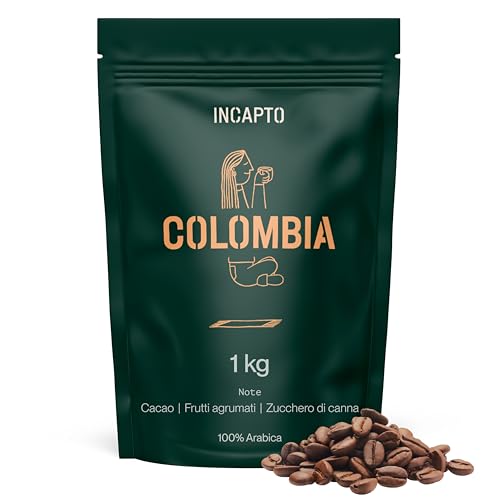
| Incapto Single Origin Kolumbien | Medium roast according to the roaster, Huila region, producer Cadefihuila, 84 SCA points according to the manufacturer | approx. €35.95 | 9.0 | you want to know the region and producer of your Colombian coffee |
| 360° Rundum Ehrlich Bio Honduras | Long, gentle roast that according to the roaster lowers the acidity, Honduran highlands, organic (DE-ÖKO-005) | approx. €35.59 | 9.3 | acidity upsets your stomach or an organic seal is a must |
| Dallmayr Crema d’Oro | Arabica and Canephora, intensity 6 out of 10, growing countries not named, according to Dallmayr for bean-to-cup and portafilter machines | approx. €15.99 | 8.6 | you mostly pull caffè crema from a bean-to-cup machine and do not need a seal |
The table sets out the kilo prices from our data sheets in September 2026; at Amazon they may have moved since. The rating is our editorial assessment from the data comparison, and it does not reflect the taste of the four beans.
When this bean fits and when another one does
It fits most clearly if you use filter coffee, a French press or a moka pot day to day and have a grinder. For all three routes Amazon has given a grind setting, and according to our guide, medium roasts are among the usual recommendations for filter and moka pot. With half a litre of filter coffee a day, you get 16 days out of one bag, as calculated above.
If you mostly pull milk drinks from a bean-to-cup machine and care about crema, the Dallmayr Crema d’Oro is the obvious alternative. At approx. €15.99 per kilo it costs €1.80 more, contains Canephora, that is Robusta, alongside Arabica, and is expressly recommended by Dallmayr for bean-to-cup and portafilter machines.
If acidic coffee upsets your stomach, we would rather reach for the 360° Rundum Ehrlich Bio Honduras. The roaster states that a long, gentle roast reduces the acidity further, and the bean is organic. At approx. €35.59 the kilo is around €21 above the Amazon bean. Amazon itself speaks of “rounded” acidity for its bean, which says nothing about the acid content.
If what draws you to Colombian coffee is the origin, the Amazon bean is the wrong choice. The Incapto Single Origin Kolumbien costs approx. €35.95, a good two and a half times as much, around €22 more per kilo. Per double espresso you pay about 65 cents at Incapto.
We would clearly advise against it if you depend on ground coffee, since the product page has no ground version. The same goes if you look for an organic or Fairtrade mark when shopping: according to the listing, the bean carries only that of the Rainforest Alliance. All 23 beans are in the coffee beans comparison, and the eight best rated in the best coffee beans list.