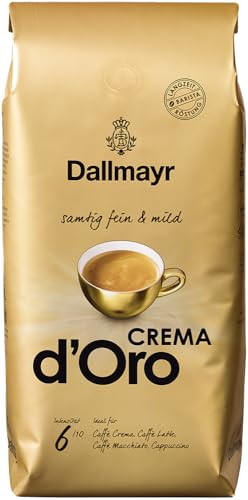
One kilo of whole beans in the golden bag, intensity 6 out of 10, about €15.99 in the Amazon.de catalogue (as of September 2026). With this bag you can read up on a good part of what is inside: bean type, roasting process and the two machine types Dallmayr approves it for are given on the pack or on the product page. According to Dallmayr, the d’Oro product family has existed since 2003. The company itself traces its history back further, to an entry from 1700, when the Munich merchant Christian Reitter ran a trading business.
What the bag says
The front is quickly read. Under the crest and the Dallmayr lettering, “samtig fein & mild” (velvety fine and mild) appears in script, below it the golden cup and the name Crema d’Oro. At the bottom left sits a large 6 with the addition /10, next to it the drinks the roaster intends the bean for: caffè crema, caffè latte, caffè macchiato, cappuccino. At the top right there is a round seal, with the word Barista on the crossbar and “Langzeit Röstung” (long-time roasting) around the rim.
The product page on dallmayr.com confirms the intensity and adds the type: Arabica & Canephora. Canephora is the botanical name of the species known in the trade as Robusta. In the company’s online shop the same product runs under “Crema d´Oro mild + fein ganze Bohne” with the article number 7678PK, and that is also where the only sentence describing the cup appears: the coffee shows “a light marbled crema” and tastes good “neat or with milk”. The roast yields “an aromatic coffee speciality with full flavour and little acidity”.
As the company placing it on the market, the shop names Alois Dallmayr Kaffee OHG at Dienerstraße 14 to 15 in Munich. On the product page Dallmayr lists the whole bean in three sizes: 1,000 g, 500 g and 200 g.
Arabica, Canephora and a contradiction in the sources
The current German product page lists the Crema d’Oro under type Arabica & Canephora. The English-language catalogue text on Amazon, by contrast, claims 100% Arabica beans, and the Dallmayr press release of September 2018, which introduced the current packaging design, also said 100 % Arabica for the pack at the time.
We go with the product page. It is the more recent source, it comes from the roaster itself, and the Amazon text reads as if it were machine-generated: phrases such as approximately 200mg caffeine per serving or resealable sachet do not come from any German Dallmayr communication. So if you are looking for pure Arabica, this is the wrong pick.
Canephora carries more caffeine and more chlorogenic acids than Arabica and releases more soluble solids when brewed. That builds body and makes the crema more stable. In a caffè crema, where a lot of water runs through a little ground coffee, this contribution weighs more than in a short espresso. A Robusta share is not strictly necessary for this, though: our catalogue also contains the Schwiizer Schüümli Crema Mild, a crema bean its maker declares as 100 % Arabica. Both work. The body in the cup simply turns out differently.
What “gently roasted at a low temperature for a long time” means
This is how Dallmayr describes the process on the d’Oro page: top qualities from the best growing regions in the world are selected for this caffè crema and gently roasted at a low temperature for a long time. One paragraph further on it says: “That is why we roast our Dallmayr d’Oro particularly slowly and gently.”
Behind this is roasting chemistry that can be explained. With slow drum roasting at a moderate temperature, the bean has time to roast through to the centre without the surface burning. Chlorogenic acids break down over the roasting time, which lowers perceived acidity, and fewer of the bitter roast products form that arise in a short time with hot, fast roasting. In a caffè crema this weighs more than in an espresso, because many times the amount of water runs through the same quantity of grounds and correspondingly more is extracted from them. The seal on the pack says the same in two words: Langzeit Röstung.
The online shop also shows a flavour profile as a bar graphic. Acidity, strength and roast each stand at three out of five bean symbols, so consistently in the middle position. We counted the filled symbols in the page source; there is no text evidence for it. The fourth row of the same graphic, intensity, shows five out of five symbols for the mild Crema d’Oro and likewise five out of five for the stronger intensa. That row is therefore unusable. The text figure of 6 out of 10 remains the authoritative one.
Bean-to-cup machine, espresso machine and a discrepancy in the company’s own shop
Under the heading “Zubereitungsart” (method of preparation), dallmayr.com lists two machines: bean-to-cup machine and espresso machine. The company’s online shop is narrower and writes only “Kaffee für: Vollautomat” (coffee for: bean-to-cup machine) in the product data. Both sites belong to Dallmayr, and both describe the same bag. We go by the product page and still think the discrepancy is worth mentioning, because it shows how loosely such approvals are meant.
In an espresso machine this bean should bring less roast bitterness and more acidity into the cup than a dark espresso roast; that follows from the intensity of 6 out of 10 and the long-roasting seal, and nobody has measured it. It usually needs a finer grind for this so that the flow time is right. How to feel your way towards the setting is covered in the guide setting the grind size, and the way there runs through small steps rather than one big correction.
On changing blends, Dallmayr is clear. On the d’Oro page, Julia Dengler from the management answers the question about machine settings: “When changing the type of coffee, I strongly recommend adjusting the settings.” As adjustment points she lists coffee quantity, grind size, water temperature and brewing pressure. If you have tuned your bean-to-cup machine to a dark bean and switch to this one without changes, you get a different coffee from the one the manufacturer describes. What can be turned in which direction is covered in the guide to setting up a bean-to-cup machine.
What the kilo costs, and where it gets dearer
On Amazon the kilo bag is listed in the catalogue at about €15.99 (as of September 2026). Dallmayr charges €20.90 in its own online shop for the same kilo, as of 8 September 2026, plus shipping. That is a difference of €4.91, around 31 per cent surcharge at the roaster for exactly the same pack.
Worked out per cup: if your machine doses 8 grams for a caffè crema, the kilo is enough for 125 cups. At €15.99 that is just under 13 cents of coffee per cup, at the roaster just under 17 cents. We use 8 grams because Dallmayr issues no dosing recommendation for this blend; if your machine shows a different value, calculate with that and use the brew calculator for the water quantity.
Among the 23 coffee beans in our catalogue, the Crema d’Oro is the sixth cheapest by price per kilo. To the Jacobs Krönung Caffè Crema, the cheapest caffè crema bean in the field, it is a difference of 70 cents per kilo, and to the comparison winner 360° Rundum Ehrlich Bio Honduras it is €19.60 upwards.
The three alternatives from our catalogue
| Blend | Roast and origin | Price per kg | Our rating | Choose this if |
|---|---|---|---|---|
| Dallmayr Crema d’Oro (this one) | Arabica and Canephora, roasted for a long time at a low temperature | approx. €15.99 | 8.6 | you want to run a bean-to-cup machine and an espresso machine with the same bag |
| Jacobs Krönung Caffè Crema | Intensity 6 out of 10, roast level and bean blend not stated | approx. €15.29 | 8.2 | the price per kilo matters more to you than information from the roaster |
| Melitta BellaCrema La Crema | Strength 3, roasted in Germany, designed for bean-to-cup machines according to Melitta | approx. €15.89 | 8.6 | your kitchen has only a bean-to-cup machine and the espresso machine plays no role |
| 360° Rundum Ehrlich Bio Honduras | Single origin from Honduras, organic-certified, hand-roasted | approx. €35.59 | 9.3 | you want the growing country and roasting place in black and white |
The rating column reflects our editorial assessment; nobody has measured anything there. The prices are catalogue figures from September 2026 and apply to online retail, not to the supermarket shelf. And the strength figures in the second column cannot be compared with each other: Dallmayr and Jacobs count up to 10, Melitta up to 5, and none of these scales is calibrated. Each one ranks its own range, none ranks the market.
When the Crema d’Oro fits and when another d’Oro would be better
The d’Oro range is a ladder, and this bean stands on the bottom rung. Alongside it Dallmayr lists the Crema d’Oro Schümli, also at 6 out of 10, the Crema d’Oro Organic at 7 out of 10 in the 750 gram pack, the Selektion des Jahres at 7 out of 10, which for 2026 comes from Brazil and Colombia, and two strong variants at 8 out of 10: the Crema d’Oro intensa and the Espresso d’Oro. The online shop additionally lists La Dolce Vita Leggero and La Dolce Vita Intenso, both at €20.90 per kilo.
Milk or black? For the Crema d’Oro Dallmayr explicitly lists caffè latte, caffè macchiato and cappuccino, and the Canephora share helps the coffee hold its own against the milk. If you drink it black and strong, the intensa or the Espresso d’Oro gets you closer to the goal.
How much coffee goes through your machine? Four cups a day take a good 30 grams from the bag by the same calculation as above, so the kilo is empty in a good four weeks. With one cup a day you spend four months on the same pack. In that time roasted coffee loses carbon dioxide and volatile aroma compounds, and the fats in the bean oxidise as soon as air reaches them. That is exactly what the smaller sizes are for. Per cup the kilo is still cheaper.
How much information do you want? The Crema d’Oro sits in the middle: more than Jacobs, which states neither bean blend nor roast level for the Krönung Caffè Crema, less than a roaster that prints growing country, altitude and processing on the bag. The coffee bean comparison puts both types side by side, and the gap in price per kilo is the price of that information.
What Dallmayr leaves open
Gathered together so that it is not scattered through the text: on the origin of the green coffees it stays with the formula about the best growing regions quoted above. No country, no region. The line “Herkunft: Deutschland” (origin: Germany) in the shop data means the country of production, not the growing area. According to the company page, roasting takes place in its own roasteries in Germany, over 80,000 tonnes of coffee a year, but which site handles this blend is not stated there. The mixing ratio of Arabica and Canephora also stays open, as does a roast level in words: Medium Roast appears in the Amazon title and in the English catalogue text, but you will look for the word in vain on dallmayr.com and in the online shop. On the roasting itself, it stays with the process in words; the roaster publishes neither a duration nor a temperature anywhere.
Missing online as well are the ingredients list, the nutritional values per 100 grams, details of an aroma valve or resealing of the bag (the resealable sachet again comes from the Amazon catalogue) and a recommended retail price. We did not find a product data sheet for the Crema d’Oro on dallmayr.com, and an instruction manual does not exist for a coffee product anyway.
Who is it for?
By the calculation above, a cup from this bag costs just under 13 cents. That suits the household that pulls two to four milky coffees every day and wants one blend in the cupboard that the roaster approves for both machine types.
You are wrong for it in three cases. If you want pure Arabica in your mug, the current type statement rules that out. If your coffee comes from a pour-over filter or the French press: the preparation list for this blend names only bean-to-cup machine and espresso machine, and the moka pot appears in the range only with the Espresso d’Oro. And if you depend on a certification seal, organic, Fairtrade or Rainforest Alliance: according to the manufacturer’s page, in the d’Oro range only the Organic variant carries certifications. A coarser grind does not turn the Crema d’Oro into a filter bean, it only shifts the extraction.