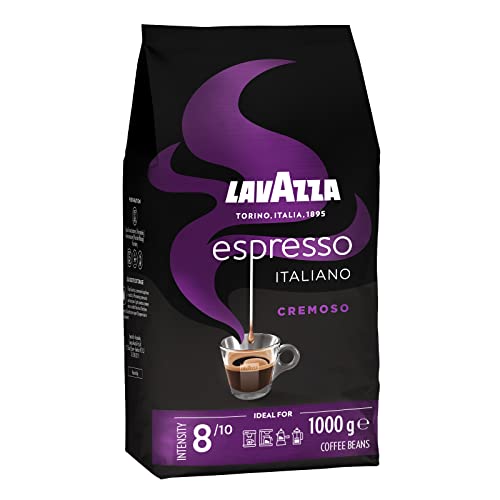
Lavazza sells the Espresso Italiano Cremoso as a kilo bag of whole beans, medium roast, intensity 8 out of 10. That almost exhausts the product page, and that is exactly what makes the blend an instructive case: the roaster holds back on almost everything a specialty roaster states of its own accord. We have not drunk it, so nothing here says anything about the taste in your cup. What can be documented is Lavazza’s own information, the catalogue entry for the pack and the storage rules from the company’s guide section.
What Lavazza says about the blend
The German product page lists four details: a blend of Arabica and Robusta, regions of origin South America and South-East Asia, medium roast, intensity 8 out of 10. Add the form, roasted coffee as whole beans, the pack size of 1 kilogram and two fields on flavour and recommended preparation, which come up further below. That completes the technical profile.
On the blend ratio of the two coffee species the roaster is silent. Figures circulate on retailer sites, for example 40 per cent Arabica to 60 per cent Robusta; they do not come from Turin, so we do not list them as a manufacturer’s statement. In the Amazon catalogue the pack is listed with a weight of 2.20 pounds, so 1.000 kilogram, and with the model and part number 41385. The number helps when reordering, because the Espresso Italiano range has several variants that look alike on the shelf.
The product photo adds a small detail that is missing on lavazza.de. On the front of the bag are the same intensity 8/10 and the fill weight 1000 g, beside them a strip with the line IDEAL FOR and four appliance symbols. One of them is clearly a stovetop pot. What the other three show cannot be told reliably from the resolution of the photo. The product page names two preparations, the pack shows four symbols, and which appliances they are stays open here.
On the price: approx. €16.99 on Amazon.de for the kilo (as of September 2026). The Amazon listing has existed since 24 January 2022. That date comes from the catalogue administration and has nothing to do with the roasting. In Lavazza’s own shop, the same pack stood at €14.99 instead of €19.99 when checked in early September 2026, but there it was marked as currently unavailable, with a notification function instead of a basket. So the lower price only helps you once the shop delivers again.
Behind the name stands Luigi Lavazza S.p.A. in Turin. The house goes back to a shop that Luigi Lavazza opened in Via San Tommaso in 1895, and in 1927 it became a public limited company. On packaging, the company history cites a two-layer paper wrapper made of glassine, which the manufacturer calls the first step towards Lavazza packaging. The same page says that in 1957 Lavazza was the largest coffee company in Italy and that in 1965 a roastery went into operation in Settimo Torinese which the manufacturer describes as the largest in Europe.
In detail: intensity 8 out of 10, cocoa and spices
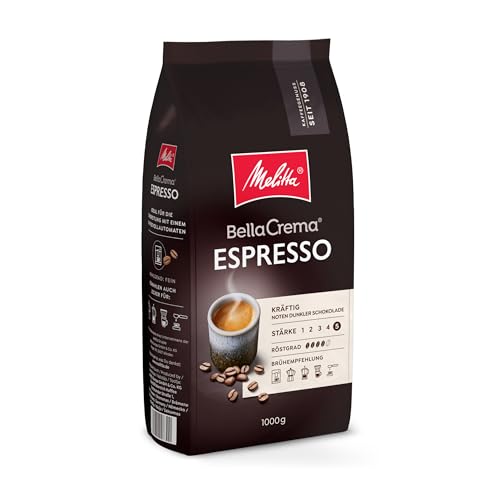
The 8 is an in-house number. Melitta lists its BellaCrema Espresso with strength 5 on a scale of its own, and the two values cannot be converted into each other. The 8 is still useful, because Lavazza ranks its whole bean range on it: Espresso Italiano Aromatico 7 out of 10, the Cremoso 8, Espresso Maestro and Caffè Crema Gustoso 9, Espresso Lamborghini 10. The Cremoso sits in the upper middle of this range.
Roast level and intensity are two different details, and Lavazza separates them cleanly. The roast level describes how far the bean went in the roaster. Medium means here: lighter than the classic southern Italian bar roast, darker than anything meant for the pour-over. The intensity, by contrast, describes how strong the cup is meant to be. In an Arabica-Robusta blend this depends mainly on the Robusta share, which brings more bitter compounds and more body and stabilises the crema.
On flavour, Lavazza says two sentences. Cocoa and spices appear as flavour notes in the details, and the product description speaks of a delicate espresso with a long-lasting crema and a pleasant finish with chocolate notes. The international page adds the short formula deep and creamy. Delicate and deep in the text about the same product show how far such descriptions carry: useful as a direction, worthless as a basis for your grind setting.
Does the Cremoso suit my bean-to-cup machine?
Yes. On the product page Lavazza writes ideal for espresso, moka, and a bean-to-cup machine brews espresso. An explicit approval for a particular appliance is not stated there, though. Anyone buying the Cremoso for a bean-to-cup machine is therefore relying on roast level and intensity.
It remains a difference from Melitta all the same, where the BellaCrema Espresso is explicitly advertised for bean-to-cup machines. With Lavazza you make the assignment yourself; with Melitta the manufacturer has already made it. The point at which bean-to-cup machines actually get into trouble with beans is a different one anyway: very oily surfaces that stick in the bean hopper and in the grinder. Oil comes out the further a roast is pushed, and a medium roast is on the inconspicuous side.
Moka means the stovetop pot. That a medium to dark roast works out better there than a light one is brewing logic: the moka pot works with much less pressure and longer contact time than a portafilter machine, and light roasts come out of the pot sour. How to handle the pot is explained in the moka pot guide.
We work out the dosing ourselves, and we state the values: for blends of this kind we would start with 18 grams in the double basket and 36 grams in the cup, so 1:2, and then turn the grind setting until the flow time fits. You can check the sums with the brew calculator; the logic behind it is in the guide to grind size. In a bean-to-cup machine you are left with the grind adjustment and the coffee quantity per brew, depending on the model also water quantity and brewing temperature.
What Lavazza leaves open
Roasted coffee has no data sheet and no operating manual, and for an industrial blend the product page is correspondingly short. We looked for these points on lavazza.de, on lavazza.com and in the Austrian shop without finding them:
- the blend ratio of Arabica and Robusta, as a percentage or as a ratio
- the countries of origin behind the regions South America and South-East Asia, plus growing altitude, harvest year and processing
- roasting time, roasting temperature and roast profile of this blend
- how the intensity scale is formed and what measured quantity stands behind the 8 out of 10
- the roasting location of this pack. All that is documented is that the group has been roasting in Settimo Torinese since 1965
- a roast date or a best-before date for this pack
- ingredients list, nutritional values and caffeine content
- certifications such as organic, Fairtrade, Rainforest Alliance or UTZ
- a figure in seconds for how long the crema lasts, which the manufacturer only calls long-lasting
- a brewing recipe in grams, seconds and degrees of water temperature
- packaging material and recyclability of the kilo bag, and whether an aroma valve is fitted at all
The last point is the most important in practice. Whether the kilo bag has an aroma valve, Lavazza does not say anywhere: neither on the product page nor on the category page nor on the storage page. The difference is real, and it works before opening: a valve lets freshly roasted coffee release its carbon dioxide without letting oxygen in, and keeps the bag sealed all the way to your shelf. Once you have cut it open, the question is settled, and what counts then is how firmly you close it again or whether you decant the contents.
Storing and using up: what the roaster specifies
For storage, Lavazza runs a guide section of its own, and it gets specific.
The coffee belongs in an airtight container of glass or ceramic or in the vacuum-sealed original packaging, at room temperature, dry, protected from light, heat and moisture. Lavazza explicitly advises against the fridge. In doing so the manufacturer contradicts the widespread household rule of storing coffee cool, and it is right: in the fridge, moisture condenses on the beans, and coffee picks up foreign odours.
For consumption, Lavazza sets a window of two to six months after roasting; ground coffee should be used up within a month. According to the manufacturer’s rule, grinding is done only shortly before brewing. For the kilo bag that means: without a grinder or the grinder of a bean-to-cup machine you should not buy it in the first place. The window also starts with the roasting, and when that was, the bag on the shelf does not tell you. That is the sore point of this pack.
What a kilo costs in use
A double portafilter basket usually holds 18 grams; that is our basis for the calculation. That puts around 55 double shots in a kilo, so one costs at €16.99 about 31 cents. In a bean-to-cup machine with single espressos of around 8 grams you get about 125 cups and around 14 cents per cup.
The sum only gets interesting when viewed against the consumption window. Two double shots a day empty the kilo in just under four weeks. Anyone living alone and pulling one cup a day from a bean-to-cup machine needs around four months and so stays within the range the manufacturer sets.
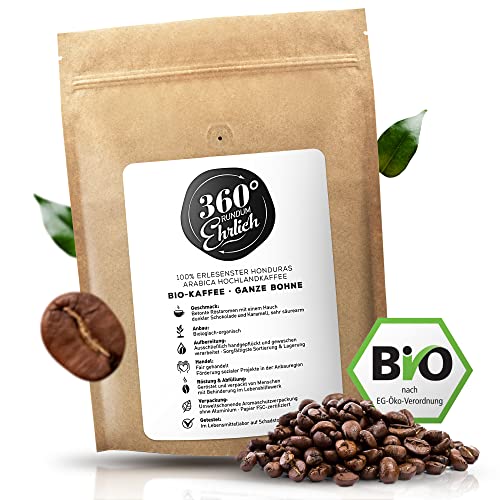
Calculating upwards: the winner of our category comparison, the 360° Rundum Ehrlich Bio Honduras, stands at approx. €35.59 per kilo (as of September 2026). The same double shot costs around 64 cents there. Over two shots a day and a year, that makes about €240 difference, and for it you get proof of origin and an organic certificate. The amount of coffee stays the same.
This bean or one of the three others?
| Variety | Roast and origin | Price per kg | Our rating | Take this one if |
|---|---|---|---|---|
| Lavazza Espresso Italiano Cremoso (this one) | Medium, Arabica and Robusta from South America and South-East Asia | approx. €16.99 | 8.9 | you want a medium espresso roast for a portafilter machine or stovetop pot and can live with a blend without proof of origin |
| Segafredo Intermezzo | Dark, Robusta with South American Arabica according to the Amazon catalogue, growing countries not stated | approx. €17.19 | 8.6 | you like it darker and more roast-bitter and often use the moka pot |
| Melitta BellaCrema Espresso | Strong, strength 5 on the Melitta scale | approx. €17.99 | 8.8 | the bean-to-cup machine is the only machine in the household and you want a bean that the manufacturer advertises for exactly that |
| 360° Rundum Ehrlich Bio Honduras | Single origin Honduras, organic, low acid, hand-roasted | approx. €35.59 | 9.3 | origin and organic seal matter more to you than the price per kilo and you are happy to pay a good double |
The table compares prices as of September 2026, and the ratings are our editorial assessment from the coffee bean comparison, not laboratory values. It says little about your cup, because four roast profiles side by side do not produce a ranking for any one palate.
When the Cremoso fits and when another bean does
Start with the preparation, it decides the most. Espresso from the portafilter machine, espresso from the bean-to-cup machine, coffee from the stovetop pot: this roast is made for those. For French press and pour-over we would not buy the Cremoso. A medium espresso roast quickly runs into roast bitterness in slow infusion, because contact time and water quantity are completely different there. If filter is your main preparation, take a bean that its roaster advertises for it, in our catalogue for example the Bio Honduras: the supplier explicitly names pour-over and French press. It is not light for that reason, its profile is, according to the supplier, long and gently roasted and designed for low acidity.
Then the quantity in the household. For a single person with one espresso a day, a kilo is a stock decision over months; for two people with two double shots each, the bag is empty after around two weeks. If you drink espresso rarely, you are better off buying smaller and more often, otherwise time works against the bag.
The roast level is the second fork. Anyone who likes light, acidity-led profiles is wrong here: medium is medium, and the manufacturer’s flavour statements point towards cocoa and chocolate, not towards fruit. If you want to stay with the brand and still drink lighter, the Espresso Italiano Aromatico is a step below.
That leaves the money. The Cremoso costs approx. €16.99 per kilo, Segafredo Intermezzo at approx. €17.19 practically the same, the Melitta BellaCrema Espresso at approx. €17.99 one euro more. Between these three the price decides little. In the Amazon catalogue the Cremoso is listed as a single pack with unit count 1; if you want to build up a stock, order several bags.
Who is it for?
In its own catalogue text, Lavazza describes the Cremoso as an ideal blend for everyone who wants to enjoy a coffee every day. That hits it quite well: an everyday bean for households where espresso and cappuccino in the morning come from the same pack and nobody feels like trying a new roastery every week. In the Amazon catalogue it is listed under food and drink as a single unit.
The pack is wrong for two groups. The first buys coffee by origin and wants to know country, growing altitude and harvest; here they get two regions. The second buys by freshness and wants to get through the coffee a few weeks after roasting; for that you buy from a roastery that prints the roast date on the bag.
A word on sustainability, because it appears in the catalogue text: there Lavazza describes its own group as active in all areas of the coffee industry and advertises a sustainable product model. The statement is in the corporate profile. About the contents of this bag, Lavazza says nothing there.
And if you buy it: take the bag from a shelf that turns over quickly, decant the kilo at home into two airtight containers and put them in a dark place at room temperature.