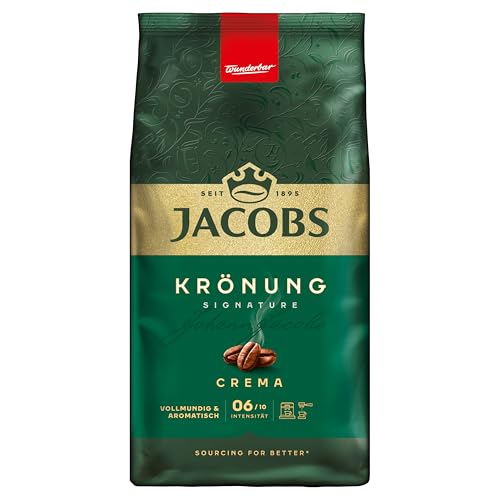
One kilo of whole beans in a green bag with a golden band, the intensity 06/10 printed large, and according to our price box approx. €15.29. On Amazon the product is called Jacobs Krönung Caffè Crema. Jacobs itself lists it on jacobskaffee.de as Krönung Crema, and on the pack, as the manufacturer shows it, it says Krönung Signature Crema.
We infer that the three names mean the same bag from the information: nut, citrus and 6 out of 10 appear in the Jacobs range only for this variety and for the Krönung Aroma beans, and those exist only in 500 grams. We have not handled a bag and have not drunk the coffee. What is written here comes from the Jacobs product page, the official Jacobs online shop, the Amazon catalogue and the pack photo.
What the bag and the product page say
At the top of the front sits the crown with the line “Seit 1895”, below it the Jacobs lettering, then Krönung, with Signature in small type, an illustration of steaming coffee beans and the word Crema. In the bottom row, “Vollmundig & aromatisch” (full-bodied and aromatic) is on the left, the 06/10 with the word Intensität (intensity) in the middle, and a group of preparation symbols on the right. The large one shows a bean-to-cup machine, next to it a small portafilter machine and a third symbol that cannot be identified with certainty at the resolution of the photo. On the Amazon product photo there is also a red label at the top left with the word Wunderbar (wonderful).
The product page is shorter than the pack. It states whole bean, the intensity 06/10, 1 kg as the only size and a single sentence on flavour: “An aromatic coffee that combines subtle notes of nut with a refreshing citrus note.” The online shop has almost the same sentence, there with “delicate nutty nuances” instead of the subtle notes.
The aroma wheel, a graphic on the same page, says more. Citrus and Nutty are highlighted in it, and Balanced in the inner ring. Fruity, Cocoa, Spicy, Mild, Intense and Strong stay unmarked. This is the manufacturer’s self-description, not a tasting note. It is still useful for telling varieties apart within its own range, because Jacobs does not mark cocoa for this variety, for example.
In detail: what 6 out of 10 means in the Jacobs range
An intensity rating is a house scale. Jacobs uses it to order its own varieties, and the number cannot be set against another roaster’s 6 out of 10, even if that one also counts up to 10. Manufacturers usually fold roast level, body and bitterness into such values.
The number therefore only becomes meaningful within the brand’s own range. The whole-bean overview on jacobskaffee.de lists the Barista Crema and the Café Crema Gold at 5, the Krönung Crema at 6, the Barista Crema intense at 7 and the Barista Espresso at 8. Within the Krönung line, the Krönung Kräftig Aroma beans sit one step higher, at 7 out of 10 and with a description that pairs hazelnut with a hint of cocoa.
The Krönung Crema thus stands one step above the two Crema varieties at 5 and two steps below the Jacobs Barista Espresso. Nothing more than this order can be read from the number.
What roast level does the Krönung Crema have?
Jacobs leaves that open. Neither the product page nor the online shop nor the Amazon catalogue speaks of light, medium or dark. The wording “dark roasted” that appears in the Jacobs shop belongs to a different variety, the Krönung Crema Kräftig, and applies only to that one.
Retailer texts outside Jacobs speak of South America and Asia, of Arabica and Robusta and of a drum roaster. None of these statements appears in a manufacturer source, so we do not adopt them.
The bean species in particular would be revealing for a caffè crema. Robusta, botanically Canephora, carries more caffeine and more soluble solids than Arabica, brings more body to the cup and keeps the crema stable for longer. Arabica brings more acidity and a wider range of aromas. A blend for the bean-to-cup machine often mixes both, because a caffè crema pushes a lot of water through little coffee, and the Robusta share gives the coffee backbone.
What can be derived remains a derivation. A citrus note stands for perceptible acidity, and acids, above all the chlorogenic acids, break down as roasting time increases. A very dark roasted coffee is therefore rarely advertised with citrus. Our reading of the description is a medium roast, though it is not documented. On its coffee expertise page, Jacobs writes generally that an average roast takes approx. 12 minutes at 200 to 250 °C. That statement does not refer to the Krönung Crema, it describes roasting in general.
Bean-to-cup machine, portafilter, milk: what Jacobs intends the bean for
The clearest statement is in the online shop: “Ideal for bean-to-cup machines”. A second point in the same list reads “Suitable for preparing caffè crema and coffee specialities such as latte macchiato or cappuccino”. The Amazon catalogue goes further and writes “Ideal for portafilter machines and bean-to-cup machines”, which fits the symbols on the pack.
The neighbouring variety shows how far an approval can go. For the Krönung Crema Kräftig, the same shop says that after grinding it is also suitable for portafilter machines, moka pots or French press. For the Krönung Crema this line is absent. Anyone who uses the bean in a moka pot or a pour-over filter leaves the area for which Jacobs describes it.
In a bean-to-cup machine, caffè crema means the same grinder and the same brew unit as for espresso, but several times the water and classically a coarser grind, provided the machine lets you adjust the grind size per drink. That way the longer extraction should not over-extract. Beans from the middle of the roast scale suit this, because a very dark roast releases many bitter compounds over the long contact time and a very light one quickly turns thin and sour. The 6 out of 10 rating fits this job in our view.
In the bean-to-cup machine itself, a lot depends on the settings. If the machine comes from a dark espresso bean and switches to this variety without adjustment, the cup contains a different coffee from the one the aroma wheel promises, because grind size and coffee quantity were set for the old bean. Which adjustment works in which direction is explained in the guide to adjusting a bean-to-cup machine. In a portafilter machine, every bean needs a considerably finer grind than in the crema brew of a bean-to-cup machine until the flow time is right.
What the kilo costs
In our price box the bag is listed at approx. €15.29. The Amazon catalogue listed it at €14.39 on 7 September 2026, so the benchmark on the site is slightly above that.
In the official Jacobs online shop, to which the buy button on the manufacturer’s page leads, the same kilo cost €21.99 on 25 September 2026. That is €6.70 or around 44 per cent more than in our price box, for a bag with an identical description.
Per cup: if your bean-to-cup machine doses 8 grams for a caffè crema, the kilo makes 125 cups. At €15.29 that is a good 12 cents of coffee per cup, and bought from the Jacobs shop just under 18 cents. The 8 grams are our assumption. You can calculate with your own quantity in the brew calculator.
Among the 23 beans in our coffee bean comparison, the Krönung Crema has the third-lowest price per kilo. Cheaper per kilo are only the Gimoka Classico at approx. €13.63, an espresso bean, and the Amazon Colombian Medium Roast at approx. €14.19.
What Jacobs leaves open
The gaps in one place: for the Krönung Crema, all manufacturer sources lack the roast level, the ratio of Arabica to Robusta, the growing countries (Amazon stays with “from the best growing regions”), the place of roasting and the roasting method. Online there is also no information on packaging, such as protective atmosphere or aroma valve, no best-before guidance and no period for the opened pack, no caffeine content, no acidity, and no grind size or dosing recommendation. The product page announces the nutritional values in its page description but does not show them.
Two catalogue fields at Amazon are not usable as product information. The date 30.10.2022 appears there as the release date, but it documents only the catalogue entry. Jacobs likewise does not say on its pages when the variety or the Krönung line came to market. The dimensions of roughly 21.0 by 9.5 by 0.7 centimetres are obviously wrong for a one-kilo bag, since no filled coffee bag is 0.7 centimetres high.
The Krönung Crema or one of the other three?
The main candidates are beans that cost almost the same and reveal more. The Dallmayr Crema d’Oro is 70 cents per kilo above the Krönung Crema, the Melitta BellaCrema La Crema 60 cents. Anyone who wants a growing country and an organic control number pays €20.30 more per kilo for the 360° Rundum Ehrlich Bio Honduras.
| Variety | Roast and origin | Price per kg | Our rating | Choose this one if |
|---|---|---|---|---|
| Jacobs Krönung Caffè Crema (this one) | Roast level and origin not stated, intensity 6 out of 10 | approx. €15.29 | 8.2 | the price per kilo matters more to you than what the roaster tells you |
| Dallmayr Crema d’Oro | according to Dallmayr Arabica and Canephora, gently roasted for a long time at low temperature | approx. €15.99 | 8.6 | at almost the same price per kilo you want to know which bean species are in the bag |
| Melitta BellaCrema La Crema | according to the Amazon catalogue medium roast and roasted in Germany | approx. €15.89 | 8.6 | a stated roast level is your buying criterion and you want to stay in the same price range |
| 360° Rundum Ehrlich Bio Honduras | Single origin Honduras, organic according to the seller (control body DE-ÖKO-005) and hand roasted | approx. €35.59 | 9.3 | you need a growing country and an organic control number |
The rating is our editorial assessment from the data comparison, nothing was measured. The prices are the benchmarks of our price boxes for online retail and say nothing about the supermarket shelf.
When the Krönung Crema fits, and when another bean does
Milk or black? Jacobs intends the bean for cappuccino and latte macchiato, which speaks for it if most of your cups end up with milk. If you drink it black and want it stronger, the Barista Espresso at level 8 keeps you with the same brand. Per kilo it costs €4.70 more in our catalogue. If you prefer cocoa to citrus, Jacobs describes the Krönung Kräftig Aroma beans with exactly that note.
Which preparation? If you have a bean-to-cup machine, that matches what Jacobs describes the bean for. If your coffee comes from a moka pot or a French press, we would choose a bean whose roaster names exactly that preparation, so within the brand more likely the Krönung Crema Kräftig.
How quickly does the bag empty? At one cup a day with 8 grams, the kilo stays open for a good four months. In that time roasted coffee loses carbon dioxide and volatile aroma compounds, and the fats oxidise as soon as air reaches the bean. For this household we consider half the quantity more sensible, and Jacobs sells the same description with the same 6 out of 10 as Krönung Aroma beans in a 500-gram bag.