The Jacobs Barista Espresso is a 1 kg bag of whole beans from the Barista Editions range. On Amazon.de it costs approx. €19.99 (as of September 2026), and Amazon gives 1 April 2018 as the release date. We have not drunk this coffee. What follows comes from the manufacturer’s site jacobskaffee.de, from the Jacobs online shop, from the pack images there and from the Amazon catalogue. Where these sources contradict each other, it says so.
What Jacobs says about the bean
On jacobskaffee.de the variety sits in the menu under Ganze Bohne (whole bean), Barista Editions, Espresso. It is described there as a strong espresso with spicy, intense notes of cocoa and a hint of dark caramel. The online shop says almost the same, except that the espresso is called intense there instead of strong. In the Amazon bullet point on flavour the caramel is missing, and it stays with a spicy cocoa note.
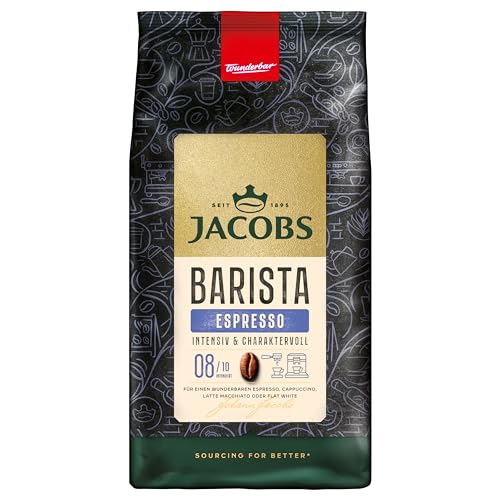
On the front of the bag the short formula reads Intensiv und Charaktervoll (intense and full of character).
On the drinks, the sources differ in detail. The bag names espresso, cappuccino, latte macchiato and flat white, the shop names crema, cappuccino and latte macchiato, and the Amazon listing names espresso, café au lait and latte macchiato. All three list latte macchiato, and only the bag lists flat white.
On production, the shop has four brief points: roasted coffee in whole beans, roasted carefully and gently in a drum roaster, packed under protective atmosphere, made in Germany. Added to that is Jacobs’ only origin statement for this variety, and it reads green coffee not from the EU. At the same place Amazon writes of premium beans from the best growing regions.
The shop names Jacobs Douwe Egberts as manufacturer, with the address Oosterdoksstraat 80 in Amsterdam, while the Amazon catalogue lists JACOBS DOUWE EGBERTS Coffee Germany. The brand belongs to JDE Peet’s. According to the company history, Jacobs Douwe Egberts was formed in 2015, followed later by the merger with Peet’s Coffee to form JDE Peet’s.
In detail: what the 08/10 measures and what it does not
The manufacturer’s site and the bag carry the same number, 08/10, each time called intensity. In the shop, eight of ten bean symbols are filled. How Jacobs arrives at this number, whether from a measurement or a tasting judgement, is not stated on any of the pages we reviewed.
Three varieties sit side by side in the Barista Editions: the Barista Crema at 05/10, with light nuances of citrus fruit and nutty undertones according to Jacobs, the Barista Crema Intense at 07/10 with notes of dark chocolate, pecan and maple syrup, and the Barista Espresso at 08/10 at the top. The Lavazza Espresso Italiano Cremoso also carries an 8 out of 10. Whether the two beans are equally strong as a result cannot be read from the number, because each roaster sets its own scale.
More information than the number comes from an infographic in the shop. It shows a strength scale with four levels, Mild, Ausgewogen (balanced), Intensiv (intense) and Kräftig (strong), and places the Barista Espresso on the top one. Below it are five flavour directions: citrus, fruity, nutty, cocoa and spicy. Only cocoa and spicy are highlighted. If you are looking for a fruity or nutty cup, you can already read from the manufacturer’s own graphic that Jacobs places this variety elsewhere.
And the roast level? It cannot be read from the drum roaster in the shop text: that is the common design in which the beans are moved in a rotating, heated drum, and it reveals nothing about roasting time or final temperature. Kräftig (strong) and 08/10 sound like a dark roast, but a roaster can roast a bean with a lot of Robusta to a medium level and still call it strong.
Which machine is the bean meant for?
None of the sources lists a moka pot, neither the manufacturer’s site and shop nor the bag and the Amazon listing. For bean-to-cup and portafilter machines, the Jacobs shop, the bag and the Amazon listing agree, and the shop also names the French press.
The front of the bag shows this in pictures too. Next to the 08/10 sit two device symbols, a portafilter above a cup and a bean-to-cup machine. A stovetop pot appears on our product photo only in the ornamental pattern of the background, among other drawn coffee motifs. We do not read that as a recommendation.
On the back, a grind size is given for each device. For the bean-to-cup machine medium to fine, for the portafilter machine fine. A third symbol shows a filter cone on a jug, with no label, and medium to coarse next to it.
The main reason the range is so wide is contact time. In a portafilter machine the pump forces the water in around 25 to 30 seconds through a firmly tamped coffee puck, and the grounds must be fine for any resistance to build up at all. At the coarse end are the filter cone from the unlabelled symbol and the French press from the shop text. Both work without pressure, and the water has minutes instead of seconds of contact with the grounds. In the French press the coffee steeps for four minutes, where fine grounds would over-extract and wander through its metal mesh into the cup. The bean-to-cup machine actually belongs on the portafilter’s side, as it also brews with pump pressure and in a similarly short time. Jacobs does not explain why the bag nevertheless sets it coarser, at medium to fine. By our assessment it comes down to the brew unit: very fine, heavily compacted grounds can clog it. In a bean-to-cup machine you therefore start in the middle of the grind scale and adjust finer in small steps for as long as the espresso runs through too fast and too pale. Whether your grinder can only be adjusted while the motor is running is stated in your machine’s manual. How to go about it is described in the guide to grind size, and you can work out the dose for your cup size in the brew calculator.
What Jacobs leaves open for this variety
Coffee has neither a user manual nor a data sheet, so everything that can be documented is on the manufacturer’s site, in the shop and on the bag. We searched there on 24 September 2026 for the following points and did not find them:
- the share of Arabica and Robusta
- the growing countries, beyond the statement green coffee not from the EU
- the roast level, plus roasting time, roasting temperature and a roast date
- the roasting location; there is a separate question on Bremen below
- a seal for this product, whether organic, Fairtrade or Rainforest Alliance
- caffeine content, nutritional values and allergen information
- a best-before period counted from roasting and a storage note for exactly this variety
- the bag material, an aroma valve, a resealing option and disposal
- a dose per cup, a brewing temperature and an extraction time
Two of these points weigh more heavily when buying than the rest. Without a roast date you cannot know on the shelf how old the beans are. And the protective atmosphere protects only the closed bag: the air in it is replaced by a protective gas when packing, so that oxygen does not attack the roast aromas. As soon as you cut it open, this protection is gone.
Common Grounds and Wunderbar Projekt: what lies behind them
The Amazon listing has a point on sustainability, the Common Grounds project, which is meant to continuously improve conditions in coffee growing and reduce packaging material. That is not a seal. Common Grounds is a programme of the parent company JDE Peet’s. The brand’s contribution is called the Jacobs Wunderbar Projekt on the Jacobs sustainability page, based in the Kagera region of Tanzania. Both can be found again on the bag: at the top sits a red label with the lettering Wunderbar, and at the bottom, in capital letters, it says SOURCING FOR BETTER with an asterisk.
The same sustainability page sets two goals with a year. By 2028 Jacobs wants to source 100 per cent of its coffee responsibly, and the manufacturer itself adds that this does not rule out risks in the supply chain. By 2030 all packaging is to be reusable, recyclable or compostable. Both goals apply to the whole company.
Our assessment: if you buy coffee by certificate, what you find here is a statement of intent by the corporation, but nothing that an inspection body checks on this product. In our catalogue the 360 Grad Rundum Ehrlich Bio Honduras is the counter-example: according to the supplier from certified organic growing, with an organic control number.
What a kilo costs in the cup
Our catalogue lists 23 coffee beans. 14 of them cost less than the Barista Espresso, 8 cost more. On the price per kilo it therefore belongs in the upper half. At the top end are the 360 Grad Honduras at approx. €35.59 and the Incapto Single Origin Kolumbien at approx. €35.95 per kilo.
We calculate with the usual amounts: 18 grams for a double espresso from a portafilter machine, around 8 grams for a single one from a bean-to-cup machine. A kilo then yields a good 55 doubles or 125 singles. The double therefore costs around 36 cents per cup, the single around 16 cents per cup.
Over a year the gap to more expensive beans becomes tangible. Two people with one double espresso each in the morning need 36 grams a day, the kilo is empty after just under four weeks, and a good 13 kilos go through in a year. With the Barista Espresso that comes to around €263 a year. With the 360 Grad Honduras it would be around €468 a year, so about €205 a year more, and the amount of coffee stays the same.
This bean or one of the three others?
| Variety | Roast and origin | Price per kg | Our rating | Choose this if |
|---|---|---|---|---|
| Jacobs Barista Espresso (this one) | Roast level not stated, drum roaster, no growing countries | approx. €19.99 | 8.4 | you make milk drinks with a bean-to-cup or portafilter machine and do not mind where the beans come from |
| Lavazza Espresso Italiano Cremoso | Medium, Arabica and Robusta according to Lavazza | approx. €16.99 | 8.9 | you want to know which bean varieties are in it, or mostly use a moka pot |
| Jacobs Krönung Caffè Crema | Intensity 06/10, nut and citrus according to Jacobs | approx. €15.29 | 8.2 | you want a lower intensity, prefer nut and citrus to cocoa and want to save €4.70 per kilo |
| 360 Grad Rundum Ehrlich Bio Honduras | Single origin Honduras, organic according to the supplier | approx. €35.59 | 9.3 | you are willing to pay 1.8 times the price per kilo for a named growing country and organic |
The prices are the guide values from our price box as of September 2026, and the ratings are our editorial assessment from the coffee bean comparison. The table does not answer which of the four beans you will like.
When the Barista Espresso fits and when another bean does
Start with your machine. If a bean-to-cup or portafilter machine stands in the kitchen, you are in line with the manufacturer with this variety. With a stovetop pot you are better off with the Lavazza, because Lavazza explicitly names moka as a preparation. For the drip filter machine we would buy neither of the two: Lavazza names only espresso and moka, and the third symbol on the Jacobs bag is unlabelled.
Then the milk. If you drink almost only cappuccino or latte macchiato, the recommendation on the bag speaks for this bean, as exactly these drinks are listed there. Whether an espresso holds its own in a large cup of milk depends just as much on dose and grind size as on the variety.
The flavour direction is the third fork, and the infographic from above helps here. If you are looking for nut and citrus rather than cocoa, the description of the Krönung Caffè Crema fits better: Jacobs lists it at 06/10, and it costs €4.70 less per kilo. Within the Barista Editions, the Barista Crema at 05/10 would be the step in the same direction.
Against the Lavazza the Barista Espresso has to hold its own hardest. For the two-person household from above, a good 13 kilos a year, the difference in the price per kilo comes to around €39 a year, and for a single shot of 8 grams a day just under €9. Our assessment: anyone who only wants espresso from a bean-to-cup machine and has no preference for the brand gets the cheaper and better-described bean there, even though Lavazza does not specifically name the bean-to-cup machine on its product page. Our rating stands at 8.9 against 8.4.
The Barista Espresso is wrong for anyone who wants to see a growing country on the bag.