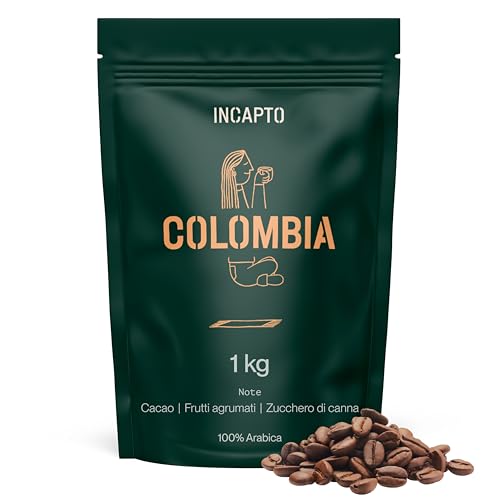
One kilo of whole beans for approx. €13.63 according to our price box on Amazon.de, and on the front of the bag a 10 in a small circle. If you want to know what is behind that 10, you hit a dead end at Gimoka.
So, first, the state of the sources. We have not drunk this bean, and we have not opened a bag either. Everything product-specific in this text comes from the Amazon catalogue entry for ASIN B0871LJKTG and from the product photo stored there. What Gimoka writes on its own website concerns other varieties and the company; where we draw on it, we say so.
A bean the roaster does not list itself
The product sitemap of gimoka.com has 164 entries, retrieved on 24 September 2026. Whole beans appear there in three groups, and a bean called Classico is in none of them. Under Casa are Armonioso (500 g), Vellutato 100 per cent Arabica (500 g), Gusto Ricco (1 kg), Gran Bar (1 kg) and Espresso (1 kg). The Ho.Re.Ca. range for the catering trade comprises 5 Stelle, Aurum and Platinum, and the vending range for machines comprises Armonioso, Bio Organic, Supremo, Cremoso and Intenso.
The detour via a German site does not help: gimoka.de is a placeholder page, gimoka.com/de redirects to an Italian product page, and the B2B portal b2b.gimoka.com does not list a Classico bean either. We also searched the source code of all 13 bean pages for the word amazon. None of them links to a shop, not even to another one.
Everything that is publicly known about this product is therefore in one Amazon entry. The catalogue lists Gruppo Gimoka S.p.A. as the manufacturer, Aroma Classico as the variant name and 18 October 2024 as the release date. That date comes from the catalogue administration and says nothing about how long this blend has been roasted. The bag is filed under Food and Drink, product group Grocery.
Intensity 10, and Gimoka’s scale goes up to 13
In the Amazon title and in one of the bullet points, the number appears without a denominator: intensity 10. On the product photo, the same number sits in a circle next to the espresso cup.
The denominator comes from Gimoka’s own website, though for other varieties. There, each bean carries a rating in the format x/13: Gusto Ricco 13 out of 13, Gran Bar 12 out of 13, Espresso 9 out of 13, Armonioso 8 out of 13, Vellutato 100 per cent Arabica 6 out of 13. So the in-house scale goes up to 13. The 10 comes from Amazon, the upper limit from gimoka.com, and that both belong to the same scale is plausible but unconfirmed: it is our assignment, and Gimoka itself does not classify the Classico anywhere there. If you assume it, the bean sits between the Espresso at 9 and the Gran Bar at 12, so in the upper third and not at the top of the in-house range.
How this roaster describes the upper end can be read for the Gusto Ricco: a strong and powerful blend with a full, decisive taste, as its product page puts it. That is Gimoka’s wording for 13 out of 13.
Across brand boundaries, the number is no use as a yardstick anyway. Segafredo rates the Intermezzo at 12 out of 13; on the newer pack it appears as 10 out of 10, because Segafredo has switched to a scale up to 10 there. Two tens from two roasters describe two different things, and neither can be converted into the other.
The catalogue names what is in the blend in two words: Arabica and Robusta. Robusta contains roughly twice as much caffeine as Arabica, plus less sugar and less fat. How strongly that comes through here depends on the proportion.
On roast level, the situation gets even thinner, and the aroma descriptions contradict each other, in part even within the catalogue. The German catalogue text describes the blend with a light and balanced aroma and a lingering aftertaste. The bullet point on the pack format, by contrast, speaks of the intense aroma of the coffee bean, which the protective atmosphere is meant to preserve. On the bag itself, above the brand mark in capital letters, it says intenso e persistente, that is, intense and lingering. None of these wordings is a roast level statement.
What a roast level would mean can still be said in general terms, because it depends on roasting chemistry and not on the brand. The further the roast goes, the more chlorogenic acids break down. The acidity in the cup falls, roast bitter compounds increase, the bean loses mass and gains volume, and it becomes more brittle. At the same setting on your grinder, a dark roast therefore ends up finer than a light one. Knowing the roast level thus gives you a starting value for the grinder.
The bag: one kilo under protective gas
The catalogue describes the packaging protection in the format bullet: one pack, 1 kg, packed in a protective atmosphere. This means protective gas. During filling, the oxygen is displaced, usually by nitrogen, so that the roast oils age more slowly.
With whole beans, this protection carries further after opening than with ground coffee. Powder has many times the surface area and oxidises correspondingly faster as soon as air reaches the bag; the whole bean only releases its aroma in the grinder.
A degassing valve works differently, even if the two are often mentioned in the same breath. The valve only takes effect after sealing: freshly roasted coffee gives off carbon dioxide for days, and the valve lets it out and lets no oxygen in. The ingredients line that Gimoka gives the Gran Bar, for example, consists only of the statement Caffè tostato. Confezionato in atmosfera protetta. Roasted coffee, packed under protective atmosphere.
The catalogue dimensions are in inches: 9.055 by 4.921 by 3.543, which converts to roughly 23.0 by 12.5 by 9.0 centimetres. On the product photo the bag stands upright, so the 23 centimetres is the height on the shelf. The weight field gives 2.205 pounds, roughly 1 kilogram, and so reflects the fill quantity, not a shipping weight.
Curious is the bullet point headed Made in Italy in the catalogue. It is not about Italy but about packaging: the Gimoka Group has been working on easily recyclable and compostable packaging solutions since the 1980s. This fits the sentence on the company page that it develops only recyclable solutions or ensures that the compostable ones act as an oxygen barrier. Both are statements about the group’s packaging development.
Does the Classico suit a bean-to-cup machine?
In our assessment, yes: whole beans, one kilo, any bean-to-cup machine grinds them, and the same applies to the grinder in front of an espresso machine.
What Gimoka gives its listed varieties sounds narrower. On the product pages of the Gusto Ricco and the Armonioso it says the bean is intended, after grinding, for the moka pot or for a home espresso machine.
In practice, the grinder decides the result: you set it by guesswork and correct it according to the extraction time, instead of working your way along a recommendation. How to approach the right setting on the grinder is described step by step in the guide to grind size, and for coffee and water quantities the brew calculator works out the ratios.
How far a kilo goes and what a cup costs
No bean in our comparison costs less than the Classico. On 7 September 2026, the Amazon catalogue noted €13.85 for the same pack, 22 cents more than our price box. That changes nothing essential in the following calculations; we use the value from the price box.
Two assumptions here are our own: 7 grams for a single espresso, 14 grams for a double. A single then costs roughly 9.5 cents, a double roughly 19 cents. A kilo makes just under 143 singles or 71 doubles.
If you pull two double espressos a day, you use 28 grams a day, 10.2 kilograms a year and therefore roughly €139 per year. With the Gimoka Armonioso at approx. €15.34, the same consumption would cost roughly €17 more per year, with the Segafredo Intermezzo at approx. €17.19 roughly €36 more per year, and with the 360 Grad Rundum Ehrlich Bio Honduras at approx. €35.59 roughly €224 more per year.
What Gimoka leaves open about this bean
We looked for the following information in the Amazon catalogue, on gimoka.com and in the product sitemap, and found none of it anywhere:
- the roast level, whether light, medium or dark
- the ratio of Arabica to Robusta in per cent
- the countries of origin of the green coffee
- the place of roasting, beyond the statement Italy
- roast date, best-before date and a period of use after opening
- a storage recommendation for this product
- a grind size or dosage recommendation
- the intended method of preparation, that is bean-to-cup machine, espresso machine, moka pot or filter
- individual flavour notes such as chocolate, nut, fruit or spice
- statements on acidity and bitterness
- information on crema
- caffeine content and nutritional values
- seals such as organic, Fairtrade or Rainforest Alliance
- the packaging material of the kilo bag, a degassing valve and whether it can be resealed
What else is there?
| Variety | Roast and origin | Price per kg | Our rating | Choose this if |
|---|---|---|---|---|
| Gimoka Classico (this one) | Roast level not stated, Arabica and Robusta without ratio, made in Italy according to the catalogue | approx. €13.63 | 8.5 | you want to save on the price per kilo and can manage without manufacturer information |
| Gimoka Armonioso | Listed and described by Gimoka itself, intensity 8 out of 13 according to the manufacturer’s page | approx. €15.34 | 8.1 | you want to stay with the same brand but buy a variety with its own product page |
| Segafredo Intermezzo | Dark roast, Robusta blend, 12 out of 13 according to Segafredo, moka pot according to the Amazon title and earlier product page | approx. €17.19 | 8.6 | you need a documented dark roast instead of a guess from an intensity number |
| 360 Grad Rundum Ehrlich Bio Honduras | Single origin from Honduras, certified organic with a named control body, roasting method stated by the seller | approx. €35.59 | 9.3 | you drink few cups a day and want to know which country the bean comes from |
The prices are the guide values from our price boxes and move daily in the shops. The ratings are our editorial assessment; the 9.6 out of 10 points that we give the Classico for value for money rate the price per kilo. The column Roast and origin reflects what the respective roaster or its catalogue entry states, and it is precisely there that the four rows differ most. You can find more varieties with a roast level statement in the coffee beans category.
When the Classico fits and when another bean does
The first question is not the price but your method of preparation. Bean-to-cup machines and espresso machines are unproblematic. For a pour-over, a filter machine or a French press, we would not buy this bean: there the grounds sit for minutes in a lot of water, and how a roast reacts to this long contact time depends on the roast level. If you brew with a pour-over and want to know what you are tipping into the filter, you are better served by the Bio Honduras from the table.
The second point is quantity. With two double espressos a day, the kilo bag is empty after a good five weeks, and in that time freshness plays a smaller role in our assessment. If you pull only two doubles each at the weekend, the same bag stays open for roughly four months. At purchase you know nothing about the age of the beans in the bag, so for that case we would reach for a smaller pack, such as one of the 500-gram varieties from Gimoka’s Casa range. What role oxygen, light and heat play here is explained in the guide to coffee beans.
Gimoka, the roaster behind the bag
Gimoka belongs to Gruppo Gimoka, based in Cinisello Balsamo near Milan. The company says about itself that, by volume of coffee processed, it is the second-largest roaster in Italy and has been one of the country’s largest roasteries since the 1980s, with customers in over 50 countries. According to its own account, green coffee purchasing, roasting, grinding, packaging and distribution all take place in-house. The operator of the shop gimoka.com is Gruppo Gimoka S.p.A., VAT number IT00177230141.
For private customers, catering and vending machines, the group has separate bean ranges. If you know the brand from the coffee machine at the office, you may therefore know a different bean from the one in the kilo bag.