The Intermezzo comes from Segafredo’s Le Classiche line, or so the Amazon title and the manufacturer’s earlier shop page say. On Amazon.de the dark roasted blend is available as a 1 kg bag of whole beans, for approx. €17.19 (as of September 2026).
We have not drunk it, nor have we opened a bag. The product information given here was written by Segafredo itself, though in several places and differently over the years: on today’s product page in the Italian shop, on two older pages that only the Internet Archive still holds, and in the Amazon text, which reproduces the earlier manufacturer description. German-language sources are missing, because on segafredo.de and segafredo.at a search for Intermezzo returns no product at all. Where the texts diverge, the source is given.
Manufacturer, EAN and Amazon listing
Behind the bag is Segafredo Zanetti S.p.a. of Sesto di Rastignano, in the municipality of Pianoro, province of Bologna. According to the product page, management and coordination lie with the Massimo Zanetti Beverage Group. Segafredo has existed as a brand since 1973, and according to Segafredo it is entered in the Italian register of historic brands of national interest. The company itself speaks of more than 100 countries supplied and over 400 Segafredo shops.
Which Amazon item belongs to which manufacturer pack is settled by the EAN. The Amazon catalogue lists the Intermezzo with the model and part number 8003410212652. The same digits are carried in the Segafredo shop by the 1 kg pack with the item number 1A3, while the half kilo is listed there under 1A1 and the EAN 8003410212638. As the release date, the Amazon catalogue gives 10 July 2020. That date comes from catalogue administration and says nothing about how long Segafredo has been roasting this variety.
Pure Robusta or with Arabica?
Today’s product page, created on 10 April 2026 according to the shop data, describes the Intermezzo as a classic Robusta blend with intense flavour, full body and lasting crema. Arabica does not appear there in any language version; in Italian it says “miscela classica di robusta”.
Older texts sound different. The Amazon catalogue speaks of Robusta with a strong character, balanced by South American Arabica. That is what the earlier shop page shop.segafredo.it also said in March 2026, and as early as March 2023 the Le Classiche page advertised “Caffè Robusta bilanciato da Arabica sudamericana”. The same page then presented the Intermezzo as “la ricetta rivisitata”, a revised recipe. This has not been tidied up to this day, because on the page for the Intermezzo pods the English description speaks of Robusta and Arabica, the Italian one only of Robusta.
Our reading: the Intermezzo is Robusta-led, and an Arabica share in today’s recipe cannot be gathered from Segafredo’s texts. This has consequences for the cup that depend on the type of coffee and not on the roaster. Robusta contains roughly twice as much caffeine as Arabica, as well as less sugar and less fat. In espresso blends, Robusta traditionally stands for body and crema, and these are exactly the two points Segafredo highlights in the current description.
The flavour statements have shifted as well. The Amazon text and the earlier shop page write of a hint of almond, while today’s product page lists chocolate, dried fruit and spices, where “frutta secca” in Italian covers nuts as well as dried fruit. Such notes describe what the roaster expects in the cup; nobody has measured them. The roast statement, by contrast, is the same in all sources: dark.
In detail: 12 out of 13, 10 out of 10 and what the number means
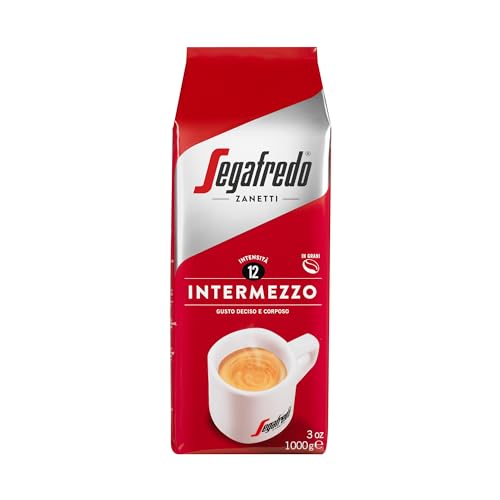
On the product page, Segafredo rates the Intermezzo “High 12/13”, roast dark. If you look at the new 1 kg pack as a variant image in the shop, however, you read 10 | 10. The explanation is found only in the Italian version: the new pack uses a scale of 1 to 10, and 10 out of 10 corresponds to the earlier rating of 12 out of 13.
The product photo in the Amazon catalogue still shows the old bag with “Intensità 12” and the print “Gusto deciso e corposo”. On the new pack it says more briefly “Deciso e corposo”, which translates as decisive and full-bodied.
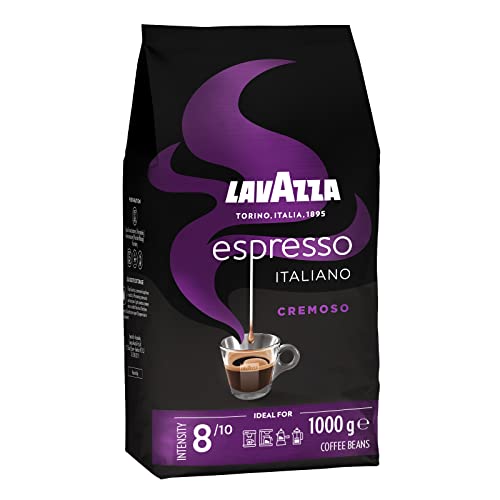
The number can only be compared within one brand. Lavazza lists the Espresso Italiano Cremoso at 8 out of 10, while the Amazon listing of the Gimoka Classico gives intensity 10 without an upper limit. You cannot convert any of these numbers into another.
Within Segafredo, however, it says quite a lot. In the shop’s bean range there are five permanent varieties alongside three limited editions. The Intermezzo shares its 12 out of 13 with the Fiesta, which is also dark roasted and costs €26.90 per kilo in the manufacturer’s shop. Espresso Casa and Classico are at 10 out of 13 and are medium roasted. The Supremo is also at 10 but is light roasted. It shows that at Segafredo intensity does not simply mirror the roast level.
What dark roasted means follows from roasting chemistry and applies to every bean. The further the roast goes, the more chlorogenic acids break down. The acidity in the cup decreases, the roast bitter compounds increase, and the bean loses mass while its volume grows. For the grinder this means: a dark roasted bean is more brittle and breaks more easily, so on the same scale setting you end up finer than with a light roast.
Is the Intermezzo suitable for the moka pot?
Yes, according to the Amazon listing and the earlier shop page. The Amazon title says “Geeignet für Mokka” (suitable for moka), the Amazon text below it, which reproduces the earlier manufacturer description, names moka coffee machines, and shop.segafredo.it recommended the bean in March 2026 “sia con la moka”. The current product page, by contrast, speaks only of bean-to-cup machines and of fresh grinding for espresso.
The stovetop pot still appears at Segafredo all the same. The manufacturer expressly describes the Intermezzo ground coffee on its own product page for the moka pot and the espresso machine, under the same variety name and with the same rating and roast as the beans.
For the bean-to-cup machine, old and new texts agree. According to the Amazon text, the beans can be used with different grind settings in automatic and traditional machines; traditional in the Italian trade means, in our understanding, the portafilter machine. The earlier shop page wrote of espresso machines for the home. So you find the right grind setting on your own grinder.
For the stovetop pot, the rules of any espresso roast apply. The pot pushes the water through the grounds at 1 to 2 bar of steam pressure, whereas a portafilter machine works at around 9 bar. That is why you grind coarser than for espresso and do not tamp the grounds in the funnel. How to handle the pot from the water level to taking it off the hob is described in the moka pot guide, and how to feel your way to the right setting on the grinder in the grind size guide. For coffee and water quantities, the brew calculator has its own mode for the moka pot.
Packaging and price per cup
According to the Amazon text the pack has a special valve, and the old shop page added that the coffee is packed directly after roasting. The two belong together. Freshly roasted coffee gives off carbon dioxide for days, and a one-way valve lets the gas out without letting oxygen in. As packaging type the old shop page listed a “Pacco morbido”, a soft bag.
The current product page also describes the packaging as resealable and aroma-protecting, and refers to the rules of your own municipality for disposal. As described in the section on intensity, the catalogue photo on Amazon still shows the old pack, so which version is shipped there remains open. For the storage cupboard: the Amazon catalogue lists the bag at approx. 23.0 x 12.0 x 9.0 centimetres and 1.0 kilograms, while the manufacturer’s shop gives a shipping weight of 1.062 kilograms for the 1 kg variant. In the catalogue photo the bag stands upright.
We calculate the price per cup with two assumptions of our own: 7 grams of coffee for a single espresso, 14 grams for a double. At the Amazon price a single then costs around 12 cents and a double around 24 cents. From the kilo you get a good 140 single or 71 double shots. If you drink two doubles a day, you use a good 10 kilograms a year, which is around €176 per year.
What Segafredo leaves open
We have not found a data sheet for the Intermezzo, and Segafredo’s product page is brief. We looked for the following information on segafredo.it, on the archived manufacturer pages and in the Amazon catalogue without finding it:
- the blend ratio of Robusta and Arabica
- countries of origin: beyond “South American Arabica” no origin is given anywhere, and none at all for the Robusta
- the place of roasting; Via Puccini 1 in Sesto di Rastignano is the company address, not a documented roastery
- roast date, best before date and a period of use after opening
- a storage recommendation
- a grind size or dosing recommendation, for whatever method of preparation
- a brewing temperature
- the caffeine content
- nutritional values and ingredients list of the beans
- seals such as organic, Fairtrade or Rainforest Alliance
- the packaging material
- a recommendation for cappuccino and other milk drinks
- a statement on pour-over, filter machine or French press
- bean size, share of broken beans and whether the beans have an oily sheen
What are the alternatives to the Intermezzo?
| Variety | Roast and origin | Price per kg | Our rating | Choose this if |
|---|---|---|---|---|
| Segafredo Intermezzo (this one) | Dark, Robusta-led, with South American Arabica according to older manufacturer texts | approx. €17.19 | 8.6 | you want a dark roast for bean-to-cup machine, portafilter machine and moka pot from one bag |
| Gimoka Classico | Arabica and Robusta, intensity 10, made in Italy, roast level not stated in the Amazon listing | approx. €13.63 | 8.5 | you brew in a bean-to-cup or portafilter machine, can do without a moka statement and want to save €3.56 per kilo |
| Lavazza Espresso Italiano Cremoso | Medium, Arabica and Robusta from South America and South East Asia | approx. €16.99 | 8.9 | you want a medium instead of a dark roast at almost the same price per kilo, and want regions of origin and storage rules from the manufacturer |
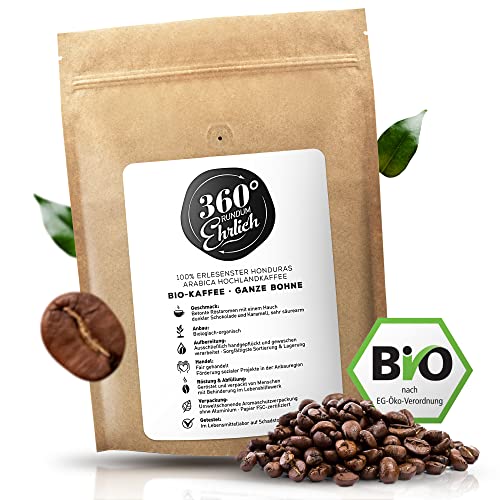
| 360 Grad Rundum Ehrlich Bio Honduras | 100% Arabica from the Honduran highlands, organic, roasted long and gently according to the supplier | approx. €35.59 | 9.3 | country of origin and organic seal are worth a good double to you and you also use pour-over or French press |
The prices reflect the position as of September 2026. The ratings come from our editorial assessment; nobody has measured them in a laboratory. The information on the Gimoka comes from its Amazon listing, and none of the columns replaces a taste comparison.
When the Intermezzo fits and when another bean does
The most important point is the method of preparation. Bean-to-cup machine, traditional machine and stovetop pot are covered by Segafredo’s texts, and if you brew on the machine during the week and with the pot at weekends, one bag will do. For pour-over, filter machine or French press we would not buy the Intermezzo. There the grounds steep for minutes in plenty of water, and in our reasoning this long contact time draws plenty of roast bitter compounds out of a dark Robusta roast. In our view the 360 Grad Bio Honduras from the table suits that better, 100 percent Arabica and roasted long and gently according to the supplier.
With the roast level it gets narrower. A dark roast at the top end of the Segafredo scale brings little acidity into the cup; if you like espresso with clear acidity, you are better off looking further. Within the brand, Espresso Casa and Classico then lead on, both medium roasted and rated 10 out of 13. With 100 percent Arabica from South America Segafredo lists, for example, the Supremo, light roasted and €22.49 a kilo in its own shop.
Without a grinder or a bean-to-cup machine, the 1 kg bag is of no use to you. Segafredo also sells the Intermezzo ready ground, 250 grams under protective atmosphere.
The quantity in your household also decides. With two double espressos a day, the kilo lasts a good five weeks. If you drink one double each on Saturdays and Sundays, the same bag is open for around eight months, and Segafredo names neither a roast date nor a period of use online as a guide to freshness. In that case we would reach for the 500 gram pack that Segafredo lists in its own shop.
That leaves the money. With the annual consumption from the cost section, you pay around €188 more per year with the Bio Honduras, and around €36 and around €2 less per year with the Gimoka Classico and the Lavazza Cremoso respectively.
Who is it suitable for?
On the product page, Segafredo gives the Intermezzo a consumption tip: in the morning or during a work break. Intermezzo means interlude in Italian.
Segafredo expressly includes people with coeliac disease. The product page lists the Intermezzo as a gluten-free product that is also suitable for them. Pure roasted coffee naturally contains no gluten, so the statement does not set the variety apart from other beans but says something about the path from the roaster into the bag.
It is the wrong bean for anyone who still drinks espresso in the evening and is sensitive to caffeine; the Robusta share counts against it. How coffee is decaffeinated and how much residual caffeine remains is explained in the decaf coffee guide. Which bean fits instead is shown by the coffee bean comparison.