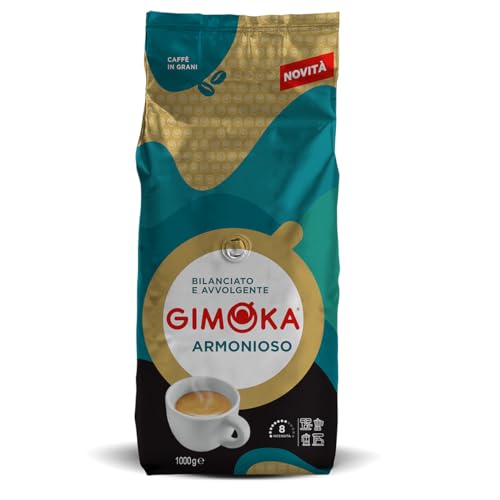
A kilo of whole beans in a bag of petrol blue and gold, with Bilanciato e avvolgente in capital letters across it: balanced and enveloping. Behind it stands the Gruppo Gimoka, by its own account the second-largest roaster in Italy by volume of coffee processed, supplying more than 50 countries. The information on this blend is not entirely free of contradictions, however.
We have not drunk it. What is written here comes from the Amazon catalogue entry for ASIN B0B394SLV6 (catalogue status 7 September 2026), from the product photo there and from the Armonioso pages on gimoka.com, which we retrieved on 25 September 2026. The pages exist only in Italian, and even the English address returns the Italian text; the translations are ours.
Which Armonioso is in this kilo bag?
The product sitemap of gimoka.com lists 164 entries. Exactly three carry the name Armonioso: 500 g whole beans from the Casa range for households, 1 kg whole beans from the Vending range for coffee machines and a 250 g ground coffee. A kilo bag for home use is missing from this list.
For the Amazon product, two Gimoka pages therefore come into question, and each fits only half. The catalogue gives the model number CTGIARMR10001T. Gimoka lists the Vending bean under the article number CTGIARM10001T, which is the same string apart from a single R, and it is the only Armonioso in a kilo. The description, on the other hand, matches the Casa page. There, as in the first Amazon bullet point, chocolate and caramel appear in a full body, which Gimoka additionally calls lasting (corpo pieno e persistente), and the Casa page describes the blend as bilanciata e avvolgente, almost word for word the print on the photo. The Vending page speaks instead of frutta secca, biscotto e caramello, that is nuts or dried fruit, biscuit and caramel.
You cannot simply buy the Vending Armonioso from Gimoka anyway. The category page shows it marked In Arrivo, roughly “coming soon”, and with an enquiry button (Richiedi Info) instead of a shopping basket.
That the bag comes from Gimoka is backed by the catalogue, where Gruppo Gimoka S.p.A. is entered as the manufacturer. Whether it contains the Vending or the Casa recipe, or whether the two are the same blend anyway, no source documents. The catalogue has listed the item since 21 March 2024, and on the photo there is a red label at the top right with the word Novità.
According to Gimoka, all production sites are in Italy, the plant is in Andalo Valtellino, and everything from green coffee buying through roasting and grinding to packaging is said to run in-house. An Amazon bullet point adds that the group has been producing coffee since the 1980s.
Is the Armonioso light or medium roasted?
Light. That is how Gimoka describes it on all three Armonioso pages; the Italian term is tostatura chiara. The contradiction lies solely in the Amazon listing: its title names a medium roast, and the first bullet point of the same listing a fine blend with a light roast.
We go with the roaster. It is the source with the most weight, and it writes the same thing in three places: for the household bean, for the one for machines and for the ground coffee. On the Casa page the light roast is meant to bring out the fine notes of the blend.
The word light is not standardised, however. Gimoka publishes no measured value for roast colour, on the Agtron scale for example. Our reading: light here is a comparison within the espresso range of an Italian roaster, not the roast that a Scandinavian filter roaster would call light.
For the grinder, the roast level is still the most useful piece of information on the bag. A more briefly roasted bean is denser and harder, more chlorogenic acids survive the roast, and fewer roast bitter compounds form. On the same grind setting it tends to come out coarser and gives up its soluble compounds more slowly than a dark one. If you switch from a dark bean to the Armonioso, it is therefore better to start one step finer.
Intensity 8 on a scale up to 13
Gimoka writes every bean in the format x/13; in the Amazon listing the denominator is missing and it says only intensity: 8. At Gimoka the Armonioso is listed at 8/13, as a Casa bean and as a Vending bean alike.
How the scale is distributed across the range is shown by the other blends. Among the whole beans for households it runs from the Vellutato 100 per cent Arabica at 6, via the Espresso at 9 and the Gran Bar at 12, to the Gusto Ricco at 13, the highest value. In the Vending range there are the Intenso at 9, the Cremoso at 8 and two further blends at 7. The Armonioso is therefore in the middle of the field, five steps below the house’s highest rating.
The scale is also shown on the bag. At the bottom, to the right of the espresso cup, the 8 sits in an arc of dots. As far as can be counted on the 500-pixel-wide catalogue photo, eight of them are light and five dark.
Across brand boundaries the number is no use. Lavazza rates the Espresso Italiano Cremoso at 8 of 10 on its own product page. Each roaster decides for itself what goes into its intensity and how it is weighted; there is no standard for it. Two eights on two scales therefore cannot be set against each other, and even a conversion into per cent (around 62 against 80) would be false precision.
Half Arabica, half Robusta
The blend ratio appears in exactly one place, in the fourth bullet point of the Amazon listing: 50% Arabica and 50% Robusta. The Gimoka pages are briefer on this point. The ingredient list of the Vending bean consists of one line: Caffè tostato in grani, roasted coffee beans.
What half Robusta means can be said in general terms, because it depends on the plant and not on the roaster. Coffea canephora, to give the botanical name, contains less sugar and considerably less fat than Arabica, but more chlorogenic acids. In the cup this leads to more bitterness and less fruity acidity. In espresso, Robusta contributes to a denser and longer-lasting crema, in our view one of the reasons why Italian espresso blends often contain it.
With the Armonioso, two pieces of information therefore pull in opposite directions: the light roast points to more acidity, the high Robusta share to less. How that balances out in the cup we can only read from Gimoka’s description: balanced, with a full body.
If you want to manage without Robusta at Gimoka, you end up with the Vellutato. Among Gimoka’s whole beans for home use it is the only blend that carries 100 per cent Arabica in its name, and it comes in a 500 g bag.
Moka pot, portafilter, bean-to-cup machine: what Gimoka names and what it does not
For the Vending bean, which as a kilo comes closest to the Amazon product, no preparation method is listed; it is intended for coffee machines. On the Casa page, by contrast, it says the bean is intended for grinding and for the caffettiera moka o macchina espresso da casa, that is the moka pot and the home espresso machine; the same two preparation methods appear for the 250 g ground coffee.
In the moka pot the water works at low pressure (how to set water quantity and heat is explained in the moka pot guide), so the grind is coarser than for espresso and finer than for filter. You fill the funnel loosely and level it off; it is not tamped, otherwise the water struggles to get through the grounds.
On a portafilter machine the same applies as above under roast level; after that you correct according to the extraction time, for which the guide to grind size gives 25 to 30 seconds as the target range. If the shot runs through clearly faster, the grind is too coarse; if it only drips, it is too fine.
Our assessment for the bean-to-cup machine: nothing speaks against whole beans of a light roast there. After changing blend, judge the result only after two or three cups, because the grinder still holds grounds from the old setting.
What a kilo costs and how long it stays fresh
The Amazon catalogue gave €15.31 for the Armonioso on 7 September 2026, three cents below our price box. Of the 23 coffee beans in our comparison, only three have a lower price per kilo.
Let us calculate with 14 grams for a double espresso, which is our assumption; if you dose differently, recalculate quantity and water in the brew calculator. A double then costs a good 21 cents, and the kilo lasts for 71 shots. With two doubles a day, a good 10.2 kilograms go through the grinder per year, which comes to just under €157 per year. With the Gimoka Classico the same consumption costs a good €17 less per year, with the Lavazza Espresso Italiano Cremoso just under €17 more per year.
How long the kilo lasts decides freshness more than the bag itself. With two doubles a day the kilo is used up after a good five weeks, with one double after about ten. According to the catalogue, the bag is filled in a protective atmosphere to preserve the aroma of the beans. That means inert gas: when packing, the oxygen is displaced, usually by nitrogen, and the roast oils age more slowly. This protection ends with the first opening.
From then on it helps that these are whole beans. They have a fraction of the surface area of ground coffee and oxidise correspondingly more slowly. Decant the supply into an airtight, light-proof container, store it dry and at room temperature, and put into the machine’s bean hopper only as much as you will use in a few days. The role of oxygen, light and moisture in roasted coffee is explained in detail in the guide to coffee beans.
The dimensions in the catalogue, 38.1 by 29.0 by 76.2 centimetres, fit no kilo bag. The photo shows a slim, upright bag, so the figures probably describe an outer carton or were entered wrongly. The weight field, on the other hand, is right: 2.2 pounds, converted 1.0 kilograms.
What Gimoka leaves open about the Armonioso
We looked for this information in the Amazon catalogue and on the three Armonioso pages of gimoka.com and found it in none of them:
- the countries of origin of the green coffee
- the roasting location for this blend; Andalo Valtellino is the company’s plant, but it is not assigned to any product anywhere
- roast date, best-before date and a time limit for the opened bag
- a storage recommendation
- a grind size or dosing recommendation
- information on bean-to-cup machine, filter or French press
- statements on crema, acidity and bitterness
- caffeine content and nutritional values
- certifications such as organic, Fairtrade or Rainforest Alliance
- material, valve and resealability of the kilo bag; about the company, Gimoka writes that it develops exclusively recyclable packaging or packaging that is compostable and acts as an oxygen barrier
- a plausible pack dimension
Which bean instead of the Armonioso?
| Blend | Roast and origin | Price per kg | Our rating | Choose this if |
|---|---|---|---|---|
| Gimoka Armonioso (this one) | Light roast according to Gimoka, 50% Arabica and 50% Robusta according to the Amazon catalogue, roasted in Italy, growing countries not stated | approx. €15.34 | 8.1 | you use a moka pot or espresso machine and want to set the grinder according to a roast statement |
| Gimoka Classico | Roast level not stated, Arabica and Robusta without a ratio, intensity 10 according to the Amazon catalogue | approx. €13.63 | 8.5 | the lowest price per kilo in our comparison matters more to you than a roast statement |
| Lavazza Espresso Italiano Cremoso | Medium roast according to Lavazza, Arabica and Robusta from South America and South-East Asia, 8 of 10 on Lavazza’s scale | approx. €16.99 | 8.9 | you want to know at least the growing regions and are willing to pay a little more for it |
| 360 Grad Rundum Ehrlich Bio Honduras | 100% Arabica from the Honduran highlands, organic according to the supplier (DE-ÖKO-005), long, gentle roast | approx. €35.59 | 9.3 | growing country and organic proof are worth more than double the price per kilo to you |
The prices per kilo are guide values from our price boxes and move constantly in the shops. The rating is our editorial assessment from the published information; the table does not replace a taste comparison. You will find further blends with price per kilo and roast information in the coffee beans comparison.
When the Armonioso suits and when another bean does
Your pace decides most clearly. If you drink fewer than one double espresso a day, the kilo stays open for more than ten weeks according to the calculation above. In that case we would reach for the 500 g Armonioso from Gimoka’s Casa range, if you can get it, or divide the kilo bag into two tins straight after opening.
And on taste: if you are looking for a dark, strongly bitter espresso roast, you get something different here according to the roaster, namely a light roast that Gimoka calls balanced (bilanciata). The Vending page does call the coffee rich and enveloping (ricco e avvolgente), but attributes this to the light roast.
In our assessment, the Armonioso is wrong for two groups. One wants pure Arabica, because half of the beans in the bag are Robusta. The other buys coffee only if the growing country or a certification is on the pack; for them, in the table above, the Bio Honduras is the bean for which both are stated, for €20.25 more per kilo.