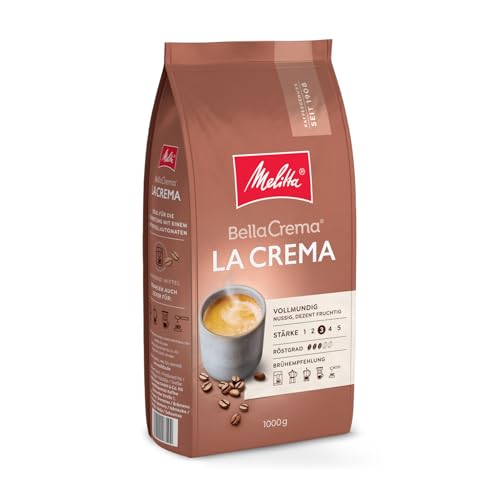
Melitta lists the BellaCrema La Crema at strength 3 of 5. The product photo of the bag shows flavour words, two scales and a row of brewing symbols, the product page a short list of technical data, and in two places the Amazon.de catalogue contradicts what Melitta itself writes: on the packaging and on the brewing methods. We did not have a pack to hand and have not drunk this coffee. What is written here comes from the manufacturer’s page, the Amazon.de catalogue and the product photo.
What the product page, the bag and the catalogue say
The legal product name is roasted coffee in whole beans, Melitta lists the coffee category as whole bean, and the weight as 1000 grams. In the Amazon.de catalogue the kilo costs approx. €15.89 (as of 7 September 2026).
Under machine use there is a single word: bean-to-cup machine. In the same technical data the blend is recommended for milk-based specialities and caffè crema. As flavour notes Melitta lists full-bodied, nutty, fruity, and in the description area of the same page the sentences follow: Full-bodied. Balanced. Great crema. We pass this on as the manufacturer’s advertising copy. In the Amazon.de catalogue Melitta describes the same bean in other words, as a soft aroma with subtle nutty notes and a slight fruitiness. On the bag itself, according to the product photo, it says FULL-BODIED and below it NUTTY, SUBTLY FRUITY.
Four numbers are available for identification: EAN 4002720008102, in the Melitta shop the article number 6771962_DE, and in the Amazon.de catalogue model 185077 and part number 81-810. The product page dates the brand’s tradition to 1908, the year in which Melitta Bentz invented the coffee filter.
Strength 3 of 5 is a Melitta scale
You come across the three in four places. In the technical data as Strength: 3. In the description area as STRENGTH 3/5. In the Amazon.de catalogue it is part of the product name itself, Melitta BellaCrema La Crema, Coffee Beans, Strength 3/5, 1KG. And on the bag, according to the product photo, the sequence 1 2 3 4 5 is printed, with the three highlighted.
Directly beneath it, a second row runs across the bag with the heading Roast level: five bean symbols, of which three are filled in. In the technical data of the product page there is only the strength.
A roast level in words appears only in the Amazon.de catalogue. There Melitta speaks of a medium roast level and of the beans being gently roasted. The manufacturer outlines the range as a whole as running from mild and harmonious to strong and intense, and only the blend overview shows which blend sits where.
There, Crema Dolce and Speciale are at 2, Bio, Decaf, La Crema and the Selection of the Year 2026 at 3, the Intenso at 4 and the Espresso alone at 5 (state of the Melitta overview: September 2026). The manufacturer gives a 1 to no BellaCrema blend. No standardised measuring method stands behind the scale, and a 3 from Melitta cannot be compared with a 3 on another roaster’s bag. Even within the range the number is not stated uniformly everywhere: for the Speciale, the technical data and the overview say 2, whereas the description area of its own product page says STRENGTH 3/5.
What can be measured, by contrast, is the roast level, via the colour of the ground coffee. How strongly the coffee arrives in the cup is not decided by that alone either: dose, grind size and brew time draw more or less out of the same bean.
Bean-to-cup machine, portafilter, French press: here the sources diverge
Melitta’s technical data know exactly one machine, the bean-to-cup machine. The same manufacturer’s Amazon bullet point lists five routes: the bean-to-cup machine and, ground, pour-over filtering, portafilter, moka pot and French press. On the bag, according to the product photo, under the heading Brewing recommendation there is a row of five symbols, so as many as the bullet point lists methods. That Melitta can also write several machines into the technical data is shown by the Selection of the Year 2026 from the same range: there, French press, bean-to-cup machine and pour-over filter are listed under machine use.
The difference is not a matter of form. A bean-to-cup machine grinds itself and doses the set quantity into the brew group. A portafilter demands a much finer and precisely set grind size, and even small deviations change the flow time. How to feel your way towards it is explained in the guide Coffee grind size. So the La Crema is not forbidden in a portafilter: in Melitta’s technical data it is not listed, but it is explicitly named in the Amazon bullet point.
Then there is the drink recommendation. Caffè crema is the long pull: considerably more water runs through the coffee grounds than with espresso, and over a longer time. The usual rule of thumb of extraction is that acids dissolve early and bitter compounds later, so a long pull brings proportionally more bitter compounds into the cup. Roast bitters arise during roasting, and a very dark roast brings more of them than a medium one. We infer from this that a medium roast is the obvious choice for long pulls, and this matches Melitta’s statements on this blend: medium roast level according to the Amazon bullet point, three of five beans on the bag, recommendation caffè crema.
Is a kilo enough, and what does a cup cost?
A kilo yields, on paper, 125 to 166 large cups, so a cup costs roughly 10 to 13 cents. The basis is Melitta’s recommendation of 6 to 8 grams of ground coffee per large cup. It appears in the FAQ for Melitta’s Molino coffee grinder and applies generally.
The calculation behind it: 1000 grams divided by 8 grams gives 125 cups, divided by 6 grams 166. The gram figure comes from Melitta, the division from us.
Your bean-to-cup machine, however, does not follow a grinder FAQ. What it grinds per pull depends on the ground coffee quantity control or the aroma setting and on the chosen drink, and each machine sets that a little differently. You can work out your own consumption with the brew calculator, and how to readjust the machine is covered in the guide Setting up a bean-to-cup machine. If your machine uses 10 grams per pull, 100 cups remain from the kilo, and a cup costs just under 16 cents.
In the same FAQ Melitta writes that roasted coffee is a delicate natural product that can quickly lose its aroma if stored wrongly. No use-by period for the opened bag is given there. For a single-person household, a kilo is a quantity that sits open for a long time.
Storage: the guidelines from the Melitta FAQ
Melitta’s storage tips come from the same Molino FAQ as the dosing recommendation and comprise four points: the opened pack should not be stored together with other strongly smelling foods. The coffee should be protected from sunlight, heat and moisture, because these factors too can affect the aroma negatively. The storage place should be cool, dry and free of odours. And the beans should not be decanted but kept in the original packaging.
A storage jar on the worktop therefore does not match Melitta’s recommendation, however tidy it looks.
And the bean hopper of the bean-to-cup machine? It is built for dosing and sits in the housing of the machine, often under a transparent lid, so exactly where heat and, depending on the location, sun can reach. We would fill in only as much as will go through in a few days and leave the rest in the bag.
What Melitta leaves open for this blend
The product details say nothing about the bean blend, neither an Arabica-Robusta ratio nor an ingredients list. Growing country, growing region and altitude are missing as well, along with nutritional values and caffeine content. A water temperature, a recommended grind size and a blend-specific dose are nowhere recorded for the La Crema, nor is anything on the packaging material, on resealing or on recycling. Melitta does not quantify bean sorting, broken-bean share or oil sheen either.
What else is worth considering?
Four blends from our catalogue between which a buyer of this bean may hesitate. The first row is the one reviewed.
| Blend | Roast and origin | Price per kg | Our score | Take this if |
|---|---|---|---|---|
| Melitta BellaCrema La Crema (this one) | Strength 3 of 5, roasting country Germany according to the Amazon bullet point, growing country open | approx. €15.89 | 8.6 | you mainly make caffè crema in a bean-to-cup machine |
| Melitta BellaCrema Espresso | Strength 5 of 5, notes of dark chocolate according to Melitta | approx. €17.99 | 8.8 | you make short espresso or want strength 5 in a large milk drink |
| Melitta BellaCrema Speciale | Strength 2 in the technical data and the range overview, 3 of 5 in the description text; according to Melitta for milk and plant-based alternatives | approx. €16.99 | 8.5 | you make almost only milk drinks, also with plant-based milk alternatives |
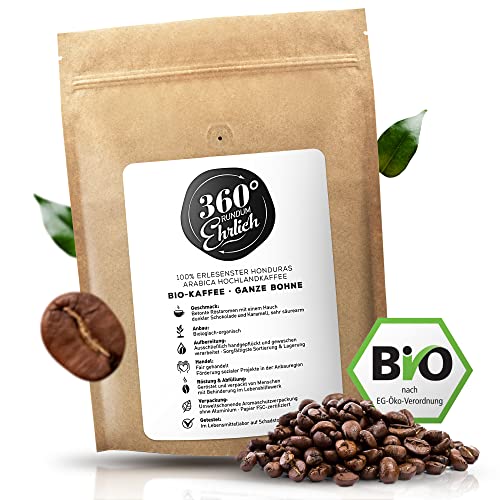
| 360° Rundum Ehrlich Bio Honduras | Single origin from Honduras, organic according to the supplier, roasting location named | approx. €35.59 | 9.3 | you need origin and organic claim in black and white and accept the kilo price |
The prices are the reference values from our price boxes and move daily in the shops. The score in the fourth column is our editorial assessment from the data available to us, not a measurement result and not a tasting verdict.
When this bean suits and when another does
Start with what ends up in the cup. If you make your coffee as short espresso, the same manufacturer lists the BellaCrema Espresso at strength 5 of 5, and at approx. €17.99 per kilo it costs €2.10 more.
With milk drinks the blends are closer together than the strength numbers suggest. All three BellaCrema beans in the table above are listed by Melitta under milk-based specialities. They part ways only at the second drink: for the La Crema caffè crema is listed alongside, for the Espresso it is espresso, and for the BellaCrema Speciale it stays at the one entry. For cappuccino and latte, the drink recommendation therefore does not separate the three.
Second, the quantity. At two large cups a day the kilo is gone, by the calculation above, in two to just under three months; at one cup the open bag sits in the cupboard for a good four to just under five and a half months. For the longer span we would take the kilo only if you can also keep to the storage guidelines from the Melitta FAQ.
Third, the machine. Without a bean-to-cup machine you need a grinder of your own, because the bag contains whole beans. That applies to the portafilter just as to pour-over filter, moka pot and French press, and for the portafilter the grinder needs fine adjustment steps.
And fourth, the point at which we would argue against this product. If you are interested in where your coffee grew, you are in the wrong place here. What roast level and origin mean for the cup is explained in the guide Coffee beans basics, and an overview of all blends is given by our coffee beans comparison. Among the eight blends in the BellaCrema overview, only the Selection of the Year 2026 has a country of origin field in the technical data, also at strength 3: there Ethiopia and Nicaragua are listed, and in the description text of the same page 100 % Arabica from Ethiopia. The 360° Rundum Ehrlich Bio Honduras states growing country, organic claim and roasting location and, at approx. €35.59 per kilo, costs more than double.
Who the La Crema is not for
For anyone who is looking for a lower level in the range. The Crema Dolce is at strength 2, Melitta describes it as harmonious with fine sweetness and recommends it for caffè crema alone.
For anyone who needs a certification. Melitta does not list organic, Fairtrade or Rainforest Alliance for this blend. Melitta lists the BellaCrema Bio on its product page with an organic label and also at strength 3, but it comes in 750 grams instead of a kilo and, according to Melitta, is recommended only for caffè crema.
And for anyone who wants advertising claims backed up. On the product page Melitta calls the blend the favourite of all passionate coffee drinkers, and in the Amazon.de catalogue advertises that the roasting time, set individually for every roast, produces over 800 aromas. Neither can be checked against a pack. In the same Amazon listing, incidentally, a kilo of roasted coffee falls under the binding Household goods.