J. Hornig started in 1912 as a small grocery shop in Graz, and since 2022 the company has been based in a new building for production and storage in Kalsdorf near Graz. Caffè Crema Bio is a blend of Arabica and Robusta, listed on Amazon as a kilo of whole beans, for approx. €30.99 on Amazon.de (as of September 2026). Only three of the 23 beans in our catalogue have a higher reference price. For that price you get two labels on the pack and a roast that Hornig advertises as a long-time roast.
What is in the pack
One bag, one kilo, whole beans. The Amazon catalogue lists the offer as a single pack of 1.0 kg with dimensions of approx. 21.0 x 13.0 x 10.0 cm, and the manufacturer’s product page gives only whole bean as the form. Without a grinder or a bean-to-cup machine with a built-in grinder, you cannot do anything with this pack.
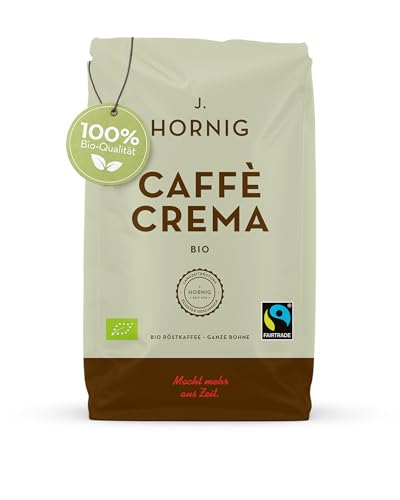
According to Hornig, the beans come from Asia, South America and Central America. Arabica and Robusta are mentioned in the Amazon title and in the catalogue texts that appear there as manufacturer text. On the product photo of the kilo pack, the EU organic logo and the Fairtrade label are visible at the front, with the print “Bio Röstkaffee, ganze Bohne” (organic roast coffee, whole bean) between them. In the middle is a round seal showing the long-time roast and the founding year 1912. The Amazon product image also shows a tag at the top left reading “100% Bio-Qualität” (100% organic quality).
Crema in the name, espresso in the profile
The pack says Caffè Crema, and on the product page Hornig describes the contents as a “kräftige Espresso-Mischung mit schokoladigen Geschmacksnoten” (strong espresso blend with chocolatey flavour notes). Both fit together, because Caffè Crema is a drink: a shot with espresso pressure, but with more water and a longer extraction time, as bean-to-cup machines serve it as a large cup. The bean for it is usually the same kind of blend that ends up in an espresso machine. Accordingly, Hornig names three preparations, bean-to-cup machine, espresso machine and moka pot, and calls the bean made for preparation as espresso.
The profile on the manufacturer’s page is short: strong aroma, strong taste, and a stable crema as a feature.
The manufacturer’s text in the Amazon catalogue is more detailed. Only there do you find the strength 4 out of 5 and the medium-dark roast level, as drinks a long Caffè Crema, cappuccino and Schümli (the Swiss name for café crema), and the Bialetti as a pot. The flavour description there is split by preparation. As a base Hornig gives cocoa, dark chocolate and malt, with a deep body and spicy notes. In an espresso machine, peanut and muscovado sugar would be added; in a bean-to-cup machine and a moka pot, cashew comes through more. We have not drunk the bean; these are the roaster’s statements. The split is nonetheless technically plausible: espresso machine, bean-to-cup machine and pot work with different contact times and different grind fineness, the pot also with much less pressure, and so they extract different portions from the same ground coffee.
In detail: long-time roast, Robusta and acidity
“Wir rösten unsere Bohnen im Langzeitröstverfahren” (we roast our beans using the long-time roasting process), writes Hornig, which makes the coffee particularly low in acid. In the Amazon title this has been shortened to a low-acid coffee.
Chemically, this comes down to chlorogenic acids. They make up a large part of the acids in green coffee and break down during roasting, the further the longer and hotter the bean stays in the heat. A long roast at moderate temperature breaks down a lot of them before the surface of the bean burns. The medium-dark roast level fits this, because with every step darker less acid remains and more roast bitters are formed.
Figures on the roast appear at Hornig only on a general knowledge page about drum and shell roasting: around 200 °C, about 12 to 20 minutes. There Hornig explicitly relates the drum to the speciality coffees of the house. These values therefore cannot be transferred to Caffè Crema Bio.
With Robusta it is about the crema. Robusta beans contain less oil than Arabica, roughly 10 against 15 per cent, and oil makes foam collapse. A blend with a Robusta share therefore holds its crema longer than pure Arabica. On its own page Hornig promises a stable crema, and in the Amazon text a dense crema in an espresso machine and bean-to-cup machine.
For milk drinks, the roast level matters more. Milk dampens acidity and bitterness, so a light roast quickly gets lost in a cappuccino, whereas a medium-dark one with Robusta holds its own.
Organic, Fairtrade and what is on the pack
In the profile on the product page, certification reads: Bio, Fairtrade. The product text says that only beans from organic cultivation, traded under Fairtrade rules, go into the pack, and on the overview page for organic coffees Hornig writes that their beans come 100 per cent from organic farming.
On Fairtrade the company is no newcomer. By its own account, J. Hornig was the first Austrian coffee company to work with TransFair, and around 30 years ago the first Fairtrade-certified Hornig coffee reached Austrian supermarkets. Fairtrade Österreich (Fairtrade Austria) was founded in 1993. The label stands for a minimum price that producer organisations receive for their green coffee, and a premium on top, the use of which they vote on themselves.
In the EU, organic is a protected term, and anyone who uses it is subject to a control procedure. The EU organic logo goes with the code number of the control body on the pack; in Austria it begins with AT-BIO, in Germany with DE-ÖKO. On the product photo available to us, this number cannot be read. If the label matters to you, look for it on the bag itself after unpacking.
Neither label says anything about taste. They regulate how the coffee is grown and how it is paid for.
Organic version or Classico?
Visibly, the organic label is what distinguishes them. Caffè Crema Classico (article number 1737) is also a blend of Arabica and Robusta at Hornig, from South America, Central America and Asia, but carries no organic claim. Regularly, the two kilo packs in the Hornig shop are only €1 apart, and for the 500 gram bag there is regularly no difference at all (as of 24 September 2026). The surcharge for organic is therefore small at the manufacturer itself.
Caffè Crema Intenso (article number 2075) regularly costs exactly as much as the Classico, is described in its profile as finely spicy in aroma and strong in taste, and likewise has no organic claim. Anyone who orders directly from Hornig and was going to choose one of the crema varieties anyway gets the two labels almost without a surcharge. Caffè Crema Bio only becomes expensive in comparison with crema beans from other roasters.
What the kilo price means per cup can be estimated. We calculate with 10 grams of beans for a cup of Caffè Crema from a bean-to-cup machine; that is our assumption. A kilo therefore gives 100 cups, and at the Amazon reference price each of them costs around 31 cents. With Dallmayr Crema d’Oro from our catalogue it would be 16 cents, with Mount Hagen Espresso Bio 23 cents.
How much ground coffee your cup really needs is worked out by the brew calculator. With a different dose, all the figures in this section shift in the same proportion.
Grinder, grind size and storage
For grind size, a fixed routine helps. In a bean-to-cup machine, after changing beans you start at a medium setting and adjust in small steps, over two or three brews each, until the cup is neither watery nor bitter. How grind size, quantity and temperature are connected is explained in the guide bean-to-cup machine settings.
Darker roasted beans dissolve more easily than light ones. If you grind them in an espresso machine as fine as a light espresso roast, you get a shot that runs too long and turns bitter. Start one step coarser and only go finer if the shot runs through too fast. For the pot, the procedure is set out step by step in the moka pot guide.
On storage, the product page has exactly one sentence: “trocken & vor Wärme geschützt lagern” (store dry and protected from heat). What we add is our recommendation and not the manufacturer’s: press the bag shut firmly after every use, or transfer the beans to a tightly closing tin and keep it dark. We would avoid the fridge and freezer, because cold beans draw condensation when you take them out.
What the manufacturer does not state
On 24 September 2026 we found the following points neither on jhornig.com nor in the Amazon catalogue. The first weighs most heavily for us:
- the blend ratio of Arabica and Robusta; how much Robusta is in the pack changes crema, caffeine and bitterness, and it would be the one figure with which this bean could be cleanly weighed against the Classico or a pure Arabica
- growing countries, cooperatives or farms
- the statement Arabica and Robusta on the Hornig product page for this variety (for the Classico it is there, for the organic version only in the Amazon text)
- an explanation of what the strength scale measures
- the roasting location for this variety; only the company seat in Kalsdorf near Graz is documented
- roasting time and roasting temperature for this variety
- the caffeine content
- roast date and best-before date
- aroma valve and resealability of the bag
- grind size and dosage
- the code number of the organic control body and a Fairtrade ID
- the year of market launch
- a data sheet with ingredient or nutritional information
This bean or one of the other three?
| Variety | Roast and origin | Price per kg | Our rating | Choose this if |
|---|---|---|---|---|
| J. Hornig Caffè Crema Bio (this one) | Long-time roast, medium-dark, Arabica and Robusta from Asia, South and Central America | approx. €30.99 | 8.4 | you want organic and Fairtrade and your bean-to-cup machine mainly makes milk drinks |
| 360° Rundum Ehrlich Bio Honduras | long, gentle drum roast, low in acid, 100% Arabica from the highlands of Honduras | approx. €35.59 | 9.3 | you drink it black and want to see an origin from a single country |
| Mount Hagen Espresso Bio | dark espresso roast, 100% Arabica from Papua New Guinea, Peru and Ethiopia | approx. €23.01 | 8.6 | organic and Fairtrade matter to you and you want to see named growing countries |
| Dallmayr Crema d’Oro | according to the manufacturer gently roasted for a long time at low temperature, Arabica and Canephora, intensity 6 out of 10 | approx. €15.99 | 8.6 | you drink a lot of crema from a bean-to-cup machine and can do without labels |
Robusta is in only two of the four beans, in this one and in the Dallmayr, which lists it under its botanical name Canephora. The table does not answer which bean you will like: the ratings are our editorial assessment from manufacturer statements, catalogue data and price, and the prices are reference values from September 2026.
When this bean fits and when another does
Caffè Crema Bio is made for machines that work with pressure. The three preparations that Hornig names all belong to that, and a medium-dark blend with Robusta suits each of them.
The strongest case for it is when your bean-to-cup machine makes cappuccino or milk coffee in the morning. For exactly this use, our coffee beans comparison includes, for example, Dallmayr Crema d’Oro as well, also with a Robusta share. It carries no organic label, and at two cups a day it saves you €109.50 a year by the calculation above. If the labels do not matter to you, we would recommend the Dallmayr to a household that drinks a lot of milk coffee.
If you drink black coffee and want to know where it comes from, Mount Hagen Espresso Bio names Papua New Guinea, Peru and Ethiopia, also carries organic and Fairtrade, and costs you €58.25 a year less at two cups a day. It is, however, pure Arabica, and the crema that the Robusta provides here lasts less long with it, in our assessment. 360° Rundum Ehrlich Bio Honduras goes back to a single growing country and costs €4.60 more per kilo.
If acidic roasts do not agree with you, the low-acid profile is a real reason for this bean. According to the manufacturer, the Dallmayr aims in the same direction, with a long roast at low temperature.
The wrong choice is Caffè Crema Bio for anyone who works with a pour-over or a French press. Both are missing from the preparations that Hornig lists, and our assessment agrees: without pressure there is no crema, which is what the Robusta share is there for, and what is left is probably a dark filter coffee with little acidity and clear roast notes. If you are looking for light, fruity roasts for the filter, the finder gets you to a suitable bean faster.