Mount Hagen explicitly advertises the kilo pack of this espresso in its product text to its espresso machine fans. The product page names Hamburg as the place of manufacture. The brand belongs to Wertform GmbH, which is also based in Hamburg, and by its own account has counted itself among Germany’s organic pioneers since 1986.
Papua New Guinea, Peru, Ethiopia: where the beans come from
The product page names three cooperatives: HOAC in Papua New Guinea, Atahualpa in Peru and Sidama in Ethiopia. How much each country contributes to the blend is not stated, so do not assume equal thirds. Sidama is also the name of a coffee region in the south of Ethiopia.
Mount Hagen speaks of highland Arabicas, grown in small coffee gardens under shade trees, picked by hand and sorted. The beans then dry in the sun for 5 to 10 days until they have a residual moisture of approx. 12 percent. The figure has a solid reason: damper green coffee can go mouldy in storage and on the ship, drier coffee weighs less, and green coffee is paid for by weight. How altitude and processing affect the cup is explained, based on studies, in the guide Coffee origin and flavour.
Papua New Guinea is also in the brand name. Mount Hagen is a mountain and the area where the company’s first coffee farm lay. According to the company history, it began in 1990 with half a container of coffee from biodynamic cultivation from a plantation near the mountain.
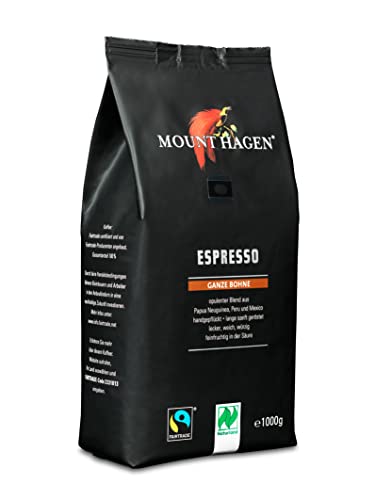
The two pack photos disagree on one point. On the pack image on this page, which comes from the Amazon catalogue, Mexico is printed as the third country. The photo in the manufacturer’s shop shows Ethiopia in the same place, and that is also what the origin information on the product page says. We cannot say which print the bag that Amazon is currently shipping carries. If the origin matters to you, go by what is printed on the front of your bag after unpacking.
Dark roasted, but for how long?
The product page says about the roast: darker, 15 to 16 minutes at approx. 200 °C in drum roasters. The FAQ on the same website, by contrast, says of all Mount Hagen coffees that they are roasted for between 11 and 14 minutes. Both cannot be true for this espresso at the same time. The product page is the more specific source, and we go by it.
That is a long time. Industrial hot-air roasters finish a batch in a few minutes, and even in a drum a quarter of an hour is on the long side. With time and heat, more chlorogenic acid is broken down, and at the same time more bitter compounds and roast aromas are formed. Dark beans also become more porous and release their soluble substances to the water faster. In an espresso machine they are therefore usually ground a little coarser than light roasts, so that the cup does not tip into bitterness.
Mount Hagen shows the profile as a graphic with seven bean symbols: strength 5 of 7, acidity 4 of 7. The roaster lists chocolatey and delicately fruity as flavours there.
Highland Arabica tends to bring a lot of acidity, and a long, dark roast takes some of it out again. That is one way to read the acidity level in the profile. In our assessment, the strength level has little to do with caffeine content: the Barista Espresso from the same brand contains Robusta, a species with clearly more caffeine than Arabica, and is nevertheless also at strength 5 in the profile.
Which seals does the bean carry, and who checks them?
Three, according to the product page. It states literally “Naturland, 100% kontrollierter Bio-Anbau, 100% Fairtrade” (Naturland, 100% controlled organic cultivation, 100% Fairtrade), and the seal graphic on the page shows the Fairtrade and Naturland logos as well as the EU organic logo. On the pack image from the Amazon catalogue, the Fairtrade and Naturland marks can be seen on the front.
If you follow up on the organic control, you come across two different codes. Under the EU organic logo, the graphic shows DE-ÖKO-039 with the addition “Nicht-EU-Landwirtschaft” (non-EU agriculture), while the legal notice of the same website gives DE-ÖKO-005 as the control body. In Germany, each of these codes belongs to exactly one approved control body that inspects the business, and the website does not explain the coexistence anywhere. What counts is what is printed on the pack: wherever the EU organic logo appears, the code number of the control body must appear as well under the EU organic regulation (which applies across the EU).
Naturland is a farming association with its own guidelines that go beyond the EU organic regulation. Mount Hagen calls them considerably stricter than the EU organic seal and says the same about Demeter, which is the seal on other espressos of the brand. Fairtrade, by contrast, starts with trade, with minimum prices and premiums for the producers. Fairtrade coffee is not automatically organic, which is why some packs carry both marks. For a single-ingredient product, 100 % Fairtrade means: all the coffee in the bag.
Espresso machine, bean-to-cup machine, moka pot
The product page lists three preparations, plus four drinks: straight, cappuccino, latte macchiato and flat white.
For the espresso machine, the roaster has published starting values on its espresso overview page that apply to its espressos in general: 7 g finely ground coffee, 30 ml water, 25 seconds brew time. That corresponds roughly to the classic Italian single portion. Anyone pulling double shots on an espresso machine today usually calculates in grams rather than millilitres, and our brew calculator also sets espresso at 18 g of grounds to around 36 g of drink. From the roaster’s starting values you then mainly take the time.
As water temperature, Mount Hagen gives 92 to 96 °C in its FAQ, for coffee in general. With a dark roast we would start at the lower end, for the same reason as with the coarser grind.
On a bean-to-cup machine you set grind size and quantity on the machine. We would start with a medium setting and go finer in small steps until the shot no longer runs watery. Never change grind size and quantity at the same time, and expect that on many machines a new grind setting only shows after a few shots, because grounds from the old setting are still in the grinder.
Amazon catalogue or Mount Hagen shop
On Amazon the pack is called Mount Hagen Espresso Ganze Bohne Bio FT Naturland 1kg, and the bullet points consist of three keywords: Bio Fairtrade Naturland, Röstkaffee, Espresso. The earlier version of this article relied on the catalogue and therefore wrote that there was no information on Arabica share, roast strength or growing countries. That applied only to the catalogue text on Amazon; on the manufacturer’s site all three are stated.
The catalogue lists Wertform GmbH as manufacturer and 516 as model number. In the shop the kilo runs under article number 10934, and the structured product data of the shop page contains the GTIN 4000799109348. With this number you can search other retailers for the same pack.
In the Amazon catalogue the kilo stood at €23.49 on 7 September 2026, 48 cents above our reference price. The manufacturer’s shop charged the same amount on 14 September, including 7 % VAT and plus shipping. The shop also offers a saver pack with six one-kilo bags, which per kilo is cheaper than the single bag there.
Three other organic beans from our catalogue
| Variety | Roast and origin | Price per kg | Our rating | Choose this if |
|---|---|---|---|---|
| Mount Hagen Espresso Bio (this one) | Dark espresso roast, 100 % Arabica from Papua New Guinea, Peru and Ethiopia | approx. €23.01 | 8.6 | alongside organic and Fairtrade you also care about a farming association such as Naturland |
| 360° Rundum Ehrlich Bio Honduras | Long roast designed for low acidity, 100 % Arabica from the highlands of Honduras | approx. €35.59 | 9.3 | an origin from a single country is worth the premium to you |
| Lavazza Tierra for Planet | Intensity 6 of 10, 100 % organic Arabica from Africa and Central and South America (page of the kilo pack: Africa and South America), pale roast according to Lavazza, light roast according to the Amazon catalogue | approx. €23.49 | 8.4 | you want a bean without a dark roast and have a grinder that can be adjusted finely |
| J. Hornig Caffè Crema Bio | Arabica and Robusta from South and Central America and Asia, medium-dark, strength 4 of 5 | approx. €30.99 | 8.4 | you want organic and Fairtrade with Robusta in the blend |
The table does not tell you which of the four beans you will like. Roast, origin and seal details come from the manufacturers or from the Amazon catalogue. The rating is our editorial assessment based on these details and the price, and the prices are the reference values of our price boxes, not all recorded on the same day. The strength ratings cannot be compared with one another either: Mount Hagen rates on seven levels, Lavazza on ten, J. Hornig on five. The other beans are in the coffee beans comparison.
Which bean suits your preparation?
If you pull espresso on an espresso machine or in a moka pot and drink it straight or with a little milk, Mount Hagen is the closest fit. The roaster presents it as a dark espresso roast, and both devices are explicitly in its list of preparations.
It looks different if your bean-to-cup machine mainly makes cappuccino and latte macchiato in the morning. Then we would spend almost 8 euros more per kilo on J. Hornig Caffè Crema Bio. It blends Arabica with Robusta, and Robusta brings more bitter compounds and more crema, so the coffee holds its own against a lot of milk better than pure Arabica.
Lavazza Tierra for Planet is also meant for espresso; the Amazon title adds ideal for espresso machines. The title gives the roast as light, Lavazza itself as pale, and Lavazza describes the taste as mild and fruity. The price per kilo is practically the same.
Filter coffee is missing from Mount Hagen’s list of preparations, and for Lavazza and J. Hornig it is likewise not in the Amazon catalogue. If you work mainly with a pour-over or French press, you end up in this round with 360° Rundum Ehrlich and pay €12.58 more per kilo than for Mount Hagen. For the Bio Honduras, the Amazon catalogue lists pour-over and French press alongside bean-to-cup machine and espresso machine.
Storage, and what the manufacturer does not state
The kilo is packed in an aluminium-free aroma-protection bag, which the Amazon catalogue lists at approx. 30.0 x 16.0 x 8.0 cm. For storage, the product page recommends the Mount Hagen coffee tin, and goes on literally: “luftdicht, trocken und kühl. Aber bitte nicht in den Kühlschrank stellen” (airtight, dry and cool. But please do not put it in the fridge).
We found the following information neither on the manufacturer’s website (accessed 14 September 2026) nor in the Amazon catalogue (as of 7 September 2026):
- Roast date and best-before date
- how long an opened kilo bag stays fresh
- whether the bag has an aroma valve and can be resealed, and what material it is made of beyond the note that it is aluminium-free
- growing altitude in metres and coffee varieties
- whether it is washed or natural processed, since both are dried in the sun
- caffeine content and size of a roasting batch
- Fairtrade ID, Naturland certificate number and the body that checks Fairtrade
- the green coffee price paid
- a cupping or SCA score
- dosage and grind size for the bean-to-cup machine, a brewing temperature for this specific bean
- the year of market launch; the Amazon catalogue gives only a catalogue date, 15 August 2021
In our view the first point weighs heaviest. A kilo is open for weeks in many households, and because neither the product page nor Amazon gives a roast date, you do not know before buying how fresh the beans are. We could not check whether the bag itself carries one. A best-before date must appear on every pre-packed product.
Who the kilo is the right format for
With the single portion from the starting values above, a kilo gives around 143 espressos. At the reference price of our price box, one costs around 16 cents, a double with 14 g around 32 cents, and with the 18 g from the brew calculator around 41 cents. At four single espressos a day that is around 64 cents daily, and the saver pack lasts around seven months at this pace.
If you drink only one espresso a day, the same bag is open for over four months, and in our view the kilo is the wrong format for that. The shop also sells the espresso as a 250-gram bag of whole beans for €7.69, which works out at €30.76 per kilo and thus €7.27 per kilo more than the kilo bag in the same shop. In return, the small pack is used up after a good five weeks at one espresso a day.
Without a grinder at home, the kilo pack is ruled out entirely.