Lavazza sells the Tierra for Planet as organic roasted coffee made from 100 per cent Arabica, whole beans in a kilo bag, light roasted and rated 6 out of 10 for intensity on its own scale. Our reference value is approx. €23.49 per kilo on Amazon.de (as of September 2026). The Amazon catalogue showed this amount on 7 September. The Lavazza shop showed it too on 24 September, there with a note that the product is currently unavailable.
Among the Italian roasters’ varieties in the coffee bean comparison, this is the highest kilo price. Caffè Mauro, Pellini, Segafredo, Lavazza’s own Cremoso and both Gimoka varieties are below it.
What is printed on the bag
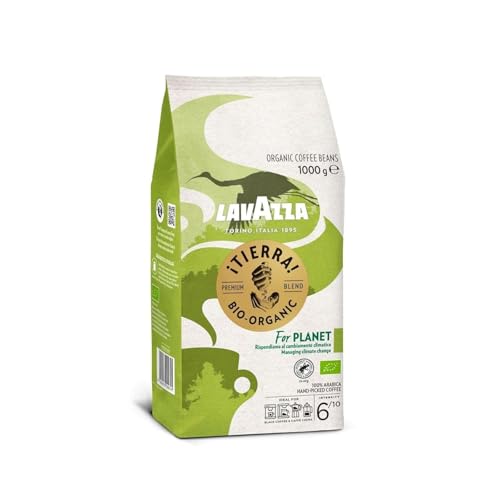
The product photo for our catalogue entry shows a white and green stand-up pouch, not a tin. At the top right it says “Organic coffee beans” and “1000 g”, and below the Lavazza lettering “Torino Italia 1895”. The year is that of the company’s founding: in 1895 Luigi Lavazza opened his first shop in the Via San Tommaso in Turin. In the middle sits the round Tierra emblem with “Premium Blend” and “Bio-Organic”, below it “For Planet” and the bilingual addition “Rispondiamo al cambiamento climatico, Managing climate change”. Besides the green EU organic logo, a second round seal is visible, too small on the 500 pixel wide image to identify with certainty. At the bottom right it says “100% Arabica, hand-picked coffee” and the intensity 6/10.
In the Lavazza shop, the kilo pack now has a new name: ¡Tierra! For Coffee Projects beans. The page title and address still read Tierra for Planet, and the 500 gram bag continues unchanged as ¡Tierra! for Planet beans.
Amazon lists the kilo pack under model number 3238, with item dimensions of roughly 25 by 15 by 10 centimetres (converted) and a weight of 1.0 kilogram. The manufacturer given there is Luigi Lavazza Deutschland GmbH, and on Lavazza’s product page the food business operator is Luigi Lavazza S.p.A. at Via Bologna 32 in Turin.
Light roast, intensity 6, aroma according to Lavazza
Both Lavazza pages for the beans, kilo and half kilo, give the roast as “Hell” (light). The Amazon catalogue text speaks of a light roast that gives the coffee a delicate aroma and a golden colour. The golden colour is advertising language, but on the roast level itself Amazon and Lavazza agree.
The 6 is a Lavazza number. It sorts the brand’s own range and cannot be set against another roaster’s strength scale, even if that one also shows a number up to 5 or up to 10. Within the brand it works as a guide: the Espresso Italiano Cremoso stands at 8.
On taste we have only manufacturer text. Lavazza sums the profile up as “Mild und fruchtig” (mild and fruity), and under aromatic notes it says “Blumig, Fruchtig” (floral, fruity). On the page for the 500 gram bag the description is more detailed: notes of tropical fruit and blossom, a delicate, fruity blend with a long-lasting taste.
Africa, South America, and depending on the page also Central America
Lavazza answers where the green coffee comes from in two ways on different pages. The page for the half kilo and the overview page of the Tierra collection name Africa, Central and South America, and the Amazon catalogue names Africa, Central and South America. The page for the kilo pack, that is, exactly the bag at issue here, names only Africa and South America, like the page for the ground coffee.
Our guide Coffee origin and flavour treats the common rule that East Africa tends to bring fruit and South America tends to bring nut and chocolate as a rough trader’s tendency, nothing more. In a master’s thesis with 20 Arabica samples, African samples were described with floral, fruity and spicy notes, some of them rather earthy. The floral, fruity description would fit an African share. That is no more than a conjecture, especially as “Africa” covers Ethiopia just as much as Uganda.
The Arabica is hand-picked, write the Amazon catalogue and the page for the 500 gram bag, while the collection page says hand-selected. Hand harvesting happens in two ways. With selective picking, only ripe cherries come off the bush, often in several passes. With strip picking, also by hand, the whole branch load lands in the basket at once, ripe and unripe mixed.
In detail: what a light roast demands in espresso
A light-roasted bean spent less time, or less heat, in the drum than a dark one. Its cell structure is less broken open, it is denser, and soluble substances pass into the water more slowly. In a pour-over filter, contact time compensates for this to a large extent, because the water stands on the grounds for minutes. An espresso runs through in roughly 25 to 30 seconds.
If the water runs through the puck too fast, the cup can turn out sour and thin. The first lever is the grind size: finer, until the flow time is right again. Our guide does not document an order in which acids dissolve before sweetness and bitter compounds; according to Batali et al. (2020), water temperature showed no effect at the same extraction level anyway. How you tell a sour cup from a bitter one is explained in Coffee tastes bitter or sour, and adjusting at the grinder in Coffee grind size.
On crema, Lavazza says nothing for this variety. Crema consists of carbon dioxide trapped in the bean during roasting and of dissolved substances that stabilise the foam. From everything known about the two species, Robusta supplies more of both. If you are coming from blends like the Cremoso, expect a thinner layer from pure Arabica that collapses faster. How dense it stands also depends on the age of the roast, because the gas escapes gradually after roasting.
The same species logic applies to caffeine. Arabica contains about half as much as Robusta, so at the same dose you get less caffeine from the Tierra than from a blend with a Robusta share.
Organic, Rainforest Alliance and the foundation projects
The product page gives “Bio-Röstkaffee, ganze Bohnen” (organic roasted coffee, whole beans) as the description. The overview page of the Tierra collection explains that the organic certification guarantees that the production methods prescribed by European standards are observed at harvest.
The product page assigns no Rainforest Alliance certificate to the Tierra for Planet, although the same collection page describes which sustainable farming requirements farms with this certificate must meet.
The obvious explanation for the new name is a documented share. On the collection page, under ¡Tierra! For Coffee Projects, it says that 10 per cent of the coffee comes from projects in which the Lavazza Foundation works to spread good farming practices.
The Tierra blend itself has existed since 2004. On the company history page, Lavazza calls it the heart of its commitment to sustainability and writes that through the Tierra project it has gradually improved the living conditions of over 3,000 farmers in eight countries.
A kilo or 500 grams, and how long does it last?
In price the difference is small, in consumption it is not. On 24 September the 500 gram bag cost €11.99 in the Lavazza shop, which converts to €23.98 per kilo and thus 49 cents more per kilo than the large pack. Neither size was available there that day. If you drink less than one double espresso a day, then in our view you should take the small bag, provided you can get it.
The calculation behind it: at 18 grams for a double, our assumption for the portafilter, the kilo lasts around 55 days, and at two doubles a day just under a month. In its storage guide, Lavazza advises using coffee within 2 to 6 months after roasting, and this window counts from the roaster, not from your order. You do not know at purchase how long a bag has already sat in the warehouse, which is why it is worth checking the roast and best-before date, which Lavazza expressly recommends.
For storage itself, the same guide says to keep whole beans and ground coffee alike in an opaque, airtight container, ideally vacuum-sealed and protected from light, heat and moisture. As material Lavazza recommends glass or ceramic rather than reactive materials, and as an equivalent alternative to the container the guide names the vacuum-sealed original packaging, in each case at room temperature in a dry place.
Lavazza advises against the fridge because water molecules from the air condense in the tin there. The guide considers vacuum-sealed ground coffee fresh in the pantry for at most five to six months. Grind only shortly before brewing, and use already ground coffee within a month.
A kilo bag is opened again and again over weeks. We would decant a week’s supply into a small, airtight tin and leave the rest in the bag, rolled up tightly or closed with a clip. Into the bean hopper of a bean-to-cup machine we would put only what runs through in a few days, unless the machine manufacturer expressly states the hopper is airtight.
What Lavazza does not state
We looked for these points on the Lavazza pages on 24 September 2026 and in the Amazon catalogue (as of 7 September) and did not find them:
- Growing countries, altitude, varieties and processing, and thus also which eight countries the Tierra project means and whether the green coffee in this bag comes from them
- the blend ratio of the origin regions
- whether hand-picked means selective picking or strip picking
- roasting time, roasting temperature and the place of roasting
- the control body number of the organic certification and which further seals apply to exactly this variety
- caffeine content and an acidity figure as a number
- a shelf life counted from roasting and whether a roast date is printed
- material, aroma valve, resealability and recyclability of the bag
- dose, grind size, brewing temperature and brewing time
- nutritional values and allergens
- since when the “for Planet” variety has existed (only the Tierra blend from 2004 is documented) and whether anything about the composition has changed with the new name
The missing dosing and grind recommendation weighs heaviest for us. With a light roast in particular, a starting value would save a lot of trial and error.
Three other beans that come into question
| Variety | Roast and origin | Price per kg | Our rating | Choose this if |
|---|---|---|---|---|
| Lavazza Tierra for Planet (this one) | Light, 100% Arabica from Africa and South America, according to the 500 g page also Central America, organic | approx. €23.49 | 8.4 | you want a light espresso with an organic claim and can adjust finely at the grinder |
| Lavazza Espresso Italiano Cremoso | Medium, Arabica and Robusta from South America and South-East Asia | approx. €16.99 | 8.9 | you want classic Italian espresso or make many milk drinks and can do without organic |
| Mount Hagen Espresso Bio | Dark espresso roast, 100% Arabica from three countries, organic, Naturland and Fairtrade | approx. €23.01 | 8.6 | you want organic with named countries of origin and Fairtrade and prefer a dark roast |
| 360° Rundum Ehrlich Bio Honduras | Long drum roast, 100% Arabica from the Honduran highlands above 1,300 m | approx. €35.59 | 9.3 | you are willing to pay around €12 more per kilo for a single, named origin |
Roast and origin appear in the table as the roasters state them. Between the Tierra and the Mount Hagen there are 48 cents per kilo. The ratings summarise our editorial assessment from manufacturer and catalogue data; none of the coffees was brewed or tasted by us.
Who is it for? When the Tierra suits your machine
Lavazza itself names espresso and moka pot as the preparation, and the page for the half kilo adds “Für Espressomaschinen” (for espresso machines). Bean-to-cup machines and portafilter machines come from the Amazon catalogue text; filter coffee and French press Lavazza lists only for the ground coffee.
In our assessment you have the most room to manoeuvre in a portafilter machine with a grinder that can be adjusted in small steps. There both levers from the section on the light roast apply.
In favour of the moka pot is that Lavazza names it expressly. There steam pushes the hot water through the grounds at much lower pressure than in a portafilter machine, and the adjusting screw is almost only the grind size.
With a bean-to-cup machine we would hesitate if the brewing temperature cannot be set in steps and the grinder adjusts only coarsely.
From two milk drinks a day we would reach for the Cremoso. That is our assessment; no source says which flavour profile holds up better in milk, and the origin guide does not name one either. The Cremoso is a blend with Robusta, intensity 8 on the Lavazza scale. At two shots of 18 grams a day it also costs you around €7 a month less. If you want to stay with the Tierra line, the Tierra for Cuba from the questions below is the alternative at the same kilo price.
Which bean suits your machine is sorted by the coffee finder according to your answers.