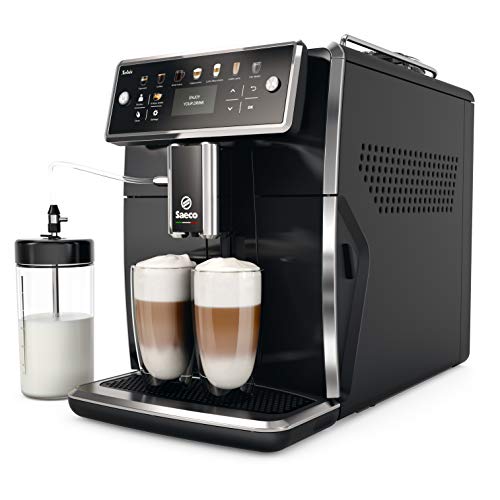
The Saeco Xelsis SM7580/00 is a bean-to-cup machine with a separate milk container, which Philips launched in 2017. In our price box it stands at approx. €439.95 on Amazon.de. Piano black is the name Philips gives the colour; according to the data sheet, the housing is made of ABS, a plastic.
We have not handled the machine. What follows comes from the German instruction manual, which also covers the SM7581, SM7583 and SM7480, from the Philips data sheet, from the product data behind the Philips product page, from a general Saeco safety booklet and from the Amazon catalogue. An earlier version of this page contained several errors, which we correct here in one place. There is no rotary dial on the control panel; the only rotary knob on the machine adjusts the grind size. The bean hopper holds 450 g, not 250 g. Instead of a jug, the Xelsis has a milk container with a tube to the internal cappuccinatore. It is not Saeco’s design flagship: the SM7680, a Xelsis with a touchscreen, came out in the same year, and today Philips lists, among others, the Xelsis Deluxe and the Xelsis Suprema. And for 9 bar extraction pressure, for care costs of €20 to €30 a year and for the claim that the piano black finish shows fingerprints and dust more clearly, we found no source.
A 2017 model with newer Xelsis models beside it
Philips entered 1 September 2017 in its catalogue as the sales start. According to the EU declaration of conformity from Philips Consumer Lifestyle B.V. in Drachten in the Netherlands, the device has carried the CE mark since July 2017. The data sheet gives Italy as the country of origin. According to the manufacturer, the Xelsis won the iF Design Award in 2018.
In its product data, Philips calls the machine “the most advanced Saeco espresso machine ever”. The same sentence appears for the SM7680, which Philips entered in its catalogue ten days later with a touchscreen and a piano black front. Today Philips lists, among others, the Xelsis Deluxe (SM8780, SM8785) and the Xelsis Suprema (SM8885, SM8889). The SM8780 is also piano black, but has a 5-inch TFT colour display with touchscreen.
In the consumer catalogue of Philips Germany, the SM7580/00 is still listed as an active product, and as deleted in the catalogue of the Philips shop. So you can get it new through retailers. In our bean-to-cup machine comparison it has a rating of 8.5.
Housing, containers and control panel
According to the manual, the Xelsis measures 283 x 393 x 489 mm, in the order width, height, depth, and the data sheet confirms the values. For weight, the manual gives a range of 10.8 to 12.2 kg, which applies to all four models described there. The power cable is 1200 mm long.
In the product photo, the milk container stands to the left of the housing, and a tube connects it to the spout. As long as it is connected, you therefore need space for it beside the machine.
The water tank holds 1.7 litres, has LED lighting and is removed from the front. The bean hopper holds 450 g; Philips promotes it as its largest coffee bean hopper and has given it an aroma-preserving lid. For the coffee grounds container, the manufacturer contradicts itself: 15 portions according to the manual, 14 according to the data sheet. The drip tray holds 500 ml. You slide the spout to a height between 75 and 148 mm. According to the safety booklet, the machine must not be used inside a cupboard, and the manual requires a level surface, because otherwise the “drip tray full” indicator does not work normally.
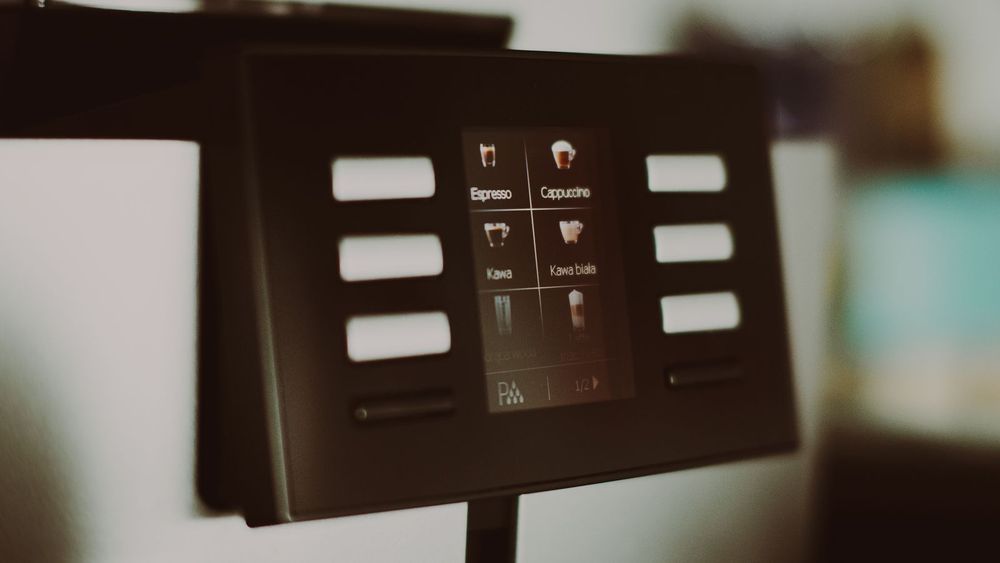
Operation is via a display with touch symbols. The data sheet gives the display type as LCD, while Amazon speaks of an LED display with direct-selection keys. Figure B in the manual shows seven symbols for one-touch drinks: Espresso, Coffee, Americano, Cappuccino, Latte Macchiato, Caffè Latte and Hot Water. Six further drinks are in a menu; Philips speaks of twelve coffee specialities. You scroll through the display with arrow keys up and down, select with OK and go one step back with Back. Starting and stopping is done with a separate key, and there are symbols for profiles, cleaning and settings.
The Xelsis stores six user profiles, each appearing in the display in its own colour. Depending on the drink, you set coffee strength (5 steps), temperature (3 steps), coffee and milk quantity and the taste, and a star marks what you have changed. If you tap Start/Stop or a drink symbol twice, the machine grinds twice in a row and prepares two cups, according to the manual for most drinks.
In detail: ceramic grinder, thermoblock and self-adjustment
According to the safety booklet, only roasted coffee beans belong in the bean hopper, so no ground coffee, no instant coffee, no green coffee and no other substances. According to Philips, the grinder underneath is 100 per cent ceramic and designed for at least 20,000 cups. For context: as a material, ceramic is harder than steel, but more brittle.
The grind size has twelve settings and is adjusted with a rotary knob in the bean hopper. The lower the setting, the stronger the coffee, says the manual. You turn the knob only while the machine is grinding, and only by one position at a time, otherwise Philips warns of damage to the grinder. According to the manual, a change takes effect only after 2 to 3 drinks. Before you touch it at all, Philips advises 100 to 150 cups on the factory setting, which corresponds to about a month of use. After every change of grind size and after a change of bean variety, the machine also runs a self-adjustment process. How to set up a bean-to-cup machine in general is described in our guide Bean-to-cup machine settings.
Hot water comes from a thermoblock made of aluminium with a stainless steel casing. A thermoblock works like an instantaneous water heater: the water flows through channels in a heated metal block and warms up on the way, instead of being kept hot as a reserve in a boiler. Because aluminium conducts heat well and has little mass, such a block heats up quickly. Philips puts it briefly: it reaches the ideal temperature “quickly”.
For many figures you would expect with a bean-to-cup machine, there is no manufacturer information for the SM7580. On the technical side, the following are missing:
- the rated power in watts and the pump pressure in bar
- the brewing temperature in degrees Celsius and the heat-up time
- the noise level in decibels (the manual merely states that it is normal for the machine to be audible)
- the type of grinder, that is, conical or flat burrs
- the factory brew volumes in millilitres and the amount of coffee in grams per brew
- the time until automatic switch-off
Some things about the materials also remain open. The data sheet does not name the material of the milk container, drip tray and control panel; ABS is given there only for the housing. Whether “piano black” denotes a lacquer layer or merely the colour shade is unclear, as is how susceptible the glossy surface is to scratches and fingerprints. And what the “(FR Version)” in the Amazon title means, plug, display language or manual, none of the documents clarifies.
Milk via tube and internal cappuccinatore
The milk container holds 600 ml. You insert a metal milk tube into it, and a flexible tube leads from there to the internal cappuccinatore, which sits behind a flap in the spout. Philips calls the technology LattePerfetto and promises “firm milk foam with a fine texture”. The data sheet also lists a milk warming function.
With LatteDuo, the Xelsis prepares one or two coffee specialities in a single run, expressly including cappuccino and latte macchiato.
After every milk drink, the machine automatically sends a burst of steam through the internal milk system; in the manual this is called Auto Steam Shoot. Of the ten warnings and cautions that the safety booklet has for this spout, two concern heat: never touch or open the flap of the internal cappuccinatore while drinks are being dispensed, because it can get very hot, and never touch the metal part of the milk tube during the cleaning programmes or immediately afterwards. After daily use, HygieSteam from the cleaning menu follows, a steam cleaning that, according to Philips, removes 99.99 per cent of milk residue; you wipe the metal milk tube on the outside with a damp cloth.
How much care does the Xelsis need?
Our assessment: more than a bean-to-cup machine with a fixed brew unit or with a tubeless milk system. Every day the drip tray and the steam cleaning are due, every week five components, every month two cleaning programmes with Philips products. On top of that comes greasing the brew group.
The brew group comes out every week. To do this, you switch the machine off at the main switch at the back, remove the coffee grounds container, open the service flap, pull out the drawer for coffee residue, press the PUSH key and pull the brew group out by the handle. It is rinsed under running tap water and then air-dried. It should not be dried with a cloth, so that no lint gets into it. The safety booklet also prohibits the dishwasher and any washing-up or cleaning agent for this part. Once a month, cleaning with Philips coffee oil remover tablets additionally runs via the cleaning menu.
The brew group is greased with Philips lubricating grease, and a tube is included. How often depends on your consumption: every 4 months with 1 to 5 drinks a day, every 2 months with 6 to 10, every month with more than 10.
On the milk system, weekly work is added to the steam cleaning. You remove the internal cappuccinatore, take it apart and rinse all parts under running water with a little washing-up liquid. The milk container is taken apart too, you push the ball inside out with the measuring spoon, and the parts may go under running water or into the dishwasher. Monthly, DEEP MILK CLEAN with the Philips milk circuit cleaner is due.
You empty the drip tray daily or as soon as the red “drip tray full” indicator shows through, and rinse it with a little washing-up liquid. You empty the coffee grounds container when the machine prompts you to, and only while the machine is switched on; once a week it is rinsed with a little washing-up liquid. Also weekly: rinse the water tank and check whether the ground coffee chute is blocked. You wipe the housing with a soft cloth dampened with water; the safety booklet rules out scouring sponges, abrasive cleaners, petrol and acetone. Philips has printed a cleaning calendar to tick off on the last page of the manual.
AquaClean, descaling and the care products
An AquaClean filter belongs in the water tank, and according to the manual only these fit. Philips calculates it like this: if you insert eight AquaClean filters one after another, you do not have to descale for 5,000 cups, which is up to 625 cups per filter. A footnote qualifies this: the actual number depends on the choice of drinks and on how often the machine rinses and cleans. The filter must come out after 3 months at the latest anyway, even if the machine does not yet indicate a change.
That gives a simple calculation. Four filters a year, one per quarter, cover 2,500 cups, which is just under 7 cups a day. If you drink less, change by the calendar; if you drink more, change by the display.
The filter requires a limescale-free machine. If it does not go in right at commissioning but only after about 25 cups, the manual requires a descaling beforehand. Before inserting it, you shake it for about 5 seconds and hold it upside down in cold water for at least 30 seconds until no more bubbles rise. What the hardness of your tap water means for coffee is explained in the guide Water hardness and coffee.
How descaling works on bean-to-cup machines in general is explained in our guide Descaling and cleaning. On the Xelsis, you fill a whole bottle of Philips descaler into the tank and add water up to CALC CLEAN. You remove the AquaClean filter beforehand, and a 1.5 litre container goes under the spout. According to the safety booklet, you must never drink what runs into it. The descaling and rinse cycle together take about 30 minutes.
The manual lists the care products with type numbers: descaling solution CA6700, AquaClean filter CA6903, grease for the brew group HD5061, coffee oil remover tablets CA6704, milk circuit cleaner CA6705 and the maintenance kit CA6707. Philips gives no prices for these in these documents, and without documented unit prices we do not calculate annual costs. Only the quantity can be counted: with one monthly cleaning each, you need tablets and milk circuit cleaner for twelve runs a year.
What else comes into question?
Three machines from our catalogue that realistically sit alongside a Xelsis when you buy:
| Model | The difference | Price | Our rating | Choose this if |
|---|---|---|---|---|
| Saeco Xelsis SM7580 (this one) | Milk via tube and internal cappuccinatore, LatteDuo for two milk drinks | approx. €439.95 | 8.5 | you often want two cappuccinos at once and accept the weekly taking apart |
| Philips LatteGo 5400 | LatteGo in 2 parts without tubes, according to the data sheet no double brew with milk | approx. €424.48 | 8.6 | you want to take as little apart as possible after a milk coffee |
| Saeco GranAroma SM6580 | Coloured TFT display, 14 drinks, 4 profiles plus guest, 300 g beans | approx. €599 | 8.5 | colour display and drink selection matter more to you than two additional profiles |
| Jura E8 | Fixed brew unit, cleaning via tablet programme | approx. €1,049 | 9.4 | you never want to remove a brew group and can spend more than double |
The prices come from our price boxes and fluctuate. The rating is our editorial assessment based on data sheets and manuals; we have not measured anything on any of the four machines, and the “The difference” column shows only the point where the decision tips, not a complete data sheet.
When the Xelsis, when another bean-to-cup machine?
The Xelsis can make two milk drinks at once, the LatteGo 5400 cannot. In return, its milk system is built from two parts without tubes according to Philips, the machine is slightly cheaper in our price box, and its milk container holds 0.26 litres according to the product page. If you mostly make just one cappuccino for yourself in the morning, the LatteGo serves you better in our assessment, because there is less to take apart on the milk system.
With the GranAroma, the milk system stays the same: LatteDuo, external container of the same size, internal cappuccinatore. It has a coloured TFT display and 14 drinks, but only four fixed profiles and a guest profile that stores nothing, and the bean hopper holds 300 g. At 26.2 cm it is around 2 cm narrower than the Xelsis according to the Philips data sheet, but clearly more expensive in our price box. For a household of five or six people who want to keep their settings, we would stay with the Xelsis. Piano black with a colour touchscreen is available from Philips, for example, in the Xelsis Deluxe SM8780; we have not researched its price.
What the roughly €609 extra for the Jura E8 spares you can be counted on the Xelsis: removing and rinsing the brew group about 52 times a year, plus greasing it 3 to 12 times depending on consumption.
Under a wall cabinet, the machine height of 393 mm counts. According to Philips, the water tank and coffee grounds container come out at the front, so you do not have to pull the machine forward for these two tasks.
Who the Xelsis is the wrong choice for
It is the wrong choice for the coffee corner in an office. According to the safety booklet, the machine is intended only for normal household use, not for staff kitchens, offices, farms or commercial environments.
It also suits a holiday flat that stays unheated in winter poorly. The machine should not be exposed to temperatures below 0 °C, because water remaining in the heating system can freeze and cause damage. If it stays unused for a long time, there should be no water in the tank.