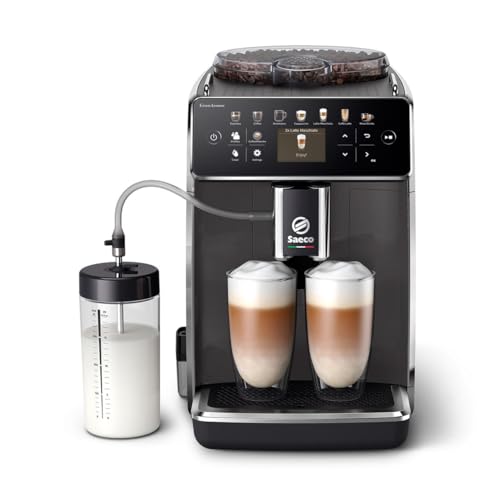
The Saeco GranAroma SM6580/10 is a bean-to-cup coffee machine with a ceramic grinder, a colour display and a milk container that stands next to the machine and is connected by a tube. Saeco calls the colour Cashmere Grey. In our price box it stands at approx. €599 on Amazon.de. The manufacturer’s recommended retail price is €849.99, and in the Philips shop it cost €799.99 when checked on 1 October 2026.
The model is not new. The EU declaration of conformity from DAP B.V. of Drachten dates the CE marking for the SM6480, SM6580, SM6582 and SM6585 to January 2021.
The rights holder in the current data sheet is Versuni Holding B.V.; the Philips brand runs there under licence from Koninklijke Philips N.V. That fits with the fact that the filter, descaler and cleaning tablets for this Saeco carry the Philips name. According to the data sheet the SM6580/10 is built in Romania, and saeco.com says Designed in Italy.
We have not handled the machine and have not drunk anything from it. The basis is the German data sheet of 18 February 2026, the shared instruction manual for the SM6585, SM6582, SM6580 and SM6480, the booklet with the important safety information, the product page at Philips and the global page saeco.com.
14 drinks, four profiles and a guest
The data sheet arrives at 14 preset drinks, although its list below has 15 entries. Twelve of them contain coffee: espresso, coffee, americano, cappuccino, latte macchiato, caffè latte, caffè crema, ristretto, espresso lungo, espresso macchiato, Italian cappuccino and café au lait. Added to those are milk foam, warm milk and hot water. According to the data sheet, two portions run at the same time.
Four user profiles store what you set. A fifth, the guest profile, lets you adjust everything but does not keep the recipe. For a family that means: four people get their cappuccino the way they saved it, while visitors start from the basic setting every time.
What can be adjusted per drink Saeco calls CoffeeEqualizer: aroma strength, coffee quantity, milk quantity, water quantity, drinking temperature and foam quantity, depending on the drink, plus the choice between one and two cups. Then there is CoffeeMaestro with three taste profiles, Delicato, Intenso and Forte. ExtraShot gives coffee and milk drinks an additional shot of ristretto, in which case only one coffee runs at a time. You get hot water through the More drinks menu and set the quantity and temperature with the arrow keys.
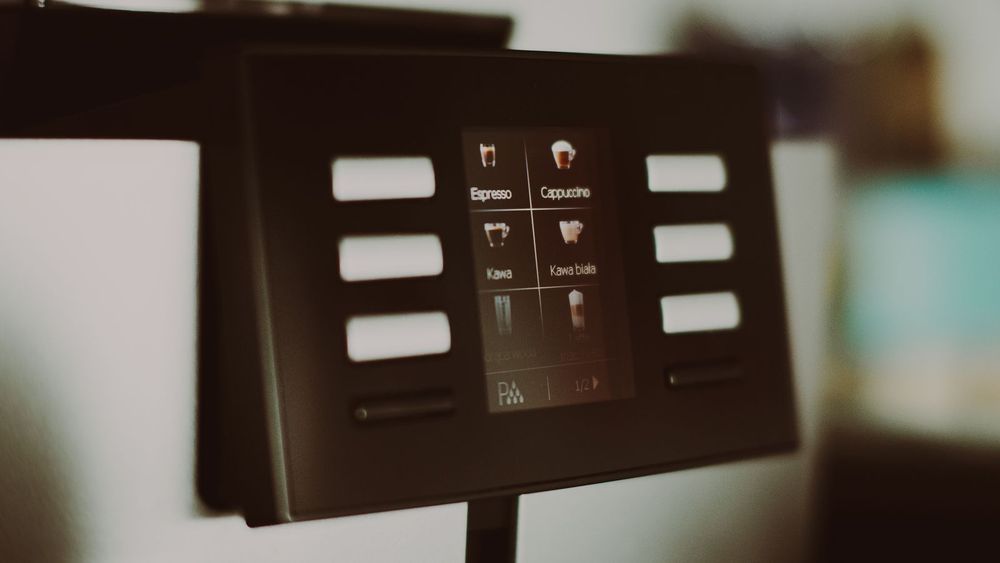
Operation is via a colour TFT display; as user interface the data sheet lists an intuitive touchscreen display. According to the manual there are two versions of the control panel which look different but whose keys and symbols work the same way. The settings menu holds display brightness in three levels, language, key tone, the front lighting (always on, only during preparation, or off) and the choice between ml and oz.
The GranAroma is connected at 1,500 W, 230 V and 50 Hz, and its energy efficiency class is B. In standby it draws 0.3 W according to the data sheet, measured to EN 50564:2011. From the factory it switches to this state after 30 minutes; in the menu you can choose 15, 30, 60 or 180 minutes.
Grinder, beans and brewing temperature
Saeco writes that the grinder is 100% ceramic and lasts at least 20,000 cups. At six cups a day that would be, by calculation, a good nine years; the calculation is ours, the number of cups is the manufacturer’s.
Twelve grind settings are available. You may only adjust while the grinder is running, and by one position at a time. The manual advises touching the factory setting only after 100 to 150 cups, which it equates to about a month of use.
The bean hopper holds up to 300 g and has an aroma-protection lid. According to the safety booklet only roasted coffee beans belong in it; ground coffee, instant coffee, raw beans or other substances can damage the machine. Caramelised or flavoured beans are ruled out by the booklet in a separate point. For a second variety, such as decaf in the evening, there is the powder chute. It takes one measuring spoon of ground coffee, and then you can neither set the strength nor prepare more than one drink. Apart from coffee powder, only the Philips coffee oil removal tablets are allowed in this compartment.
When brewing, the machine keeps the water between 90 °C and 98 °C according to the data sheet and regulates the flow rate in doing so; Saeco calls this Aroma Extract.
And the 15 bar? That is the pump pressure, so what the pump can build up at most. How much of it arrives at the coffee grounds is determined by the resistance that grind setting and amount of powder create in the brew group. Saeco gives no value for the pressure at the coffee bed in any of the documents we evaluated, so the 15 bar say nothing about extraction.
How much space does the GranAroma need?
On the worktop it takes 26.2 centimetres of width and 44.8 centimetres of depth, and it is 38.3 centimetres high. Added to that is space for the milk container, which on the product photo stands to the left of the machine, and air above, because the beans are filled from the top.
How high the lid of the bean hopper reaches when opened is not stated in any of the sources. If you want to place it under a wall cabinet, it is therefore better to measure whether the lid can be opened there, or to pull the machine forward for filling.
On weight the documents contradict each other: the data sheet gives 8.5 to 9 kg, the manual 8 to 8.5 kg. The carton measures 491 x 295 x 506.5 mm and weighs 11.3 kg. The power cable is 1,200 mm long and is plugged in at the back with a small connector, so you can detach it. As main material of the housing the data sheet lists plastic, as secondary material metal.
The water container holds 1.8 l, the coffee grounds container 12 portions. Vessels up to 147 mm fit under the spout, and it can be lowered to 87 mm. According to the safety booklet, warm, hot or mineral water does not belong in the tank, because it can damage the container and the machine.
For the location the safety booklet requires, among other things: the machine stands on a level, stable surface and stays upright, also during transport. It does not go on a hotplate and not directly next to a hot oven, a heater or a similar heat source. And during use it must not stand inside a cupboard.
In detail: milk through a tube
Bean-to-cup machines draw the milk in two ways. In one, a carafe plugs straight into the front of the machine and froths there. In the other, a tube draws the milk from a container into a frothing head, where steam and air are added. Milk residue stays behind in the channels in both designs. With the tube system, the tube and frothing head are added as parts that want cleaning regularly.
The GranAroma belongs to the second kind; Saeco calls the technology LatteDuo. The container holds 600 ml, and Saeco itself calls it external milk carafe. According to the manual you put the metal milk tube into the container and connect the flexible tube to the internal Cappuccinatore, which sits behind a flap in the machine. This connection has to be in place before every milk drink.
Directly after every drink with milk the HygieSteam Shot runs: the adjustable spout automatically releases some steam and so cleans the internal Cappuccinatore. Saeco advertises that HygieSteam removes 99.9% of microorganisms, and a footnote gives 99.9999% for parts of the milk carafe from laboratory tests.
The steam has a downside, which the safety booklet points out several times. You do not open or touch the flap of the internal Cappuccinatore during dispensing, because it can get very hot. The metal part of the milk tube you put into the HygieSteam container before every cleaning programme for the Cappuccinatore, and you do not touch it during it or directly afterwards.
What is left in the container after the coffee you keep in the fridge according to the manual, but without the milk lines; those you rinse beforehand.
What else is worth considering?
| Model | The difference | Price | Our rating | Take this one if |
|---|---|---|---|---|
| Saeco GranAroma SM6580 (this one) | Milk via tube from a 600 ml container, 4 profiles plus guest | approx. €599 | 8.5 | there are several of you and everyone wants their drink saved |
| Philips LatteGo 5500 | LatteGo according to Philips made of 2 parts without tubes | approx. €515 | 8.7 | you drink milk every day and want to take as little as possible apart on the milk system |
| DeLonghi Dinamica Plus 370.70 | Pot function with 250, 500 or 750 ml in one run | approx. €599 | 8.6 | a whole pot for visitors should run through more often at the weekend |
| Jura E8 | Brew unit stays fixed in the machine, cleaned by tablet programme | approx. €1,049 | 9.4 | you never want to remove, rinse and grease a brew group |
The prices are the guide values from our price boxes, not daily prices. The rating is our editorial assessment from data sheets and manuals; no measured values are in any cell. You can find all machines in the category in the bean-to-cup machine comparison.
When the GranAroma, when another machine?
Start with the milk. If someone at your place drinks cappuccino every day, the GranAroma comes with a fixed care rhythm for the milk system (the plan is below). According to Philips, the LatteGo 5500 has no automatic milk cleaning; you clean its milk part by hand or in the dishwasher. In our price box it costs about €84 less. We would prefer the GranAroma to it only if you need more than two saved profiles: the LatteGo 5500 has two plus guest, the GranAroma four plus guest.
Then the number of people. The SM6580 has no more than four saved profiles; whoever needs more will find the answer in the questions below. It is only partly made for visitors: two portions at once is the maximum. The Dinamica Plus 370.70 costs the same in our price box and fills up to 750 ml in one run.
Household size counts too, in both directions. According to the safety booklet the water in the tank should be used up within 1 to 2 days. If you live alone and drink two cups a day, in our assessment it is better to fill only part of the tank. At the other end is the coffee grounds container with its 12 portions: with five people at two cups each it is full after a good day.
Hard water is planned for from the factory. Water hardness has five levels, the preset is level 4 for hard water, and a test strip is included. How to find out the value for your home is explained in the guide Water hardness and coffee.
And finally the brew group. Whoever never wants to hold it in their hands ends up with the Jura E8, whose brew unit stays in the machine. For that you pay €450 more according to our price box, and in our assessment that is only worth it if precisely this handling bothers you.
Cleaning plan according to the manual
Daily you empty the drip tray as soon as its red indicator is visible through the tray, start the HygieSteam programme in the cleaning menu and wipe the outside of the metal milk line with a damp cloth.
Once a week the brew group comes out: open the service flap, press the PUSH button, pull on the handle. It is rinsed under running tap water and air-dries; you are not supposed to dry it with a cloth, so that no fluff gets in. The safety booklet also states: the brew group does not belong in the dishwasher, and washing-up liquid or cleaning agents are taboo, because they can lead to faults in the brew group and affect the taste of the coffee negatively.
In the same week you take out the internal Cappuccinatore, take it apart and rinse all parts with a little washing-up liquid under running water; according to the safety booklet it must not go in the dishwasher. You take the milk container apart as well, push the ball inside out with the pin on the milk tube, and clean the parts under running water or in the dishwasher. Added to this are the HygieSteam container (empty it, clean it under water or in the dishwasher, air-dry it), the powder chute, which you check for blockage with the plug pulled and the brew group removed and, if necessary, clear with a spoon handle, the water container, and the front, which gets a non-abrasive cloth. You empty the coffee grounds container when the machine asks for it, clean it weekly and take it out only with the machine switched on. It may go in the dishwasher, its front excepted.
Once a month the brew group cleaning runs with a Philips tablet against coffee oil, and also Deep Milk Clean with the milk circuit cleaner. The solution that comes out in the process you must on no account drink. Every two months you grease the brew group with the Philips lubricating grease, on the piston, shaft and the rails on both sides.
Descaling happens when the machine asks for it. According to the manual the process takes about 30 minutes, one descaling cycle and one rinse cycle. You pour the whole bottle of Philips descaler up to the CALC CLEAN mark into the tank and place a container of 1.5 l underneath. An inserted AquaClean filter comes out beforehand; afterwards you clean the tank thoroughly and put it back. More on descalers and cleaning tablets is in the guide Descaling and cleaning.
Consumables, spare parts and open points
The manual lists the maintenance products with type numbers: descaler CA6700, AquaClean filter CA6903, grease for the brew group HD5061, coffee oil removal tablets CA6704, milk circuit cleaner CA6705 and the maintenance kit CA6707. As a water filter only the Philips AquaClean fits according to the manual, and its compatibility list includes the GranAroma series.
In the carton, according to the manual, are the milk container, the milk tube, a tube of lubricating grease, an AquaClean filter, a measuring spoon and the test strip for water hardness. For the first greasing of the brew group after two months you therefore do not have to buy anything extra.
An AquaClean filter is exhausted after 95 litres and is replaced after three months at the latest. By calculation, 95 litres in three months is enough for a good litre a day; whoever sends more water through the machine changes it sooner. At least four filters a year are needed in any case. Saeco promises up to 5,000 cups without descaling, based on eight filter changes. A new filter is activated in the cleaning menu, which takes about 5 minutes.
Spare parts you find through an online list when you enter the model number. It is on the inside of the service flap. The parts are obtained through retailers, authorised customer centres or philips.com.
Some things we did not find in any manufacturer source: the heat-up time in seconds, the noise level in decibels (the manual only states that audible noises during operation are normal), the type of heater, the number of temperature and aroma strength levels, the volume of the drip tray, euro amounts for the annual running costs, how long spare parts remain available, the date of market launch in Germany, and who carried out the laboratory tests behind the 99.9999% footnote for HygieSteam. Beyond the housing, the documents also name no materials for the brew group, tank or milk container.
Children and the office kitchen
Under 8 years of age, according to the safety booklet, children should not operate the machine and should not get at it or at accessories and cable. From 8 years they may use it under supervision or after instruction, but clean it only under supervision.
The GranAroma is the wrong choice for any office or staff kitchen. The safety booklet defines it only for normal household use and explicitly excludes staff kitchens, offices, agricultural businesses and other commercial environments.