According to the manufacturer search, Rommelsbacher in Dinkelsbühl currently lists the electric coffee grinders EKM 100, EKM 200, EKM 400, EKM 500 and EKM 600. The EKM 400 is the one with 35 grind settings and a removable holder that positions a portafilter directly under the grounds outlet. It grinds with stainless steel conical burrs. According to the manual, it is intended for grinding whole coffee and espresso beans, and the grind chart runs from pump-pressure espresso machines to the French press.
In our overview of electric coffee grinders, it appears at approx. €87.99 on Amazon.de according to our price box. In the Amazon catalogue, which we exported on 7 September 2026, it was €92.38. Rommelsbacher itself charged €129.99 in its own shop on 25 September 2026.
Design: bean hopper on top, control panel in the middle
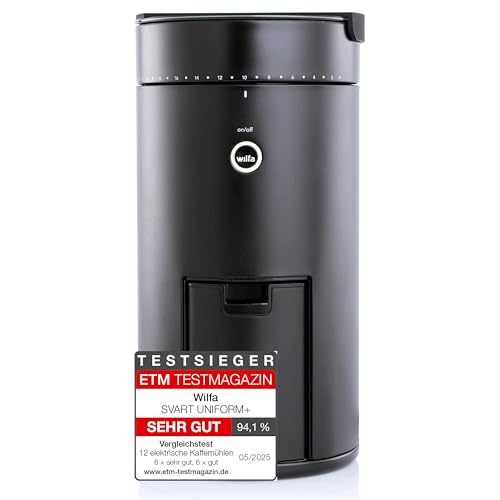
The product photo shows an upright grinder. At the top sits the transparent bean hopper, below it a black housing. The display and three buttons sit on a black panel, under which a stainless steel plate with the lettering is located, and at the very bottom front is the equally transparent ground coffee container. Rommelsbacher names stainless steel and plastic as housing materials. The manufacturer gives the dimensions as 12.2 × 19.0 × 31.0 cm (width, depth, height) and the weight as 1.90 kg. The Amazon catalogue lists the same values converted, 31.0 × 19.0 × 12.2 cm and 1.90 kg.
According to the manual, the bean hopper holds at most 220 g and the ground coffee container at most 130 g, both depending on the beans and, for ground coffee, also on the grind size. You should fill it to no more than 1 cm below the rim. When fitting the hopper, you line up the lock symbol on the base unit with the arrow marking on the hopper and turn it clockwise until the arrow points to the desired grind size. A closing mechanism holds back the beans when you remove the hopper. If it is not seated correctly, the grinder does not start at all; the manual calls this the safety system. The lid of the ground coffee container has a silicone seal, and the container itself stands in a round recess under the outlet.
It is operated with three sensor buttons, which Rommelsbacher calls Touch Control: ON/START/STOP, minus and plus. The grinder confirms switching on with a beep. The LED display shows the number of portions and the portion size. The grind size, on the other hand, you read off the housing, from a small arrow on the bean hopper and a printed scale below it, and you adjust it by turning the hopper to the right or left.
Five rubber feet carry the appliance. You wind the power cable up on the underside and route it through a recess at the edge of the housing; according to the product page, it is not detachable. The motor draws 200 W. Because turning the hopper can move the grinder, the manual advises holding it with your free hand if necessary.
According to the manual, the box contains the grinder, bean and ground coffee containers with their lids, the portafilter holder and the grinding plunger, which is already inserted in the base unit. The cleaning brush and measuring spoon are stored in the lid of the bean hopper.
In detail: 35 settings, and how many of them are meant for espresso
In a conical burr grinder, a cone-shaped grinding element turns inside a ring with cutting edges. The narrower the gap between the two, the finer the grounds. The burr set is stainless steel and has electronic overload protection against foreign objects, and Rommelsbacher divides the adjustment range into 35 settings, from 1 for very fine to 35 for very coarse grounds. One part of the burr set, called the grinding plunger in the manual, can be pulled off upwards.
More informative than the number 35 is the recommendation chart in the manual. Settings 1 to 5 are called extra fine there and are intended for automatic pump-pressure espresso machines. From 6 to 12, the grounds count as fine, suitable for boiler espresso machines, moka pots and Moka jugs, with Bialetti given as an example by Rommelsbacher. Medium is 13 to 22 for filter coffee, coarse is 23 to 35 for the French press.
For a portafilter machine with a pump, that leaves five clicks. With espresso, the flow time reacts sensitively to particle size, and if the right setting for a bean lies between two clicks, you are left with dose and tamping as adjustment levers. Double-wall baskets, often called crema baskets (pressurised baskets), build up part of the resistance themselves and are more forgiving of a grind that is slightly too coarse. With such a basket, five clicks are quite enough in our assessment.
Two rules apply to adjusting. When the bean hopper is filled, you turn it only while the burrs are running. With a full hopper, beans lie between cone and ring, and anyone who tightens the setting while stationary can jam them there. In addition, after every change you first have to grind a small amount of beans before the result of the new setting becomes visible. How to work your way towards a new bean setting by setting is described in our guide Adjusting your grind size.
How much ground coffee does the EKM 400 grind per portion?
Rommelsbacher gives no gram figure per portion anywhere. The grinder grinds portions whose size you adjust relatively, and according to the manual, the amount dispensed depends on bean type, roast and grind size. It can therefore also deviate from the preset portion sizes.
There are two operating modes. In coffee mode, marked on the display with a coffee bean, you choose 1 to 12 portions; the quantity is tuned to medium grind sizes and intended for filter coffee machines and French press pots. In espresso mode, with the portafilter symbol, it is 1 to 2 portions, tuned to fine grind sizes. You switch modes by going past the end of a range with plus or minus, and two beeps confirm the change.
The digit before the point is the number of portions, the digit after it the portion size. The standard is 5, so four portions is 4.5. With a short tap, you go down to 4.0 or up to 4.9, while a long touch jumps to the next standard portion. In coffee mode, portions 10, 11 and 12 are fixed. The grinder remembers the last setting used and stops by itself after the selected amount.
When setting up, we would weigh one portion on the kitchen scale and repeat that after every change of bean or grind setting, because both shift the quantity. How much water then belongs with your grounds is calculated by the Brew calculator.
For large quantities, a time limit comes into play. The grinder is designed for a maximum of 3 minutes of continuous operation, after which it must cool down for at least 10 minutes, otherwise the motor can be damaged, according to the manual.
Portafilter holder and anti-static
For the portafilter, you pull out the ground coffee container and slide the holder into the guide rail on the grounds outlet channel until it clicks into place. The opening points forwards, and the portafilter must sit exactly under the outlet so that it catches all the grounds. According to the manual, the holder is designed for portafilters with a diameter of approx. 60 mm. You grind 1 to 2 portions directly into the portafilter, exactly the range of the espresso mode.
Portafilters are usually described by the diameter of the brew group as 51, 54 or 58 mm. Whether Rommelsbacher means one of these standards or an outer dimension is not clear from the documents. We would measure our own portafilter at the rim and, if in doubt, ask customer service before buying.
Against grounds that cling to the walls, the EKM 400 has an anti-static function. According to the manual, an ion generator ionises the air in the grounds outlet channel, which significantly reduces the static charge, so that no grounds stick to the container, outlet channel or measuring spoon. The product page words it more strongly: there, the function neutralises the charge “completely”. We stick to the more cautious wording from the manual. In addition, a separate seal sits between the outlet channel and the ground coffee container so that no grounds are lost during grinding.
The EKM 400 or one of the other three?
| Model | The difference | Price | Our rating | Choose this one if |
|---|---|---|---|---|
| Rommelsbacher EKM 400 (this one) | Stainless steel conical burrs, 35 settings, holder for portafilters of approx. 60 mm Ø | approx. €87.99 | 8.0 | you want to grind espresso and filter coffee with one grinder and your portafilter fits the holder |
| Rommelsbacher EKM 200 | Steel disc grinder, 110 W, no portafilter holder | approx. €54.99 | 7.8 | you only make filter coffee or French press |
| De’Longhi Dedica KG 520.M | 18 settings, 350 g bean hopper, cup selection 1 to 14 | approx. €131.89 | 8.2 | you want to keep more beans in stock and 18 settings are enough for you |
| Eureka Mignon Specialita | 55 mm flat burrs of hardened steel, stepless adjustment | approx. €431.90 | 9.4 | you pull espresso almost daily and want to adjust between two clicks |
The prices come from our price boxes and do not all have the same retrieval date. The rating is our editorial assessment from the data comparison; we measured nothing on any of the four grinders.
When the EKM 400 fits and when another grinder does
First, the preparation method. If you grind only for filter or French press, you need neither the portafilter holder nor the espresso mode. According to the Rommelsbacher product page, the EKM 200 adjusts the grind size from 1 to 9 in 46 steps (the manual speaks only of several settings), and according to our price boxes it costs approx. €33 less.
Then the question of how precisely you want to dial in espresso. For double-wall baskets and the occasional espresso, the five pump clicks from the manual’s recommendation chart are enough. For anyone who works every day with single-wall baskets and light roasts, we would recommend the Eureka Mignon Specialita. It costs approx. €344 more, around five times as much.
The De’Longhi Dedica KG 520.M is approx. €44 higher and, according to De’Longhi, holds 350 g of beans instead of 220 g. That helps a household that grinds a lot of filter coffee and rarely wants to refill. With espresso, only one to two portions are needed per shot, so the hopper matters little there.
The morning rhythm depends on the limit for continuous operation from the portion section. We would time the first big grinding run. Then you know whether a filter pot and two espressos in a row fit in, or whether you have to plan for the cool-down break.
With space, more than the footprint counts. It is filled from above through the lid, and for cleaning or after a blockage you first lift the bean hopper and then the grinding plunger upwards. Under a wall cabinet, it is therefore not enough that the 31 cm height just fits underneath. We would place the grinder so that you can pull it forward for filling and removal.
The EKM 400 is explicitly intended for an office kitchenette. The manual designates it for the household and similar areas, for example in staff kitchens in shops, offices and other small commercial areas, on farms, and for guests in hotels, motels, bed and breakfasts and similar residential environments. It is not intended for commercial use, which rules out a café. With the Dedica KG 520.M it is the other way round: its safety sheet restricts it exclusively to household use.
Cleaning according to the manual
Before the first grind, you remove protective films, adhesive tapes and packaging remnants and clean the appliance and accessories according to the care section of the manual. That begins with a warning: always unplug before cleaning, and “do not immerse the base unit, power cable and plug in water or clean them under running water!”
You clean the base unit with a damp cloth and dry it afterwards. The bean and ground coffee containers go into hot water with a little washing-up liquid together with their lids and must be completely dry before next use. You clean the burrs with the brush from the hopper lid, and for easier cleaning you remove the grinding plunger. As an alternative, the manual allows a standard compressed air spray for blowing it out.
For the burrs, the manual thus describes exactly two ways, brush and compressed air, and both are dry. We would stick to that and keep water away from cone and ring.
You clean the grounds outlet channel regularly and carefully loosen stuck grounds with the brush. The finer the grind and the oilier the grounds, the more often this is due; anyone who mainly grinds espresso from dark, shiny beans is, in our reading, the one who has to do it most often. Abrasive cleaners and solvents are taboo, and the appliance must “under no circumstances” be treated with a steam cleaner. The regular cleaning is justified by consistent grind quality. How other grinder types are looked after is covered in the guide Cleaning a coffee grinder.
Spare parts, fuse and open points
On the product page, Rommelsbacher lists spare parts with part number and price: the grinding plunger DN1530 for €16.00, the bean storage container DN1570 for €12.00 and its lid DN1580 for €3.00, the ground coffee container DN1680 and the portafilter holder DN1670 for €5.00 each, the lid of the ground coffee container DN1690 for €3.00, and the coffee spoon DN1590 and cleaning brush DN1600 for €2.50 each. In the same block there is a container seal DN1700 for €3.00, though without its own model line. According to the manual, these are the most common parts you can replace yourself; customer service is responsible for everything else, and repairs may only be carried out by authorised specialist workshops or the factory customer service.
Against overheating, according to the product page, the grinder has a thermal fuse that cannot be reset. Such a component blows when it trips and cuts the circuit permanently, so cooling down as after an E1 message is then no longer enough.
Collected together, here is what the product page and manual leave open: the diameter of the conical burr set, the unit of the maximum speed (the product page gives only the number 670), the noise level in decibels, the grinding rate in grams per second, the amount retained in the burrs, how uniform the particles are, the cable length, the material of the bean hopper, ground coffee container and portafilter holder, whether the containers may go in the dishwasher, the country of production, the year of market launch, whether the grinding cone is available individually or only the grinding plunger, how long spare parts remain available, how the thermal fuse relates to the E1 shut-off, and which warranty terms apply outside Germany.