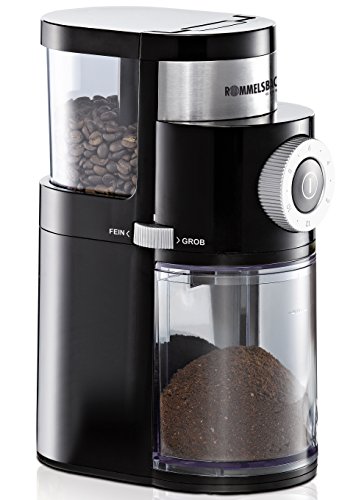
With the Rommelsbacher EKM 200, running time decides the quantity: one rotary selector sets how many cups to grind for, a second adjusts the burr grinder, and a button starts it. There is no scale inside the appliance. Our price box lists it at approx. €54.99 on Amazon.de; when the Amazon catalogue was queried on 7 September 2026, it showed €55.23.
Rommelsbacher and the grinders beside it
The company was founded by Dipl.-Ing. Gustav Rommelsbacher in Stuttgart in 1928, and the appliances used to run under the name robusta. Today the family business is based in Dinkelsbühl, in its third generation since 1991, with 110 employees and, by its own account, over 160 appliances in its range. On its company page Rommelsbacher advertises Made in Germany from Dinkelsbühl. That refers to the company; neither the product page nor the manual says where the EKM 200 is built.
On 25 September 2026 the manufacturer’s online shop listed five coffee grinders: the EKM 100 for €32.99, the EKM 200 for €79.99, the EKM 400 for €129.99, the EKM 500 for €154.99 and the EKM 600 for €149.99, plus the EKM 200 as a WieNeu appliance. The EKM 100 crushes with a two-bladed stainless steel cutter and, according to Rommelsbacher, is also intended for dry spices, nuts and sugar. The EKM 400 has a stainless steel conical burr grinder. In September the EKM 200 on Amazon was therefore clearly below the price in the online shop of its own manufacturer.
In our overview of electric coffee grinders it scores 7.8 out of 10 and carries the Beginner pick badge.
Design: eight parts and two containers
The product description on page 2 of the manual numbers eight parts, and the manual refers to exactly this list for the scope of delivery: the ON/OFF button, a rotary selector for the amount of ground coffee, one for the grind setting, the ground coffee container, the grinding plunger, the cleaning brush that is stored in the grinding plunger, the mains plug with cable, and the bean hopper with lid.
At the top sits the bean hopper with a capacity of 250 g. It is transparent and has an aroma-protection lid that, according to Rommelsbacher, keeps the beans aromatically fresh. You may only fill it with the grinding plunger fitted, with whole roasted beans, and up to the MAX mark. The ground coffee falls into the ground coffee container, for which the manufacturer states 170 g. It is pushed with its lid pressed on into the side guide rails on the lower housing until it clicks into place. On the product photo both containers are transparent.
The two fill quantities have a practical consequence: a full bean hopper does not fit into the catch container in one go. If you want to grind everything in advance, you empty the container in between.
Both containers are tied into the electrics. According to the manual, the grinder only runs if the catch container with its lid is pushed fully in and the lid on top is completely closed.
The product page gives 11.20 cm width, 18.50 cm depth and 26.50 cm height, and a weight of 1.44 kg. The housing is black and made of plastic, high-gloss according to the product page with a stainless steel accent. The mains cable cannot be detached; whatever is not needed disappears into the cable winder on the underside. The bean hopper is filled from the top. Under a wall cabinet you need room to fill it above the 26.5 cm, or you pull the grinder forward to do so.
In detail: two flat discs, dosing by time
The manual speaks of two flat, toothed grinding discs for gentle, aroma-preserving grinding, the product page of discs made of steel. The lower one is connected to the motor and turns, the upper one is fixed, and the gap between the two determines the grind setting. The beans reach the centre, are caught by the teeth and pushed outwards until the pieces fit through the gap. The gap therefore sets an upper limit on particle size. This is exactly where a burr grinder differs from the blade mechanism of the EKM 100, where a blade smashes the beans and the fineness depends mainly on how long it runs. The conical burr grinder of the EKM 400 follows the same gap principle as the discs, only with a cone-shaped inner part that turns in a ring.
The whole thing is driven by 110 W at 230 V~ and 50 Hz, protection class II.
The rotary selector for the amount of ground coffee regulates the quantity, from 2 cups at the far left to 12 cups at the far right. After you press ON/OFF, a timed grinding cycle runs, the grinder switches itself off at the end of the set time, and a second press interrupts it at any moment. A cup here is a unit of time. How many grams come out depends on the bean and the grind setting: the narrower the gap, the less coffee generally passes through it per second, and the same position on the selector then delivers less ground coffee. After every change of bean or grind setting we would weigh once. The brew calculator works out which amount of ground coffee suits your amount of water.
At a stretch the EKM 200 may run for 2 minutes at most. The manual translates that into 2 x 12 cups and then demands at least 2 minutes of cooling time, because otherwise the motor can be damaged. If it still gets too hot, a self-resetting thermal cut-out takes effect according to the product page. The EKM 400 protects itself differently, with a thermal fuse that, according to the manufacturer, cannot be reset.
How many grind steps does the EKM 200 have?
That depends on which Rommelsbacher source you open. The product page gives a scale from 1 (fine) to 9 (coarse) in 46 steps, the manual speaks of several steps, and an article in the support centre describes the grind setting as infinitely adjustable.
You turn left for finer and right for coarser. The manual links the numbers to brewing methods. Step 8 to 9 gives coarse powder, which it recommends for hand-filtered coffee. Step 5 to 7 stands for medium powder, according to the manual for conventional boiler espresso machines. Step 3 to 4 is fine and intended for drip filter machines or automatic pump-pressure espresso machines, step 1 to 2 extra fine for manual Turkish coffee (mocha) preparation.
The support article on the same question distributes the uses over other notches: coarse at 5 to 7, medium at 3 to 4, fine at 1 to 2 and extra fine at notch 1. The manual of the EKM 400 from the same company, in turn, assigns filter coffee to the medium range, the French press to the coarse range and automatic pump-pressure espresso machines to the extra-fine range.
Our assessment: the EKM 200 manual rates the hand filter as coarser than the filter machine. Our guide to setting the grind size shows that manufacturers disagree here: Baratza places the filter machine between V60 and Chemex, while Wilfa sets filter coarser than pour over. No fixed order results from this. Rommelsbacher itself describes its own recommendations as a basis from which you should experiment, and that is how we would read them: as a starting point. The French press, which is named as a use on the product page, does not appear in the EKM 200 manual at all.
And espresso?
On the product page Rommelsbacher lists filter coffee, espresso and French press, saying that everything is possible with this grinder. Among the eight parts in the manual, however, there is no portafilter holder.
We find the scale more important. The manual puts the drip filter machine and pump-pressure espresso in the same steps and does not separate the two preparations from each other. At the portafilter, though, even a small step in the grind setting decides the flow time. For that reason we would not buy it primarily for a portafilter.
Cleaning and care according to the manual
Before first use, the appliance and all accessories should be cleaned. For ongoing care, page 9 of the manual lists these points, given here in full and in their order:
- Always pull the mains plug before cleaning.
- Do not immerse the appliance and mains plug in water or clean them under running water.
- For consistent grinding quality, Rommelsbacher recommends cleaning the grinder regularly.
- Clean the appliance with a damp cloth and dry it afterwards.
- Clean the ground coffee container and lid in hot water with a little washing-up liquid; both must be completely dry before the next use.
- Clean the grinder with the supplied cleaning brush; the upper grinding plunger can be removed for this.
- Clean the ground coffee discharge opening regularly.
- Do not use abrasive or solvent cleaners.
- Never treat the appliance with a steam cleaner.
- The finer the grind setting and the oilier the coffee or espresso powder, the more often the discharge opening should be cleaned.
- Carefully loosen stuck powder from the opening with a pointed object such as a toothpick, and then clean thoroughly with the brush.
The appliance itself gets only a damp cloth, neither a water bath nor a jet of water; the general safety notes expressly exclude the mains cable and plug from immersion too. For the catch container the manual provides hand washing in hot water; a dishwasher is not mentioned there.
Our reading of the second-to-last line: anyone who sets the EKM 200 to fine and grinds dark, oily beans will have the toothpick in hand more often than someone who grinds coarse for the hand filter.
What running it costs: electricity and spare parts
Electricity hardly matters when grinding. If the manual equates 2 minutes with 2 x 12 cups, a run of 12 cups takes about one minute, which at 110 W is around 1.8 Wh. Anyone who grinds 12 cups every day arrives at about 0.7 kWh a year. We calculated this ourselves, using the figures from the manual and the product page.
Standby can matter more if the grinder stays plugged in permanently. Rommelsbacher gives at most 0.5 W for this, and according to the product page the grinder switches into this state immediately. Over a whole year, 0.5 W comes to up to 4.4 kWh, more than six times the grinding electricity in the example. The manual solves this in its own way: after grinding, the mains plug should always be pulled.
Rommelsbacher lists spare parts with prices on the product page, as of 25 September 2026: container with lid (MT0021) for €5.00, grinding plunger (MT0030) for €8.00 and cleaning brush (MT0040) for €2.00. At the end of its life, according to the manual, the grinder does not belong in household waste; it is handed in free of charge at a municipal collection point, such as a recycling centre.
What Rommelsbacher does not state
Some things you want to know before buying appear in none of the documents we evaluated: not on the product page, nor in the manual or the support articles on the EKM 200, and the Amazon catalogue does not help either. Rommelsbacher nowhere gives the diameter of the grinding discs; earlier versions of this page listed 42 mm, and we have found no source for that. Also missing are a noise level in decibels (the product page only calls the grinder quiet), a grinding rate in grams per second, the amount of ground coffee per cup, a figure for dead space, the plastic of the bean and ground coffee containers along with a statement on BPA, the cable length, the fineness of the finest step in micrometres, and a year of market launch (the manual only carries the print code W-1902). The maximum speed is given on the product page as 23500, without a unit. Whether the numbers 1 to 9 are printed on the grind setting dial is left open by the illustration in the manual; there, as on the product photo, only FEIN and GROB (fine and coarse) are shown. The grinding discs themselves are missing from the spare parts list, and which of the two containers is meant by MT0021 remains open there.
This grinder or one of the others?
| Model | The difference | Price | Our rating | Choose this if |
|---|---|---|---|---|
| Rommelsbacher EKM 200 (this one) | Steel burr grinder, dosing by time, no portafilter holder | approx. €54.99 | 7.8 | you grind 2 to 12 cups at a time for the filter machine |
| Caso Barista Crema (our review) | Burr grinder with smaller containers: 190 g beans, 140 g ground coffee | approx. €39.99 | 7.6 | smaller supplies are enough for you and every euro counts |
| Rommelsbacher EKM 400 (our review) | Conical burr grinder with 35 steps, holder for a 60 mm portafilter | approx. €87.99 | 8.0 | you want to grind straight into the portafilter |
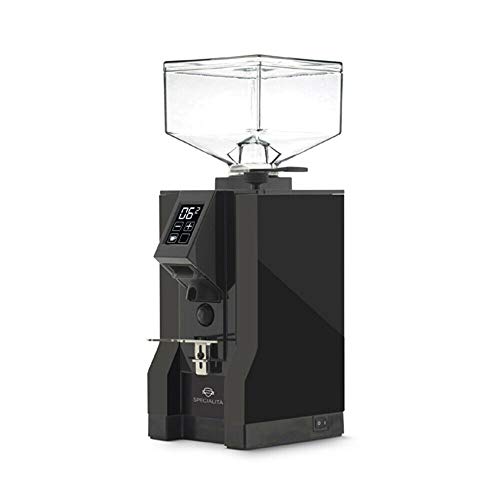
| Eureka Mignon Specialita (our review) | 55 mm flat burrs, stepless, touchscreen timer | approx. €431.90 | 9.4 | you grind single espressos every day and like to fine-tune them |
The prices are the guide values from our price boxes and may differ from the daily price. The rating is our editorial assessment; we did not measure anything.
Who is the EKM 200 right for, and when should you choose another?
If you weigh every portion and grind it individually, timed dosing suits you less well. The smallest setting on the selector is 2 cups, and what that means in grams only the scale will show (see the detail section above). For single doses even Rommelsbacher support refers to a different grinder; more on that in the questions below.
With a portafilter machine we would reach for the EKM 400: €33 more in our price box, and according to the manufacturer it grinds 1 to 2 portions directly into the portafilter.
The Eureka Mignon Specialita costs around €377 more than the EKM 200 in our price box, almost eight times as much. In return it adjusts steplessly and doses single shots by timer.
Looking at budget alone, the Caso Barista Crema is €15 cheaper. In the Amazon listing Caso likewise names a burr grinder and 150 W, and the catch container there is enough for up to 12 cups. The containers are smaller; the fill quantities are in the table above.
If you change beans often, fill only the amount for a few days, because the container has to be empty before every thorough cleaning. With a kilo of the same bean in the cupboard this hardly bothers you, with three open bags from different roasters it does.