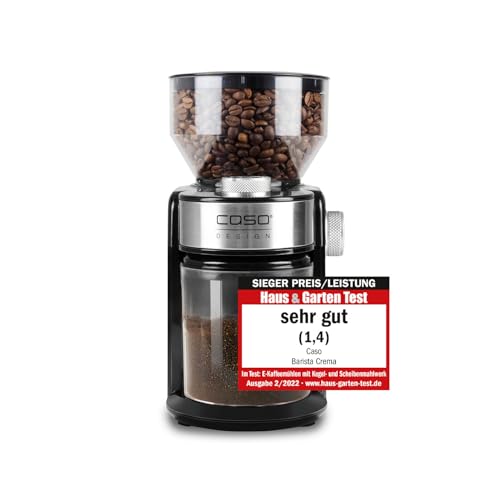
The Caso Barista Crema grinds with a flat burr grinder and doses by time. You turn one dial to set the grind size, a second to set the number of cups, press Start/Stop, and once the set duration has run out it stops by itself. Our price box lists it at approx. €39.99 on Amazon.de. In the Amazon catalogue it stood at €42.08 on 7 September 2026, and in Caso’s online shop at €44.99 on 1 October 2026, or €39.99 with the cashback advertised there.
Caso and the other grinders in the range
The brand is owned by CASO GmbH of Arnsberg, Germany. The company was founded in 1952 as a distribution organisation for German and European branded products, and Caso has been registered as a brand since 2003. By its own account around 110 people work at several sites in the Sauerland region, and it exports to around 30 countries.
On its category page for coffee grinders, Caso lists five entries. The Coffee Flavour (1830) chops with a blade. The BaristaChef Inox (1834) and the BaristaChef Inox Pro (1837) have stainless steel conical burr grinders according to Caso, and there is also a bundle of the BaristaChef Inox and the Caso appliance EspressoGourmet. The Barista Crema, which is Caso article 1833 and is listed under the same number in the Amazon catalogue, is therefore the only grinder in the range with a flat burr grinder. In the manufacturer’s online shop its price sits between the blade grinder and the two conical grinders.
In our overview of electric coffee grinders it appears as a value pick with 7.6 out of 10 points. This text is based on the product page and the manual with the document number 1833 16-02-2024.
Design: what is in the box
According to the manual, the box contains the grinder, the bean container with lid, the container for coffee powder with lid, the grinder unit, a cleaning brush and the manual. Besides the containers, the overview drawing numbers the controls: a rotary dial for the grind size, a second for the grinding duration, which Caso labels by number of cups, an indicator ring, the Start/Stop button and two safety switches.
The bean container sits on top and holds up to 190 g. The ground coffee falls into the removable powder container, for which Caso states up to 140 g, enough for up to 12 cups. In the product photo both containers are transparent, and the powder container sits at the front in the lower part of the housing.
The two capacities do not match. You cannot grind a full bean container in one go without the powder container overflowing, and the manual warns against exactly this.
According to the product page the front is stainless steel, and the feet are rubberised and meant to hold the grinder in place. Caso gives 130 mm width, 180 mm depth and 250 mm height, and a net weight of 1.2 kg. The Amazon catalogue lists the same dimensions but around 1.46 kg for the weight.
The grinder connects to 220 to 240 V at 50 or 60 Hz, via a 100 cm cable with a Euro plug. Caso names CE and GS as certification marks. The rating plate with the connection and power data is on the underside.
In detail: how the burrs grind and the clock doses
A flat burr grinder consists of two toothed grinding burrs facing each other, one of which is driven by the motor. The beans get between the teeth and travel outwards until the fragments are small enough for the gap. The gap between the burrs therefore sets an upper limit on particle size, and this is exactly the gap you change with the grind size dial. The blade of the Coffee Flavour works on a different principle: it smashes the beans, and how fine the powder gets depends mainly on how long it runs.
For dosing, Caso relies on the clock. The manual calls the second dial the grinding duration control, but it is labelled by cups. The drawing shows the numbers 2, 4, 6, 8, 10 and 12 with small dots in between. No 1 is printed, and the smallest step with a number is 2. After the set duration the grinder switches to standby; you can stop it earlier at any time with the Start/Stop button.
According to the manual, you should find out by trial how much powder goes into one cup, because cup size, type of bean, grind size and personal taste all affect the portion. Only the container figures give a rough guide: 140 g for up to 12 cups works out at just under 12 g per cup. This ratio describes the full container, not every dial position. As a general rule with timed dosing (nobody has measured this on this appliance): set fine, the motor pushes less coffee per second through the narrow gap than set coarse, so the same number of cups then delivers less powder. A kitchen scale next to the grinder settles this with one run after every change of beans, and the brew calculator tells you how much powder belongs with your amount of water.
The running time has a limit. Caso recommends no more than 60 seconds of continuous operation followed by 60 seconds of cooling time, and after two such intervals the grinder should rest for 5 minutes. After grinding, according to the manual, you pull the mains plug straight away, remove the lid of the powder container and take out the powder.
How many grind steps does the Barista Crema have, and is that enough for espresso?
Caso does not state a number of steps, neither on the product page nor in the manual, and in the photo in the manual the dots of the scale cannot be counted completely. The grind size dial carries a dot scale with three printed labels: French Press & Percolator, Drip Coffee/Filterkaffee and Espresso. The range is advertised as fine to coarse, for espresso and coffee.
Our assessment: for filter coffee and French press the grinder is well placed. Both methods have their own range on the scale, and both forgive it if the grind size is not exactly on the mark.
Espresso from a portafilter is different. There, a small step on the dial decides whether the shot runs through too fast or too sluggishly, and how big the steps of the Barista Crema are and how fine its finest setting grinds cannot be read from the documents. Then there is the path of the powder: it lands in the container, and the grinder has no holder for the portafilter. How grind size and preparation relate is explained in our guide to setting the grind size.
Cleaning according to the manual
The grinder is meant to be cleaned before the first use. On first use, according to Caso, a slight smell can occur, which is harmless and disappears over time.
Of the safety instructions in chapter 7.1, two matter in everyday use. Clean straight after use, because waiting too long makes cleaning harder and in extreme cases impossible according to Caso, and heavy soiling can under some circumstances damage the appliance. And the appliance itself goes neither into water or other liquids nor into the dishwasher.
You remove the two containers, the one for beans only when it is empty, and rinse them with their lids under running water. Then you dry everything thoroughly.
The grinder unit is a separate part in the scope of delivery. It is fitted by holding the grind size dial and turning the grinder unit anticlockwise until it clicks into place, so it can be taken out for cleaning. According to chapter 7.2 you clean it carefully with the supplied cleaning brush, because the grinder and the grinding screw can be sharp according to Caso, and the manual warns of a risk of injury.
Where to put it, the socket and power consumption
For the place of use, the manual requires a level and stable surface. The grinder should not be operated outdoors, and the spot should be chosen so that children cannot reach the appliance. Building it into a wall or a fitted cupboard is not intended. Hot, wet or very damp surroundings are ruled out, as is the vicinity of flammable material.
It is refilled from the top. If the grinder stands under a wall cabinet, there must be room above the housing for the removed lid and your hand, otherwise you briefly pull it forward to fill it.
The manual is detailed on the electrical connection. The connection data on the rating plate must match the mains supply, and if in doubt a qualified electrician should be asked. An extension cable may be at most 3 m long, must be fully unwound and have a cross-section of 1.5 mm², and Caso prohibits multi-way adapters and power strips because of the fire risk. The cable should be undamaged and must not run under the oven or over hot or sharp-edged surfaces. The socket must be protected by a 16 A circuit breaker, and according to the manual the grinder is electrically safe only on a correctly installed protective earth system. If you were planning to plug it into the power strip next to the kettle, these requirements mean you need a wall socket, or at most a single extension cable.
The consumption itself is small. Caso gives the motor as 150 W, so one full interval from the detail section costs 2.5 Wh. If the grinder ran one such interval on every day of the year, it would add up to around 0.9 kWh, calculated by us from the power and the running time limit.
At the end of its life, according to the manual, the Barista Crema must on no account go into household waste. It goes to a municipal collection point and is kept out of children’s reach until it is taken away.
What Caso does not state
Besides the number of steps, the product page, the manual and the Amazon catalogue lack several details you would like to have before buying. The material and diameter of the grinding burrs remain open; Caso explicitly names stainless steel only for the front, and no material for the housing, containers and lids is given in the documents either. Missing are the speed and motor type, a noise level in decibels, a grinding rate in grams per second and the duration of one cup step in seconds, which also leaves open whether the highest cup step fits into a single interval. There is likewise nothing on the amount of ground coffee that stays behind in the appliance, on an anti-static function, or on the fineness of the finest setting in micrometres. Country of manufacture, year of market launch, standby consumption and a cable wind-up are not mentioned in the documents at all.
Earlier versions of this page gave 18 grind steps, a cup scale starting at 1, a housing mostly of plastic and a dishwasher-safe powder container. None of this is documented, so it no longer appears here.
This grinder or one of the others?
| Model | The difference | Price | Our rating | Choose this if |
|---|---|---|---|---|
| Caso Barista Crema (this one) | Flat burr grinder, timed dosing, 140 g powder container | approx. €39.99 | 7.6 | you grind filter coffee or French press for a few cups and the budget is tight |
| Rommelsbacher EKM 200 | Steel flat burr grinder, 250 g beans and 170 g powder, up to 2 minutes in one go | approx. €54.99 | 7.8 | you regularly grind several pots in a row |
| Rommelsbacher EKM 400 | Stainless steel conical burr grinder with 35 steps, removable portafilter holder for approx. 60 mm | approx. €87.99 | 8.0 | you have an espresso machine with a portafilter and want to grind straight into the basket |
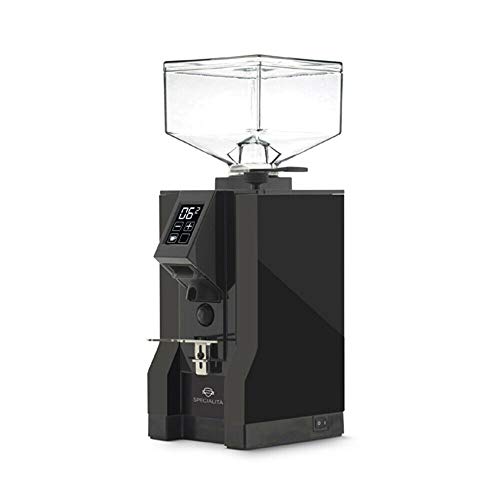
| Eureka Mignon Specialita | 55 mm flat burrs of hardened steel, stepless adjustment, portafilter fork | approx. €431.90 | 9.4 | you pull espresso every day and want to find the grind size in the smallest steps |
The prices are the guide values from our price boxes, and the day price in the shops may differ. The rating summarises our editorial assessment of the manufacturer data; no measurement is behind it.
When the Barista Crema fits, and when another one does
The powder container is enough for a full pot of filter coffee or French press, and once you have found your position on the cup dial, it largely saves you from weighing every day.
If you often need more than one full powder container in a row, you have to empty it in between, and the pauses from the detail section slow you down further. In that case we would reach for the Rommelsbacher EKM 200: €15 more in our price box, larger containers, and according to its manual it may run twice as long in one go.
The EKM 400 costs €48 more in our price box and, according to Rommelsbacher, grinds 1 to 2 portions straight into the portafilter.
If you pull espresso every day and want to fine-tune the grind size, then from our point of view the step up to the Eureka Mignon Specialita is worthwhile. For that you pay almost eleven times as much, around €392 more.
If you often change the type of bean, a detail from the manual helps. You may only remove the bean container when it is empty, because its base is open and the beans would otherwise fall out. If you grind one bean in the morning and another in the afternoon, fill in only the amount needed at that moment.