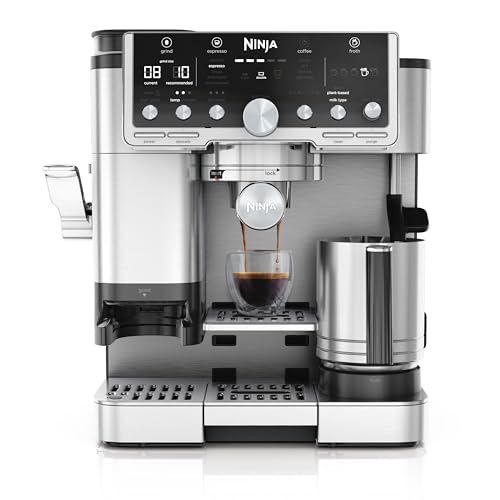
The manufacturer calls this machine the Ninja Luxe Café Pro, model ES701EU. It is a portafilter machine with a built-in conical burr grinder and a scale that weighs the grounds directly in the portafilter, plus a steam wand that works with a whisk in the jug. Ninja counts it as a 3-in-1 machine: espresso, filter coffee, cold brew.
ES701EU: what Ninja sells, and at what price
On Amazon the machine is listed as “Ninja Luxe Pro 3-in-1-Kaffeemaschine, Silber, ES701EU”. The operating manual belongs to the ES700 series, which Ninja calls “Pro Series”, and covers two models, the ES701EU and the ES771EUBK. The supplier in Germany is SharkNinja Germany GmbH in Frankfurt am Main.
Our price box lists the machine at approx. €386.85 on Amazon.de (as of September 2026); that is how it stood in the Amazon catalogue on 7 September. In the manufacturer’s shop, the same model was clearly higher on 1 October 2026.
It is no longer brand new. Amazon has 1 June 2025 on file as the release date, and the manual carries a 2024 copyright notice. In the espresso machine comparison, it is one of the machines with a built-in grinder, which a classic single-boiler machine plus a separate grinder has to be measured against.
The build: one tank, one grinder, 11.56 kilograms
Ninja gives the dimensions as 33.3 × 35.1 × 37.11 cm (length, width, height). One Amazon bullet point differs, giving H 37.7 × W 33.7 × L 35.5 cm and 17.25 kg. We go with the manufacturer’s figures, because the manufacturer’s shop gives them identically for all five colour variants of the ES701. In the product photo, the grinder holder, where the portafilter is hung for grinding, sits on the left, with the bean hopper above it, the group head in the middle and the milk jug under the steam nozzle on the right. Ninja does not say whether the tamper lever sticking out at the side is included in the dimensions. Plan some space to the side when choosing where to put it. When moving the machine, do not grip it by the grinder holder: according to the manual, it is not meant to carry the weight of the whole machine.
The water tank sits at the back and holds 2 litres. On top is the bean hopper, which Ninja describes as UV-protected, as well as a cup warmer. The cup tray is adjustable, according to the product page for espresso cups and travel mugs. Electrically, the machine draws 1650 W at 220 to 240 V and 50 to 60 Hz; the product page gives 7.8 A.
According to the manual, the grinder is an integrated conical burr grinder. One Amazon bullet point says “Scheiben-Mahlwerk” (disc grinder); we follow the manual, which in its cleaning section describes how to unscrew the conical burr grinder. It has 25 settings, where 1 is the finest and 25 the coarsest. The setting is made with the grind dial on the side of the machine.
Tamping is done with a lever. After grinding, you press it firmly down to the stop and repeat that a second time. In the parts overview of the German manual, this lever is labelled as part N with the Danish caption “Indbygget stampergreb”, even in the printed sheet.
The control panel has two rotary dials, one in the middle for drinks and one for froth, plus buttons for, among other things, grind selection, milk type, temperature and strength, hot water, nozzle rinse, cleaning and descaling. Ninja counts 29 drink settings: 13 espresso types, 4 coffee types, 7 drink sizes and 5 froth presets.
Ninja does not publish some details for this machine at all, so they are collected here and not estimated anywhere: the portafilter diameter, the pump pressure in bar, the heating system (whether thermoblock or boiler), the brew temperature in degrees, the heat-up time, the capacity of the bean hopper and the XL milk jug, the materials of the housing, portafilter and baskets (only the jug is stated as stainless steel), the standby consumption, a noise figure in decibels, the country of manufacture and which settings the active sensors mentioned on the product page adjust. The manual does not describe a separate hot water outlet. The cable length is given on the product page as 1.02 cm, which is clearly a data entry error. We also did not find a date for the market launch in Germany from the manufacturer. Earlier versions of this page mentioned several tanks, active pressure and temperature control and a hot water lead over the Premier; the manual and Ninja’s comparison table support none of these.
In detail: what Barista Assist does, and what you do yourself
Under “Barista Assist Technology”, Ninja groups several functions together. The most tangible is a grind setting recommendation. After a shot, the machine suggests a grind setting according to the manual, based on the beans used and the brew level so far. You have to do the turning yourself. With new beans, Ninja expects 2 to 3 brews until the grind setting is right. The assistance can be reset in the extra menu under _h04, and the grind display is under _h03.
The product page additionally speaks of active sensors that continuously monitor and adjust the settings; “pressure” as a controlled variable appears only in one Amazon bullet point.
The scale weighs the portafilter as soon as it sits in the grinder holder. The machine also detects which basket is inserted and shows the matching preparations. There are three baskets: Single with 9 g of ground coffee, Double with 18 g and the Luxe Basket, which handles the quad espresso with 40 g and also all coffee drinks.
The manual defines strength as the ratio of water to coffee grounds: 4:1 at standard, 2.5:1 at level two, 2:1 at level three. A double espresso from 18 g ends up at 72 ml at standard, and a ristretto from the same amount at 43 ml, which is roughly 2.4:1 and therefore almost exactly level two. For a classic espresso, we work with about twice as much drink as ground coffee, which here corresponds to the third level. The figures do not match completely, because Ninja calculates with the water while portafilter practice weighs the finished drink, and part of the water stays behind in the grounds. The brew calculator works out your own ratios.
You choose the brew temperature from three levels: low, medium (standard) and high. For Over Ice, Cold Brew and Cold Press it cannot be chosen. While a shot is running, the portafilter stays in: the manual warns that the machine is then under pressure and there is a risk of scalding when removing it.
Milk froth, filter coffee, cold drinks
Frothing is handled by the Dual Froth System Pro. The steam nozzle dips into the stainless steel milk jug, in which a whisk sits, and the machine steams and whisks at the same time. How milk froth forms in principle is explained in our guide to frothing milk. Elsewhere on the product page, the same system is called the “Advanced Dual Froth System”. Five presets are available: hot milk, thin, thick and extra-thick froth, and cold froth. With the milk type button, you switch between cow’s milk and plant-based milk.
Frothing can be scheduled while the espresso is still running, and starts directly afterwards. The machine makes cold froth in parallel with brewing. The nozzle is insulated and, according to Ninja, safe to touch when cool.
For filter coffee, the machine offers four types, namely classic, rich, over ice and cold brew, and seven sizes from S at 175 ml to XL at 530 ml. Coffee strength is controlled by the amount of beans: at mild the machine grinds less, at strong more. The manual requires tamping for all espresso drinks and for coffee in L+ and XL.
If you want a cold drink after a hot one, you have to rinse first. The machine then asks for a RINSE cycle and sends about 250 ml of water through the group head; the mug underneath should hold at least 355 ml. Before the very first drink, an initial rinse with the Double Basket is required: programme CLASSIC in size M+, at least 360 ml in the water tank and a cup of 420 ml or more underneath.
Is the Pro worth it over the Luxe Premier?
Only if the tamper lever on the machine and the Advanced Dual Froth System are worth something to you. In our price box, the Pro is €5.42 above the Luxe Premier at approx. €381.43.
The basis for this is Ninja’s own comparison table on the Pro’s product page. The “Integrated hot water system” is listed there for the ES601 (Premier) just as for the ES701 (Pro). The table shows differences in two places. For the baskets, it says “Double Quad” for the Premier and “Single Double Quad” for the Pro. This does not match the Premier product page, however, which also lists a Single Basket in the starter pack, exactly like the contents of the Premier’s Amazon listing. We therefore see no reliable difference in the basket. And “Tamper” for the Premier becomes “Integrated tamper” for the Pro: according to Ninja, the Premier works with a separate, spring-loaded tamper. In the running text above, Ninja writes that the Pro brings the Advanced Dual Froth System and an “even more intuitive control panel”; for froth, that means five programmes instead of four.
Our assessment: at the current price gap, the Pro is the obvious choice. The sums only tip if the Premier becomes clearly cheaper in a deal and you can do without the tamper lever and the fifth froth programme.
This machine or one of the other three?
| Model | The difference | Price | Our score | Choose this one if |
|---|---|---|---|---|
| Ninja Luxe Pro (this one) | Grinder, scale, tamper lever and automatic froth in the machine | approx. €386.85 | 8.3 | you make several milk drinks every morning and do not want to set up a separate grinder |
| Ninja Luxe Premier | separate, spring-loaded tamper instead of a tamper lever, four instead of five froth programmes | approx. €381.43 | 8.1 | you can get it clearly cheaper in a deal and can do without the tamper lever and extra-thick froth |
| Sage Barista Express Impress | 54 mm portafilter, milk frothed by hand on the steam wand | approx. €379.00 | 8.9 | you want to froth milk yourself and are looking for a portafilter with a stated size (54 mm); however, accessories that Sage neither sells nor recommends are also prohibited by its manual |
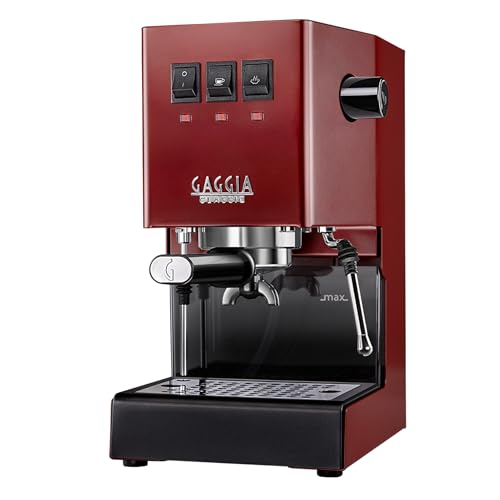
| Gaggia Classic Evo Pro | single-boiler machine with 58 mm portafilter, without grinder and without assistance | approx. €499.52 | 9.4 | you want to learn the craft yourself and plan to get a grinder of your own |
The prices are our catalogue values from September 2026; in the shops they change constantly. The score is an editorial assessment of the manufacturer’s data; nobody measured anything.
When the Luxe Pro fits, and when another machine does
Milk drinks are the strongest reason for this machine. With two or three cappuccinos in the morning, there is no steam wand to guide, and according to the manual the main drip tray catches the water from up to 6 cappuccinos; empty it as soon as the orange marker is visible. You should not prepare drinks or froth without the main drip tray inserted.
Before you order, look at where it will stand. Among the general precautions in the manual, number 9 reads: “To avoid the risk of fire, electric shock or damage to the appliance, do NOT use the appliance in an appliance cabinet or under a wall cabinet.” (our translation of the German manual). On the cable, the manual says two things: “A short power cord is provided to reduce the risk of becoming entangled in or tripping over a longer cord.” And: “Do NOT use extension cords with this product.” (both our translations of the German manual). The socket must therefore be close to where the machine stands, and according to precaution number 8 it must not be a socket below the worktop.
The Gaggia Classic Evo Pro has a 58 mm portafilter without assistance, but costs €112.67 more than the Ninja in our catalogue and additionally needs a grinder of its own. Including the grinder, the gap is therefore clearly above this amount. Whether it should be a portafilter machine at all or a bean-to-cup machine is weighed up in principle in the guide bean-to-cup machine or espresso machine.
Cleaning, descaling, spare parts
After every coffee, the portafilter and basket are next. The manual says: “For best results, you should clean the portafilter and basket after every use.” And further: “Remove the basket from the portafilter. Wash both parts by hand with soapy water to remove all coffee oils.” (our translation of the German manual). You wipe the steam nozzle with a damp cloth after frothing, before you put it back in the lower position. If you push the steam wand down, automatic cleaning begins. For more thorough care, there is a ring spanner in the middle of the cleaning brush, with which you remove the tip of the steam nozzle.
According to the product page, the dishwasher-safe parts go on the top rack. The manual does not include the milk jug in its list, so we would wash it by hand. According to the manual, you should wash the drip tray itself by hand regularly and let it air dry thoroughly, and clean the machine base regularly with a damp cloth.
For the grinder, a strict prohibition applies. “The grinder must NOT come into contact with water,” says the manual (our translation); you unscrew the conical burr grinder and clean it dry with the brush. If water has got into the grinder anyway, Ninja requires you to call customer service immediately, free of charge on +49 800 000 9063. Precaution number 4 applies to the whole machine: “To avoid the risk of fire, electric shock and injury, NEVER immerse the cable, plug or other parts of the appliance in water or other liquids.” (our translation).
The machine signals two programmes with their own lights. The cleaning cycle (CLEAN) takes about 6 minutes and runs with the cleaning disc and a cleaning tablet. Descaling (DESCALE) takes about 90 minutes, so that belongs in an evening, not before the first cup. Why limescale harms a machine is explained in the guide descaling and cleaning; with the Luxe Pro, according to the manual, you risk worse drinks and a clogged machine if you ignore the light.
You soak the water filter in water for 5 minutes before use, rinse it for 60 seconds and set the date display 2 months ahead. Whether it is included with the ES701EU is unclear: the manual lists it as an accessory, the scope of delivery on the product page does not. That list has the XL milk jug with whisk, cleaning brush, a starter pack of portafilter, Single, Double and Luxe Basket, funnel and tamper, a cleaning set with 2 cleaning tablets and 1 descaling tablet, a water hardness kit and a recipe booklet. The manual marks the Single Basket as “not available on all machines”; for the ES701EU, it is in the scope of delivery.
The manufacturer’s shop sells spare parts under their own numbers, as of 1 October 2026: water tank with lid (273UO600EUK) €25.99, main drip tray (262UO600EUK) €50.99, whisk (269UO600EUK) €3.99, cleaning brush (372UO600EUUK) €9.99, water hardness strips (282UO600EUK) €4.99 and a carafe (XSKCARAFEEUK) €39.99. A rubber seal (375UO600EUUK) is listed there for €3.99. According to the manual, you replace the seal on the group head yourself: unscrew the puck screen with a Phillips screwdriver, change the seal with a flat-head screwdriver, and replacements are available via ninjakitchen.eu. Eight cleaning tablets (XSKCLNTBLT8EUK) cost €11.99 in the manufacturer’s shop; at one tablet per cycle, that is around €1.50 per clean.
Who is it for?
The manual itself draws a line. According to the manufacturer, the machine is “for indoor use only and intended for private purposes” (our translation), elsewhere only for household use, and precaution number 7 reads: “For household and worktop use only. NEVER let the power cord hang over the edge of the table or touch hot surfaces such as the hob.” (our translation). For an office kitchen or a small café, the Luxe Pro is therefore the wrong purchase.
It is also unsuitable for anyone who wants to preheat their machine with a timer or smart plug. Precaution number 12 says: “The appliance is not intended to be operated by means of an external timer or a remote control system.” (our translation). Conversely, it switches itself off automatically after 20 minutes, and in the extra menu there is an eco mode under _h02 that switches the machine off after brewing.