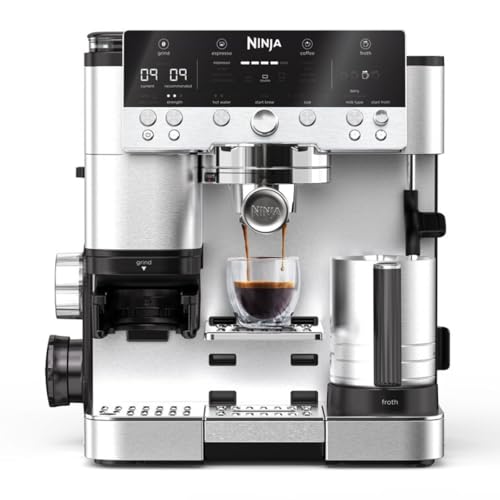
At the manufacturer, the Luxe Premier is called the Ninja Luxe Café Premier in full, model ES601EU. It grinds the beans into the portafilter, weighs as it goes, brews espresso and filter coffee, makes cold brew and froths milk in its own jug. In our price box it stands at approx. €381.43 on Amazon.de; as a recommended retail price, SharkNinja gives €549.99 (manufacturer’s shop, retrieved on 01.10.2026).
ES601EU: model, range and how long it has existed
Under the ASIN of this listing, the Amazon catalogue gives the model number ES601EU. The SharkNinja support site groups four variants under the same entry: ES601EU, ES601EUBK, ES601EUCY and ES601EUGM. The manual covers the whole ES600EU series and states right at the front that features may vary by model.
Amazon gives 23.10.2024 as the release date, and the manual carries the note © 2024 SharkNinja Operating LLC. So the machine is no longer new: in October 2026 the catalogue entry is almost two years old. For Germany, the manual names SharkNinja Germany GmbH in Frankfurt am Main.
Under the Luxe Café name, SharkNinja sells five base models: MINI (ES301EU), MINI Plus (ES352EU), Premier (ES601EU), Premier Plus (ES655EU) and Pro (ES701EU). There are also colour variants of the Pro and the ES771EUBK, which Ninja advertises as designed by David Beckham. It shares the Pro’s manual but, according to Ninja, is larger and heavier. In the manufacturer’s shop the MINI costs €419.99 and the MINI Plus €399.99, while Premier, Premier Plus and Pro are each listed at €549.99. These shop prices cannot be compared directly with our price box, which carries an Amazon reference value: for the Premier there is €168.56 between the recommended retail price and the price box.
In our espresso machine comparison it is one of the machines with a built-in grinder, that is, one of those where you do not need a separate grinder.
Layout: grinder on the left, milk jug on the right
The product photo shows the arrangement. On the left sits the grinder cradle, where you insert the portafilter for grinding, with the bean hopper at the top left. In the middle the portafilter hangs in the group head, and on the right the stainless steel milk jug stands on its own surface. The control panel is on top.
The manual gives 220 to 240 V at 50 to 60 Hz and a power of 1650 W; the product page adds 7.8 A. The water tank holds 2 l. It is filled with cold or room-temperature water (the manual rules out hot water) and only up to the maximum mark.
The cup tray can be set to three heights or removed entirely, and the machine also has a built-in cup warmer. According to the manual, the main drip tray is sized for the water produced by up to 6 cappuccinos. To save power the unit switches itself off after 20 minutes, and the additional menu has an Eco mode that switches off straight after brewing. The bean hopper is removable and, according to the product page, protected against UV light, and the unit is declared BPA-free.
On weight we go with SharkNinja: 11.77 kg. The Amazon catalogue arrives at roughly 11.7 kg with 25.79 pounds, whereas one of the Amazon bullet points says 17 kg, which fits neither of the other two figures.
Some things appear in no Ninja source, neither on the product page nor in the 32 pages of the German part of the manual: the brew pressure in bar, the pump type, the heating system and the heat-up time, the capacity of the bean hopper and milk jug, the materials of the housing, portafilter, baskets and burrs including the burr diameter, a noise level in decibels, standby consumption, the country of manufacture, the maximum cup height, a descaling interval in weeks, and the number of years spare parts remain available. Retailers give figures for some of these points, for example 250 g for the bean hopper, but none of them could be verified. The cable length is on the product page, but as 1.02 cm, which is obviously a typing error.
In detail: dosed by weight, not by seconds
A timed grinder runs for a set number of seconds. How many grams end up in the basket depends on bean and grind size, because set fine, a grinder delivers less ground coffee per second than set coarse. So if you change the grind size with timed dosing, you change the dose too, and the two adjustments run into each other.
The Premier weighs. As soon as the portafilter sits in the grinder cradle it is weighed, and the machine recognises which basket is inserted. The manual assigns them like this: Double for espresso, Americano and cold pressed coffee, Luxe for the quad espresso, Americano, cold pressed coffee and all coffee drinks. There is also a Single for espresso and Americano, which according to the manual comes with only some of the models.
The manual gives ground coffee amounts of 9 g for the single espresso (22.5 ml), 18 g for the double (45 ml) and 40 g for the quad (90 ml). You choose the strength in three levels. The standard is a ratio of water to ground coffee of 2.5:1, the concentrated level is 2:1, the larger one 4:1. With the double espresso, 18 g and 45 ml give exactly the 2.5:1 of the standard level. At the same dose, the larger level means more liquid in the cup, so a longer and thinner shot. How other ratios and cup sizes work out is shown by the brew calculator.
The conical grinder has 25 steps, 1 being the finest and 25 the coarsest. It is set by hand on the grind size dial on the side of the machine, but the machine suggests a value. Ninja calls this Barista Assist: the display shows the current and the recommended grind size, and you turn the dial to the recommendation, which depends on the bean and the last brew. With new beans, the manual allows for 2 to 3 brews until the right value is found.
Tamping is not done with a lever. To tamp, you put the automatic tamper inside the funnel and press it all the way down by hand until it meets the funnel. The product page calls it spring-loaded and assisted.
Ninja gives a brew temperature of 90 to 96 °C; in the additional menu you choose LO, M (standard) or HI. According to the manual, this setting does not apply to Over Ice, Cold Brew and Cold Press. The manufacturer’s recommendation: low to medium for darker roasts, medium to high for light ones. We have not measured this on this machine. The usual reasoning is that dark-roasted beans give up their soluble compounds more easily, and hot water dissolves bitter components faster there.
Filter coffee, cold brew, hot water and milk
Besides espresso, the Premier brews coffee in four types, which Ninja calls classic, rich, over ice and cold brew. There are seven sizes for this: 175, 235, 295, 355, 415, 475 and 530 ml. For Americano the machine lengthens the espresso with water; depending on strength, the double yields 216, 135 or 108 ml, the quad 414, 258 or 207 ml. Cold pressed espresso is available with the Double and the Luxe basket in the same doses as the double and quad.
If you switch from a hot to a cold drink, the machine first rinses about 250 ml of water through the group head. Allow for a vessel that holds this amount. A separate hot water button delivers water in three temperature levels, 200 ml without a manual stop.
For milk, Ninja built the Dual Froth System: steam from the nozzle plus a removable whisk in the stainless steel milk jug. Four programmes are preset: hot milk, light froth, thick froth and cold froth.
The manual also describes the manual way: pull out the steam wand, guide the jug yourself, hold START FROTH for 3 seconds. The machine is built around the programmes, though. In our assessment, anyone who wants to practise latte art seriously has more room to manoeuvre on a classic steam wand; we explain the technique in the guide How to froth milk.
Premier or Pro: what do €5.42 more get you?
Mainly one extra froth level. In our price box the Ninja Luxe Pro costs approx. €386.85, which is €5.42 more than the Premier. The Pro also grinds with a conical grinder and weighs in the cradle.
The Pro has five froth programmes instead of four, additionally extra-thick froth, and the Advanced Dual Froth System with an insulated steam nozzle. In the comparison table on Ninja’s Pro page there are two more rows: for baskets it says Double and Quad for the Premier and Single, Double and Quad for the Pro, and for the tamper it says integrated tamper for the Pro and simply tamper for the Premier. Ninja gives the weight of the Pro as 11.56 kg, 210 g less than the Premier.
The Single basket is a contradiction in Ninja’s own documents, because the Premier’s product page counts it as part of the delivery, as does the Amazon listing. If you want to make single espressos, check when unpacking whether it is in the box.
Our assessment: if you drink cappuccino every day and want the fifth froth level, you pay the difference; everyone else gets by with the Premier.
The Premier or one of the others?
| Model | The difference | Price | Our rating | Choose this if |
|---|---|---|---|---|
| Ninja Luxe Premier (this machine) | Scale in the grinder cradle, espresso, filter coffee and cold brew, four froth programmes | approx. €381.43 | 8.1 | you want espresso and mug-sized coffee from one machine and leave the milk to the automatics |
| Ninja Luxe Pro | five instead of four froth programmes, insulated steam nozzle | approx. €386.85 | 8.3 | you make a lot of milk froth and want the extra-thick level |
| Sage Barista Express Impress | 54 mm portafilter, steam wand guided by hand | approx. €379.00 | 8.9 | you want to learn to froth milk yourself and look for a portafilter with a stated size (54 mm); accessories that Sage neither sells nor recommends are, however, ruled out by its manual as well |
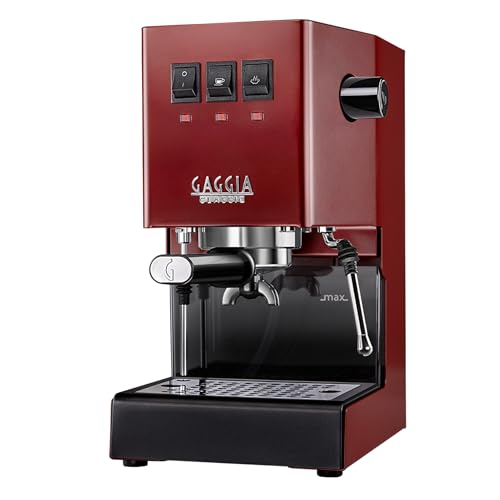
| Gaggia Classic Evo Pro | 58 mm portafilter, no grinder, no scale | approx. €499.52 | 9.4 | you already have an espresso grinder or will buy one |
The prices are reference values from the price boxes of our reviews, not daily prices. The rating is an editorial assessment based on manufacturer data; we have not handled any of the four machines ourselves.
When the Premier fits and when another machine does
Whether you need the 3-in-1 design is shown by your cup cupboard. If it holds only espresso and cappuccino cups, the four coffee types from classic to cold brew stay unused, and the choice then depends on portafilter size and milk system, exactly the two points where the Sage in the table above is built differently.
The most important restriction is in the safety instructions. Five of the 15 general precautions concern where you put the machine, quoted: “For household and countertop use only. NEVER let the power cord hang over the edge of the table or touch hot surfaces such as the stove.” “NEVER use an outlet below the countertop.” “To avoid the risk of fire, electric shock or damage to the unit, the unit must NOT be used in an appliance cupboard or under a wall cupboard.” “Do NOT place the unit on top of other appliances.” “Do not place the unit in a cupboard during use.” Three of the 14 operating notes belong here too: always on a clean, dry and level surface, not on hot surfaces, not near a hot gas or electric hob and not in a heated oven, and never outdoors. The power cord is deliberately short to avoid tripping and entanglement, and the manual prohibits extension cords.
There are two sets of figures for the footprint. Ninja’s product page gives 40.41 × 38.71 × 50.8 cm (L × W × H), an Amazon bullet point H 37.2 × W 33.6 × D 34.4 cm (the catalogue data gives 35.5 cm width, with the other values the same). The manufacturer page for the Premier Plus arrives at 34.29 × 33.58 × 37.21 cm, almost exactly the Amazon values. Ninja does not explain whether the larger figures describe the packaging; we would plan with them, then it fits in any case.
When you move it, do not hold the machine by the grinder cradle. The manual explicitly forbids this, because the cradle is not meant to carry the weight of the whole unit.
Budget decides in favour of the Gaggia. In our price box the Gaggia Classic Evo Pro costs €118.09 more than the Premier and has no grinder, so an espresso grinder comes on top. In return you get a 58 mm portafilter and a machine on which you work out grind size, dose and froth entirely yourself. Which grinder suits which basket size is covered in our espresso machine buying guide.
Two further limits affect the morning routine. According to the precautions, the unit is “not intended to be operated by means of an external timer or a separate remote-control system”, and you are never to leave it “unattended during use”. Anyone who wants to start the first coffee by timer or app socket gets, by our reading of these sentences, no suitable machine in the Premier. Something similar applies to the office kitchenette: the manual restricts use to indoors and private purposes, and the warranty draws the same line at normal household purposes.
What is in the box, accessories and spare parts
According to the product page, the box contains the milk jug with integrated whisk, a cleaning brush, a starter pack of portafilter, Single, Double and Luxe basket, funnel and automatic tamper, a cleaning set with two cleaning tablets and one descaling tablet, a kit for checking water hardness and a recipe booklet. The Amazon listing lists the same parts in different words, for example froth jug with integrated whisk.
The manual additionally describes a water filter with housing. When inserting it, you set its date indicator 2 months ahead, which corresponds to six changes a year; we have not recorded a price for replacement filters. The product page’s delivery list does not include the filter, whereas the manual’s accessory list names water filter and water filter housing as parts 12 and 13 of the series.
The documents give no portafilter diameter in millimetres against which you could match third-party parts. Sieves and portafilters from other makers are therefore your own risk. Among the precautions it says: “Do NOT use accessories not recommended by the manufacturer, as this may cause injury or damage to the unit.” By this wording, that also applies to the usual upgrades, such as a bottomless portafilter or precision baskets. Among the seven exclusions of the manufacturer’s warranty are also damage caused by parts and accessories that are not original Ninja parts. From Ninja’s own range, the Luxe basket is available separately, under the number 260UO600EUK.
In the manufacturer’s shop, the following are listed for the Premier (as of 01.10.2026): the milk jug (268UO600EUK) for €29.99, water hardness strips (282UO600EUK) for €4.99, a brush (275UO600EUK) for €5.99 and a carafe (XSKCARAFEEUK) for €39.99. Even the complete machine base is available separately there, as XBSES601EU for €400.99, which is just under three quarters of the recommended retail price.
Cleaning and care according to the manual
Before the first drink, the manual requires you to clean the accessories by hand and dry them and to rinse the machine through once: insert the Double basket, choose CLASSIC in size M+, place a vessel of 420 ml or more underneath.
Directly after use it provides eight steps:
- Carefully take the portafilter out of the group head after brewing and dispose of the grounds by knocking against the basket over a container or a separately available knock box.
- Clean the portafilter and basket after every use.
- Take the basket out of the portafilter and wash both parts by hand with soapy water to remove all coffee oil. The brew basket must be dry before you brew again.
- Wipe the nozzle with a damp cloth after frothing before you return it to the lower position.
- Push the steam wand into the lower position so the automatic cleaning begins.
- Empty the drip tray when the orange marker is visible.
- Wash the drip tray by hand regularly and let it air dry thoroughly.
- Clean the machine base regularly with a damp cloth.
Before any cleaning you pull the plug. The general note applies here: “To avoid the risk of fire, electric shock and injury, NEVER immerse the cord, plug or other parts of the unit in water or other liquids.” Which removable parts may go in the dishwasher is answered differently by the manual and the product page; we sort that out below in the questions.
A separate rule applies to the conical grinder, quoted: “The grinder must NOT come into contact with water.” To clean it, you switch the unit off, pull the plug, remove the beans, take off the bean hopper and unscrew the upper grinding ring anticlockwise; the manual uses the ALIGN marking as a guide. Then you clean with the brush. If water does get into the grinder, you are to call customer service immediately.
For the steam nozzle, a pin is stored on the underside of the cleaning brush, with which you remove residue from the nozzle and nozzle tip, plus a ring spanner for removing the tip. You also remove material from the rubber seal.
The CLEAN light requests the cleaning cycle. It takes approx. 6 minutes and runs with the Double basket, the cleaning disc and one cleaning tablet. At €11.99 for eight tablets in the manufacturer’s shop (as of 01.10.2026), one cycle costs just under €1.50.
The DESCALE light signals descaling, depending on the water hardness, which you determine during setup with the supplied strip and set in six levels from hd 0 to hd 5. The factory setting is hd 5. Why limescale harms a machine and how to find out the hardness of your tap water is covered in the guide Descaling and cleaning. According to the manual, a descaling cycle takes approx. 90 minutes.