The CI Touch is a bean-to-cup machine from Melitta’s CI range with two bean hoppers and a milk system that draws milk up through a tube. Our price box lists it at approx. €626 on Amazon.de. In the Melitta shop it cost €729.00 at the regular price on 1 October 2026.
The version covered here is the matt black one with Melitta item number 6781950. The machine is listed under the same number in the Amazon catalogue, where the colour is given as “frosted black”. A silver variant carries the number 6781945. The manufacturer is Melitta Europa GmbH & Co. KG in Minden (Germany), and according to the product page the service hotline, 0571 86 1040, is staffed Monday to Friday from 8 am to 3 pm. How the CI Touch compares with the other machines we list is shown in the bean-to-cup machine comparison.
Control panel, dimensions and containers
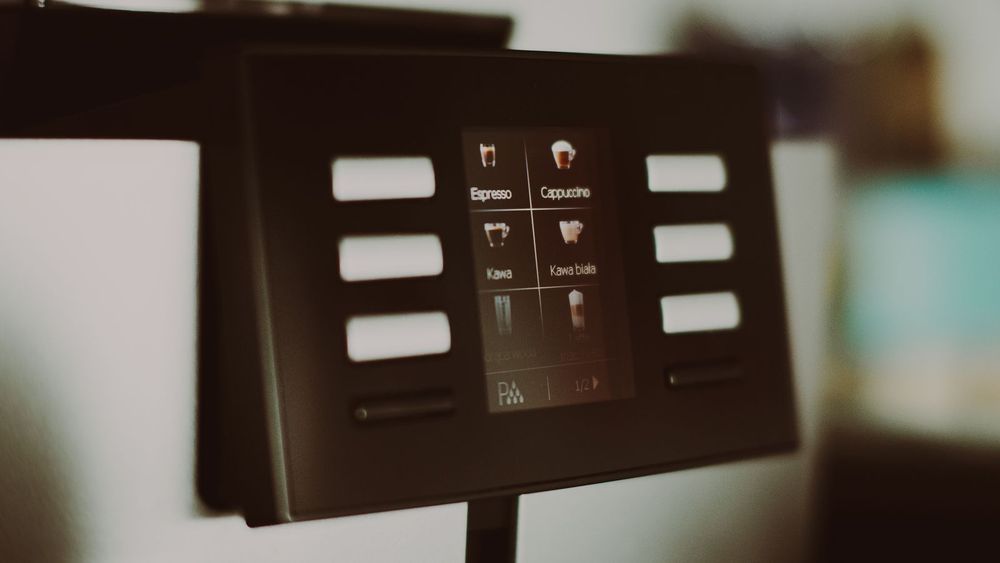
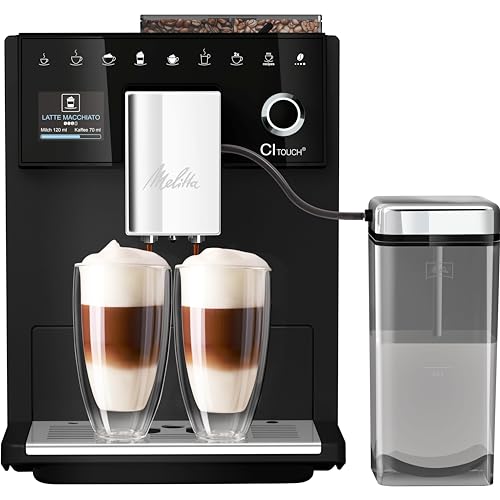
The CI Touch does not have a large touchscreen, as the name might suggest. Melitta calls the operating concept “Touch & Slide”. According to the operating manual, it consists of a row of sensor keys, a TFT colour display and a rotary push dial called the Rotary Switch. In the product photo the display sits to the left of the spout and takes up only a small part of the front; the dial sits on the right, and the key symbols run in a row above it.
There are keys for espresso, café crème, cappuccino, latte macchiato, milk foam or warm milk, hot water, two cups, “my recipes” and coffee strength. Six more coffee drinks such as lungo, ristretto and americano are in the menu. You get there by pressing the Rotary Switch for longer than 2 seconds, and you turn it to scroll. The data sheet lists app support and app control with a terse “None”.
For the installation spot, Melitta gives two slightly different sets of dimensions. The product page states 345 millimetres high, 255 wide and 475 deep, weighing 9.3 kilograms without packaging; the manual says 340, 255 and 470 millimetres and 9.25 kilograms empty. Plan with the larger values, because the manual requires extra air space all round, more on that below. In the Amazon catalogue the axes are distributed differently: it gives a width converted to around 35.2 centimetres, which does not match any Melitta figure.
The water tank holds 1.8 litres and is lifted out upwards. The bean container has two chambers of 135 grams each under an aroma-saving lid. According to the data sheet, the machine has no fill level sensor for the beans, and the manual advises small quantities anyway: only as much as you will use in the next three to four days.
According to Melitta, glasses and large cups also fit under the height-adjustable spout; the product page gives the height as 140 millimetres. The spout houses two coffee nozzles, two milk nozzles, a hot water nozzle and a cup light. The drip plate is stainless steel. The cup warmer works passively, and there is a storage compartment for the power cable.
The power consumption is a maximum of 1,400 watts. According to the manual, the machine may only be connected to a properly installed earthed socket protected with at least 10 amperes, and beforehand you check whether the mains voltage matches the operating voltage of 220 to 240 volts at 50 hertz. If in doubt, Melitta advises asking a qualified electrician.
The machine tells you to empty the drip tray and the grounds container after a set number of drinks, and a float additionally shows a full drip tray. If you empty both while the machine is switched off, the machine does not register this, according to the manual.
In detail: two bean hoppers, one grinder
You switch between the two chambers by hand, with a slider called BEAN SELECT; Melitta calls the whole thing Manual Bean Select. The documents mention a single grinder, and by our reasoning both chambers feed into it. Whatever is still inside it and on the way to the brew group when you switch therefore comes from the previous variety.
Melitta quantifies how much that is, indirectly. After switching, the first two drinks may still contain caffeine, the manufacturer writes, and anyone who is sensitive to caffeine should only drink the third coffee drink. Our conclusion for a household where one person wants decaf in the evening: for a single cup you switch and pull two drinks for the drain, or for someone who does not mind caffeine. The second chamber makes more sense when used in blocks, for example switching from the afternoon onwards and then staying with the decaffeinated variety.
According to Melitta, the grinder is a steel conical burr grinder with 5 grind settings. It is adjusted with a lever on the back of the machine, to the right for coarser, to the left for finer; how to work your way towards the right setting is described in the guide Setting up a bean-to-cup machine. The machine regulates the grinding quantity itself (in the data sheet “automatic grinding quantity regulation”). From the position of the lever we derive a practical consequence: if the machine stands tightly in a corner, you pull it forward to adjust it.
Melitta excludes freeze-dried and caramelised beans. Ground coffee belongs in the powder chute, not in the bean container. For very oily beans the manual’s troubleshooting table has its own entry: the grinder then does not grind, the cause given is “coffee beans too oily”, and the remedy is to switch to other beans. Oil comes to the surface mainly with very dark roasts, so with glossy espresso beans it is worth checking the roast level before they go into one of the chambers.
How finely can you adjust the coffee on the CI Touch?
Strength in 4 steps, brew temperature in 3 (85, 90 or 95 °C) and water quantity between 25 and 220 millilitres, not continuously variable according to Melitta. You can store this in up to four personal profiles.
The profiles are called My Coffee. According to the manual, for each person you set recipes, coffee quantity, foam quantity, milk quantity, hot water quantity, coffee strength and temperature. 10 recipes are stored at the factory, the espresso and nine more. If you reset the machine to factory settings, you lose all personal settings, including those in the My Coffee menu.
During a drink you can adjust, but only for that one cup: strength with the coffee strength key while the grinder is running, quantity with the Rotary Switch while the drink is running in.
Melitta itself defines two processes. Before the actual brewing, the pre-brew function, called “Pre-Infusion” by Melitta, briefly moistens the freshly ground coffee. For milk drinks a fixed order applies, which the manufacturer calls the Italian Preparation Process: for a latte macchiato the espresso goes into the glass after the milk and milk foam, for a cappuccino it is the other way round. With Double Cup, two cups run at the same time, with or without milk. According to the manual, mixed drinks with hot water such as the americano are excluded, as are milk foam, warm milk and hot water.
For pressure, the technical data say “pump pressure static max. 15 bar”, that is, the maximum value the pump builds up without flow. Espresso is usually brewed at around 9 bar at the coffee puck. What pressure is actually present in the brew group of the CI Touch, Melitta has not published.
Milk from a container or a carton
Melitta calls the system the One Touch milk function. A tube draws up the milk, and its end sits either in the milk container supplied or, according to the manual, directly in a standard milk carton. The milk key has two functions: pressed briefly it gives milk foam, pressed for 2 seconds it gives warm milk.
There is no milk level indicator; the manual puts it briefly: “The machine does not indicate missing milk.” Anyone drawing straight from an opaque carton therefore notices the end only at the glass.
After every milk drink the machine prompts you to start Easy Cleaning, a rinse programme for the milk system. On the product page the function is called Easy Steam Cleaning and cleans the milk-carrying parts with hot water and steam. Once a week Melitta additionally recommends the Milk System Cleaning programme: about 3 minutes running time, a collecting vessel for 0.7 litres and, as cleaner, exclusively Melitta PERFECT CLEAN milk system cleaner. By hand, the milk unit, milk tube and milk container are added regularly. For this you pull the milk unit down out of the spout and clean it with warm water and washing-up liquid.
What else is worth considering?
| Model | The difference | Price | Our rating | Choose this one if |
|---|---|---|---|---|
| Melitta CI Touch (this page) | two bean hoppers of 135 g each, milk through a tube from a container or carton | approx. €626 | 8.5 | you want two kinds of beans to hand |
| DeLonghi Dinamica Plus 370.70 | milk from the LatteCrema carafe, CLEAN rinse after every milk drink, carafe to be taken apart every two days | approx. €599 | 8.6 | you get by with one kind of beans and would rather tap a touch display (3.5 inches) than sensor keys |
| Philips LatteGo 5500 | LatteGo milk system, according to Philips two parts without tubes | approx. €515 | 8.7 | you want a milk part you only need to rinse, and want to spend less |
| Jura E8 | brewing unit stays in the machine and is cleaned with a tablet programme | approx. €1,049 | 9.4 | you never want to remove the brew group yourself and your budget stretches beyond €1,000 |
The prices are the guide values from our price boxes. The rating reflects our editorial assessment of the manufacturer data; we measured nothing. What the difference column says about the other three machines comes from their operating manuals (DeLonghi, Jura) and from the product pages (Philips, plus the display size of the DeLonghi).
When the CI Touch, when one of the others?
The milk decides first. The care routine of the tube system is described in the milk section above, and how heavy it weighs depends on your cup count. If you only make a cappuccino at the weekend, you mostly bear the weekly programme; if you pull three or four milk drinks a day, you get the prompt to start Easy Cleaning three or four times a day. According to Philips, the Philips LatteGo 5500 works without tubes and costs around €111 less.
With the Dinamica Plus 370.70, the manual work does not disappear, it just looks different. According to the DeLonghi manual, after every milk drink you turn the carafe’s dial to CLEAN, and then the machine rinses with steam and hot water. Every two days the carafe is additionally taken apart and cleaned, and its parts may go in the upper basket of the dishwasher for that. So you are swapping a tube for a carafe rather than a lot of care for little. The DeLonghi is around €27 below the CI Touch.
For two varieties in rotation it looks different. Of the four machines in the table, only the CI Touch has two bean hoppers according to the manufacturer; for the other three the documents list one container and a single fill quantity each. If you drink espresso from a dark roast in the morning and decaf in the afternoon, you have, in our assessment, the strongest reason for the Melitta here. If you only buy one variety anyway, you should decide more on the milk system.
With the brew group the calculation turns around. The Jura E8, our comparison winner, keeps its brewing unit in the housing and cleans it with a tablet programme, but costs around €423 more than the CI Touch. With the CI Touch the brew group is manual work every week, as described in the care section.
A small calculation helps with the installation spot. The manual requires at least 20 centimetres of clearance above and about 10 to the wall and to other objects. With the larger height from the product page you therefore need 54.5 centimetres up to the underside of a wall cabinet, and in depth the machine including wall clearance takes up around 57.5 centimetres of worktop. The manual’s other installation rules: no damp room, a stable, level and dry surface, no place near sinks or the like, no hot surface as a base, and a power cable that cannot be damaged by edges or hot surfaces.
Brew group, descaling and care products
The brew group sits behind the right side cover and comes out for cleaning. Melitta recommends this once a week, “to avoid damage to the machine”, and the instruction reads: “Rinse the brew group thoroughly from all sides as a whole under running water.” Afterwards the sieve should be free of coffee residue.
Roughly every 2 months, or when the machine prompts you, the programme for cleaning the coffee system follows. It takes about 15 minutes, you clean the brew group beforehand, and the manual prescribes exclusively Melitta PERFECT CLEAN cleaning tablets as the product. In between, the nozzles at the spout and the internal parts of the coffee system can be flushed through via the Care menu, item Rinse.
Without a water filter Melitta advises descaling every 3 months, with a filter only when the machine asks for it. The programme runs for about 25 minutes, needs a 0.7-litre vessel for collecting, as the milk cleaning does, and exclusively Melitta ANTI CALC liquid descaler. You take a screwed-in filter out beforehand because it can be damaged during descaling, keep it in tap water meanwhile and put it back afterwards. The set water hardness determines how often the machine prompts for descaling; with a filter it cannot be set at all.
According to the manual the water filter is included, is screwed into the bottom of the water tank and is replaced when prompted. It should not stand dry for long, and if you do not need it for a while, you store it in tap water in the fridge. According to Melitta, the filter extends the life of the machine, and you descale less often. Melitta sells Pro Aqua filter cartridges and cleaning sets for bean-to-cup machines with a milk system as accessories in its own shop. How far a cartridge lasts on this machine, in litres or in weeks, is not stated in any of the documents, and without that figure a reliable annual calculation cannot be made.
For a broader overview of descalers and cleaning programmes across different machines, see the guide Descaling and cleaning. For general cleaning of the CI Touch, Melitta gives four instructions. Abrasive cloths, sponges and cleaning agents are off limits. You wipe the outside of the switched-off machine with a soft, damp cloth and standard washing-up liquid, you clean the drip tray and grounds container likewise with a soft, damp cloth and washing-up liquid, and the bean container with a soft, dry cloth.
What Melitta does not state
We went through the product page, data sheet and operating manual. These details are missing there:
- the capacity of the milk container, and which of the two containers from the manual (plastic or thermo) comes with the matt black 6781950
- the noise level in decibels; Melitta only describes the grinder as especially quiet
- the heat-up time until the machine is ready to brew
- the type of pump and the type of heating system
- the materials of the housing, brew group and bean container
- the size of the display
- the year of market launch and a predecessor model
- the country of manufacture
- how many portions the grounds container and drip tray hold
- how long spare parts remain available (there is a shop section for spare parts and milk containers)
- the diameter of the grinder
- the temperature of the milk foam
- a pot or multi-portion function; it appears in no drinks list
We also have no figure for energy consumption including standby power. For this the product page refers to a separate Melitta page, which we did not evaluate for this text.
Who the CI Touch is not for
The office kitchenette. The manual defines the intended use as follows: “The machine is intended for preparing coffee drinks from coffee beans or ground coffee and for heating milk and water. The machine is intended for use in a private household. Any other use is considered improper and can lead to personal injury and damage to property.” An office is not a private household.
The machine also does not belong in an unheated holiday home. According to the technical data it is designed for 10 to 32 °C at 30 to 80 per cent relative humidity (non-condensing), and according to the manual it should not be exposed to temperatures below 0 °C at all. Before transport, before a long period of non-use and when there is a risk of frost, it is steamed out.