The Barista Crema is Melitta’s 1 kg bag of whole beans for caffè crema. On Amazon.de the catalogue lists it at approx. €17.99 (as of September 2026), and it has been listed there since 15 October 2018. That is the date of the catalogue entry and does not have to match the market launch.
We have not drunk this bean, and we have not had a bag in our hands. What is written here comes mainly from Melitta’s product page, from two pack photos in Melitta’s image gallery and from the Amazon catalogue, whose product texts are supplied by the manufacturer itself. On the most important question these sources contradict each other, namely the one that decides the purchase: which machine the bean is meant for.
One bag, three names
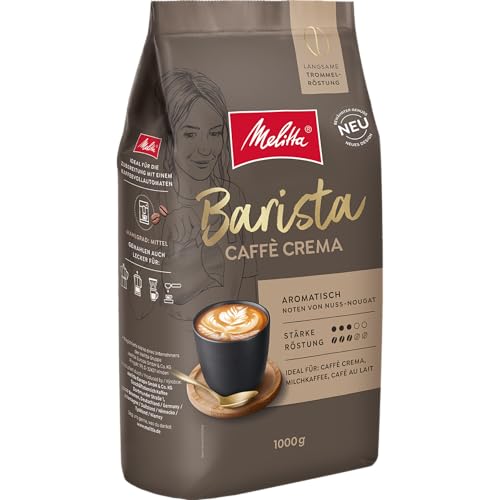
In the manufacturer’s shop the variety is called Melitta Barista Crema. On the front of the bag it says Barista in script, and below it in capitals Caffè Crema, and the Amazon catalogue adopts this pack name: “Melitta Barista Caffè Crema, Kaffeebohnen, Stärke 3/5, 1KG”. The word Classic from our page address appears in none of the three sources. Melitta speaks of its “Barista-Range”.
Melitta counts six products in this range. Whole beans in a 1 kg bag come three times, as Crema, Crema Forte and Espresso. Alongside them are a ground Barista filter coffee of 500 grams, an instant coffee called Barista Instant Crema Gold and Barista Lungo capsules in a pack of twenty.
That the Amazon listing really is the Crema is shown by the strength in the catalogue title: of the three Barista beans, only it carries a 3. Melitta’s pages have no link to Amazon, so the match rests on name and strength. The product image on Amazon fits, as it shows the same bag as the gallery on melitta.de.
What the bag says
Roasted coffee in whole beans, 1000 grams: that is the legal product name and fill quantity in the technical data. Melitta shows the strength in four places, always as 3, three of them explicitly on a five-point scale. The technical data say “Stärke: 3”, the description area says “STÄRKE 3 / 5”, on the bag three of five dots are filled, and the overview of the Barista range shows the same picture.
Directly below the strength, Melitta prints a second line headed Röstung (roast): five bean symbols, three of them filled, two only outlined. We consider two separate scales on one pack the most revealing detail. They mean that Melitta intends strength to be something other than roast level. Melitta does not explain anywhere what the strength is made up of, and so a Melitta 3 cannot be translated into the ten-point scale on which Jacobs places its Krönung Caffè Crema.
In words, Melitta describes the roast only in the Amazon catalogue, as a “mittlere Röstung” (medium roast) with a “sanften Röstprofil” (gentle roast profile). At the top right of the front it says “Langsame Trommel-Röstung” (slow drum roasting). In a drum roaster the green coffee tumbles in a heated, rotating drum.
As flavour notes Melitta gives “aromatisch, Noten von Nuss-Nougat” (aromatic, notes of hazelnut nougat), and we reproduce that as the manufacturer’s description. The technical data recommend the variety for a single drink, caffè crema. The bag and the Amazon catalogue extend the list with milk coffee and café au lait, two long drinks with a lot of hot milk. Espresso appears in none of these drink lists.
Bean-to-cup machine in the data, four ways in the banner
Under “Maschinenverwendung” (machine use), Melitta’s technical data contain a single word: Vollautomat (bean-to-cup machine). The banner in the description area of the same page lists more: “Ideal für die Zubereitung mit Vollautomat French Press Siebträger Handfilter”. The side panel of the bag separates the two levels cleanly. At the top it says “Ideal für die Zubereitung mit einem Kaffeevollautomaten”, below that “gemahlen auch lecker für:” (ground also delicious for) and four unlabelled pictograms. We read them as moka pot, French press, pour-over and portafilter; that is our interpretation, as there are no words there. Finally, in the Amazon catalogue the beans are suitable “für die Zubereitung im Vollautomaten oder gemahlen für den Siebträger oder der French Press”. The pour-over is missing from this version.
Four sources, four lists. Only the bean-to-cup machine appears in all of them.
More revealing than any banner is how Melitta sorts the variety in its own shop. The filter “Kaffee für Vollautomaten” shows the Barista Crema, together with Crema Forte and Barista Espresso. Under “Kaffee für Siebträger” there were seven products on 24 September 2026, and from the Barista range only the Espresso. In the filters for French press and pour-over, only the ground filter coffee appears from the range. Across the whole range Melitta writes that bean and roast are matched to the respective preparation method. We therefore read the sorting this way: the intended preparation of the Crema is the bean-to-cup machine, and everything else is the “gemahlen auch” from the side panel.
Incidentally, the banner with the four preparation methods is not a feature of this one variety. It reads exactly the same on the product pages of Crema Forte and Barista Espresso.
The side panel also carries “Mahlgrad: Mittel” (grind size: medium), with no connection to any of the preparations pictured. In the guide Setting your grind size you will find a table showing which setting belongs to which brewing method.
Is the Barista Crema suitable for espresso from a portafilter?
Ground, you can use it in a portafilter: Melitta names it in the banner, and the bag has a symbol that we read as a portafilter. The variety is recommended for caffè crema, though. For espresso, Melitta has a bean of its own in the same range.
Crema Forte stands at strength 4 at Melitta, described as “vollmundig” (full-bodied) with “Noten von dunkler Schokolade” (notes of dark chocolate), and like the Crema it is recommended for caffè crema. The Barista Espresso stands at strength 5, “intensiv” (intense), with “Noten von kräftigem Kakao” (notes of strong cocoa), and is the only one of the three recommended for espresso. Under machine use all three carry the same word, Vollautomat.
What a medium roast means in a portafilter can be derived from roasting chemistry; nobody has measured it on this bean. The lighter the roast, the more fruit acids stay in the coffee; the darker, the more roast bitter compounds form. An espresso from a medium roast therefore usually turns out more acidic than one from a dark espresso roast.
For the portafilter you need a grinder of your own with fine adjustment steps. The bag contains whole beans, and with espresso even small steps in grind size shift the flow time through the basket.
Cost per cup and storage
In the FAQ for its Molino coffee grinder, Melitta recommends 6 to 8 grams of ground coffee per large cup. The recommendation is general and not tailored to this variety. A kilo thus makes 125 to 166 large cups, and at approx. €17.99 per kilo a cup costs between roughly 11 and 14 cents. The division is ours.
A bean-to-cup machine doses by its own logic. How much it grinds per cup depends on the aroma setting and the drink. If your machine takes 10 grams, the kilo gives 100 cups at 18 cents each. A double espresso from a portafilter with an assumed 16 grams of grounds would come to 62 shots at roughly 29 cents each. You enter your own quantities in the Brew calculator.
On storage, the same FAQ has several points. “Der richtige Aufbewahrungsort sollte kühl, trocken und geruchsfrei sein.” (The right storage place should be cool, dry and free of odours.) The coffee should be protected from sunlight, heat and moisture, and the opened pack does not belong in the cupboard together with other strongly smelling foods. Then: “Wir empfehlen zudem die Kaffeebohnen nicht umzufüllen, sondern stattdessen in der Originalverpackung aufzubewahren.” (We also recommend not decanting the coffee beans but keeping them in the original packaging instead.) And only the amount needed for brewing should be ground. The advice applies to Melitta coffee in general.
Going by these instructions, we would fill the bean hopper of a bean-to-cup machine only with a supply for a few days. The rest stays where Melitta wants it, in the original bag.
What Melitta leaves open about this bean
There is no information at all on the blend, bean type and country of origin included. The place of roasting gets fiddly. In the Amazon catalogue it says “Geröstet in Deutschland” (roasted in Germany), and the roast profiles and recipes there come from the “Röstmeister in Bremen” (roast master in Bremen). The Melitta product page names as manufacturer Melitta Europa, Geschäftsbereich Kaffee, Dortmunder Straße 1 in 28199 Bremen, and the side panel of the bag adds as brand owner Melitta Europa GmbH & Co. KG in Minden. That roasting also takes place in Bremen does not follow from a manufacturer’s address alone.
Roasting time and roasting temperature of the drum roast, acidity and caffeine content are stated nowhere. An organic, Fairtrade or Rainforest Alliance seal appears neither on the product page, nor on the pack photos, nor in the Amazon catalogue. Roast date and best-before date may be on the back, which Melitta does not show; they cannot be found online, nor can a period of use for the opened bag. Whether the pack has an aroma valve or a reseal is left open by the photos, and the manufacturer is silent on the material and recycling of the bag. A dosing recommendation specifically for this variety is also missing, and for grind size it stays with the “Mittel” from the side panel. The download area of the product page says: “Zu diesem Produkt gibt es momentan keine Dateien, die zum Download bereit stehen.” (There are currently no files available for download for this product.)
Which other 1 kg bean comes into question
The Barista Crema is at the top, with three varieties from our catalogue below it that come into question for the same kitchen.
| Variety | Roast and origin | Price per kg | Our rating | Choose this if |
|---|---|---|---|---|
| Melitta Barista Crema (this one) | Strength 3 and roast 3 out of 5 according to the bag, roasted in Germany according to the Amazon catalogue, country of origin open | approx. €17.99 | 8.4 | you drink caffè crema or milk coffee from a bean-to-cup machine and now and then grind the same bean for a French press or pour-over |
| Jacobs Krönung Caffè Crema | Intensity 6 out of 10 according to the Amazon catalogue, beans from “the best growing regions” without country names | approx. €15.29 | 8.2 | you feed only a bean-to-cup machine and the price per kilo matters most |
| Melitta BellaCrema La Crema | Strength 3 out of 5 according to Melitta, medium roast level and roasting country Germany according to the Amazon catalogue | approx. €15.89 | 8.6 | you want to stay with Melitta and strength 3 and the price per kilo matters |
| 360° Rundum Ehrlich Bio Honduras | 100 percent Arabica from the Honduran highlands, organic, long and gentle roast according to the manufacturer | approx. €35.59 | 9.3 | you want to know the country of origin and bean type and are willing to pay almost twice the price per kilo for it |
The prices are guide values from our price boxes and keep shifting in the shops. The rating is our editorial assessment from the information available; we have not drunk any of the four varieties.
When the Barista Crema, when another?
The machine decides first. If you have only a bean-to-cup machine, our comparison offers two cheaper routes. The Jacobs Krönung Caffè Crema is €2.70 per kilo below the Barista Crema in our price box, the BellaCrema La Crema €2.10. La Crema has the same strength and the same machine statement, but in our rating it sits ahead of the Barista Crema. For a pure bean-to-cup household we would prefer it.
If a French press or pour-over also stands next to the bean-to-cup machine, that changes little in this calculation. The bag of La Crema also carries brewing symbols, and in the Amazon catalogue Melitta names pour-over, portafilter, moka pot and French press for it when ground. In the technical data, both varieties list the bean-to-cup machine alone. For the second preparation you need a grinder of your own, because a bean-to-cup machine delivers finished coffee, not loose grounds. How the French press works with coarse grounds is covered in the French press guide.
If you want one step higher on Melitta’s scale without leaving the range, you will find the Crema Forte there, from the espresso section above.
Country of origin and bean type are stated by the 360° Rundum Ehrlich Bio Honduras, which costs €17.60 more per kilo in our price box. More varieties with their details are in the coffee beans comparison.
Who is it suitable for?
For anyone who drinks decaffeinated, the Barista Crema is the wrong choice. The technical data say “Entkoffeiniert: Nein” (decaffeinated: no). Melitta itself has the BellaCrema Decaf in its range for this, also a kilo of whole beans, decaffeinated according to the technical data and recommended for milk foam specialities and caffè crema.
It gets harder for single drinkers. The overview of the Barista range shows the Crema only as a 1000-gram bag, according to the Amazon catalogue around 29.4 centimetres high, 14.0 centimetres wide and 8.0 centimetres deep. At one large cup a day, the kilo lasts a good four to five and a half months by the cup calculation above, and an open bag sits in the cupboard that long. Because Melitta advises against decanting, this cannot be solved with small tins that you open one after another.