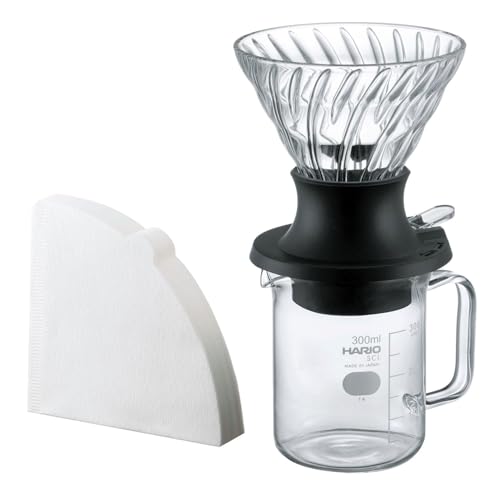
On the manufacturer’s sites this device is called the V60 Immersion Dripper Switch, in Japan Immersion Dripper SWITCH, and Hario Europe lists it under the item number SSD-5012-B. The name Start-Stop comes from German retail. It still describes fairly exactly what the lever on the base does: it holds the water in the funnel until you press. The same device therefore brews either like an ordinary V60 with drainage or with full steeping time like a French press, which Hario USA describes as a hybrid method.
In our catalogue the set stands at approx. €54.46 on Amazon.de and 8.7 out of 10 points; in the Amazon catalogue on 7 September 2026 it was €51.99, so €2.47 lower. Among the filter coffee makers it sits in the middle of the price range: more than twice as expensive as the Hario V60 Starter Set, a good fifth of what the Moccamaster KBG Select costs, and more expensive than four of the simple filter machines in this category. According to Hario Europe it is made in Japan, and it is supplied in black.
What is in the box: glass, silicone and a stainless steel ball
Hario Europe lists five components: the glass body, the base, the switch, the stainless steel ball and the glass server, which the spec line there calls a Measure Cup. In addition there is one consumable, 40 sheets of filter paper of the VCF-02W type.
Measure Cup is meant literally. In the product photo the glass carries a scale on the side, the 300 ml mark and the words Made in Japan, plus a handle and a pouring spout on the rim. So you read off the brewed amount on the cup itself, without putting it on the scale.
On materials, Hario is unusually precise. The glass body is made of heat-resistant glass, which the company markets under its own name HARIO Glass, and the US site explicitly names borosilicate glass for the glass body and the server. The base is silicone rubber, the switch PCT plastic, the ball stainless steel. How this combination holds up against a dripper made entirely of plastic, Hario does not say anywhere, and we cannot judge it: we have not handled either of the two devices.
According to Hario Europe the set measures 130 by 115 by 215 millimetres, and the global manufacturer page gives the weight including the individual box as around 700 grams.
A footprint cannot be derived from these figures, and that is not nitpicking. For the dripper alone, Hario gives not only 118 by 115 by 133 millimetres but also explicitly a diameter of 115 millimetres. The body is therefore round, and the extra three millimetres of width belong to the lever, which sticks out at the side. For the complete set, the product photo shows the same pattern: the measuring cup is cylindrical and has a straight handle, and the base is a round silicone disc that sits on the rim of the cup like a lid. The 130 millimetres of width span the handle and the lever, and there is no rectangular footprint behind it.
The Amazon catalogue gives different figures: 1.1 pounds, so about 500 grams, and packaging dimensions of roughly 22.9 by 13.7 by 13.5 centimetres. The 500 grams match the dripper without the server, which Hario lists individually as the SSD-200-B at approx. 500 grams, and for the complete set the figure is too low. Two more catalogue fields visibly belong to a different item: a feature bullet about an adapter for induction hobs and an energy efficiency class A+ for a device that needs no electricity.
In detail: how the ball in the base stops the flow
The funnel looks like a V60 and is one, except that it does not sit directly on the server but in a silicone base. In its outlet lies a metal ball that blocks the flow, as Hario Europe describes it. With the switch up, the outlet is closed and the water stays standing in the coffee grounds. If you press it down until it sits flush with the edge of the base, the ball frees the way.
Why this is more than a gimmick shows when you compare the two brewing methods. In an open dripper the water runs while you pour. There the contact time results from grind size, bed depth and pouring speed. It can only be lengthened indirectly, through a finer grind or slower pouring, and both interfere with the extraction at the same time. Turning one variable therefore shifts the other. With the ball closed, the contact time becomes a number you set yourself. The water stands until you press the lever, however coarse the powder is. That is what you pay the extra for here.
There is also a difference in flow. In the open funnel, the water finds the path of least resistance through the coffee bed; in the standing water of immersion this path does not exist, because nothing flows. That is how brewing theory describes the difference between immersion and pour-over. Nobody has measured it on this dripper.
The open mode is kept alongside. Hario USA explicitly describes the device as letting you pour either as with a normal V60 or work as an immersion brewer. If the lever stays down, the funnel works like an ordinary V60 standing on a base.
The recipe from the manual: 20 grams, 240 millilitres, two minutes
Medium grind, plenty of hot water, let it stand for two minutes, then the switch: that is how briefly the instructions put it. For a stronger brew Hario additionally recommends stirring. And then comes the sentence that hands the real work over to you: you are to adjust grind size and steeping time yourself until the result suits you.
20 grams to 240 millilitres is a ratio of 1 to 12, calculated from the two manufacturer figures. For filter coffee that is a strong dose. In our guide to filter coffee we otherwise work with 1 to 15 to 1 to 17, so in its own recipe Hario uses more coffee for the same amount of water. Our assessment: if the coffee is too thin, it is better corrected through the amount of coffee than through the two minutes, because the steeping time in the closed funnel can be fixed to the second here without anything else shifting along with it.
For the dripper, Hario gives 200 millilitres of finished volume. If you put this figure next to the 240 millilitres from the recipe, about 40 millilitres remain stuck in the wet coffee grounds and the paper. It was our editorial team, however, that linked the two values. At Hario they stand in two different places, the finished volume in the data sheet of the product page and the amount of water in the recipe of the manual. For 20 grams that is 2 millilitres per gram, and that is roughly the amount normally calculated for pour-over.
How to approach the grind size in small steps is explained in the guide Setting the grind size. For amounts other than the 20 grams of the manufacturer’s recipe, the brew calculator converts the ratio.
Is one batch enough for two cups?
For two small cups yes, for two large mugs no. Take one of the usual mugs with 250 millilitres: one batch does not even fill it completely.
A second batch costs the same time as the first: new paper, new grounds, two minutes of steeping again. And both portions together do not fit under the funnel, because according to the US page the supplied server holds a practical 300 millilitres. For two people you therefore need either a second vessel or patience.
The 200 and the 300 millilitres on this page are two different statements: the first belongs to the dripper, the second to the server. The Amazon catalogue lists only the first under capacity.
Filter paper, supplies and care
On the filter, the instructions are clear: use HARIO V60 paper filter 02. The set contains 40 sheets of VCF-02W, the same type that Hario also sells separately. According to Hario USA the paper is made of paper pulp, comes without chemicals and without adhesive, and is manufactured in Japan.
You can do the sums with the 40 sheets. With one brew a day they last just under six weeks, which comes to around nine packs of this size per year.
For care, the manual prescribes a soft sponge and a neutral washing-up liquid, and Hario rules out scouring agents and abrasive sponges. All parts can be taken off for cleaning, and before first use the set should be rinsed through once.
Two warnings from the instructions concern assembly. If the glass body does not sit properly in the base, the set can leak. And if the stainless steel ball is missing, hot water runs out of the bottom. Both sound banal, but both revolve around a small part that can disappear down the drain while rinsing.
Descaling is not needed here, because nothing heats. A limescale haze on the glass is a matter of looks and goes away with diluted acid.
What Hario does not state
The missing temperature in degrees for the pouring water is already in the FAQ further down, the instructions speak of hot water throughout. How many cups the 200 millilitres yield also remains open. Hario has weighed neither the set nor the dripper without packaging, and all weight figures include the individual box. For the server alone, dimensions, item number and the brimful volume are missing, and the only documented figure for it is the practical capacity.
The manufacturer gives no warranty period for Germany anywhere, and we found no spare parts offer for the ball, switch, base or glass body on any Hario page. When the Switch came onto the market, Hario does not say either, and the Amazon field with 25 May 2016 is a catalogue entry and not a manufacturer date. Whether the PCT plastic is BPA-free or carries a food-contact approval is not stated on any of the pages. On filter paper from other brands Hario expresses itself neither approvingly nor disapprovingly, its own 02 filters are prescribed. There is no German-language manufacturer page, and the instructions come in Japanese and English. And for longer steeping times or a bloom step before the immersion, the manual offers nothing, it stays with the two minutes and the advice to adjust it yourself.
Three alternatives from our catalogue
| Model | The difference | Price | Our rating | Choose this if |
|---|---|---|---|---|
| Hario Start-Stop Set SSD-5012-B (this one) | Ball in the base, steeping time controllable by lever, 200 ml per batch | approx. €54.46 | 8.7 | you want to set the contact time instead of guessing it through the grind size |
| Hario V60 Starter Set | Same 02 filter, plastic dripper without a ball, server with 600 ml | approx. €24.87 | 8.6 | you just let it run through in the morning and need two to four cups |
| Kalita Wave 185 | Stainless steel, flat bottom with three holes, its own Wave filters, no server | approx. €49.14 | 8.4 | you want consistent results without your own timing and you have a jug |
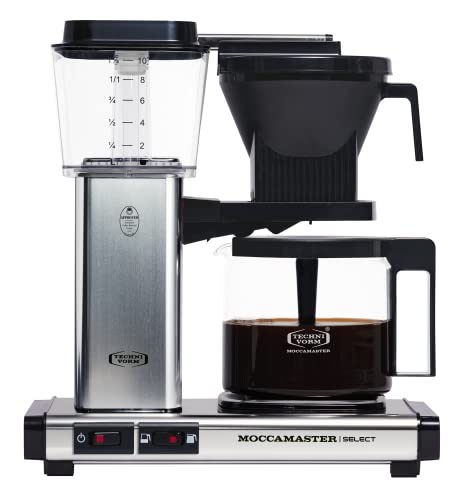
| Moccamaster KBG Select | Electric, 1.25 litres, 92 to 96 °C according to the manufacturer | approx. €259 | 9.5 | several cups should be ready in the morning without anyone standing at the kettle |
The prices are guide values from German retail for September 2026 and change faster than this page. The scores come from our editorial team, and we have never brewed the four devices side by side. More candidates are in the best filter coffee makers list.
When the lever is worth the extra cost
First work out the difference. The Hario V60 Starter Set costs approx. €24.87 and takes the same filter paper, but has no ball in the base. Without the lever, a function stays unused in the cupboard for which around €30 extra was due.
Then there is the equipment around it. The box contains neither a scale nor a kettle. We recommend a kettle with a thin spout mainly for the pour-over mode; in immersion the water stands still anyway, and there the scale is the more important purchase. Without it, you tip a different amount of coffee into the funnel every morning and at the same time hold the time to the second, which adds up to little.
For consistent results without your own timing, the Kalita Wave 185 is the more suitable purchase, because its flat bottom with three holes limits the flow rate by itself. The price for that is the dedicated Wave filters and no server in the box.
Then the amount in the morning. With four cups before work you brew four times in a row, each time with fresh paper and two minutes of steeping. In that case the Moccamaster KBG Select with 1.25 litres and the manufacturer’s 92 to 96 °C is the more honest choice, even though it costs almost five times as much.
Finally, willingness to clean. Base, ball and switch have to be taken apart and rinsed individually every day, an effort that does not end with unpacking. If you are not prepared for that, a dripper without moving parts is the more sensible choice, and which designs come into question is covered in the pour-over dripper comparison.
Who is it suitable for?
Our four individual scores for this set are 8.6 for build quality, 9.0 for performance, 8.2 for handling and 9.0 for value for money. Handling is the weakest of them, and two things lie behind that: the loose small part in the base and the single portion per batch.
The set suits a household in which one person brews their own cup in the morning and likes to play with the steeping time. It also makes sense as a second device next to a filter machine, because it needs no electricity and takes up no more space than the cup it sits on.
It is wrong for an office kitchen or a shared flat in which several people operate the same device. A base with a loose ball and a switch that everyone leaves in a different position cost more nerves there than the coffee is worth.
And anyone who still has their first pot of pour-over coffee ahead of them is better off starting without this lever. The basics are in the guide How to brew filter coffee; the switch is one more variable, and nobody needs that on day one.