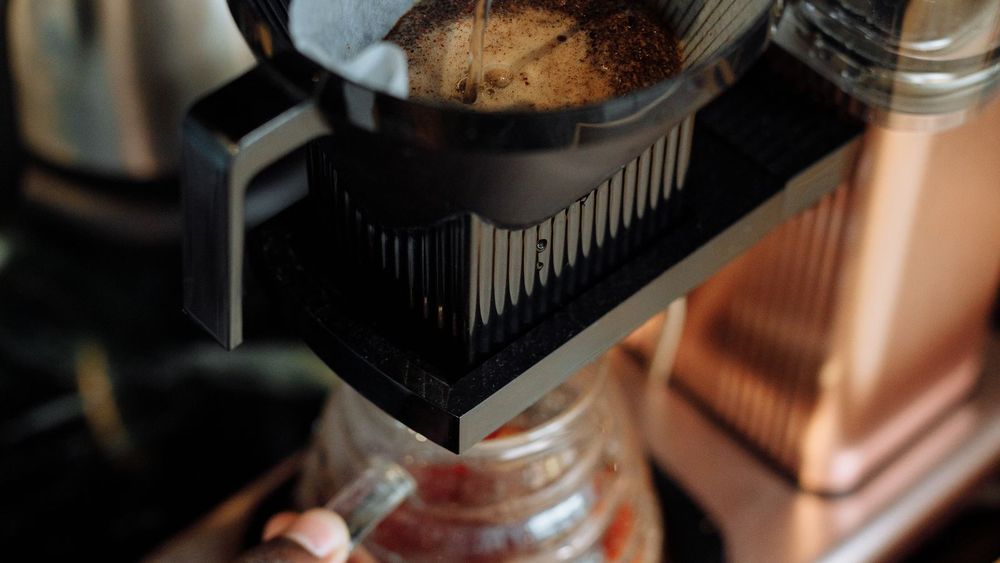
A glass carafe without a handle, a plastic cone with a glass server for just under €25, two machines with a built-in grinder and a filter machine that, according to Moccamaster, is assembled by hand in the Netherlands: the eight devices on this list hardly resemble one another. They share the method. Ground coffee sits in a filter, hot water dissolves what dissolves, and runs into the vessel below.
No water has run through any of these eight filters at our end. What is written here about the heating element, grinder, dripper or paper of a device summarises manufacturer documents and catalogue data and is backed with a source in its review; where we give our own assessment, it says so.
How these eight were picked from twelve
On 15 September 2026, twelve filter coffee makers have a review in Filter Coffee & Pour-Over. Sorted by overall rating and cut off after the eighth, that gives this page: first place stands at 9.5 points, eighth place at 8.2. Price and design had no weight in the selection.
The result still splits into two equal halves. The electric ones are the Moccamaster KBG Select, the Melitta AromaFresh X, the WMF Stelio Aroma and the Severin KA 4810, two of them with their own grinder. Built for pour-over are the Chemex carafe with six cups, the two Hario sets (Start-Stop and V60) and the Kalita Wave 185.
Where two places in the ranking lie close together, this page compares the four individual scores of the reviews: build quality, performance, handling, value for money. They grade manufacturer documents and catalogue data, and no measurement stands behind any of them. How uneven these documents are shows in the brewing time of the machines: for a full jug, among the four manufacturers only Moccamaster gives a figure, roughly six minutes.
Between the cheapest and the most expensive device on the list there are a good €234: the V60 Starter Set costs approx. €24.87 on Amazon.de, the Moccamaster approx. €259.00, also the most expensive product in our whole category.
Who heats the water and what slows the flow
The first dividing line runs between a heating element and a kettle. A filter machine heats the water itself and delivers it at its own pace. With pour-over you boil separately, and temperature as well as pouring speed are up to you.
This decides who answers for the brewing temperature. With the four machines it is the manufacturer, but only one commits: Moccamaster states 92 to 96 degrees and heats with a copper element for it. Melitta and WMF give the temperature of their devices nowhere. Severin lists an adjustable brewing temperature on the product page, but without a value, and no button for it appears in the manual.
With pour-over the manufacturers help to different degrees. The brewing guide from Hario UK works with 92 to 96 degrees for the V60. Kalita calculates in Fahrenheit, 195 to 205, which converts to roughly 91 to 96 degrees Celsius. Chemex leaves the water temperature open. For the Start-Stop set, the manual gives a component limit instead of a brewing temperature: the switch made of PCT plastic is designed for 100 degrees, so boiling water sits exactly on that limit.
The second dividing line concerns only the pour-over devices, and in our assessment it determines how much practice a device demands. The question is: what holds the water back? With the V60, at any rate, not the dripper. The 60-degree cone has a single large hole at the bottom, and according to Hario this opening does not slow the water. How long water and grounds stay in contact is therefore decided by grind size and pouring speed together.
The Kalita Wave 185 goes the opposite way. The grounds lie flat and at the same height across the whole surface, three small holes below slow the flow, and according to Kalita the water thus arrives evenly across the whole bed even when poured from one side. In the Start-Stop set, a stainless steel ball in the outlet of the silicone base holds the water back until you press the lever. The standing time becomes a number on the clock.
With the Chemex the difference lies not in the dripper but in the paper. Chemex states that its own bonded filters are 20 to 30 per cent thicker than those of most competitors and remove fats, bitterness, acid and sediment. On the point of acid the review disagrees: dissolved fruit acids pass through any paper, while fats and solids stay behind. According to Chemex, the channel at the spout serves as an air duct during brewing, through which the displaced air escapes from the carafe.
With the machines there is also the question of beans or ground coffee. The AromaFresh X has a ceramic grinder with eleven settings, adjusted at the dial of the bean hopper. The KA 4810 has a stainless steel conical grinder whose dial gets by without a number of steps and, according to the manual, may only be adjusted while the grinder is running. Both can be switched off. If you buy ground coffee anyway, you carry a grinder with you that never runs.
The eight places and what supports each
1. Moccamaster KBG Select (9.5)
The 2026 comparison winner is 0.6 points ahead of the Chemex, the largest gap between two places on this list. For a single cup in the morning it is too much machine; for daily jugs of bought filter coffee or from your own grinder it fits. What decides it in the review is not the equipment, which is limited to two switches, but what only counts after years: Moccamaster calls the machine repairable and all parts individually available, and the spare parts page lists the glass jug with lid as an article of its own.
2. Chemex Carafe 6 Cups (8.9)
Among the four pour-over devices on this list the Chemex has the highest rating. If you want as little oil and fines as possible in the cup, you are right with it; what it demands in filters over time is covered further down under the work after purchase. Where the points come from is shown by the individual scores: build quality 9.3 and performance 9.2 pull it up, handling at 8.3 pulls it down, because a handle is missing and there is no spare part for the glass body. Dripper and carafe are a single piece of borosilicate glass.
Only a tenth of a point behind stands the AromaFresh X, and in the individual scores the two mirror each other: the Chemex leads on build quality and performance, the Melitta on handling and value for money.
3. Melitta AromaFresh X (8.8)
The AromaFresh X holds the editors’ pick of the category as a device for freshly ground coffee without a second machine. It is 0.1 points away from the Start-Stop set in fourth place, and the two lie furthest apart on handling, 9.0 against 8.2, while the set leads on performance and value for money. The review justifies the pick less with the grinder than with the menu for water hardness. Four levels range from under 7 to over 21 °dH (German degrees of hardness), and from the chosen level the machine derives when it wants to be descaled. It is set to the highest level at the factory, so with soft water and no change you descale more often than necessary.
4. Hario Start-Stop Dripper Set (8.7)
The set is the only pour-over device on the list with a valve, and that turns a V60 into a device for immersion. It is narrowly ahead of the V60 Starter Set: the Starter Set wins only the value-for-money score, 9.3 against 9.0, while the Start-Stop set leads in the other three.
Its handling is weakest at 8.2, and the review gives two reasons for this, the loose ball in the base and the one portion per run. The valve makes sense for people who already filter by hand and want to experiment with contact time; whoever is just starting is better off with the V60 without a valve.
5. Hario V60 Starter Set (8.6)
The beginner pick has the highest value-for-money score of the list at 9.3, and whoever wants to learn pouring by hand seriously starts here. In the box are the plastic dripper in size 02, a glass server, 40 filters and a measuring spoon. Against this stands the open design described above under the dividing lines: the first jugs can therefore turn out differently.
6. WMF Stelio Aroma (8.5)
The Stelio Aroma sits in a housing made of Cromargan (stainless steel) and has the fewest controls of the four machines, namely one start/stop button. We recommend it when a filter machine should have a metal housing without belonging to the upper price class. A tenth of a point separates it from the V60 Starter Set, with the Stelio Aroma clearly ahead on build quality at 8.9 against 8.3 and clearly behind on value for money at 8.3 against 9.3. In the WMF data sheet, several equipment lines also say No, among them the function for one to four cups and an adjustable keep-warm time.
7. Kalita Wave 185 (8.4)
The Wave 185 is a dripper made of polished stainless steel, weighing 120 grams and with no moving parts. It trails the Stelio Aroma on build quality, performance and value for money; on handling it leads at 8.3 against 8.2. Kalita describes its base shape explicitly as a help for beginners. The scope of delivery is lean in return: only the dripper is supplied, and you buy the vessel below separately. We therefore do not see it as an entry-level device but as a second purchase for everyone who already filters by hand.
8. Severin KA 4810 (8.2)
In its favour, it combines grinder and filter machine in one housing and stays under €100. It becomes a fit from two to three people who empty a jug in one go. Against it speaks above all what is missing for descaling, namely a hardness setting, a limescale filter and a descaling indicator, and its performance score of 7.8 is the lowest individual score on the list. It is 0.2 points short of the Kalita Wave 185: the dripper leads on build quality and performance, on handling both stand at 8.3, and on value for money the Severin leads with 8.7 against 8.2. In the Severin shop it was marked as sold out on 8 September 2026.
The list as a table: difference, price, condition
| Model | The difference | Price | Our rating | Choose this if |
|---|---|---|---|---|
| Moccamaster KBG Select | Copper heating element, 92 to 96 °C according to the manufacturer, no grinder | approx. €259.00 | 9.5 | you prefer to replace parts one by one rather than the whole machine |
| Chemex Carafe 6 Cups | Dripper and carafe in one glass body, own bonded paper | approx. €56.67 | 8.9 | you pour three to six cups at a time by hand |
| Melitta AromaFresh X | Ceramic grinder with eleven settings, water hardness menu | approx. €166.99 | 8.8 | you buy whole beans and have only one spot free |
| Hario Start-Stop Dripper Set | Ball valve in the base, standing time by lever, 200 ml per run | approx. €54.46 | 8.7 | you drink alone and do not want to control contact time through grind size |
| Hario V60 Starter Set | Cone with one large hole, 600 ml glass server in the box | approx. €24.87 | 8.6 | you start without equipment and still plan for scales and grinder |
| WMF Stelio Aroma | Cromargan housing, one button | approx. €47.00 | 8.5 | you buy ground coffee and want to set nothing |
| Kalita Wave 185 | Stainless steel, flat base with three holes, only Wave paper 185 | approx. €49.14 | 8.4 | a vessel is already there and nothing should be made of glass |
| Severin KA 4810 | Conical grinder without a scale, no hardness setting | approx. €99.99 | 8.2 | you want to grind fresh and your limit is around €100 |
The calculation uses the guide prices shown in our price boxes on 15 September 2026, which can change daily. The rating column assesses data sheets, not the coffee in the jug.
Price tiers: what the extra money buys
Under €50 there are three devices on this list that share little besides the price class; in the whole category there are six, and the other three are missing here because of their rating and are listed at the end of the page. The V60 Starter Set for approx. €24.87 is a pouring set with a server. The Stelio Aroma for approx. €47.00 is a complete machine with a glass jug. The Kalita Wave 185 for approx. €49.14 is a single dripper, according to the catalogue exactly one piece. Whoever merely lays prices side by side here compares three different purchases.
The middle is tight. Between the Start-Stop set (approx. €54.46) and the Chemex carafe (approx. €56.67) lie €2.21, and for that amount the principle changes: on one side a valve for single portions, on the other a carafe for roughly 887 millilitres. Compared with the V60 Starter Set, the Start-Stop set costs €29.59 more, the Chemex €31.80 more.
At around €100 the grinder moves into the housing. Between the Severin KA 4810 (approx. €99.99) and the AromaFresh X (approx. €166.99) lies a difference of €67.00. According to the data sheets, this buys above all adjustability: settings on the grinder, a selectable water hardness and a keep-warm duration of your choice.
At the very top stands the Moccamaster KBG Select for approx. €259.00, €212.00 above the Stelio Aroma and €92.01 above the AromaFresh X. Compared with the Stelio Aroma you get only the Select switch in operation; compared with the AromaFresh X, the grinder and timer, among other things, are missing. What is paid for is 1,520 watts total power instead of the 1,000 watts of the WMF, 1,450 watts of it in the copper heating element, plus a stated brewing temperature and the repairability mentioned at first place. In our assessment, from this tier on the extra money buys hardly any more convenience, but above all what the manufacturer commits to in writing.
With the pour-over devices the calculation does not end at the till. The V60 review counts scales and a grinder as basic equipment that is not in the box, and additionally advises a kettle with a thin spout. Kalita’s own recipe also calculates in grams, and for pouring the manufacturer recommends a gooseneck kettle.
Who should take which maker
If you brew only for yourself in the morning and like standing at the kettle for a few minutes, a pour-over device is enough. With its 600-millilitre server, the V60 Starter Set fills two mugs of 250 millilitres in one go. With the Start-Stop set that does not work: Hario gives the finished quantity as 200 millilitres, which stays under one full mug of that size.
If you buy whole beans and drink more than two cups a day, the two machines with a grinder come into question, and the kitchen has a say. The AromaFresh X is 46.3 centimetres tall, and it needs air above to fill the bean hopper; under a wall cabinet with 45 centimetres of clearance to the worktop it has no room. The KA 4810 measures 43.5 centimetres according to the product page. Its manual also requires more than 15 centimetres of clearance to walls, more than one metre to heated or flammable surfaces and a dry, level, non-slip and heat-resistant surface that does not react with the rubber feet. Next to a cooker, the setup is more likely to fail on that metre than on the height.
If it should be a machine without a grinder and the jug is emptied within 40 minutes, the Stelio Aroma at approx. €47.00 costs you the least among the machines on this list. Two requirements from the WMF manual belong to the purchase decision: in operation the machine must not stand in a cupboard, and it runs only under supervision. Whoever lets it brew in the study while sitting next door acts against this manual.
If your needs swing between a full and a half jug, the Moccamaster KBG Select covers both: in the second position of the Select switch, according to the manual, the machine pumps more slowly so that the smaller amount of grounds stays in the water long enough. One condition for this is in the manufacturer FAQ. With a water softener in the house you set at most eight cups or switch to the half jug, otherwise the filter holder overflows.
At the weekend, when several cups should reach the table at once, the Chemex belongs there, because it is brewed in and poured from. It is wrong in households where everyone gets up at a different time: a hotplate is missing, and the only heat source Chemex approves is a low gas flame; the manufacturer rules out the microwave.
What takes work after the purchase
None of the four machines keeps the coffee warm for longer than an hour. The KA 4810 switches off after 35 minutes, the Stelio Aroma after 40 minutes of keep-warm time, the KBG Select 40 minutes after the start of brewing. Only on the AromaFresh X is the duration selectable, 20, 40 or 60 minutes, and Melitta notes in the manual itself that the taste changes with longer keeping warm on the plate. If the coffee should last through the morning, we would pour it into a thermal jug with all four.
For descaling the manufacturers go four different ways. The AromaFresh X reports the date according to the set hardness level with a red CALC LED and needs roughly 25 minutes for the programme, which must not be interrupted. WMF prints a table in the manual, each as a guide value for daily household use: up to 7 degrees of German hardness every six months, over 7 to 14 degrees every three months, over 14 to 21 degrees every six weeks, over 21 degrees monthly. Moccamaster counts in runs, every 100 brews and at least every three months, more often with hard water. For the KA 4810 the manual says only the word regularly, so the date belongs in your own calendar.
Pour-over devices have no heating element, so limescale does not settle in any pipe on them. What demands lasting planning with them is the paper. For the carafe, Chemex provides only its own bonded filters, FP-1, FC-100, FS-100 and FSU-100. Kalita designates the Wave 185 solely for Wave paper 185. According to its manual, the Start-Stop set requires V60 paper in size 02, and the Starter Set needs the same format, because the cut belongs to the 60-degree cone.
Four reviews of the category that are missing here
Four products of the category are not on this page, and the reason is the same for all: the overall rating. Missing by the narrowest margin is the Russell Hobbs Textures+ with 8.1 points and approx. €39.99, directly below the 8.2 of eighth place, and its build quality score of 7.6 lies below every individual score of the eight devices above. Its review has already been revised. It documents a 24-hour timer whose clock keeps the setting only as long as the plug is in, and the requirement to descale at least once a month with a descaler from the manufacturer. Whoever returns the Textures+ with limescale damage during the warranty period pays a repair fee according to the manual.
The reviews of the other three have not been revised yet: the Braun PurShine KF 1500 with 7.9 points for approx. €29.00, the Emerio CME-122933 with 7.7 points for approx. €22.99 and the Bodum Pour Over 1 l with 7.6 points for approx. €58.38.
That also leaves out the cheapest product of the category. The Emerio CME-122933 costs approx. €22.99, which is €1.88 less than the V60 Starter Set, which has the lowest price on this list. Cheaper than the Stelio Aroma in the category are only three filter machines, and all three are in this group: Textures+, PurShine KF 1500 and CME-122933.
All products on the list side by side
| Product | Type | Rating | Price | |
|---|---|---|---|---|
| KBG Select | Filter coffee and pour-over | ★★★★★ 4.8 | approx. €259.00 | View on Amazon → |
| 6-Cup Carafe | Filter coffee and pour-over | ★★★★★ 4.5 | approx. €56.67 | View on Amazon → |
| AromaFresh X | Filter coffee and pour-over | ★★★★☆ 4.4 | approx. €166.99 | View on Amazon → |
| Start-Stop Dripper Set 200 ml | Filter coffee and pour-over | ★★★★☆ 4.4 | approx. €54.46 | View on Amazon → |
| V60 Starter Set | Filter coffee and pour-over | ★★★★☆ 4.3 | approx. €24.87 | View on Amazon → |
| Stelio Aroma | Filter coffee and pour-over | ★★★★☆ 4.3 | approx. €47.00 | View on Amazon → |
| Wave 185 | Filter coffee and pour-over | ★★★★☆ 4.2 | approx. €49.14 | View on Amazon → |
| KA 4810 | Filter coffee and pour-over | ★★★★☆ 4.1 | approx. €99.99 | View on Amazon → |
The prices are guide values from our price boxes and change with the retailer. Prices are in euros from Amazon.de and may differ in your country. You will find the current status for each product on the linked product pages, and all products side by side in the comparison table.