Severin builds the KA 4810 as a machine meant to replace two purchases: the filter coffee machine and the grinder in front of it. In the manual, the type of appliance is simply called a coffee machine with grinder. Whether that adds up depends less on the grinder itself than on how precisely Severin describes it.
What the KA 4810 is and what it costs
Amazon has listed the model in its catalogue since 5 July 2016, so it is more than ten years old. In our price box it stands at approx. €99.99 on Amazon.de (as of September 2026); the Amazon catalogue showed €99.00 on 7 September 2026. In the Severin online shop the last price was €126.99, with €199.90 struck through above it as the original price, and on 8 September 2026 the KA 4810 is marked as sold out there. That leaves buying it from retailers only.
The article number in the manufacturer’s shop is 10004810000, the EAN is 4008146022098, and the Amazon catalogue gives the model number 4810-000. Severin itself is a family company from Sundern, founded in 1892, and its own manual lists eight product groups with over 250 products. One point matters most for the purchase decision: Severin lists a repair service for the KA 4810 and takes back electrical appliances, and the data sheet lists two spare parts with their own numbers, the glass jug GK 5410 and the permanent filter ZT 9064. The product page also gives two environmental details: the packaging is predominantly recyclable, and the machine itself contains no recycled material.
Design: beans on top, swivel filter below
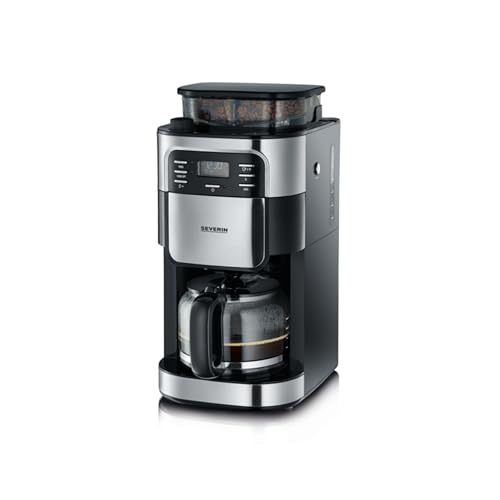
The product photo shows a tall, narrow body in black, with brushed stainless steel applications on the front. At the top sits the transparent bean hopper under a black lid, below it the control strip with the LC display, and at the very bottom the glass jug on the hot plate. In the data sheet, Severin describes the housing as a design with stainless steel applications, and the colour as brushed, black, silver.
On dimensions, the manufacturer sources contradict each other slightly. The product page and data sheet give 43.5 x 22 x 27 centimetres (height x width x depth), while the technical data in the manual give 215 x 430 x 315 millimetres (width x height x depth). The depth differs most, at 31.5 instead of 27 centimetres, plus five millimetres each in height and width. For planning your worktop, it is better to use the larger value; the height further down in this text is the one from the product page. On weight, a spread of around 240 grams remains: approx. 4.4 kilograms according to the manual, 4.44 kilograms according to the data sheet, 4,643 grams according to the product page, and the 9.70 pounds from the Amazon catalogue also correspond to around 4.4 kilograms. With the carton it is 6,191 grams, at packaging dimensions of 48.7 x 36.8 x 26.2 centimetres.
The bean hopper holds a maximum of 200 grams, the water tank 1,370 millilitres with a fill level indicator. According to the product page, both are non-removable, so you fill them on the standing machine. The equipment includes a filter ring, a filter holder of size 1 x 4 with drip stop, a permanent filter, a filter door, a measuring spoon and the hot plate. There are also non-slip rubber feet, an on/off switch and a cable winder.
Ten cups or eight? What really fits in the jug
Ten. The manual gives a tank volume of 1,370 millilitres for 10 cups of about 125 millilitres each, the data sheet says up to 10 cups, and the product page says 1.25 litres. The eight comes from the Amazon title, while the feature text of the same Amazon page speaks of up to 10 cups.
The manufacturer’s figure is what counts, and it is the same in the manual, data sheet and product page. In practice the number matters mainly because of one sentence in the manual: for brewing, all the water that has been filled in is used up. So you measure through the jug, which has a scale up to the mark 10 for this purpose. The product page and the data sheet also list an adjustable coffee quantity, and the Amazon bullet point mentions it as well; what is behind this line is one of the open points further down. For a single cup you fill in correspondingly little water, for ten up to the mark 10.
In detail: conical burr grinder and a dial without numbers
The product page, the data sheet and the Amazon feature text agree on an integrated stainless steel conical burr grinder. We consider this the better design compared with a blade grinder, and the reason is mechanical: a conical burr grinder crushes the bean between two conical surfaces with a defined gap instead of smashing it, and therefore produces more even grounds. Evenness is the lever for extraction in filter coffee, because particles that are too fine over-extract and particles that are too coarse under-extract.
The setting is made with a dial. If you turn it clockwise towards minus, the machine grinds finer, and in the opposite direction coarser. Severin gives no number of steps for it, and the word stepless appears in none of the three manufacturer sources. Two things follow: you cannot note down a setting you have found as a number, and you cannot correct it quickly either, because the manual requires that the grind size be adjusted only while grinding is running, since otherwise the grinder may be damaged.
For the direction, Severin gives a rule of thumb: grind finer for a light roast, coarser for a dark roast. How to feel your way from there to the right setting is explained in the guide Setting the grind size. For coffee that is too weak, the manual’s fault table names exactly two causes, a grind that is too coarse and too little coffee powder.
On bean material, the manual is strict: no caramelised or sugar-coated coffee beans, no raw coffee and no mixtures with raw coffee. Severin gives the reason that the machine may be damaged only for the raw coffee; the ban on sugar stands without a reason. Coffee powder does not belong in the bean hopper either. And when refilling the beans, the water tank should be closed, otherwise beans can fall into the water system and block it. As a suitable bean, the manual lists its own accessory ZB 8688, 500 grams of coffee for Severin coffee machines.
Operation: three aroma levels, a timer and the 35-minute limit
You set the coffee strength with one button in three levels, which Severin calls mild, medium and strong. You switch the grinder off with the GRIND OFF button, and an LED next to it shows the state. The KA 4810 then works as an ordinary filter machine with powder, and for this the manual provides a dosing table using the supplied measuring spoon: 1.5 to 2 spoons for 2 cups, 3 to 4 for 4 cups, 4.5 to 6 for 6 cups, 6 to 8 for 8 cups and 8 to 10 for 10 cups. This table is in the chapter on preparation with coffee powder.
You programme the timer by holding the PROG button for two seconds and then setting hours and minutes. A precondition is that the time of day was set beforehand. Important for your expectations: the programming works once at the set time, it is not a weekly profile. For the next morning you set it again every evening.
At the end of brewing, the machine gives three signal tones. It then keeps the coffee warm for 35 minutes and switches itself off automatically; the display also goes out 35 minutes after brewing, and without brewing already one minute after the last input. For the amount of powder beyond the measuring spoon table, the brew calculator helps. You can interrupt the brewing at any time by pressing a button, and the remaining water then stays in the tank.
Cleaning and descaling, as the manual states
Every day Severin requires two things: empty and clean the coffee jug, filter holder and permanent filter, and change the water to prevent germs forming. Before any cleaning, you pull the mains plug and let the machine and its components cool for at least 30 minutes.
The most important sentence is a prohibition, and it applies word for word: never immerse the machine in water or other liquids, do not clean it under running water and do not put it in the dishwasher. This concerns the machine, not the removable parts. According to the manual, the filter ring, permanent filter, filter holder and coffee jug may expressly go in the dishwasher. You wipe the filter door with warm washing-up water, the hot plate with a damp cloth, and the surface of the machine with a soft, lint-free cloth. For all parts in contact with water and coffee, only food-safe cleaning agents are permitted, and abrasive agents and scratching utensils are excluded.
To descale, you pour 80 millilitres of vinegar essence into the water tank and fill the coffee jug with cold tap water up to the mark 10. Beforehand you press GRIND OFF so that the grinder stays quiet. After the cycle comes a rinse cycle to remove residues of the water and vinegar solution. Severin does not prescribe an interval for this, the manual says only regularly. Since the product page also lists neither an adjustable hardness setting nor a limescale filter, and the manual describes no descaling reminder, the date belongs in your calendar. Some other manufacturers stagger their interval by hardness or use. The guide Descaling and cleaning sets the manufacturer values side by side and adds a staging by hardness range, which it expressly marks as its own assessment without a source.
That leaves the grinder. The cleaning chapter of the manual covers filter parts, jug, filter door, hot plate and housing surface. The bean hopper and grinding chamber do not appear in it, and that is a gap with consequences, because coffee oil in the grinder turns rancid over time. General notes on this are in the guide Cleaning a coffee grinder, but we would not build instructions for this machine from it: anyone who brushes it out dry does so without the manufacturer’s backing, and because the machine must not go under running water, the quick route is ruled out anyway.
What Severin does not state
Gathered in one place, so you know what you get no figure for when buying. Two equipment lines have no counterpart in the manual. The first is on the product page and reads adjustable brewing temperature: yes, but with no value and no range. The second is the adjustable coffee quantity, which is also in the data sheet and in the Amazon bullet point. The manual describes only cup count via the jug, coffee strength, grind size and timer; a button for temperature or quantity does not appear in it anywhere. Also without figures are the noise level of the grinder in decibels, the heat-up time and the brewing time for a full jug, the temperature of the warming plate, the energy consumption per brew and in standby, and the period of spare parts availability.
Three further points concern details that other suppliers give. First, Severin nowhere explains how the three aroma levels work technically, that is, whether through water quantity, flow rate or contact time; anyone who reads an explanation of this online is reading a guess. Second, the jug is described only by the word glass jug, with no proof of borosilicate and no wall thickness, and for the plastic share of the housing there is no breakdown of materials apart from the stainless steel applications. Third, there is no quantity of grounds per cup for bean operation, because according to the manual the dosing table applies to coffee powder. Severin also does not state the country of manufacture; the manual gives only the company seat in Sundern.
What else is worth considering?
| Model | The difference | Price | Our rating | Choose this if |
|---|---|---|---|---|
| Severin KA 4810 (this one) | Conical burr grinder in the housing, but no grind size scale and no water hardness setting | approx. €99.99 | 8.2 | you want to grind fresh and plan for only one machine and just under 100 euros |
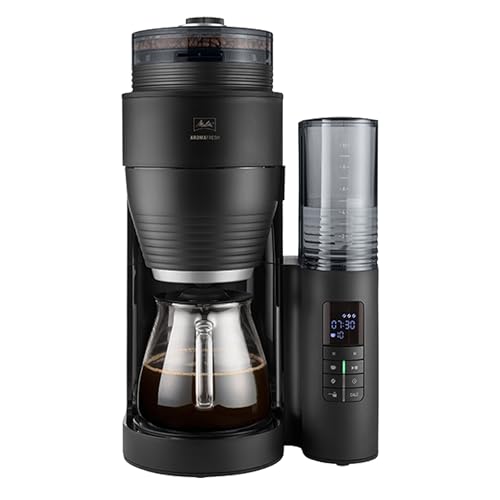
| Melitta AromaFresh X | Eleven fixed grind steps, adjustable water hardness with descaling programme | approx. €166.99 | 8.8 | you want to find your setting again reproducibly and have hard water |
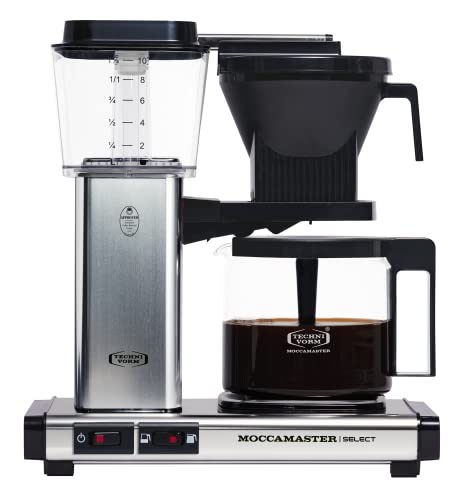
| Moccamaster KBG Select | Documented brewing temperature of 92 to 96 degrees, but no grinder and no timer | approx. €259.00 | 9.5 | you grind with your own grinder anyway and want a documented brewing temperature |
| WMF Stelio Aroma | Cromargan housing and exactly one button, no grinder in the machine | approx. €47.00 | 8.5 | you buy your coffee ground and want as little operation and technology as possible |
The prices are guide values as of September 2026 and change daily; the rating in the fourth column is our editorial assessment from the manufacturer data, not a measurement result from a laboratory. What the table cannot do: it does not compare grind fineness, because only Melitta quantifies it, with eleven fixed steps.
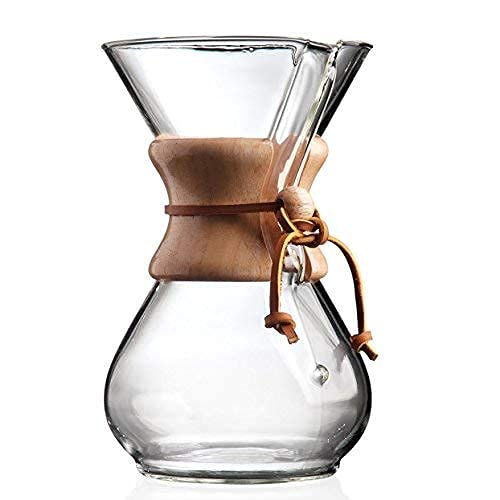
On price, it sorts out like this: the Melitta costs around 67 euros more than the Severin, the Moccamaster around 159 euros more, and only the WMF is below it. A look at the filter coffee section shows how thin things get between 47 and 100 euros: there is one filter machine without a grinder and four sets for hand pour-over, drippers and carafes. The next machine with a built-in grinder in our catalogue comes only at around 167 euros.
When the KA 4810 fits and when another machine is better
For one to two cups a day it is the wrong design, because of the logic of the jug: since the water filled in is used up completely, you measure anew each time, and the warming plate then runs for 35 minutes for a remainder that hardly anyone drinks. The machine becomes suitable from two to three people who empty the jug in one go.
Measure upwards before buying. At 43.5 centimetres high, the machine fits tightly under many wall cabinets, and the lid of the bean hopper has to be removed at the top, so you need clearance above it, not just beside it. Then there are the siting requirements from the manual: more than 15 centimetres of distance from walls, more than one metre from heated or flammable surfaces, and a dry, level, non-slip and heat-resistant surface that does not react with the rubber feet. In a narrow kitchen run, the metre to the hob is the harder condition than the height.
With hard water, the sums become less comfortable. Without a hardness setting and without a limescale filter, only the manual route with vinegar essence and a following rinse cycle remains. The Melitta AromaFresh X takes the bookkeeping off you with its descaling programme, for the extra cost shown above.
There is no measured value for noise, but Severin itself draws a line between its own models. The more expensive KA 4813 has a Be-Silent function that is not listed for the KA 4810, plus an LED touch display instead of the LCD. Otherwise the key data are identical: 1000 watts, 1.25 litres, stainless steel conical burr grinder and the same outer dimensions as above. In the Severin shop it shows €249.00 as the original price. Our assessment: if someone in the household is asleep while you make coffee, the more obvious solution is not the more expensive model, but GRIND OFF the evening before and ground coffee in the morning.
The KA 4810 is wrong for anyone who wants to rebuild their coffee by recipe. The figures you would need for this are above under What Severin does not state; a successful brew can be drunk without them, but not noted down and repeated next time. For that you need fixed grind steps and a scale. If you buy ready-ground coffee, you also pay for a moving part that never runs: the WMF Stelio Aroma does the same with one button and around 53 euros less.
Two small points get lost in the price comparison. The machine does not come ready to brew out of the box: before the first cup, the manual requires the complete daily cleaning and then a cycle with one jug of cold tap water, without coffee. And according to the Amazon feature text, the glass jug can be operated with one hand.