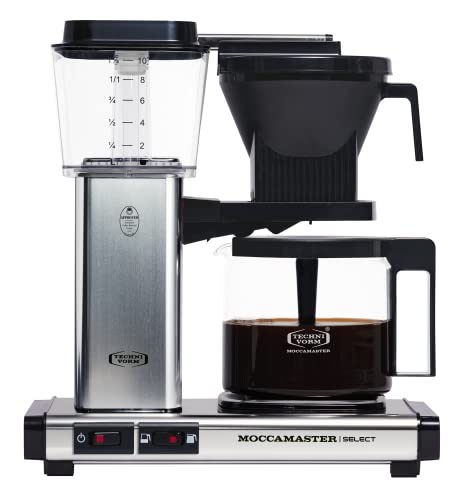
€259 on Amazon.de, as of September 2026. From the manufacturer the price list starts at €264.00, and because Moccamaster offers the KBG Select in 17 colours, the price can differ depending on the variant. For the money you get a filter machine with exactly two switches: one switches it on and off, the other sets half or full pot. Every product figure in this text is a manufacturer or catalogue figure with a source, or a calculation based on one, which we mark as such. Our ratings are editorial assessments. No figure rests on a measurement of our own.
Manufacturer, model number and what is in the box
In the box, besides the machine, you find the glass pot, a lid, the filter holder, the overflow tube, a measuring scoop, the manual and three no. 4 filter papers. A water filter cartridge and descaler are not included.
The pot holds 1.25 litres, which Moccamaster converts into 4 to 10 cups. We recalculated: ten cups from 1.25 litres is 125 millilitres per cup. If you count 200 millilitres for yourself, a full pot gives you a good six servings.
Behind Moccamaster is Technivorm B.V. of the Netherlands; according to the manual, Moccamaster is a registered trademark of that company. The variant listed on Amazon is called Polished Silver and runs at the manufacturer under article number 53970, EAN 8712072539709. The Amazon catalogue shows the same model number, so the match is unambiguous. The manual traces the manufacturing philosophy back to the founder Gerard Clement Smit and the year 1964, and according to the manufacturer every machine is made by hand and checked individually.
Aluminium outside, copper inside
The heating is copper, 1,450 watts. For the whole device Moccamaster states 1,520 watts, and the difference of 70 watts matches exactly the upper limit the manufacturer gives for the warming plate: 25 to 70 watts. Copper conducts heat many times better than stainless steel, which is the reason for choosing it. Whether the temperature really stays within the stated window in operation is vouched for by Moccamaster alone. The manual lists the copper heating element in its parts list under item 11, the enamelled warming plate under item 7.
The housing is aluminium, as the manual says. The data sheet on the product page summarises the same more briefly as metal and plastic, and adds that the plastic parts are free of BPA, BPS, BPF and phthalates.
Under the pot sits an enamelled plate with a PTC heating element, that is, a resistor whose value rises as the temperature increases. The hotter the component gets, the less current it lets through, and so it limits its own temperature through its own physics. We read it this way: the plate does not need a control board to do this job, which could fail later.
The water outlet above the filter is stainless steel and has nine holes. Nine exit points spread the water over a larger area than a single jet. That less powder stays dry at the edge as a result is our conclusion from the design. There is also a drip stop on the filter holder which, according to the troubleshooting table in the manual, can become blocked; the filter holder is then to be cleaned.
The machine takes up 32 by 17 centimetres of worktop and is 36 centimetres high. The cable measures 100 centimetres, and Moccamaster gives the weight as 2.8 kilograms. Electrically it is 220 to 240 volts, 50/60 Hz, plug type E/F, and the manual lists the EU directives on low voltage, electromagnetic compatibility, waste electrical equipment and hazardous substances. A data sheet with 120 volts and a switch-off only after 100 minutes belongs to the US model KBGV Select, not to this device.
92 to 96 degrees and the Select switch
Moccamaster gives the brewing temperature as 92 to 96 degrees, and the full pot runs through in about six minutes; a bullet point in the Amazon listing gives 5 to 6 minutes for it. In the pot the coffee arrives at 82 to 85 degrees, and the warming plate itself works between 80 and 85 degrees.
Why this particular window: below about 90 degrees the less soluble sugars and roast products barely dissolve, while the fruit acids go into the cup early. The result is under-extracted, with few dissolved sugars and proportionally more acidity. Well above 96 degrees, bitter compounds come along too. The difficult part is not the first pour but the six minutes after it: during the run-through, cold water keeps flowing in, and the temperature is supposed to stay in the window regardless. That is exactly what the copper heating element in the machine is for.
The Select switch has two positions, full pot and half pot. According to the manual, in the second position the machine pumps the water through more slowly in order to lengthen the extraction time. The reason lies in the physics of the filter bed: less powder slows the water less, and without a countermeasure the contact time would be too short.
According to the manual, brewing and keeping warm are separate systems. If the water tank is empty, brewing stops by itself, and 40 minutes after brewing starts the machine switches off completely. The glass pot stands on the hot plate from the start and is preheated on it, as the manual describes. For filling the tank, by the way, you are meant to use a different jug from the coffee pot.
Moccamaster gives no power consumption, but the lower limit can be calculated from its own figures. Heating 1.25 litres of water from 15 to 95 degrees takes around 0.12 kilowatt hours, without counting losses to the housing, pot and surroundings. At 1,450 watts of heating power that is just under five minutes of pure heating time, which fits the manufacturer’s figure of six minutes for the whole run-through. For the keeping-warm phase, at 25 to 70 watts another 0.02 to 0.05 kilowatt hours are added.
What is behind the ECBC seal?
According to the manual, a laboratory inspection by the Norwegian Coffee Association. The manual does not describe which points the inspection covers, and the German product page says only that the device is ECBC and SCA certified. That leaves the one sentence the manual writes about it: the seal is only given to products that pass the quality controls and laboratory checks of the Norwegian coffee association.
Our assessment: the seal is the most verifiable part of the data sheet, and it says nothing about whether you will like the result in the cup. That depends on the bean and the grind.
Its reach should be mentioned. According to the manual, Technivorm is the only manufacturer whose machines may all carry the ECBC certificate. Within the brand the seal therefore separates nothing: the KBGT with thermal carafe carries it just as this model does.
The dosing recommendation comes from the same standard. The manual gives 60 grams of coffee per litre as the ECBC standard, so 75 grams for the full 1.25 litre pot. That works out at just under 17 millilitres of water per gram of coffee. On grind size the manual leaves no room: quick-filter grind belongs in this machine, espresso grind is too fine and makes the water run through more slowly. The consequence is in the troubleshooting table: the filter holder overflows.
What Moccamaster leaves open
A data sheet also shows what you look for in vain. For the KBG Select that is: the capacity of the water tank separately from the pot volume and whether it has a scale, the millilitre amount a cup is based on, the time to the first drop and a tolerance for the 92 to 96 degrees. Also a noise level in decibels, the consumption per brew and in standby, the cooling behaviour of the plate after switch-off, the weight of the glass pot, the clearance needed to open the tank lid, the price difference between the 17 colours, a limit in degrees of German hardness (°dH, German degrees of hardness) from which descaling must be more frequent, and where to find the serial number for a warranty claim. Whether the Select switch also changes the temperature of the warming plate, Moccamaster states only for the US model KBGV Select, not for this one. Which components besides heating element, plate and water outlet are inside the housing also remains open in the manufacturer’s documents.
What the glass pot is made of, the manufacturer says neither on the product page nor on the spare parts page. Borosilicate glass appears at retailers, nowhere at the manufacturer, which is why we do not present it here as fact. There is likewise no expected service life in years. Figures such as ten or twenty years, which circulate in buying guides for this device, Moccamaster has never given.
In four places the Amazon listing and the manufacturer’s figures differ. The listing gives six instead of four cups as the smallest quantity, 1968 instead of 1964 for the start of hand assembly in the Netherlands, 4.409 pounds and so roughly 2.0 kilograms instead of the 2.8 kilograms from the data sheet, and it attributes an antibacterial effect to the copper that none of our sources documents. Who wrote the listing text is not stated, so in case of doubt we take the manual and the product page. On the dimensions the two agree: 14.17 by 12.60 by 6.69 inches in the Amazon catalogue are, rounded, the same 36 by 32 by 17 centimetres.
Three alternatives from our catalogue
| Model | The difference | Price | Our rating | Choose this one if |
|---|---|---|---|---|
| Moccamaster KBG Select (this one) | Copper heating element 1,450 W (device 1,520 W), ECBC certified according to the manufacturer, no grinder | approx. €259 | 9.5 | you already have a grinder and brew half to a full pot every day |
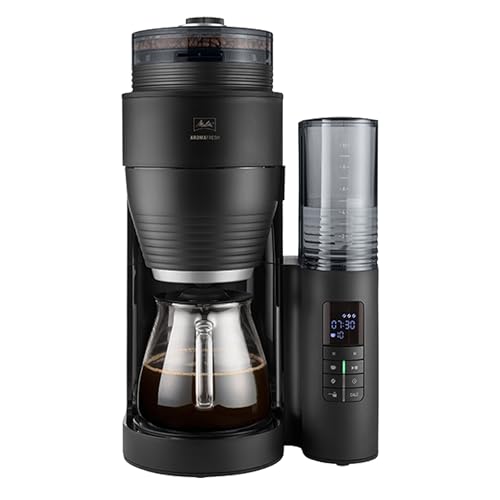
| Melitta AromaFresh X | Ceramic grinder with 11 grind settings on board | approx. €167 | 8.8 | you want to brew from whole beans but have no room for a second device |
| WMF Stelio Aroma | According to WMF up to 10 cups of 125 ml, litre figure contradictory, 1,000 W instead of 1,520 W, Cromargan housing | approx. €47 | 8.5 | you want to stay under €100 and the pot is empty within half an hour anyway |
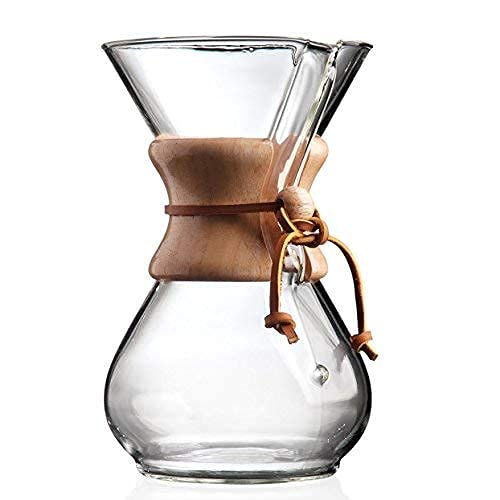
| Chemex carafe 6 cups | No electrics, you pour by hand | approx. €57 | 8.9 | you would rather put your budget into beans and a grinder than into a machine |
The prices are indicative figures from the data sheets of our own reviews, as of September 2026, and they change daily. The rating column summarises how we classify the data situation and features of the four devices. What ends up in the cup is in none of their columns.
When the KBG Select fits and when another machine does
Four to ten cups is the quantity range Moccamaster gives; the full 1.25 litre pot corresponds to ten of them, and the Select switch covers the half fill as well. For a single cup in the morning that is too much machine; you brew more cheaply and flexibly with a manual filter. Ground filter coffee or a grinder alongside is a prerequisite, and the grinder comes on top of the €259.
There is no milk system; cappuccino is not intended with this device. The 36 centimetres of height in the data sheet are the machine only: add enough air for the water tank lid to open. Under a wall cupboard you are better off measuring beforehand. The cable is one metre long, so the socket should be close.
What else belongs here is not in the machine but in the water pipe: if you have a water softener in the house, then according to the manufacturer’s FAQ you should set at most eight cups at once or put the Select switch on half pot, because otherwise the filter holder overflows. How hard the water from your tap is, the drinking water report of your supplier tells you, and what the degrees mean for the machine is explained in the guide to water hardness and coffee.
What care requires and what the warranty excludes
Moccamaster gives every 100 brews as the descaling interval, but at least every three months, more often with hard water. Vinegar and organic descalers are explicitly excluded, and that has a legal consequence: according to the warranty terms, damage caused by unsuitable cleaning or descaling agents is excluded. Before the very first coffee the manual asks for one to two runs with clear water. How to proceed with limescale in detail is covered in the guide to descaling and cleaning.
According to the manual, the interior should be cleaned four to six times a year, depending on use. On the outside a damp cloth is enough, once the plug has been pulled and the device has cooled. For the glass pot, hand washing applies, without abrasive cleaners and without steel wool, and a pot with a crack or a loose handle should no longer be used. At the end of its life the device does not belong in household waste.
Among the running costs the coffee comes first: with one full pot a day, 75 grams daily is around 27.4 kilograms a year. What that costs depends solely on the bean. On top come no. 4 paper filters and a descaler. How to convert water and coffee for a different quantity is done by the brew calculator.
According to Moccamaster’s warranty terms, as of September 2026, it is five years from the purchase date for private use, and your statutory warranty rights (Gewährleistung) are not affected by this. Loose parts such as the pot, filter holder, water outlet and covers are excluded, and the claim lapses as soon as an unauthorised workshop works on the machine or third-party parts are fitted. Spare parts go through the retailer or directly through the manufacturer; for service the manual gives info@moccamaster.de.
Who the KBG Select is built for
The KBG Select is our comparison winner 2026 in the Filter coffee & pour-over area. The deciding factor is the part of the data sheet that only counts after years: Moccamaster writes that the machine is repairable and that all parts are available individually. You can check this on the spare parts page, which lists the glass pot with lid under article number 89830 for €26.50. How long after the end of production it will still be supplied, the manufacturer does not say. Which other filter machines are in our catalogue is shown by the filter coffee comparison.
For the office it is the wrong choice. There Moccamaster shortens the cover to two years, and the machine switches off 40 minutes after brewing starts, whereas in an office kitchen coffee is more likely to be wanted ready all morning.