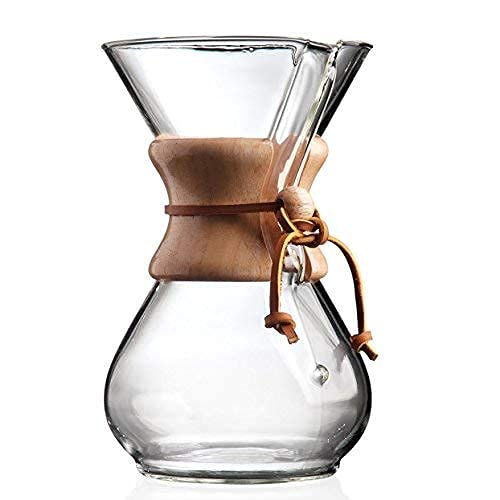
Peter Schlumbohm was a chemist, and Chemex counts more than 300 patents to his name, from the cocktail shaker to the automobile. One of them is this coffee maker: designed and patented in 1941, with the first US patent, number 2,241,368, following in 1942 according to the manufacturer. As models for the shape, Chemex names the Bauhaus school and the non-porous laboratory glass from Schlumbohm’s chemistry experiments. The Erlenmeyer flask that product descriptions like to mention alongside does not appear on any of the manufacturer’s pages we looked through for this. It still brews on the same principle, and in 2026 the design turns 85.
In our catalogue the 6-cup version stands at approx. €56.67 on Amazon.de and 8.9 out of 10 points; in the Amazon catalogue the price on 7 September 2026 was €58.91, which is €2.24 higher. That puts it, in our comparison of filter coffee makers, above four drip machines and the three manual drippers from Hario and Kalita in price; only the Bodum Pour Over and the three machines from around €100 are more expensive.
Museums took up the coffee maker early. According to Chemex, MoMA in New York has 23 of Schlumbohm’s inventions in its permanent collection, and the manufacturer dates the recognition to 1943. On the list of the 100 best-designed products of modern times compiled by the Illinois Institute of Technology, the Chemex ranks number 36 according to the manufacturer, the only coffee maker at all. The Amazon bullet point lumps both honours together and credits the list of 100 to MoMA.
The carafe needs no power: no heating element, no automatic shut-off. You boil the water separately and handle the timing yourself.
Glass from Taiwan and Germany, assembled in Massachusetts
The carafe is a single piece of borosilicate glass in an hourglass shape, the same material that according to Chemex is used in laboratories and releases neither chemicals nor flavours into the coffee. There is no plastic and no metal on the way from the water to the cup. Around the waist sits a collar of rubberwood, with a bead of the same wood and a tie of full-grain leather. That is what the Classic Series support page says, and it is more precise than the polished wood in the product description.
For the CM-6A, Chemex gives 8 1/2 inches in height and 5 1/8 inches in diameter, which converts to roughly 21.6 and 13.0 centimetres. The Amazon catalogue also lists 1.35 pounds, so roughly 0.61 kilograms, as well as 9.6 by 6.3 inches. These values are above the manufacturer’s dimensions and evidently refer to the shipping unit; no weight for the carafe itself appears on any Chemex page. More important than the footprint is the space above it anyway. You pour from above into an open funnel, and the kettle has to clear the rim.
During brewing the spout is more than a spout. Chemex describes it in the FAQ as an air channel: the groove lets out the air that the incoming water displaces from the lower chamber. The small glass nub on the belly, known in factory jargon as the bellybutton, marks the half-fill level on all models from five to ten cups.
In the box you will find the carafe, collar and leather tie. There is no lid; Chemex sells the Glass Coffeemaker Cover separately for US$9.50. According to the manufacturer, every carafe is inspected, polished and hand-tied at the plant in Massachusetts, where Chemex also makes every filter. According to the Chemex FAQ, the glass of the Classic Series comes from Taiwan and from Germany, and the company has been family-owned for over 40 years.
The Amazon catalogue lists the same device under model number CM-6A, colour Clear, size 6 cups. This is the number to look for when buying accessories, because Chemex grades filters and collars by size.
Six cups are 30 ounces: quantity, dose, grind size
Chemex counts one cup as 5 ounces, so six cups are 30 ounces. That is roughly 887 millilitres. Because the manufacturer works exclusively in ounces, the millilitre figure is our conversion, rounded on this page to approx. 900 ml. If you take a 250 millilitre mug as your yardstick, you end up with three and a half fills per pot, not six. The six cups of the model name are small cups.
For the dose, Chemex gives one heaped tablespoon of ground coffee per 5 oz cup, so around six for a full carafe. There is no weight in grams and no coffee-to-water ratio anywhere from the manufacturer, and the tablespoon is an elastic measure: how much fits depends on the grind size and the roast level, because darker roasted beans are less dense than light ones. If you prefer to work with scales, get the quantity for a full carafe from the brew calculator and weigh once what six spoonfuls of your own beans actually come to.
The Chemex FAQ sets the grind size at medium-coarse, saying it gives the best extraction and the right flow speed. How to work your way towards it systematically is covered in the guide on setting the grind size. The short version: start coarse and go finer in small steps until the flow is right.
Chemex explicitly recommends letting the coffee bloom, saying it improves the flavour. Because the coffee bed lies flatter in the wide funnel than in a narrow cone, the water of the first pour spreads over a larger area here. We would therefore rather use a little more water in the first pour and wet the grounds completely before the main pour begins.
In detail: what the bonded paper holds back
The real difference from every other manual dripper lies in the paper. Chemex states that it is 20 to 30 percent thicker than that of most competitors, and describes the effect like this: the bonded filters work like laboratory paper and remove bad fats, bitterness, acidity and sediment. That is the manufacturer’s wording, and on the point of acidity it is generous. Dissolved fruit acids pass through any filter paper; what stays behind are fats and solids. That is our view; Chemex sees it differently.
Where this comes from: paper largely holds back the fat-soluble diterpenes cafestol and kahweol. That is well-known coffee chemistry; nobody has measured it on this carafe. There is less body and less mouthfeel in the cup, while what is water-soluble comes to the fore.
In the pour-over dripper comparison the thick sheets sit next to V60, Kalita and Melitta papers. If you want body, a French press or a permanent metal filter serves you better, as oils and fines end up in the drink there. The Chemex goes consistently in the other direction. For it the paper is a component and not an accessory that you swap for a finer or coarser one.
Filter price, spare parts and the risk of breakage
For this carafe Chemex lists four filter models, FP-1, FC-100, FS-100 and FSU-100. The pre-folded squares FS-100 cost US$11.00 for 100 in the manufacturer’s shop, which works out at around 11 US cents per filter. If you brew a pot every day, you need 365 sheets a year, around US$40, spread over just under four packs. This is calculated with US shop prices; they show the order of magnitude and not your till receipt.
Two items from the accessories range can come on top: the carafe brush for US$22.00 and the glass lid from the section above.
Spare parts are thin on the ground. Chemex lists collar, bead and leather tie, and that is the whole list, and on the product page the manufacturer explicitly excludes any warranty against breakage. If the carafe falls, it is gone, and the replacement costs the same as the first purchase. For a device made entirely of glass this is the hardest point in the buying decision.
What Chemex does not state
For a product built on the same principle since 1941, the data sheet is short. A water temperature appears neither on the product page nor in the FAQ nor on the support pages. Also missing are the flow time for a full carafe, the bloom duration in seconds, the grind size in micrometres or as a click setting on a particular grinder, the weight of the filter paper in grams per square metre, and any temperature limit for the borosilicate glass. How hot the water may be and how abrupt the temperature jump may be when rinsing is therefore not answered by the manufacturer itself.
A good deal also remains open on materials. Chemex nowhere says where the wood and leather come from, nor whether the collar is lacquered or treated to be food safe. The manufacturer does not prescribe a roast level for the Chemex, so light or dark is your decision. The US shop grants a return period of 30 days, but says nothing at all about statutory warranty rights in German retail, where the statutory regulation between you and the retailer applies.
What are the alternatives?
| Model | The difference | Price | Our rating | Choose this if |
|---|---|---|---|---|
| Chemex CM-6A, 6 cups (this one) | Funnel and carafe from one piece of glass, 887 ml per brew, only its own bonded filters | approx. €57 | 8.9 | you brew three to six cups at a time and reorder the filters deliberately |
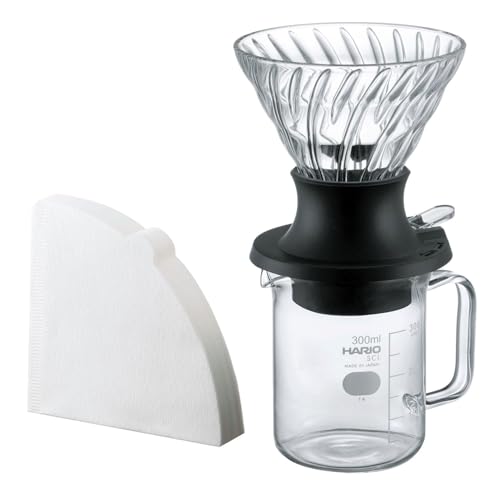
| Hario V60 Starter Set | V60 paper in size 02 as a regular Hario catalogue item, dripper and server in a set | approx. €25 | 8.6 | you want to start out with dripper and server in one box for under €25 |
| Kalita Wave 185 | Stainless steel dripper with a flat bottom that sits on a jug you already own | approx. €49 | 8.4 | you mostly brew two to four cups and want nothing fragile in the cupboard |
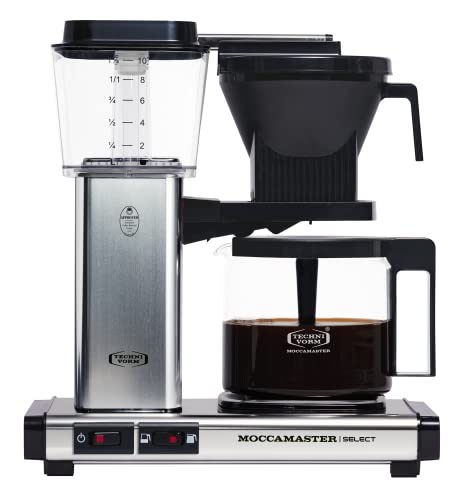
| Moccamaster KBG Select | Electric, 1.25 litres, copper heating element with 1,450 W and 92 to 96 degrees according to the manufacturer instead of a manual pour | approx. €259 | 9.5 | you want to press a button in the morning instead of standing at the kettle |
The prices apply to September 2026 and change faster than this page. The scores are our editorial rating made up of four individual marks; we did not brew the four devices against each other. More candidates are in the best filter coffee makers list.
When the Chemex fits and when another manual dripper does
Quantity decides first. 887 millilitres per brew is meant for three to six cups. Below roughly 400 millilitres it becomes impractical, because the grounds then lie as a thin layer on a wide surface and the water looks for its shortest path. For one or two cups you are better off with a small cone.
Next comes the filter question, and it is a question of habit. The Hario V60 also needs its own format, V60 paper in size 02, which Hario lists under its own item numbers; a trapezoid filter does not fit in it. If you order online anyway, being tied to one filter model changes little.
Your time budget in the morning is the third point. A manual pour does not run on its own; you stand at the kettle and split the water into several pours. If you would rather press a button, the Moccamaster KBG Select is the right one, which leads the category in our comparison and costs around €259.
Then the grinder. Medium-coarse means in practice that a pure espresso grinder reaches its limits, and pre-ground coffee from the supermarket is matched to machine filters. Whether it is coarse enough you only see from the flow, because coffee ground too fine dams the water up in the funnel.
Finally the grip. The Classic Series has no handle, the wooden collar takes over that job, and according to the Amazon bullet point it is heat-insulated. If that is not enough for you, Chemex lists its own Glass Handle series with an attached glass handle.
Cleaning: dishwasher yes, collar off first
The glass may go in the machine. Chemex explicitly allows this in the FAQ once collar and leather tie are removed. That is the only condition the manufacturer sets for it.
For hand washing Chemex sells its own brush. The trick with rice grains and water that circulates as a home remedy for narrow glass necks does not come from there. We would not swirl hard grains in a glass body for which there is no breakage warranty.
Descaling is not needed at all here, because the carafe has no heating element on which limescale could build up. A limescale haze on the glass is a question of appearance. Against a coffee film, hot water with a little washing-up liquid is enough; against limescale only acid helps, so diluted vinegar or citric acid, followed by a thorough rinse. We would let the carafe dry before reassembling, because wood and leather sitting on wet glass stay wet.
Who is it suited for?
The Chemex fits a household that has time for a pour-over at the weekend or after work and needs three to six cups at a time. In our rating, build quality at 9.3 and performance at 9.2 pull the score up, while handling at 8.3 pulls it down. Behind that stand two things: no handle, and a glass body for which there is no spare part.
If you want to put the pot on the table, you get two things in one. In the Amazon bullet point Chemex advertises the carafe as a filter coffee maker and decanter at once, and credits the pouring groove with drip-free pouring. Brewing and serving happen in the same vessel, with no decanting.
The carafe is wrong for households where everyone gets up at a different time in the morning. What stays in the pot cools down, and a hotplate is not part of the system. The small gas flame is the only heat source the manufacturer approves, and it does not replace a keep-warm function.
If you handle children in the kitchen or regularly carry the full pot through the home, take the breakage exclusion seriously. Filter coffee is also available in stainless steel, for instance with the Kalita Wave 185, whose dripper sits on a jug you already own.