Kalita lists this hand filter as the Wave Dripper 185 under item number 05033. The trade catalogue shows the same sequence of digits as model and part number 5033, which makes the match unambiguous. Stainless steel, made in Japan, designed for two to four servings. Our price box lists approx. €49.14 on Amazon.de, the same amount the catalogue showed on 7 September 2026.
Kalita was founded in October 1958 in Nihonbashi in Tokyo, has been a joint-stock company since 25 July 1959, and according to its own company chronicle its quality management has been ISO 9001 certified since April 2002. The head office is now in Yokohama, Kanagawa-ku, Koyasu-dori 1-111-1, where the company only moved in October 2011. For the 2021 financial year, Kalita states 70 employees and share capital of 32.94 million yen. The US presence describes the company as a pioneer of the Japanese coffee movement and states the manufacturing principle as Made in Japan, with Japanese materials or traditional craft techniques. In our Filter coffee and pour-over category, the Wave 185 stands at 8.4 out of 10 points.
Kalita has taken the product page for 05033 off the web, and the dripper has disappeared from the overview of the Wave series. Dimensions, weight and material are therefore given here from two archived versions of exactly this page, captured on 29 June 2016 and on 20 January 2020. Both carry the same item number as today’s trade listing, so the match does not depend on the age of the source. The second source is kalitausa.com, and it is not an ordinary retailer’s shop: Espresso Parts and Kalita Japan merged in 2016, and since 2022 the US brand presence has run through this address. We treat it as a manufacturer source and state where a detail appears only there.
Dimensions, weight and what the product photo says
The archived manufacturer page gives 140 by 115 by 70 millimetres for the body, plus 120 grams. The material is given there as stainless steel, with no alloy and no grade, and the catalogue lists the surface as polished. Kalita itself describes the dripper as a stainless steel part with a neat-looking wave pattern.
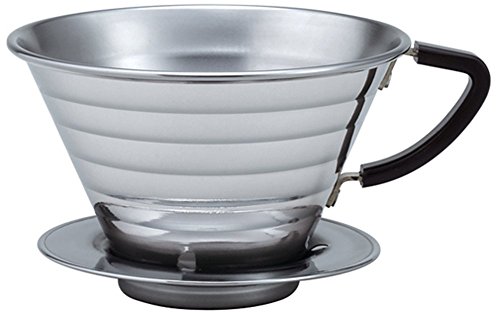
The product photo takes you further. The body is round and tapers conically downwards, and the wave steps that give the series its name run around the outside. A black loop handle sits on the side, and at the bottom the dripper has a continuous flat ring as its base. No individual feet can be seen on it. The picture suggests that the 25 millimetre difference between 140 and 115 is accounted for by this handle; standing upright, the dripper would then need less space than the longest edge suggests. That is not a manufacturer statement but our inference from the photo and the dimension sheet.
For the base, the seller’s catalogue text provides two figures. The flat coffee bed has a diameter of 5.1 centimetres, the entire base 10.2 centimetres, and the dripper is said to fit almost all cups and carafes. The dimensions in the adjacent field, by contrast, are unusable: 0.98 by 1.89 by 1.77 inches at 0.02 pounds would be nine grams and a housing narrower than the base diameter from the same entry. A capacity in millilitres is stated nowhere, and we do not calculate one from height times base area; for a conical dripper with a wavy wall the result would be a number that nobody could fill.
In detail: three holes, a flat bed, twenty waves
Kalita calls its own method the Kalita style and defines it as a combination of its in-house three-hole dripper and a paper filter. The Wave 185 is the stainless steel version of this idea.
Two components work together here. The coffee bed sits flat on a base with three small extraction holes, and above it lies the wave filter with twenty folds, patented according to Kalita, which keep the paper away from the wall. Because the contact area stays small, the water is said to drain freely, evenly and at the right pace instead of pooling in one spot in the filter; that is how the manufacturer describes it.
Kalita’s reasoning for the flavour hangs on this. Because the liquid does not stand for long either in the paper or in the wave zone, fewer bitter and off flavours would be extracted; the caption on the Japanese page speaks of an extraction without taste imbalances. Where this comes from is a manufacturer statement about its own design. We have no measurement on this, and we have not measured anything on this dripper ourselves.
The second point concerns the pouring hand. Kalita writes that the flat bed spreads the water evenly through the coffee grounds even when you pour from one side, and that the three-hole structure together with the flat wave filter leads even beginners to a cup with stable flavour. The difference from a conical dripper is pure geometry: there the bed narrows towards the point, the grounds lie higher in the middle than at the edge, and the flow depends on one single large opening. Here the grounds stand at the same height across the whole surface, and three small holes slow the flow.
Nothing works here without the Wave filter 185
The archived manufacturer page describes the dripper as intended exclusively for the Wave filter 185, which Kalita for its part specifies for two to four people. Kalita USA phrases the same tie as a requirement: the brewer requires Kalita Wave 185 filters.
The manufacturer’s support section contains a part on drippers and filters, and it has four points. For Wave drippers, the Wave filter intended for them is to be used. The brewing devices should be uniformly from Kalita. The wet filter must not be pulled up by the edge after brewing, because otherwise the base can tear. And the Wave filter does not belong in a dripper of a different shape; Kalita explicitly names conical models from other manufacturers as an example.
That is the price of this design. Whoever buys the Wave 185 keeps a second paper format in the household, and for this dripper the manufacturer provides no other, neither trapezoid nor cone. Once the pack is empty, the device stands idle.
One hundred Wave 185 filters cost US$13.00 in the manufacturer’s shop in the USA, which is 13 US cents per sheet. Kalita does not state what a pack costs in German shops.
Kalita’s own recipe, recalculated
For one to two cups, Kalita uses 20 grams of coffee to 320 grams of water, ground medium coarse, compared in its own brewing guide with medium coarse sea salt. First 60 grams of water go on for the bloom, then a pause of 30 to 45 seconds, then the rest. After two to three minutes everything should have run through. As a frame, the manufacturer gives 1:16 to 1:18. Doing the sum shows that 20 to 320 grams is exactly 1:16, so the strong end of its own range. It becomes milder at 360 grams of water, which is then exactly 1:18.
The temperature is awkward. Kalita works in Fahrenheit and specifies 195 to 205 degrees; no Celsius figure appears there anywhere. Converted, that is around 91 to 96 °C, and this conversion comes from us, not from Kalita.
The brewing guide assumes two things without supplying them. It works in grams, so scales are part of it, and for pouring Kalita recommends a gooseneck kettle, because the stream can be guided more precisely with it. Kalita recommends it without prescribing it. Before brewing, a short pour should run over the inserted paper, which removes the paper taste and stabilises the brewing temperature. For other quantities, the brew calculator converts the ratio. If the coffee runs through too fast, we would turn the grind size first and only then adjust the pour: the grind size changes the resistance in the bed, the pouring technique only the distribution above it.
How many cups does one brew make?
Two to four. Kalita Japan designs the 185 for two to four people, Kalita USA writes two to four cups, and the house’s dripper overview places the smaller Wave 155 next to it with one to two doses. If you mostly brew for yourself, the 185 is one size too big.
The Wave range comes in glass, stainless steel and ceramic, although according to the same overview ceramic is only available in size 185. For the stainless steel version, the seller’s catalogue text says it warms up faster than ceramic or glass, stays hot during brewing and lasts longer. No measured figure stands behind any of the three claims. It is striking that Kalita nevertheless explicitly advises warming the dripper before brewing: 120 grams of metal draw heat from the first pour, even if they heat up quickly.
The upper limit is not set by the dripper. The recipe above is calculated for one to two cups; for four servings you scale coffee and water up, and from there the vessel underneath and the amount the wet paper can carry decide. If you regularly need a whole pot, brew twice, each time with a fresh sheet.
What Kalita does not state about this dripper
For a component without electronics, the list is long. Nothing can be found on the stainless steel grade, neither 18/8 nor 18/10 nor a material number, and the wall thickness is missing too. How large the three holes in the bed are is documented nowhere. Kalita Japan gives no flow time for this dripper, nor a cleaning guide with brush, washing-up liquid or descaling, and nothing is stated on any Kalita page about suitable servers, their diameters or a minimum size of the vessel underneath. We have not found warranty terms for Germany or the EU; what the US presence writes about returns and commitments applies to orders there.
One point belongs here because in the catalogue text it looks like a commitment. There is a satisfaction pledge there: Kalita is a Japanese family business, you are asked to get in touch if there are problems, and the matter will then be put right. The sentence appears in the catalogue text, not in a warranty statement, and it names neither a deadline nor a party against whom a claim lies.
What else goes on the carafe
| Model | The difference | Price | Our score | Pick this if |
|---|---|---|---|---|
| Kalita Wave 185 (this one) | Flat bed with three small holes, tied to Kalita’s own Wave paper | approx. €49.14 | 8.4 | you already have a vessel and want the attachment not to break |
| Hario V60 Starter Set | One large conical opening, plus glass server, measuring spoon and filter paper in the box | approx. €24.87 | 8.6 | you are starting from zero and have no server in the cupboard yet |
| Hario Start-Stop Dripper Set | Valve in the outlet, you set the contact time yourself, but around 200 ml per brew | approx. €54.46 | 8.7 | you like to adjust draw times and want to repeat single cups exactly |
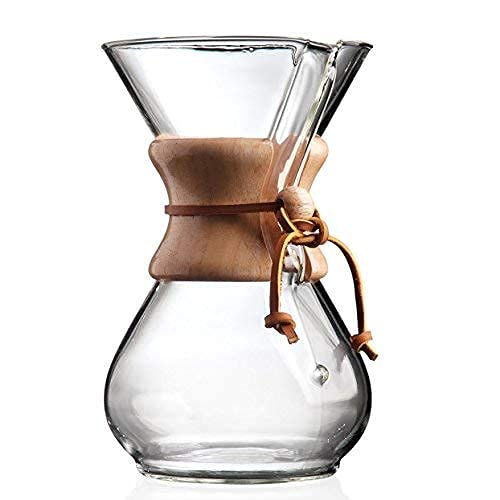
| Chemex Karaffe 6 Tassen | Dripper and server in one glass body, much thicker bonded paper | approx. €56.67 | 8.9 | you brew for several people and prefer glass to stainless steel |
The prices are the guide values from our price boxes as of September 2026 and change faster than this page. The scores are our editorial assessment; we have never brewed the four devices side by side. Further candidates are listed in the best filter coffee makers list.
When the Wave 185 fits, and when another device does
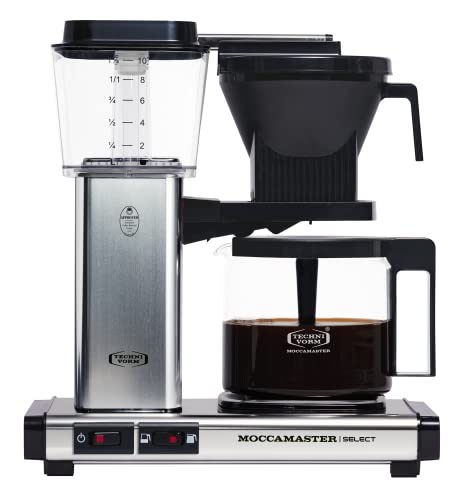
First, the question of how much attention the morning allows. According to Kalita’s brewing guide, bloom and drawdown together take two and a half to just under four minutes, and someone stands beside it the whole time; boiling water, grinding and weighing come before. Whoever does not want that is served more honestly by a machine. The Moccamaster KBG Select makes 1.25 litres in one go, but at approx. €259 costs around €210 more than the Kalita.
The second point is the contents of the cupboard. The Wave 185 is only the attachment; one piece is delivered. Whoever has nothing at all is better off with the Hario V60 Starter Set at approx. €24.87, which is a good €24 less, and server, measuring spoon and paper come in the box.
How much you want to steer yourself decides the rest. With the Kalita, the design takes over part of the work: the flow sets itself through the shape of the bed and the size of the holes, without you intervening. Whoever prefers to stop the contact time by hand will find that valve in the Hario Start-Stop Dripper Set at approx. €54.46, a good €5 above the Kalita, but gets only around 200 millilitres per brew in return. And whoever regularly brews for several people is better served by the Chemex Karaffe 6 Tassen at approx. €56.67, around €7.50 more, where dripper and server are a single glass piece.
We would advise against it above all because of the paper. The Wave format 185 has to be ordered and kept in stock; a trapezoid or cone filter from the supermarket shelf does not fit. On top of that, the purchase price is not the final sum: scales and kettle belong to the method, and the paper remains a running item. In our comparison, the Kalita is therefore not an entry-level device but the second purchase of someone who already filters by hand. That does not contradict Kalita’s beginner argument, it simply lies on a different axis: the manufacturer talks about brewing behaviour at the dripper, we about the scope of what you need to buy around it. Which designs otherwise come into question is sorted by the guide Pour-over drippers compared.
What the seller claims, and what buyers have given
Kalita markets the Wave series explicitly broadly, as a product range with which everyone from the beginner to the professional barista easily arrives at the best flavour. The seller’s German catalogue text goes further and claims that the dripper is found in the world’s best speciality cafés and at professional brewing competitions. No specific businesses or competitions are named. We treat it as the seller’s advertising.
Something more modest can be documented, and it at least comes from buyers: the manufacturer’s shop in the USA shows 4.8 out of 5 points from 63 reviews for the dripper, as of 8 September 2026.
Anyone expecting a fully documented purchase is mistaken here. There is no instruction manual for this item, a warranty statement for Germany is missing, and the official product page lives on only in the archive. If you can live with that, measure the rim of your carafe before ordering. According to the catalogue text, the entire base measures 10.2 centimetres in diameter, and that it therefore fits almost everything is the catalogue text’s claim; Kalita has never published a minimum or maximum size for the vessel underneath.