Hario Europe lists this package under the part number VCDS-02-B-EU and the name V60 Coffee Dripper and Server Set, 02 Size. On this page we shorten that to V60 Starter Set. According to the manufacturer it is made in Japan and intended for pour-over at home or in the office.
Our price box lists the set at approx. €24.87 on Amazon.de, and in our rating it stands at 8.6 out of 10 points. That makes it the cheapest manual filter brewer in our category filter coffee makers; only an electric filter machine is cheaper there. Hario Europe itself lists the same set at €33.00. In the Amazon catalogue the price on 7 September 2026 was exactly €24.00, which is 87 cents below our reference value and €9 below the manufacturer’s list price. Between the manufacturer’s list price and the retail price stand the distribution channel and the retailer’s margin.
What is in the box
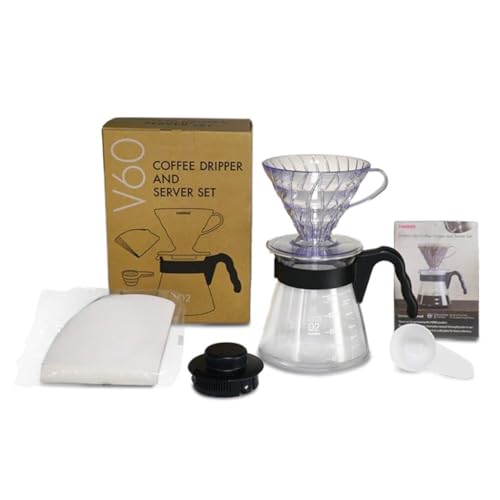
Hario names four parts: the V60 funnel in size 02 made of plastic, a server of heat-resistant glass holding 600 millilitres, a pack of 40 filter papers and a measuring scoop for 12 grams. There is also a printed sheet that, according to the product page, explains the basics to people who are just starting with drip coffee. The manufacturer’s materials list gives the server as heat-resistant glass, the measuring scoop as polypropylene and the filter paper as cellulose.
In the product photo the funnel is clear and transparent. The server has a black plastic handle and a scale on the side with the mark 02, and next to it lie a black lid with a knob, a white scoop, a stack of paper and the sheet mentioned above. Two statements on colour sit side by side: Hario Europe says transparent, Amazon lists the set as black. Both fit the picture, because the funnel is transparent and the attached parts are black.
For the server volume, two figures run side by side. For VCDS-02-B-EU, the European manufacturer page and the Amazon catalogue agree on 600 millilitres, and that is the figure we use here. The 700 millilitres belong to the V60 Coffee Server 02, which Hario sells separately on its own product page. That is a different item, even though both are called server glasses, and anyone planning by that figure counts on 100 millilitres too much.
For the whole set Hario gives 175 millimetres wide, 125 millimetres long and 240 millimetres high. A footprint cannot be derived from that. The photo shows a round server with a handle sticking out of the side, and above it a funnel that is wider at the top than the glass below. The 175 millimetres span the handle, so standing on the counter the set needs less space. The plastic funnel in size 02 sold separately measures 137 by 116 by 102 millimetres according to Hario USA. For the overall dimensions the two sources do at least agree: the Amazon catalogue gives, converted from inches, around 24.2 by 17.4 by 12.6 centimetres, and these are the same three edges in a different order.
On weight the sources contradict each other a second time. Hario puts it at around 600 grams including the box, the Amazon catalogue at 1.014 pounds, so about 460 grams. The 140 grams of difference is not a rounding error for a box of glass, plastic and paper.
In detail: why the V60 does not slow anything down
The name comes from the shape. Hario describes the funnel as a cone with a 60 degree opening angle, hence the V and the number. It came onto the market in 2005.
Three design features belong together, and Hario explains each of them on the dripper page in contrast to the trapezoid filter. The cone stacks the ground coffee upwards instead of spreading it over a flat surface, and the water runs towards the centre. The spiral ribs on the inner wall hold the paper at a distance, so that an air layer forms in between and the filter does not stick to the wall. At the bottom there is a single large hole instead of the several small ones a trapezoid filter has. According to the manufacturer’s description, the funnel therefore does not hold back the water poured in at all, and the extraction is said to come close to that of a cloth filter.
In practice this means that the design does not slow the flow. Where small holes dam the water up by themselves, the contact time settles more or less on its own. Here only the coffee bed dams it, so grind size and pouring speed together decide how long water and coffee are in contact. Hario explicitly writes pouring down as a tool: pouring quickly gives a gentler cup, pouring slowly a stronger one. That is the manufacturer’s logic; nobody has measured it on this set.
Hario calculates in ratios, not in grams
The manufacturer’s instructions work with factors rather than absolute gram figures. First the filter is rinsed with hot water, which according to Hario does two things: it preheats the equipment and removes the paper’s own smell. Then comes the bloom with twice the water weight of the coffee weight, followed by a 30 second wait. Each following pour adds four times the amount of coffee. The pot is supposed to be finished within three minutes, regardless of how many cups it makes.
Worked through with an example: with 15 grams of coffee that is 30 millilitres for the bloom and then pours of 60 millilitres each. Until 250 millilitres of water have gone through, that is the bloom and just under four pours. There is less in the server afterwards, because the ground coffee absorbs part of the water. The 15 grams to 250 millilitres come from the Hario UK brew guide, which also gives a medium-fine grind and a total time of around 2.5 minutes. As a ratio that is 1 to just under 17, so the mild end of the range used by our guide how to make pour-over filter coffee.
For other quantities the brew calculator converts the ratio. If the coffee runs through too fast and stays thin, we would adjust the grind size first and only then the pouring; what step size makes sense is covered in the guide setting your grind size. Otherwise too much changes at once in the pour.
Is one batch enough for two people?
For two normal mugs yes, for four cups it gets tight. Hario gives 1 to 4 cups for the set, and the server holds 600 millilitres. Two mugs of 250 millilitres each therefore fit, with some left over.
The 150 millilitres per cup that follow from four cups and 600 millilitres are our own division; Hario defines a cup size nowhere. Our own guide calculates with 125 millilitres, and by that figure four cups would leave 100 millilitres of air in the glass. Which part reaches its limit first therefore depends on the cup size: at 150 millilitres the glass and the filter size are at their limit at the same time, at 125 millilitres the filter size, limited to four cups, is the first brake, while the glass would still have room.
In terms of time, one batch is not something that runs alongside other things: Hario sets three minutes as the upper limit for the pot, and grinding and boiling water come on top.
Filter paper, accessories and what the box does not replace
The 40 sheets from the box last into the sixth week at one pot a day. After that you need V60 paper in size 02: the cut belongs to the 60 degree cone, and a trapezoid filter does not fit in it.
What the box lacks is half the equipment. Scales are not included, even though the manufacturer’s guide doses in grams. A grinder is also missing, and without one you cannot correct the grind size, which is the most important adjustment here. The third item is our own addition: a kettle with a thin spout, with which the stream can be guided precisely. What is needed straight away and what can wait is covered in the guide barista accessories.
What Hario does not state about this set
The list is longer than you would expect for a funnel with a jug. For the plastic in the set, the manufacturer page says only the word plastic, giving neither the type of plastic nor an upper water temperature. Whether the server is made of borosilicate glass remains open; heat-resistant is the only material statement. A net weight without packaging is missing, as are individual dimensions for funnel and server. Whether the 40 sheets in the box are bleached or natural is not revealed by the set page, and how much coffee belongs in one cup Hario says only as a ratio, never in grams.
Two statements also cannot be carried over from the neighbouring product, even though it seems obvious: the approval for dishwasher and microwave belongs to the V60 Coffee Server sold separately, and the 700 millilitres come from there too. We found no warranty commitment for Europe anywhere on the manufacturer pages; the only warranty statement is at Hario USA and explicitly applies there to the United States.
Four ways into the first pot
| Model | The difference | Price | Our rating | Choose this if |
|---|---|---|---|---|
| Hario V60 Starter Set VCDS-02-B-EU (this one) | One large bottom opening without a brake, plastic funnel, glass server with 600 ml | approx. €24.87 | 8.6 | you want to hold the pouring in your own hands and want to start small |
| Kalita Wave 185 | Flat bottom with three small holes, the water bed sits calmer, own Wave filters, no server included | approx. €49.14 | 8.4 | fluctuating results annoy you and you do not want to practise pouring technique |
| Hario Start-Stop Dripper Set | Valve in the outlet, you set the contact time by the clock rather than by the stream, but only 200 ml per batch | approx. €54.46 | 8.7 | you already brew and want to repeat single cups exactly |
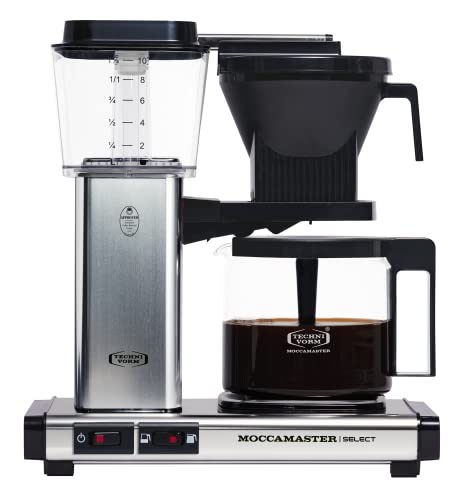
| Moccamaster KBG Select | Electric, 1.25 litres at a time, the machine holds the brewing temperature itself | approx. €259 | 9.5 | you want several cups ready in the morning without anyone standing next to it |
The prices are the reference values from our price boxes and change faster than this page; the more current Amazon figure for this set is at the very top. The scores come from our editorial team; we have never brewed the four devices side by side. Further candidates are listed in the best-of list for filter coffee makers.
When this set fits, and when one of the others
The first question is not budget but patience. Anyone who sees their own pouring technique as part of the point is in the right place here, because exactly that technique controls the result. Anyone who needs a reliable cup in the morning and has no wish to practise is better off spending the money elsewhere.
Then the quantity. For one person with one or two mugs the set is enough. Four cups of 125 to 150 millilitres still fit in one batch, four large mugs of 250 millilitres do not: for those you brew twice in a row, each time with new paper and new grounds, and from there a machine is the more honest purchase.
Time in the morning is the third point. The Moccamaster KBG Select makes 1.25 litres while you get dressed, but costs a good ten times as much. In our comparison it also has the higher rating, which is expressly no argument against this set: the two solve different tasks.
If fluctuating results annoy you more than they appeal to you, the Kalita Wave 185 is the calmer design, because its flat bottom with three holes limits the flow itself. And anyone who would rather fix the contact time with a lever than with the stream will find that in the Hario Start-Stop Dripper Set, and pays a good double for it.
Finally the budget. The approx. €24.87 are the entry, not the final sum, because scales, grinder and kettle come on top. Anyone who does not plan for these purchases gets a decent filter machine for the same total budget.
Who is it suitable for?
The set suits a person who brews their own pot in the morning and enjoys adjusting grind size and pour. It also makes sense as a second device alongside a machine, because it needs no electricity and takes up hardly any space on the worktop. And as a gift, the beginner sheet in the box mentioned above saves the recipient the first search online.
That a box for around €25 contains a glass server and not a plastic jug has to do with the company’s history. Hario was founded in October 1921 by Hiromu Shibata in Tokyo, the name means king of glass according to the company, and Hario describes itself as the only manufacturer of heat-resistant glass in Japan with its own factory. The company entered the coffee business in 1948 with a siphon, which is also a glass device.
The set is wrong for a household where four people each want a large mug in the morning. That means two batches in a row, each taking the time from the calculation further up, and anyone who wants to be out of the house in that time is brewing on the wrong device. It is equally wrong as a gift for someone who sees coffee as fuel rather than as an occupation.
And anyone who already has a V60 funnel in the cupboard is better off buying the server on its own than taking a second set.