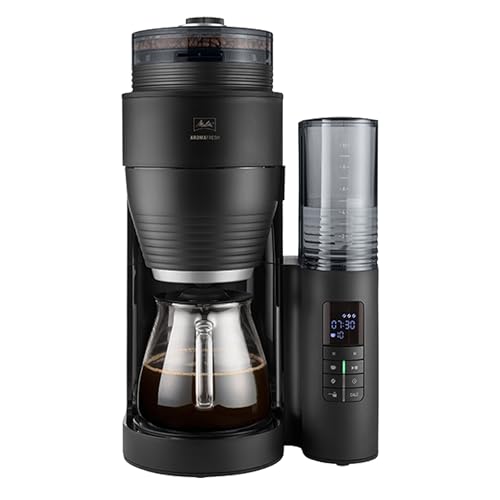
The AromaFresh X costs around €167 on Amazon.de, as of September 2026. In its own shop Melitta lists it at an RRP of €199.95. For that you get a filter machine that grinds first: beans in at the top, jug out at the bottom, with a ceramic grinder with eleven settings in between. Every manufacturer statement in this text comes from the Melitta pages on the product, spare parts and company history or from the instruction manual with document number 4186-1224, and where the Amazon catalogue entry differs from them, we say so. The price above is a daily price from the retailer listing and not a manufacturer statement. Our rating is an editorial assessment. None of us has held a measuring instrument to this machine.
What is in the box and what the type plate says
According to Melitta, the box contains the machine, a manual, a cleaning brush and a trial pack of five Melitta Gourmet filter bags in size 1x4. Descaler is not included, and neither is coffee.
The type designation is 1030-06. The same number appears in the Amazon catalogue as both model number and part number, so the match between listing and manufacturer data sheet is unambiguous. The glass jug has its own designation, RJ-A-14-bk, which shortens the search if you need a replacement. Melitta gives the colour as black-silver. The manufacturer is Melitta Europa GmbH & Co. KG of Ringstraße 99, 32427 Minden.
The instruction manual is available as a free PDF download. The cover, however, does not say AromaFresh X but AromaFresh: document 4186-1224 covers the whole AromaFresh New Generation range, to which type 1030-06 belongs. If you want to know what a machine like this demands of you in operation, read it before buying. With a machine that has a display and a hardness menu, that is worth more than with one that has a single rocker switch.
On dimensions, the sources contradict each other. Melitta gives 463 millimetres in height, 268 millimetres in width and 252 millimetres in depth, plus 3.7 kilograms. The Amazon catalogue lists 51.0 by 34.3 by 29.0 centimetres and 3.75 kilograms, converted from inches and pounds. For the same machine the difference is too large, and for a typing error too systematic: these are packaging dimensions. On the worktop, the 46.3 centimetres of height from the data sheet apply.
The ceramic grinder, eleven settings and three strength levels
Melitta states eleven variable grind settings, adjusted with a dial on the bean container: clockwise for finer, anticlockwise for coarser. In a grinder, ceramic is always a grinding surface and never a blade that chops, which is the design difference from the choppers in many cheap grinders. Fixed click stops have a practical advantage over stepless adjustment: you can find a setting again after you have left it.
Melitta writes in the manual where a wrongly chosen grind leads. Too fine and the coffee turns bitter, too coarse and it tastes sour; how to feel your way to the right setting is covered in the guide to adjusting your grind size. Surface area is behind this. Finer ground powder has more of it, the water dissolves more in the same time, and beyond a certain point those are the substances nobody wants in the cup.
On top of that come three strength levels, mild, medium and strong, shown in the display as one, two or three beans. What happens technically, whether more powder goes into the filter or the water runs through differently, stays open in the Melitta sources we checked. For the grind setting, the manual states the effect; the strength level remains a matter of trial and error.
According to the manual, the bean container is enough for two to three brews of ten cups each. With one full jug a day, that means refilling about every two to three days. And the grinder can be switched off: the machine then carries on with ready-ground coffee, for which a dedicated button sits on the control panel.
1.25 litres, ten cups and a rule Melitta sets itself
The water tank holds 1.25 litres, is not removable and is filled in the machine. It is transparent and carries a scale with marks at 2, 4, 6, 8 and 10 cups. Ten cups from 1.25 litres works out at 125 millilitres per cup; what you need in coffee and water for a different number of cups is worked out by the brew calculator. A full jug then fills a 200-millilitre mug a good six times, not ten.
Then there is the rule Melitta expressly points out in the manual: the amount of water and the set number of cups must match, otherwise the result deviates from what you wanted. We read it like this: the machine doses the ground coffee according to the number of cups you choose on the display, and nowhere checks how much water is actually in the tank. Set eight cups and fill the tank to the brim, and the coffee turns out thin without the machine objecting.
Brewing is into a swing-out filter with a removable filter insert, filter size 1x4, and Melitta recommends its own filter bags of this size. According to the manual, a drip stop prevents dripping when you take the jug out before the brew has finished.
How long until the jug is full?
Melitta does not commit itself. Neither the product page nor the manual contains a brewing time or a brewing temperature, for four cups as little as for ten. The lower limit can at least be calculated, and it is a good six minutes, not yet counting the grinding.
This is how the figure comes about: bringing 1.25 litres of water from 15 to 90 degrees takes around 0.11 kilowatt-hours, that is 4.19 kilojoules per kilogram and kelvin times 1.25 kilograms times 75 kelvin. At 1,080 watts of connected power this takes about six minutes, and only if all the power ends up in the water, which it never does. The 15 degrees of tap water and the 90 degrees in the filter are our assumptions here and not values from the data sheet.
If you do not want to spend six minutes next to the machine in the morning, programme the start time in advance. The timer switches the machine on at the set time and starts the grinding and brewing process on its own, and a signal announces the end of the brew.
After that the hot plate takes over, which has its own heating element and whose running time can be programmed to 20, 40 or 60 minutes. The same manual contains the sentence that no advertising text includes voluntarily: with longer keeping warm on the plate, the taste of the coffee changes. Why that happens is chemistry and not a peculiarity of this model. Finished coffee is a solution of acids, oils and roasting products, and heat speeds up what carries on happening in it. Our recommendation follows directly: set the 20 minutes and decant the rest into a thermos flask if it is to stand longer.
Three machines from our catalogue for up to ten cups
| Model | The difference | Price | Our rating | Choose this one if |
|---|---|---|---|---|
| Melitta AromaFresh X (this one) | Ceramic grinder with eleven fixed click stops, 1.25 l, 1,080 W | approx. €167 | 8.8 | you brew from whole beans and have only one spot free |
| Severin KA 4810 | Also with a grinder, but no number of settings on the grind dial and no water hardness setting, jug also for up to ten cups | approx. €100 | 8.2 | you want to grind fresh and your budget is under €120 |
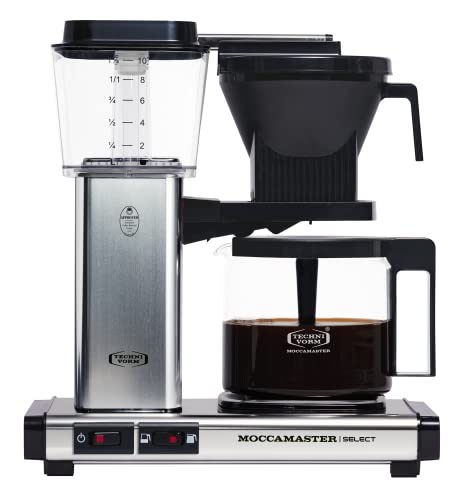
| Moccamaster KBG Select | No grinder, but a brewing temperature of 92 to 96 degrees as a manufacturer statement | approx. €259 | 9.5 | you have a grinder and find documented brewing values more important |
| WMF Stelio Aroma | Also up to ten cups, at 125 ml each according to WMF, but no grinder and no hardness menu | approx. €47 | 8.5 | you buy ground coffee anyway and want to stay under €60 |
The prices are guide values from the data sheets of our own reviews, as of September 2026, and they change daily. The rating column shows how we rank the data and features of the four machines; nobody measured them. What ends up in the cup depends on the bean and is not in any of these columns.
When the AromaFresh X fits and when another machine does
Two cups a day is the lower limit at which the technology pays off at all. Below that you heat up a grinder designed for ten cups for a single mug, and you are better off, and cheaper, with a hand filter and a small hand grinder.
Measure the height before you order. The housing needs 46.3 centimetres, and above that there must still be room to fill the bean container. A row of wall cabinets with 45 centimetres of clearance above the worktop is therefore ruled out.
The second question is beans or ground coffee. Anyone who never buys beans pays here for a grinder that stands idle, and the WMF also gives up to ten cups for less than a third of the money. Conversely, if you already have a grinder on the worktop, buying the AromaFresh X means buying the second one.
Third question: your water. Out of the box the machine is set to hardness level 4, i.e. over 21 dH (German degrees of hardness). In an area with soft water you therefore descale more often than necessary; with hard water and an ignored indicator, the scale grows into the heating element instead. What the hardness degrees mean and how to find out yours is covered in the guide to water hardness and coffee.
That leaves the budget. €167 sounds like a lot for a filter machine, but it covers machine and grinder in one spot. A machine with documented brewing values plus a separate grinder quickly ends up at double that, but you can replace both parts individually. With the combined machine both sit in one housing, which saves space and complicates repairs: if the grinder stops working, you can still brew with ready-ground coffee, but you have paid for the grinder anyway.
Descaling, cleaning and the one clause that can cost money
The menu knows four hardness levels: under 7 dH, 7 to 14 dH, 14 to 21 dH and over 21 dH. From the set level the machine derives when it requires descaling, and then signals with a permanently lit red CALC LED.
The programme runs for around 25 minutes because, according to Melitta, it is meant to dissolve even heavy scale. It must not be interrupted, because only a complete run clears the indicator again. Afterwards the manual calls for two runs with the maximum amount of water and no coffee, so that none of the agent stays in the machine. The same two rinse runs are due before the very first cup, then without a filter bag and without ground coffee.
With the descaler it becomes contractual. Melitta recommends Anti Calc Liquid for Filter Coffee & Aqua Machines, and the guarantee terms exclude damage caused by consumables outside the original specification; how a descaling run works in general is covered in the guide to descaling and cleaning. The home remedy from the kitchen cupboard saves a few euros and, in the event of damage, costs you the guarantee claim.
The glass jug, jug lid and filter insert may go in the dishwasher, as the product page and the manual agree. The housing is wiped with a soft, damp cloth. You clean the grinder as soon as you notice visible dirt, and afterwards the ground coffee channel too; for this the grind setting dial can be pulled straight up and out, and the matching brush comes with the machine.
Two things cost you money on an ongoing basis: filter bags in size 1x4 and descaler. The five bags from the box last five days with one jug a day.
What Melitta leaves open
A data sheet also shows what you look for in vain. For this machine these are: the brewing temperature, the duration of a brew, the noise level of the grinder in decibels, the cable length, the capacity of the bean container in grams, the number of grams the grinder dispenses per cup, the material of the housing, filter insert and hot plate, the temperature of the hot plate, the power consumption per brew and on standby, the span of the eleven grind settings in micrometres, the grinder design as conical or flat burrs, the country of production and an EAN. Added to that are two points that weigh more in everyday use than they sound: whether the bean container closes airtight and thus keeps the aroma of the stored beans, and whether the grinder has been insulated against noise at all. A water filter option for this model also appears nowhere in the manufacturer sources we checked. On energy efficiency, the product page merely refers to a separate collection page and itself states no value.
The spare parts topic ends in a similar way. The Melitta shop lists bean containers, bean container lids, filter holders and jugs for the AromaFresh range. Grinding ring, grinding disc and seals are not listed there, and how long after the end of production parts are supplied at all, the manufacturer also says nowhere.
One statement on the product page is advertising and not a specification: Melitta advertises that every coffee bean carries more than 800 aromas and that these only develop fully when freshly ground. The figure comes from coffee chemistry and counts volatile compounds, most of which lie below the perception threshold. The core is still right: ground coffee loses aroma faster than a whole bean because the surface area is many times larger. That is exactly the argument for a grinder in the machine.
Who the AromaFresh X is built for
For households that drink several cups of filter coffee a day and buy whole beans for it, without wanting to stand in front of a second machine in the morning. This profile earns it our editor’s pick in the Filter coffee & pour-over category. For us, the decisive factor was less the grinder than the hardness menu: it is the part of the equipment that decides over the years whether the heating element stays free.
The manual expressly counts staff kitchens in shops, offices and other commercial areas as intended use. The guarantee terms, by contrast, name only the household and exclude commercial use; whether an office kitchen falls under that, neither source says. In our assessment, the volume alone argues against use for a team: anyone who needs twelve cups a day will not get by with 1.25 litres. The hot plate switches off after 60 minutes at the latest, which does not stretch to a whole morning. In the filter coffee comparison the other filter machines in our catalogue are set side by side.