Russell Hobbs lists this appliance as the Textures Plus+ Digital Glass Coffee Maker, and both the manual and the Amazon catalogue give the model number 22620-56. In our catalogue the reference price is around €39.99 on Amazon.de (as of September 2026). For that you get a filter machine with a glass jug, a digital control panel and a brew head that the manufacturer calls a shower head.
Every statement about the Textures+ comes from Russell Hobbs itself (German and English product pages, the manual with a three-page German section, the spare parts section of the online shop) or from the Amazon catalogue entry for ASIN B01B0YQV66. On one point these sources contradict each other, the number of cups, and there the contradiction is stated openly in the text instead of us picking a number. Nobody on our side has had the machine in their hands.
Layout: glass jug at the front, control panel in the base
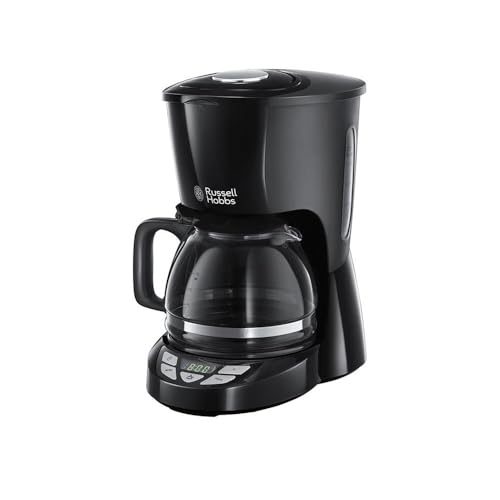
This is how the manual names the parts in its drawing: lid, water tank, filter holder, water level indicator, measuring scoop, warming plate, digital control panel and jug.
In the product photo, the upright body stands at the back, the head section with the lid projects forward above it, and the glass jug slides underneath onto the warming plate. The control panel is not on top of the tank but set at an angle in the base, at the front under the jug: a small display with buttons on both sides. A silver band runs around the lower curve of the jug, and a silver element sits on top of the appliance lid. The Amazon catalogue text describes the jug lid as a hinged lid. According to the manual, the lid is opened by a lever at the back of the jug lid, directly above the handle.
On the exterior, Russell Hobbs writes that the housing is matt black and glossy with chrome accents. The Amazon catalogue field lists a weight of 3.71 pounds, which by our conversion is around 1.7 kilograms, and black as the only colour.
In detail: what the shower head does
Russell Hobbs explains the technology briefly. According to the German product page, the integrated shower head technology sprays the water more evenly and faster through the ground coffee; the English version says the same from the other side, saying the head showers all the coffee particles and not just those in the middle of the filter. Russell Hobbs advertises richer flavour and less waste in the filter as the result, attributed to the improved water distribution, which dissolves more coffee.
In the coffee bed, water takes the path of least resistance. If the whole stream hits one spot, it digs a channel there, runs through and leaves the edge of the grounds under-extracted. If the same stream is spread over several outlets, the flow rate at each point falls and more of the grounds come into contact with water at all. Pour-over users achieve this by hand, pouring in circles.
The power rating is on the rating plate line of the manual: 22620-56, 220 to 240 volts, 50/60 hertz, 975 watts.
Ten cups or twelve?
Ten. Russell Hobbs writes 10 cups on both the German and the English product page. The twelve appears only in the Amazon catalogue title, and no manufacturer source supports it. The jug capacity, on the other hand, is undisputed: 1.25 litres.
Why the two figures diverge can only be guessed at, which is why we do not commit to a third. Divide the 1.25 litres by ten and you get 125 millilitres per cup, the classic size of a coffee cup. That calculation is ours: Russell Hobbs itself gives no cup size in millilitres anywhere, and the English page speaks of 10 large cups. For you this means: if you drink from 200-millilitre mugs, a full jug arithmetically covers a good six refills rather than ten.
Dosing is by cups, not by grams. According to the manual, one measure of ground coffee per cup goes into the filter with the measuring scoop, and the tank gets exactly the amount of water needed. To measure it, the machine has a water level indicator, and the jug, according to the Amazon catalogue text, has a fill-level marking. How much the scoop holds is left open, so the dosing recommendation is only as precise as the spoon you apply it with. If you prefer to weigh, start with around 60 grams of coffee per litre of water, the starting value from our filter machine guide; for 1.25 litres that is about 75 grams, and for other quantities the Brew Calculator (not available in English) works it out. Some of the water never reaches the jug: wet ground coffee holds back about twice its own weight, so with 75 grams of coffee that is about 150 millilitres. What the grind size does in a paper filter is explained in the guide Coffee grind size.
The timer, and why the clock depends on the plug
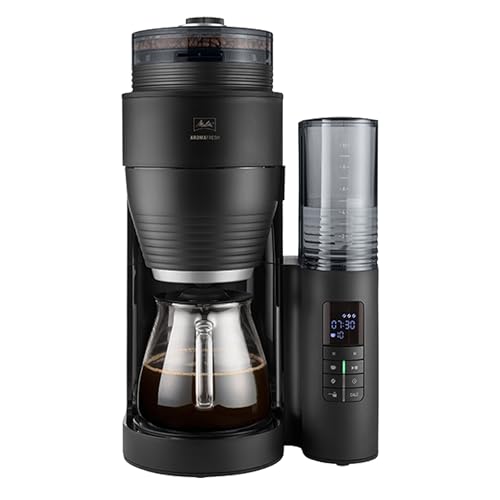
Among the four filter machines under €50 that we list, the Textures+ is the only one for which manufacturer or Amazon information states a timer; the other three are the Emerio CME-122933, the Braun PurShine KF 1500 and the WMF Stelio Aroma. The manual describes programming like this: press the button with the clock symbol, set the desired start time with the hour button and the minute button, then press the AUTO button until the display stops flashing and stays lit. If no input is made for five seconds, the machine returns to normal mode and you start again. The programmed start can be switched off before brewing begins with the same AUTO button.
A single sentence in the manual decides whether this timer is any use in daily life: the clock keeps its current setting until the plug of the coffee machine is pulled from the socket. If you unplug the machine after every use because no appliance should stay on standby, you reset the time before every programmed start. The same applies to a switchable power strip.
Two more figures belong to operation. The German product page advertises that thanks to the keep-warm function you can drink the coffee straight away or keep it for later; how long that later lasts is governed by the manual: after 40 minutes the warming plate is switched off automatically. This is presumably the automatic switch-off named in the Amazon catalogue text. And if you pull the jug out mid-cycle to pour the first cup, you have a window of about 20 seconds before it must be back on the plate, otherwise the filter holder overflows. During that time the drip stop kicks in, which the English page calls Pause & Pour and the German page describes like this: as soon as the coffee is taken off the plate, no more flows.
What else is worth considering?
| Model | The difference | Price | Our rating | Choose this if |
|---|---|---|---|---|
| Russell Hobbs Textures+ (this one) | 24-hour timer with programmable start time | approx. €39.99 | 8.1 | you want to set a start time the evening before |
| Braun PurShine KF 1500 | According to Braun, no clock, brewing is started by hand | approx. €29 | 7.9 | you are standing at the machine in the morning anyway and want to save eleven euros |
| WMF Stelio Aroma | Cromargan stainless steel housing, operated with exactly one button | approx. €47 | 8.5 | the machine is permanently on view and metal matters more to you than a start time |
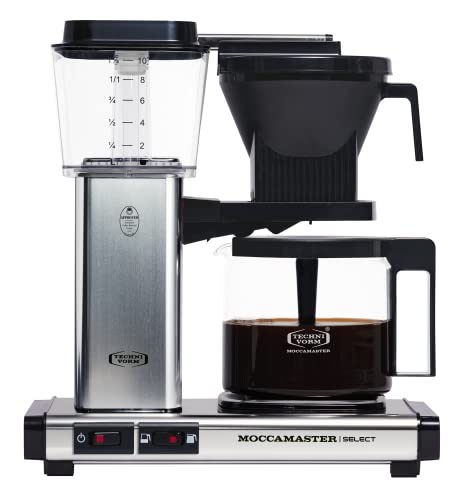
| Moccamaster KBG Select | 92 to 96 degrees brewing temperature as a manufacturer statement, copper heating element with 1,450 W | approx. €259 | 9.5 | a documented brewing temperature is worth a 219 euro premium to you |
The price column shows the reference values from the price boxes of our own reviews, and they change with every offer. The rating next to it is our editorial assessment of the available data and features, not a measurement result.
When this machine suits you and when another one does
Do you brew a jug or a single cup in the morning? Russell Hobbs states no setting for one to two cups or an aroma level for the Textures+; dosing follows the same rule for every quantity, one measure per cup. If you almost always drink a single cup alone and do not need the timer, you are better served by a pour-over dripper, in our assessment.
The timer is worthwhile if the coffee should be ready before you are standing in the kitchen. If you set it the evening before, you fill in water and ground coffee in the evening, and ground coffee loses aroma compounds much faster than the whole bean because its surface is many times larger. If you grind fresh, you therefore grind for the timer in the evening as well. Besides, only the start is solved: if you drink a jug spread over the morning, you pour it into a thermal flask or buy a machine with a thermal jug right away.
If you need a figure for the brewing temperature, this is the wrong appliance: Russell Hobbs states none, while Moccamaster does for the KBG Select in the table above. The Textures+ also has no grinder, so ground coffee or a grinder of your own is a prerequisite. Which features make the difference in filter machines and which only appear on the box is sorted out in the guide Drip coffee maker buying guide.
Filter papers, descaler, repair fee
Size 4 paper filters, and they are not included. That is what the legend to the drawing in the manual says, in brackets after the filter type. According to the English product page, a single-cup measuring scoop is included. After brewing, the filter contents go in the bin according to the manual; with one jug a day, that makes 365 filter papers a year.
The second item is the descaler. The manual requires the appliance to be descaled regularly, at least once a month, using a descaler from the manufacturer. A few lines further on comes a warranty clause: for products returned during the warranty period because of defects attributable to limescale deposits, a repair fee is charged.
Hard water leaves more limescale than soft water, so with hard water we would descale more often than monthly. How hard your water is and what that value does inside the machine is covered in the guide Water hardness and coffee, and the course of a descaling run in the guide Descaling and cleaning.
What Russell Hobbs does not state
There is no brewing temperature in degrees, nor the run time for a full jug, the heat-up time to the first drop, or the noise level in decibels. The manufacturer names no material for the housing, filter holder, water tank or lid, and for the jug it says only glass, without the type of glass. Also missing are the cable length, the number and arrangement of the openings in the shower head, any information on whether the water tank can be removed, a grind size recommendation, the power consumption per brew and on standby, the EAN or GTIN, the country of manufacture and the year of market launch. Russell Hobbs lists no permanent filter, either as an accessory or as an alternative to paper, and no source mentions a descaling indicator, a descaling programme or a water hardness setting. If one of these details is at the top of your list, you are deciding on this appliance without it.
Who is it for?
The manual itself defines what the machine is for: household use and similar applications, and the list covers four settings. These are staff kitchen areas in shops, offices and other working environments, use by customers in hotels, motels and other residential-type environments, and bed and breakfast establishments and farm houses. If you run a bed and breakfast, you are expressly included.
The Textures+ is the wrong purchase for anyone who wants to add to the appliance to their own taste. The manual permits only accessories and attachments supplied by Russell Hobbs itself, and the intended use is limited to what is described in the instructions. A third-party replacement jug or a permanent filter bought separately falls outside that requirement. Then there is the heat: the surface of the appliance gets hot and the heating element gives off residual heat after use, so a fixed place on the worktop makes more sense than an appliance that is put away after every brew.
How the other filter machines in our catalogue compare is shown by the best filter coffee makers list, and the category Filter coffee gathers pour-over drippers and carafes as well. If you pass the machine on later, according to Russell Hobbs you hand over the manual with it. And when it has reached the end of its life: according to the manual it does not belong in unsorted household waste but at an official collection point.