Our price box lists the Braun PurShine KF 1500 at approx. €29 on Amazon.de (as of September 2026). Among the seven electric filter machines in the Filter coffee & pour-over category, only the Emerio CME-122933 is cheaper. Braun itself charges €52.90 in its own online shop (as of 15 September 2026). The product page gives 1 January 2023 as the availability date.
The name on the front belongs to Procter & Gamble. De’Longhi has used the Braun brand for small kitchen appliances since 1 September 2012 under an unlimited licence, which is why the manual names De’Longhi Braun Household GmbH of Neu-Isenburg as the manufacturer. It is built in China, as stated in the Russian-language part of the manual and in the product data that Braun embedded in the source code of its page.
The information on this page comes from Braun’s product page and the PurShine category page, the manual, the separate safety leaflet, the warranty terms together with the warranty service page, and the Amazon catalogue. In addition there are the product page of the sister model with the thermal jug, the accessories category in the Braun shop, two customer FAQs from Braun and a 2012 announcement from De’Longhi about the brand licence. The manual works almost entirely with drawings; in German it contains only two sentences: a reference to the safety leaflet and a note on descaling. We have not had the machine in our hands.
Design: tank under the hinged lid, filter basket that swings out
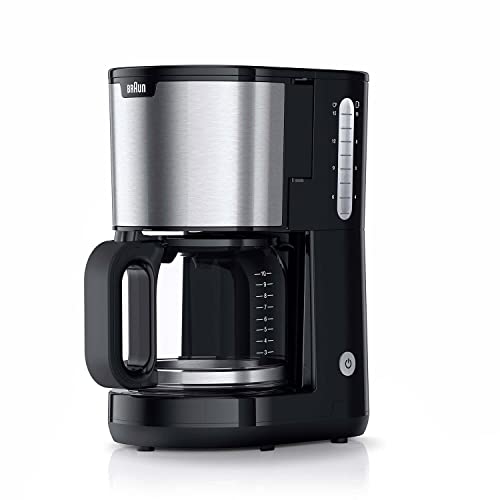
The product photo shows a black machine whose upper front carries a silver panel, with the Braun logo in a black recess at the top left. Braun gives the material as “metal and plastic”. To the right of the panel a narrow black column runs downwards, with the water level window at the top and below it a round button bearing the on/off symbol.
Water goes in from the top. According to the manual drawing, a lid that folds upwards sits above the tank. The tank itself stays in the machine: in the product data from the page source it is listed as fixed.
According to the product page the filter basket folds open and is removable. In the preparation pictures it swings out, receives the filter and the grounds, and swings back in. The manual draws the on/off button as the only control, whereas the Amazon text speaks of illuminated buttons in the plural. The product page also lists cable storage and an item “easy pouring”, and the clock field there says no.
For the jug, the Amazon text names heat-resistant glass. For all materials that come into contact with food, the safety leaflet refers to EU Regulation 1935/2004.
In detail: what Braun means by OptiBrew
On the KF 1500 product page the name appears only next to coffee taste and even aroma. To find out what is behind it, you have to switch to the page of the KF 1505, which shares its manual with the KF 1500. There it is about the balance of temperature, brew time and extraction of the ground coffee, and the Amazon text describes the system in almost the same words. None of the Braun sources we have evaluated mentions a shower head that spreads the water more widely over the grounds.
Temperature and contact time determine how much of the grounds passes into the drink. This share is called extraction, and the Specialty Coffee Association puts it at 18 to 22 per cent for filter coffee. Hot water releases acids and volatile aroma compounds from the grounds early, then sugars and finally bitter compounds, and the hotter the water, the faster this sequence runs. On a machine with no adjustment, how long water and grounds stay in contact depends mainly on the amount of water and on the grind size.
How hot the water arrives at the filter is decided by the heater. Two sentences in the safety leaflet say more about it than the whole product page: “Always use cold water only.” And: “Before preparing coffee again, switch the machine off and let it cool down for at least 5 minutes to avoid steam formation.” Both fit the design of almost all simple filter machines, and what follows is our transfer of this common design to the KF 1500. In such machines a heating element under the warming plate brings water to the boil in a tube, and rising steam bubbles push it up to the filter basket. If water runs into a tube that is still hot from the last run, or if the water itself is already warm, part of it evaporates immediately. Limescale on the tube wall acts like an insulating layer, the heater takes longer, and more steam is produced.
How much coffee comes out of a full jug?
Ten cups of about 125 millilitres each. You will look in vain for a litre figure for the jug at Braun, and we do not work one out ourselves either. The number of cups is on the product page, the cup size in the manual, there as an addition next to a small cup symbol.
This cup reappears at the water level window, and that is where it gets confusing. The drawing shows two scales side by side: a small cup symbol with marks up to 12 and a mug symbol with 4, 6 and 8, both with a “max” as the top mark. So above the 12 there is still a piece of cup scale, while the jug has markings from 3 to 10: that does not fit together neatly. In the product photo the numbers of the real window cannot be read reliably at this image size. Our advice is therefore simply to measure by the jug. You fill it with cold water up to the number of cups you want, tip it into the tank and stay below “max”.
For the grounds, the manual draws a limit at 10 spoons, shown with a measuring spoon above the filter. Kitchen scales measure more accurately than the spoon. Our guide Drip coffee maker buying guide recommends about 60 grams of coffee per litre of water as a starting point, which works out at 7.5 grams for a cup of 125 millilitres. The brew calculator works out other amounts for you.
Warming plate and automatic shut-off
After brewing the jug stays on the plate, and the plate switches itself off. The product page and the manual give 40 minutes for this, the manual with the label “Auto-off” right next to the plate. The safety leaflet, on the other hand, is printed jointly for a whole range of Braun coffee machines, lists the switch-off times by device type, and for type KF101BI, which is also part of Braun’s article code for the KF 1500, it says 39 minutes.
In practice the minute makes no difference.
“The warming plate still retains residual heat after switch-off”, Braun writes in the leaflet, and in the point directly after: “Do not touch hot surfaces, especially the hot warming plate. Do not let the power cable come into contact with hot surfaces.”
What a heating plate under a glass jug does does not depend on the brand. It keeps heating from below. Volatile aroma compounds escape in the process, and other compounds break down with time and heat. The automatic shut-off limits this phase, after which the glass gives its heat off to the room air. A thermal jug, by contrast, only insulates and does not keep heating.
Cleaning and running costs
For the machine itself, one sentence from the safety leaflet applies without exception: “Never clean the machine under running water or immerse it in water.” The care pictures in the manual begin with the plug pulled and a thermometer with a warning symbol, so only a cooled-down machine is cleaned. According to the drawing, the housing, warming area and filter basket are wiped with a cloth; washing-up liquid with water is shown, scouring powder is crossed out.
On the microwave the leaflet leaves no room for doubt: “None of the parts may be used in a microwave oven.” On the dishwasher, by contrast, the sources disagree. The manual picture puts the glass jug and its lid in, and shows the filter basket only being wiped. The Amazon text declares the removable filter insert and the glass jug dishwasher-safe. As long as Braun’s own drawing shows the basket only with the cloth, we would wash it by hand.
In a paragraph on contact with food that is easy to overlook, Braun also asks you to check the product regularly for signs of material deterioration. The list covers micro-cracks, blistering, delamination, shrinkage, stickiness, loss of transparency, corrosion or any other change in the structure or consistency of the material.
The one German sentence in the manual on descaling reads: “Descale your coffee machine regularly, especially if you notice excessive steam during brewing or water residue in the tank at the end of the brewing process.” Why steam is a warning sign is explained in the OptiBrew section. According to the embedded product data on the Braun page, the KF 1500 has no descaling indicator, so you watch for these signs yourself. Pictures show the procedure: Braun Descaler into the tank, top up with water to mark 8 on the mug scale, switch on, pour the liquid from the jug away. After that you run clear water through twice to the same mark. How hard your tap water is and how to find out is described in the guide Water hardness and coffee.
Running costs include, besides coffee, electricity and descaler, the filters. According to the manual, a paper filter marked “Nr.4” goes into the basket, and anyone who brews a jug every day uses 365 of them a year. The product page gives a power of 1,000 watts. Switched off at the socket, the machine draws less than 0.3 watts according to the leaflet, by our calculation (0.3 watts times 8,760 hours) at most about 2.6 kilowatt hours over a year.
What Braun does not state
Of all things, the key figures for brewing are missing: a temperature in degrees and the brew time for a full jug. A heat-up time is not given anywhere either. Which values OptiBrew actually aims for on the KF 1500 therefore cannot be put into numbers.
For the warming plate there is neither a temperature nor a power rating. The tank has no stated volume, and how much a mug holds on the mug scale remains as open as a descaling interval, whether in weeks or by water hardness. Braun does not publish device dimensions; the figures in the buying decision section come from the Amazon catalogue. On weight the sources do not help: Braun’s product page shows “1.79” without a unit, Amazon lists 2.6 pounds, which by our conversion is about 1.2 kilograms.
Also left open are noise level, cable length, protection class and standards applied, as well as the power consumption of a single brewing cycle. What jug lid, handle, filter basket and warming plate are each made of disappears behind the collective statement on material, and nothing can be found on BPA. Braun does not list the scope of delivery either; whether a measuring spoon, paper filters or a permanent filter are in the box, you only find out when unpacking. And for the “aroma jug” which, according to the product page, preserves aroma and temperature over a longer period, there is no time given at all.
This machine or one of the other three?
| Model | The difference | Price | Our rating | Choose this if |
|---|---|---|---|---|
| Braun PurShine KF 1500 (this one) | according to Braun no clock, started by hand | approx. €29 | 7.9 | you start it yourself in the morning and empty the jug within 40 minutes |
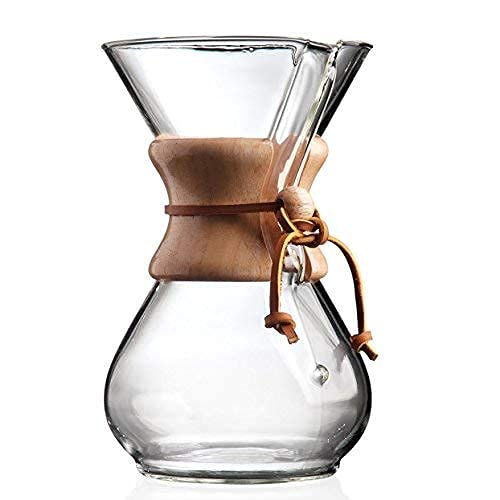
| Emerio CME-122933 | reusable mesh filter according to the Emerio manual | approx. €22.99 | 7.7 | you do not want to keep buying paper filters and want to save six euros |
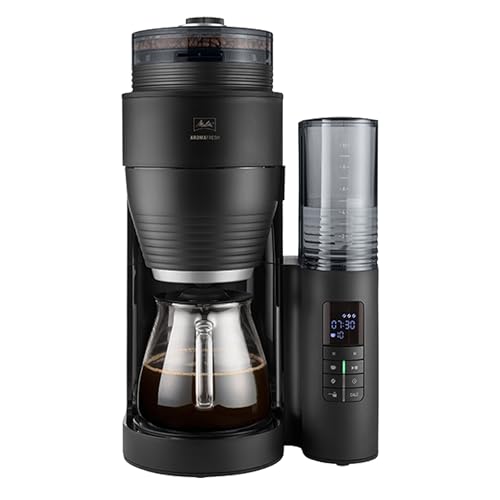
| Russell Hobbs Textures+ | shower head and programmable 24-hour timer according to Russell Hobbs | approx. €39.99 | 8.1 | the coffee should be ready at a time set the evening before |
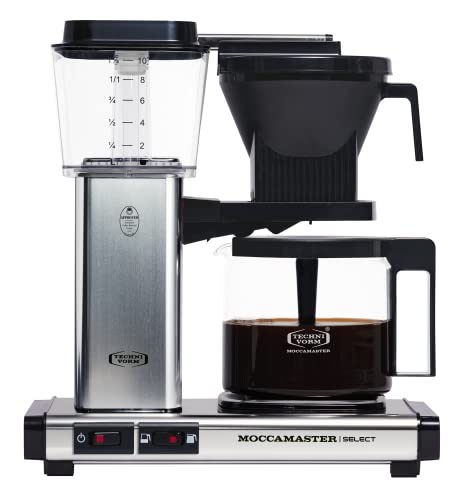
| Moccamaster KBG Select | 92 to 96 °C brewing temperature as a manufacturer’s figure | approx. €259 | 9.5 | a documented brewing temperature is worth €230 extra to you |
The prices are guide values from the price boxes of the respective reviews (as of September 2026) and change with every offer. The rating is an editorial assessment of the available data and features; no measurement on any of the four machines lies behind it.
When the KF 1500 fits and when another machine does
If you drink the coffee spread over the morning, pour it into an insulated jug straight after brewing or reach for the sister model KF 1505 with the thermal jug.
Two jugs one straight after the other are not intended; in between lies the cooling-down pause from the safety leaflet, that is at least five minutes switched off. If you brew one jug in the morning and the next in the afternoon, you will not notice. At a big breakfast where the second jug is needed at once, it means waiting.
For the footprint the Amazon dimensions remain: approx. 31.1 centimetres high, 29.2 centimetres long, 15.8 centimetres wide. The catalogue does not assign length and width to a side, so measure your recess along both edges. When brewing, the safety leaflet says: “The coffee machine must not be placed in a cupboard during use.” Because the tank lid folds upwards, the machine also needs more air above it when filling than its own height, or you pull it out from under the wall cabinet for that.
If you buy whole beans, a grinder belongs in the budget. Braun itself has the FreshSet KG 7070 in its online shop for €77.90 (as of September 2026), and for orders in that shop the KF 1500 product page shows a return period of 30 days.
Who is it suitable for?
For a private household. Where the line runs, Braun sets out in a single point of the safety leaflet: “This appliance is intended for household use only. Use is not intended in: staff kitchen areas in shops, offices and other working environments, in agricultural tourist establishments, hotels, guest rooms, motels and other accommodation.”
The warranty terms draw the same line and exclude commercially used products, as well as products purchased by persons who are not consumers within the meaning of § 13 BGB (the German Civil Code).
Even at home the purpose is narrowly defined. The leaflet requires the machine to be used “only with water and only for preparing coffee” “to avoid damage to the appliance”. Tea therefore does not belong in the machine.
The leaflet devotes a separate point to children. From 8 years of age they may use the appliance if they are supervised or have been instructed in its safe use and understand the resulting hazards; the same applies to persons with reduced physical, sensory or mental capabilities or a lack of experience and knowledge. Children must not play with the machine, they take over cleaning and user maintenance only from 8 years of age and under supervision, and children under 8 must keep the appliance and its cable out of reach. In a household with small children, the place you put it therefore helps decide whether the machine fits.