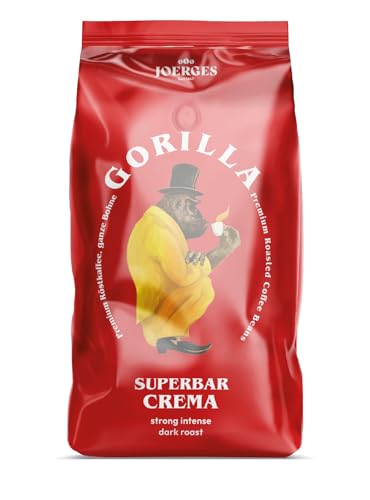
A red kilo bag, a gorilla in a top hat holding an espresso cup, and below it, in small print, “strong intense dark roast”. That is how the large-scale roaster A. Joerges from Obertshausen near Frankfurt packages its Superbar Crema, an espresso blend of Arabica and Robusta beans. Our price box lists the kilo on Amazon.de at approx. €19.96; the Amazon catalogue itself gave €20.21 on 7 September 2026.
In the coffee beans comparison, that puts 13 of the other 22 beans cheaper per kilo and nine more expensive. We have not drunk the Superbar. What is written here comes from Joerges, from the Amazon catalogue and from what can be deduced professionally from the bean species and roast level.
What Joerges writes about the blend
“An all-rounder with great crema” is how the roaster headlines the variety on kaffee-joerges.de. The description below it mentions an intense, chocolatey and nutty aroma with a subtle honey note. The keyword line has four terms: chocolatey, berry, nutty, honey. According to Joerges, the nutty nuances are meant to show up once more in the finish, and the roaster describes the taste in general as round and powerful.
You can only verify that with a cup in your hand. The list is still informative. Chocolate, nut and honey are notes that mostly come from the roasting itself, from caramelised sugar and the browning reactions in the bean. Berry aromas, by contrast, usually come from the fruit acids of the green coffee and weaken with every minute in the drum. In a dark roast, the word berry is therefore the outlier in the list.
On crema, the variety page gives two statements: once especially stable and foamy, once especially smooth and fawn-brown. The Amazon listing, in which Joerges is entered as manufacturer, speaks of a dark brown crema. Those are two different colours. Which one ends up in your cup also depends on grind size and dose anyway.
Joerges recommends the blend straight as espresso and equally as a base for cappuccino, latte macchiato or milky coffee, prepared in a portafilter machine or a bean-to-cup machine.
Is the Super Bar Crema medium or dark roasted?
Dark, if you count up the manufacturer’s statements. Only one place says medium-strong, and that happens to be the description text on the Joerges variety page.
There it says the beans develop an intense aroma “through their medium-strong roast”. The pictogram block on the same page, however, says “dark roast”, illustrated with four filled bean symbols. The graphic does not make clear how many beans the full scale would have. The company’s own online shop, gorillakaffee.shop, also states a dark roast in the flavour profile, the Gorilla overview on kaffee-joerges.de classifies the variety the same way, the bag carries the English print, and the Amazon title ends with “Röstgrad: dunkel” (roast level: dark).
The same block contains two more values. Joerges puts the intensity at 8 out of 10 and the acidity at low, graphically two of five filled dots. Both scales are in-house. There is no standard for intensity figures, so an 8 at Joerges cannot be set against an 8 at another roaster.
Our assessment: plan for a dark roast, so start a little coarser and with slightly cooler water than for a medium espresso bean.
In detail: what a fifth of Robusta does
The Joerges pages say only Arabica-Robusta blend. A figure comes solely from the Amazon listing: 80 per cent Arabica, 20 per cent Robusta. Individual retailers write 60 to 40, without a source. We stay with 80 to 20, because Joerges itself is entered as manufacturer in the Amazon listing.
The share matters for the crema. The foam layer on an espresso consists of carbon dioxide, which forms in the bean during roasting and is trapped in fine bubbles under pressure during extraction. The bubbles are held by proteins, polysaccharides and the brown melanoidins from the roast. Coffee oil works in the opposite direction, making the foam collapse faster. Robusta contains roughly a third less oil than Arabica, around 10 versus 15 to 17 per cent of dry matter. That is the technical reason why Italian espresso blends often contain Robusta, and it makes Joerges’ crema claim at least plausible.
On flavour, Robusta shifts the picture towards bitterness. The species brings more chlorogenic acids than Arabica and less sugar. Bitter compounds form from the chlorogenic acids during roasting, and the darker the roast, the further this conversion has progressed. The same breakdown explains the acidity figure: chlorogenic acids contribute to the acidity in green coffee, and whatever has been converted into bitter compounds is missing from the cup as acidity.
If you want pure Arabica, you need a different bean, even though the Robusta share here is only a fifth.
Drum, 220 degrees and separate roasting
In 1847 A. Joerges opened a coffee wholesale business in Frankfurt am Main. The Hühsam family has run the company since 1982, today with Roman and Tim Hühsam as managing directors. The house brand Gorilla was added in 2004, and in 2012 headquarters and production moved to Obertshausen. The legal notice today gives the address as Raiffeisenstraße 10 to 12.
Joerges describes the roasting process for the whole house, not variety by variety. The page on its quality standards speaks of drum roasting over 12 to 20 minutes at a maximum of 220 °C, while the About Us page words it as a maximum of 20 minutes at 180 to 220 °C. Those are two versions of the same framework. A roasting time of that length gives the heat time to reach the core of the bean before the outside gets too dark, and that is exactly the tricky point with a dark roast.
For a blend, the second detail weighs more. Joerges roasts beans of different origins separately by variety and combines them into blends only afterwards. Arabica and Robusta beans differ in size and density and absorb heat at different speeds. In a shared batch, one component would be too dark while the other is still catching up. Roasted separately, each gets its own end point.
What the Superbar costs per cup
We calculate with our own assumptions: for a double espresso from a portafilter machine we assume 18 grams of ground coffee, so the kilo lasts for 55 shots, and at approx. €19.96 according to the price box each costs around 36 cents. Bean-to-cup machines usually grind between 7 and 10 grams for a single cup. Calculated with 8 grams, that is 125 cups at 16 cents each.
In its own online shop gorillakaffee.shop, the kilo cost €22.99 on 25 September 2026, €3.03 more than in our price box and €2.78 more than the Amazon catalogue of 7 September. For the kilo bag, nothing on this basis argues for ordering directly from the roaster.
Lavazza, Segafredo or organic from Honduras?
| Blend | Roast and origin | Price per kg | Our rating | Choose this if |
|---|---|---|---|---|
| Gorilla Super Bar Crema (this one) | Dark according to the bag (variety text contradictory); Arabica and Robusta with no country of origin | approx. €19.96 | 8.3 | you mostly make milk drinks with a portafilter or bean-to-cup machine and want Robusta in the blend |
| Lavazza Espresso Italiano Cremoso | Medium roast, Arabica and Robusta from South America and South-East Asia | approx. €16.99 | 8.9 | you at least want to know the growing regions and also use a moka pot alongside the espresso machine |
| Segafredo Intermezzo | Dark roast, according to Segafredo a classic Robusta blend | approx. €17.19 | 8.6 | you also brew your dark espresso in a stovetop pot, which the Amazon text of the Intermezzo explicitly mentions |
| 360° Rundum Ehrlich Bio Honduras | Long drum roast, low acidity, 100% Arabica from the Honduran highlands, organic | approx. €35.59 | 9.3 | you drink it black, also use pour-over or French press and want to see origin and an organic seal |
The two Italians are close together and both below the Superbar: the Lavazza costs €2.97 less, the Segafredo Intermezzo €2.77. The 360° Rundum Ehrlich is €15.63 above and is the only one of the four without Robusta.
What the table does not do: it says nothing about which of the four beans you will like. The ratings are our editorial assessment based on the roasters’ statements and the price, and the prices are indicative figures from our price boxes, which can change at any time.
Which machine and which drink suit the Superbar?
The case is clearest for milk drinks, and there the technology supports Joerges’ recommendation. In a cappuccino, 25 to 40 millilitres of espresso meet several times that amount of milk, whose fat and protein bind bitter compounds and buffer acidity. A light, acidic roast loses its profile in the process, while a dark blend with a Robusta share keeps more of it. How cappuccino, latte macchiato and flat white differ in the ratio of coffee to milk is explained in our guide to coffee drinks.
In a portafilter machine, a dark roast is not very forgiving. The bean is brittle and releases its compounds quickly, and a grind that is too fine or water that is too hot tips the shot into bitterness. If you switch between single and double baskets, the easiest way to convert dose and yield is the brew calculator.
In a bean-to-cup machine, the surface of the bean counts. Dark roasts often release oil, which gums up the grinder and the bean hopper and goes rancid over time. Whether the Superbar beans are shiny, we do not know; the product photo shows only the bag. In an open hopper, air also reaches the beans. We would therefore fill only as much as runs through in two to three days, so with four cups a day at 8 grams each, around 100 grams.
For the stovetop pot, the sources differ. On Joerges’ Gorilla overview, the Superbar carries only the symbols for portafilter and bean-to-cup machine; the moka pot symbol appears on two other varieties, the Bar Crema and the Espresso Delicato. The Amazon listing speaks more generally of all Italian coffee preparations. Technically, nothing speaks against a dark roast in the moka pot. If you want a bean for which the roaster itself names the pot, take the Segafredo Intermezzo or one of its two sister varieties.
For pour-over and French press, we would choose a different bean, one that its roaster specifies for that. Joerges does not do so for the Superbar. In our comparison that includes the 360° Rundum Ehrlich: the supplier explicitly names pour-over and French press, even though its profile is also geared towards low acidity.
Without a grinder, the Superbar is the wrong choice, because both packs in the Gorilla shop contain whole beans. Which bean suits your machine instead can be narrowed down with the coffee finder.
That leaves pack size. With two double espressos a day, that is 36 grams, the kilo is gone after just under four weeks. With one a day it lasts just under eight weeks. If you make espresso less often, then in our assessment the 250-gram bag from the Gorilla shop is worth considering, even though it is more expensive per kilo: an opened bag loses aroma in the air with every week, and over two months that adds up.
What Joerges leaves open
These details are missing on kaffee-joerges.de, in the Gorilla shop and in the Amazon catalogue, as of 25 September 2026:
- countries of origin of the green coffees, growing altitudes, processing (washed or natural) and varieties
- the roast level of the Arabica and the Robusta component before blending
- roasting date and best-before date before purchase
- grind size, dose, brewing temperature and extraction time
- the caffeine content
- whether the bag has an aroma valve or a reseal
- storage advice from Joerges itself (only the Amazon listing gives some, more on that below)
From our point of view, origin weighs heaviest. In a blend with Robusta, a lot depends on where that share comes from. The best-before date is mandatory on the pack for roasted coffee, but you only see it once the bag is with you.
Fridge or storage tin?
Here the sources contradict each other. The Amazon listing says: “Nach dem Öffnen in einem luftdichten, lichtundurchlässigen Behälter im Kühlschrank aufbewahren” (after opening, store in an airtight, light-proof container in the fridge). In our best coffee beans list, however, two other roasters expressly advise against the fridge, Lavazza and Mount Hagen.
We would follow those two. If you take cold beans out of the fridge, humidity condenses on them, and coffee picks up foreign odours from its surroundings. The first part of the Amazon recommendation remains right: airtight and light-proof, plus cool and dry, for example in a kitchen cupboard away from the hob.