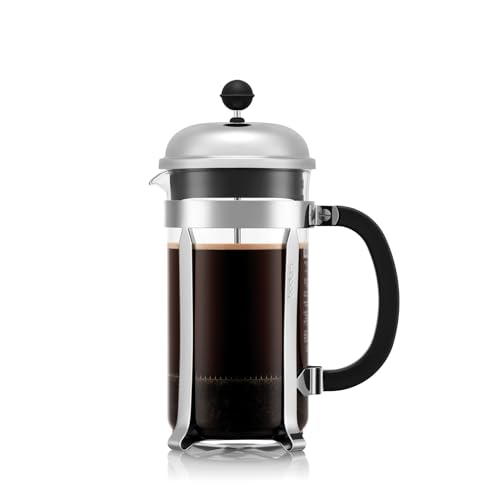
The Chambord is a glass pot with a capacity of one litre, a frame of chrome-plated stainless steel and a plunger with a stainless steel screen. It needs no electricity, and no paper either. Two questions therefore decide the purchase, and only the data sheet answers both: what does a litre mean in cups, and what happens when the glass breaks?
One litre of glass, two prices
In the Bodum online shop, the pot stood at €49.90 including tax on 8 September 2026, marked as in stock. Through our price box the same model runs at approx. €34.99 on Amazon.de (as of September 2026), roughly €15 cheaper. That it really is the same model can be checked: Bodum lists the article number 1928-16 and the EAN 727015248905, and the Amazon catalogue gives the same model number 1928-16 with the part number 1928-16US4.
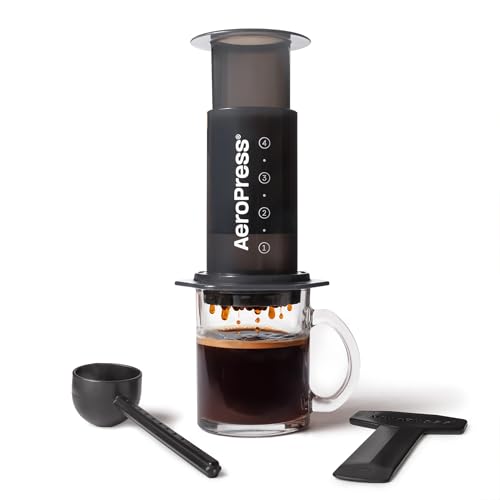
At the manufacturer, the pot is called CHAMBORD coffee maker, 8 cups, 1.0 l, stainless steel. The series also exists in smaller sizes: the filter screen that Bodum lists as a spare part for this pot fits coffee makers of 0.5 and 1.0 litres, according to the article description. In our French Press and AeroPress category, the Chambord is thus in the middle of the price range. The Bodum Brazil with the same litre of capacity costs approx. €16.89, the AeroPress Original approx. €41.08, though it brews only one to two cups per round.
Frame, glass, plunger
The carafe is made of borosilicate glass, which Bodum describes as non-staining and heat-resistant, and which the manufacturer credits with neither altering nor impairing the natural taste of the coffee. Frame and lid are stainless steel that, according to the product page, has gone through several chrome-plating processes. The handle is black polypropylene with a matt finish, the plunger stainless steel. Accordingly, the data sheet gives the material as stainless steel, plastic, borosilicate glass, the colour as chrome, and in the Shatter Proof field a No.
Bodum gives the dimensions as 17.0 centimetres wide, 24.5 centimetres high and 10.7 centimetres deep. The product photo shows why width and depth are so far apart: the body is a round cylinder, held vertically by chrome struts, and a sweeping C-shaped handle projects on the right. For the eight-cup pot, Bodum lists the replacement glass at 9.6 centimetres in diameter and 18 centimetres in height, so the glass cylinder itself measures less than ten centimetres across. We therefore read the 17 centimetres as an envelope dimension over handle and spout, put together from two Bodum figures and the photo. For the worktop that means a footprint of just under 17 by 11 centimetres. From the difference between 18 and 24.5 centimetres, around six and a half centimetres remain for frame foot, lid and knob; this too is our own calculation.
One figure is confirmed across the sources: the 4.2 inches of length in the Amazon catalogue convert to 10.7 centimetres, exactly the depth in Bodum’s data sheet. For the weight, the catalogue then has to help out entirely on its own: it puts the pot at 1.3228 pounds, so around 600 grams.
In detail: the manufacturer’s brewing instructions
Bodum describes the procedure twice, on the product page and in the instruction manual, and in one place the two texts contradict each other. The product page doses one heaped teaspoon or one Bodum spoon of coarsely ground coffee per cup of water, whereas the instructions give one heaped tablespoon or one Bodum measuring spoon per cup of 1.25 decilitres. For a whole pot this adds up to a considerable difference. We would start with the instructions, because they supply the cup size, and correct downwards from there. A ratio in grams appears in neither source; Bodum doses exclusively by spoons. The Brew Calculator works out the amount of water for your own number of cups.
For the water, the sources do not contradict each other, but they are not identical either. The product page gives about 92 to 96 degrees Celsius. The instructions word it as hot, not boiling water. At least 2.5 centimetres must stay free at the top. One step before that, the instructions also cover where to stand the pot: dry, flat and non-slip, because the filter rod will later be under pressure from above.
Then you stir, and here the instructions are clear: with a plastic spoon, because a metal spoon can scratch and damage the beaker. Next you put on the press filter unit and turn the lid so that the spout opening is closed. This keeps the heat in the pot. The filter stays up during this phase. The product page gives four minutes of steeping, the instructions at least four minutes.
When pressing down, more depends on it than it seems. Bodum prescribes holding the handle, turning the spout away from you and using only the weight of your hand. The best results come from slow pressing with minimal pressure, it continues. If the filter rod jams, you pull it back out, stir and press again slowly. The reason is given as a warning beside it: excessive force can break an already damaged pot, and hot water then shoots out.
Then there is the precaution on grind size, for this screen the most important sentence in the whole booklet: use only coarsely ground coffee, because finely ground coffee can clog the filter and create high pressure. If you cannot set your grinder coarse enough, you are wrong here. How far you have to go is covered in the guide Setting your grind size, and the step-by-step version of the preparation in the French press guide.
How many cups come out of a litre?
Eight, if you count in Bodum’s cup measure. On the product page the manufacturer assumes roughly 120 millilitres per cup, in the instruction manual 1.25 decilitres, so 125 millilitres. With ordinary household mugs of 200 millilitres, this becomes four to five by our calculation.
The second figure sits in the filling rule. At least 2.5 centimetres must stay free at the top. How much water goes in up to the maximum fill, Bodum does not state, and we do not extrapolate it from the glass diameter either: the cylinder sits low in the frame, and the filter unit displaces additional volume at the top.
For two people with two mugs each, one brew is enough. If four sit at the table, you brew twice, and the steeping time runs a second time.
Spare parts, glass breakage and what Bodum replaces
The product page lists four spare parts: filter screen, replacement glass, cross plate and spiral plate. The replacement glass carries the article number 1508-10, is likewise made of borosilicate glass and costs €18.90, a good half of what the complete pot costs through our price box. A broken beaker is thus an annoyance but not a total loss, because frame, handle and plunger unit remain. For this size the instructions list two replacement beakers with spout, one in glass under 1508-10 and one in plastic under 1508-10P.
How reliable this supply is, Bodum explains in its own FAQ with a simple rule: if a product in the shop lacks the spare parts subcategory, there are none for it. For the Chambord, it exists.
With glass breakage, however, goodwill ends early. According to the Bodum FAQ, breakage of glass articles is not covered by the guarantee, because, according to the manufacturer, it cannot be established how it came about.
For the rest, it is worth keeping apart two things that are constantly mixed up in everyday life. The statutory warranty (Gewährleistung) is directed against the seller; the terms and conditions of the German Bodum online shop give two years from delivery of the item. Separately from this runs the manufacturer’s guarantee: according to its own statement, Bodum does not maintain a repair workshop, and what breaks during the guarantee period the manufacturer generally replaces with a new product. How long this period runs, Bodum does not say in any of the places we checked. In a guarantee case, the first route leads back to the retailer anyway, which the Bodum FAQ also states.
Cleaning and the four safety notes
After every use, the instructions demand the same thing: unscrew the filter unit and clean it. That the unit can be taken apart at all, you can read off the spare-parts list, which carries filter screen, cross plate and spiral plate as three separate articles. Bodum gives further care notes in its own FAQ: in the instructions for use or in the product information of the online shop.
On the dishwasher, the exact wording is worth having, because our own data sheet line above is stricter than the manufacturer. Only the filter and the glass, plastic and chrome parts are dishwasher safe, the instructions state, and the chrome parts are thus expressly included. We still advise hand washing for the frame. If you follow the manufacturer, you may put it in the machine.
Four safety instructions appear in the German section of the instructions, and they are short enough to reproduce in full:
- Do not use the pot on the stove.
- Check the beaker for scratches, cracks or chips. Do not use scratched, chipped or cracked beakers; fit a replacement beaker before the next use.
- Keep third parties away during coffee preparation, hot water is dangerous.
- Do not allow children to use this coffee pot.
In addition there is a requirement that is easily overlooked: the coffee pot is to be used only together with a coaster. How you take the plunger unit apart and free the individual parts of coffee oils is described in the French press guide. On limescale on the screen, according to the guide, none of the French press manufacturers in our sources comments, Bodum included.
What Bodum does not state
For a device without electronics and without moving mechanics, the data sheet stays silent in several places. Missing are the wall thickness of the glass, the mesh size of the screen in micrometres, the material of the lid knob and the content of a Bodum measuring spoon in millilitres. The manufacturer also gives no keeping-warm time or temperature curve for the single-walled pot anywhere, and a scope of delivery as a list of its own is likewise absent from the product page.
On glass, the information stops where it would become interesting. A drop height, an impact resistance or a limit for thermal shock appears nowhere. In general, the material FAQ describes borosilicate glass as insensitive to temperature differences, but there this applies to all Bodum glasses and not to this model in particular. And Bodum names no designer for the Chambord anywhere, neither on the product page nor in the company chronicle.
What the chronicle offers instead explains this silence to a degree. Peter Bodum founded the company in 1944 in Copenhagen, towards the end of the Second World War, and set as its core philosophy that form should follow function. Since 1978, an in-house department has designed all of the brand’s products, Pi-Design AG, by Bodum’s own description a team of designers, engineers, graphic artists and architects. An attribution to one person does not fit a department that draws everything, and for the Chambord none would be backed by any source from the manufacturer.
What else comes into question?
| Model | The difference | Price | Our rating | Choose this if |
|---|---|---|---|---|
| Bodum Chambord 1 l (this one) | Borosilicate glass in a chrome-plated steel frame, four spare parts listed individually | approx. €34.99 | 8.8 | the pot stands on the table and you like to buy spare parts |
| Groenenberg Edelstahl Thermo | Double-walled stainless steel instead of glass, but no view of the coffee | approx. €36.99 | 8.5 | there are children in the household or the pot sits on the table for half an hour to an hour |
| Bodum Brazil | Plastic frame instead of chrome-plated stainless steel, same 1508 spare-parts series | approx. €16.89 | 7.9 | you do not care about the frame and the pot lives in the cupboard |
| AeroPress Original | Paper filter and pressure extraction instead of metal screen and long steeping | approx. €41.08 | 9.3 | you mostly brew for yourself alone and want no sediment in the cup |
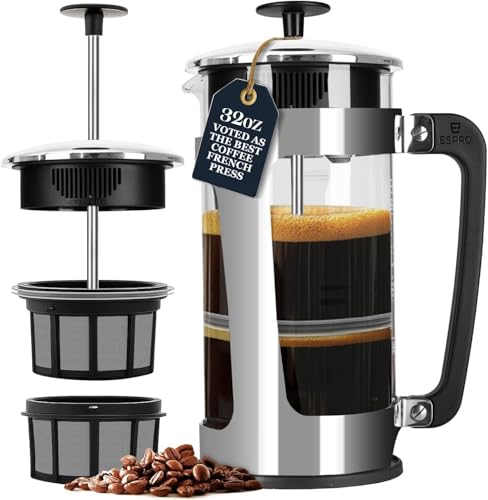
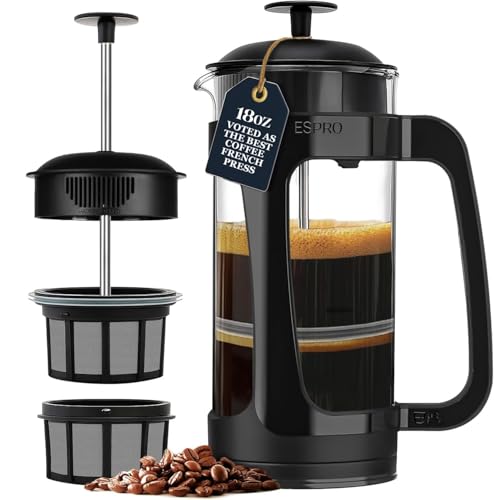
Prices are as of September 2026, and the rating is our editorial assessment from the data sheets, not a measurement result. What ends up in the cup, the table does not decide; for that we would have to brew the four devices against each other with the same bean. Further candidates in the category are in the best French press and AeroPress list.
Who is it for, and when another pot?
Quantity decides first, and a litre is a lot. If you drink alone, you either pour away leftovers regularly or wait out the full steeping time for a half-filled pot. Bodum’s dosing notes calculate per cup anyway, not per pot, so you can easily make less.
The second point is the running costs, and they are unusually low here. Bodum advertises that this preparation needs neither paper filters nor plastic capsules, and that is true: what is consumed is coffee, nothing else. The pot only costs money again when something breaks. The prices of the spare parts are in the spare-parts section above.
Bodum credits the stainless steel plunger with preventing ground beans from escaping when pouring. Fine particles that pass through the mesh are not meant by this, and these are exactly what ends up in the last cup. We draw this conclusion from the construction of the screen. If you do not want the sediment at all, you need paper, and the guide AeroPress or French press describes the way there.
On origin, the sources diverge. The Amazon title says Made in Portugal; the Bodum FAQ confirms a plant of its own in Portugal but also names facilities in Germany, Poland and China. How that came about is in the company chronicle: in 1988 Bodum took over part of the Portuguese manufacturer Fertugal, which later passed entirely into the brand’s ownership and is now called BODUM Portuguesa. The Chambord product page names no country. The publisher of the instructions is BODUM AG in CH-6234 Triengen.
This pot is wrong for anyone who wants to let children make coffee on their own: Bodum’s instructions rule that out with a sentence of its own, and the combination of glass and just-boiled water proves it right. The booklet, by the way, does not belong in the bin afterwards; Bodum expressly asks you to keep it for later reference.