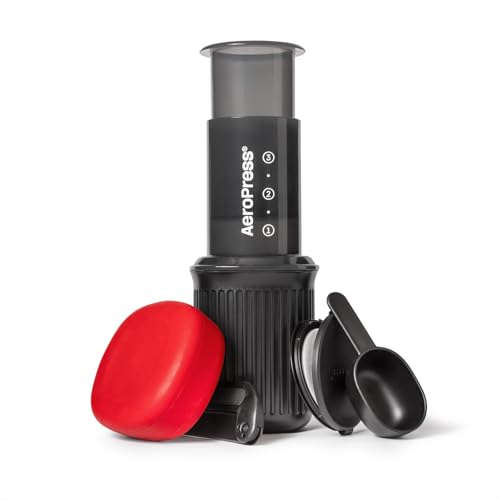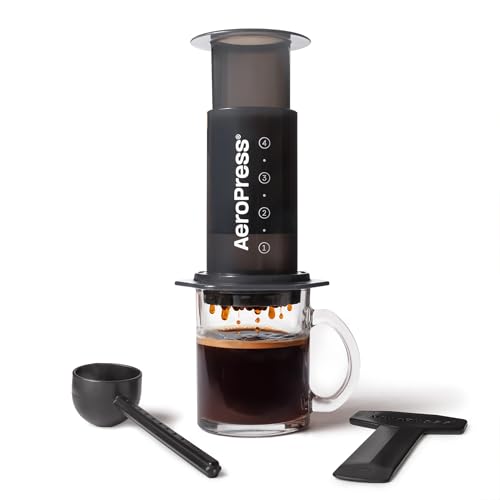
Alan Adler developed the prototype in his garage in Palo Alto, California, according to the manufacturer’s FAQ. According to the product page, the Original is made in the USA, together with the variants Go, Clear, Clear Colors, Clear XL and Original XL.
In the Amazon catalogue, when retrieved on 6 September 2026, the press stood at €41.08, and that is the figure we use for it, as of September 2026. In the manufacturer’s shop it costs US$39.95. In the comparison of French press and AeroPress coffee makers, the Original leads with 9.3 out of 10 points.
Chamber, plunger, filter cap
Chamber and plunger are made of polypropylene, the seal on the plunger of food-safe silicone. That is the complete materials list from the manufacturer’s support article, and AeroPress describes silicone there as a rubber-like material made of silicon and oxygen. The manufacturer lists the seal as a wear part and sells it separately, as it does the chamber, plunger and filter cap.
The dimensions are in the support section, given per component and, like the other measurements for this device, in inches; the centimetre values here are our conversions. The plunger with the seal fitted is 5.26 inches long and 3.28 inches in diameter, which is about 13.4 by 8.3 centimetres. The chamber alone measures 4.75 inches in height and 4.22 inches at the widest point of the hexagon, so about 12.1 by 10.7 centimetres. With the plunger inserted, the whole thing measures 5.26 by 4.22 inches, and the product page rounds the same values to 5.25 by 4.2 inches.
The product page gives a weight of 7.75 ounces, for chamber, plunger, filter cap, scoop and stirrer together. That is about 220 grams.
The contents are kept sparse: paper microfilter, a stirrer and a scoop, plus the three load-bearing parts. The product page and the support article agree on this. The manufacturer’s shop lists a funnel for filling as a separately sold spare part at US$9.95. In the Amazon catalogue the device appears as model 85A02 with part number 85A01, and the colour is called Original Grey.
In detail: infusion, immersion and the pressure from the plunger
AeroPress calls the method patented 3-in-1 brewing technology and breaks it down into three phases on its how-it-works page. First, hot water wets and aerates the coffee grounds. Then the coffee steeps, and according to the manufacturer most of the extraction takes place in this second phase. Finally comes the plunger: the rising air pressure speeds up the process, and according to the manufacturer this lowers acidity and bitterness compared with methods with a long brew time.
The second phase is what the press has in common with the French press. Coffee and water sit together in the vessel, instead of water trickling through a bed of grounds as with a pour-over. The difference lies at the end, in the filter cap. With the paper microfilter the coffee oils stay behind, since support expressly certifies that the stainless steel filter lets them through. According to the manufacturer, the choice has no effect on grind size: the manufacturer’s text in the Amazon catalogue credits both paper and metal microfilters with allowing finely ground coffee to be brewed with a short brew time and no sediment, and explains this by the combination of agitation, pressure and microfiltration. A French press pot, by contrast, works with a metal mesh, which AeroPress does not list as a microfilter at all; that fine grounds end up in the cup there is our assessment from the design and not a manufacturer statement.
The chamber holds 10 ounces, converted about 296 millilitres, and on the product page that corresponds to one to two cups.
Why a fine grind helps at all is quickly explained: finer means more surface area per gram, and more surface area means faster extraction. That is why a short minute of contact time is enough here, while coarse grounds in a pot steep much longer. The plunger also shortens the last step, because it presses the water through the filter instead of letting it run through on its own.
Is this an espresso machine, then?
No. The Amazon catalogue title lists the device as a coffee and espresso maker; AeroPress itself is much more careful in its wording: anyone who defines espresso by the taste in the cup will indeed regard the result as espresso.
Compare this with the espresso machine: there, about 9 bar is applied at the portafilter basket, built up by a pump and held over the whole extraction time of 25 to 30 seconds. Here a person presses a plunger by hand, the pressure exists only while pressing, and it drops as soon as the water has passed the filter. The manufacturer does not publish a measured value for it. The product page is specific only on quantity: up to three shots of espresso-style coffee per press.
The crema depends on this pressure difference too. It forms when carbon dioxide from roasting is dissolved in the water under high pressure and gasses out again as it leaves the basket. Without a pump, the build-up for this is missing, which is why the concentrate from this press looks different from a shot from a bar. Diluted, it gives filter-coffee strength; drunk neat, it remains a concentrate.
How the manufacturer brews
The instructions on aeropress.com are unambiguous. Heat water to 185 degrees Fahrenheit, which is 85 degrees Celsius, and if you do not have a kettle with temperature control, the manufacturer says you may also use boiling water. Fine-tuning by roast level is in the FAQ: 80 degrees for dark roasts, 85 degrees for medium and light ones. For grind size AeroPress recommends medium-fine. For the dose, the FAQ gives two values, both measured with the supplied scoop: level 12 to 13 grams, heaped 16 to 18 grams.
85 degrees is low for an infusion, and that fits the short contact time. Hotter water dissolves faster, but towards the end of extraction it also pulls out the bitter components.
Then it goes step by step. Fill water up to marking 4 on the chamber. Stir gently for three seconds. Insert the plunger about half an inch, so roughly 1.3 centimetres, into the chamber and pull it back slightly so that a vacuum forms and nothing drips through. Then wait 60 seconds, and if you have really ground medium-fine, the instructions allow you to press after just 30. The two figures belong to different grind sizes. Finally, press evenly and gently until the hiss begins, and do not press harder as you go. For brewing and cleaning together, the manufacturer allows under two minutes.
If you prefer to work with ratios rather than scoops, the brew calculator works out the amount of water for the amount of coffee, and the detailed step-by-step version of this preparation is in the AeroPress guide.
One point that looks different in many videos: AeroPress expressly advises against the inverted method, where the press stands upside down and is only turned over at the end, in its own FAQ. The reason given there is that the setup is less stable, therefore prone to tipping, and exposes the user to hot liquid. If you brew inverted anyway, you are consciously deciding against a manufacturer’s safety warning.
Ideas for other recipes come from the same source: AeroPress publishes the winning recipes of the World AeroPress Championship from 2008 to 2022 on its own site.
Paper or stainless steel, and what running it costs
Neither electricity nor paper filters are mandatory, as the manufacturer’s FAQ puts it literally. The paper filter is still the normal case, and it is a consumable. The refill pack contains 350 and costs US$9.95 in the manufacturer’s shop, which makes about 2.8 US cents per brew, although the pack price differs in German retail. If you brew once a day, one pack lasts you just under a year by our calculation.
The alternative is also in the shop: the stainless steel filter, standard size US$14.95. According to support it lets the coffee oils through and so gives a fuller-bodied cup, it can be reused as often as you like and may also go in the top rack of the dishwasher. It is not compostable. Measured against 2.8 cents per paper filter, it has paid for itself after a good 500 brews, so with one cup a day after about a year and a half. We would still start with paper, because the filters are included anyway and the lower-oil cup is the difference from the pot.
AeroPress lists spare parts for the Original in full. Seal, filter cap, funnel, stirrer and scoop are each US$9.95 in the shop, the plunger with seal and the chamber each US$19.95. On the seal, the manufacturer itself writes on the product page that it wears out over time; how long it lasts, in months or in brews, remains open. Over five years, with one cup a day, you come to six filter packs, not counting the filters included, and one replacement seal, together just under US$70, plus the purchase price once.
What AeroPress does not state
For a device with so few components, the data sheet is surprisingly thin in places. What was not already given above where you need it while reading is collected here. Missing are: the pore size of the paper filters in micrometres, a clearance for microwave or freezer, and the travel weight of the core parts without accessories. AeroPress gives metric values only occasionally, such as the cup diameters in millimetres, the pack weight of the Go in grams and the brewing temperature in degrees Celsius. A data sheet or an operating manual as a PDF is also searched for in vain in the official support, which has only help articles as web pages.
For purchases in Germany, the information stops sooner. The manufacturer gives a one-year warranty against defects in material and workmanship from the purchase date at an authorised retailer; the German wording is also in the manufacturer details of the Amazon catalogue. How it is handled in Germany, who the contact is and what return route there is, on the other hand, it does not document. It lists no German retail price, nor a German-language manufacturer site, since the address www.aeropress.com.de could not be resolved during our research. And whether the shop ships spare parts to Germany and what seal, chamber or plunger then cost in euros is not stated on any of the pages examined.
One contradiction remains to the end. The Amazon catalogue gives 5.02 by 2.26 by 2.26 inches and 0.55 pounds, converted about 12.8 by 5.8 by 5.8 centimetres at 250 grams. A cylinder 5.8 centimetres in diameter would be narrower than the plunger, which on its own measures 8.3 centimetres. We therefore stick to the manufacturer’s values. The catalogue date 10.07.2015 in the same entry is, incidentally, the date since which Amazon has stocked the press, and so does not count as a market launch. According to its own About page, AeroPress presented the press in November 2005 at the Coffee Fest in Seattle.
What else is worth considering?
| Model | The difference | Price | Our rating | Choose this if |
|---|---|---|---|---|
| AeroPress Original (this one) | Polypropylene cylinder with paper microfilter, one to two cups per brew, about 220 g | approx. €41.08 | 9.3 | you brew one to two cups by hand and want to take the device with you |
| AeroPress Go | Same brewing principle, but 8 instead of 10 ounces; in return a drinking cup with a lid as a transport container | approx. €44.00 | 8.9 | you commute or brew at the office and need cup plus lid in your rucksack |
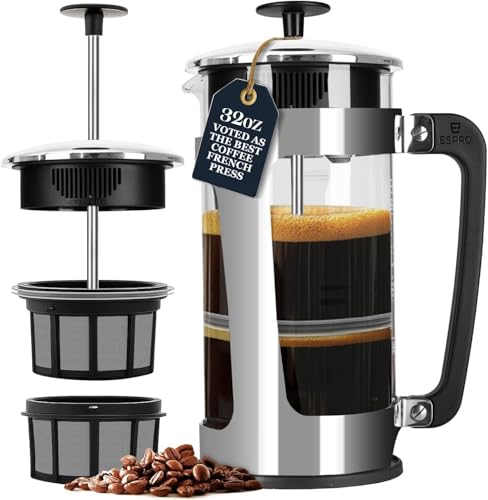
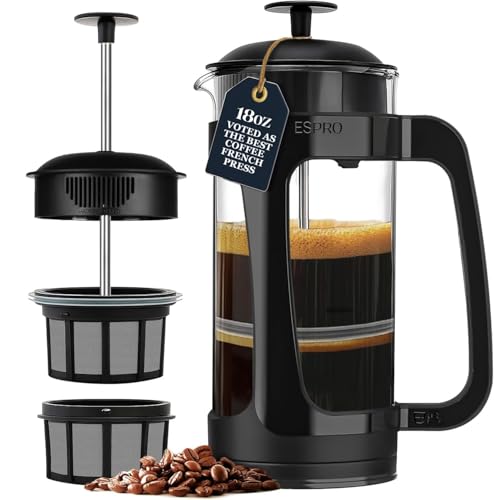
| Espro P5 | 950 ml pot with double metal filter instead of plunger with paper: more volume, more oils | approx. €50.00 | 9.1 | two to four people regularly want coffee at the same time |
| Bodum Chambord 1 l | Borosilicate glass pot with one litre and stainless steel filter, fragile instead of shatterproof | approx. €34.99 | 8.8 | the pot should stay on the table and sediment does not bother you |
Prices are as of September 2026; the rating is our editorial assessment. The table does not decide what ends up in the cup: for that we would have to brew the four devices against each other with the same bean. Our lowest score is build quality at 8.9, and that is consistent for a device whose load-bearing parts are made of polypropylene and whose only wear part is a silicone seal. More candidates in the category are in the best list of French press and AeroPress.
Who is it for, and when another press?
Quantity decides first, and the chamber fixes it: pressing longer does not bring one more drop. For a one- or two-person household that is the right size. If three or four sit at the table, the press runs several times in a row, each brew with its own infusion and its own filter. Then the question of a pot is worth asking: the Espro P5 makes 950 millilitres at once, the Bodum Chambord one litre.
One hurdle is in the kitchen cupboard. AeroPress gives an inside diameter between 67 and 95 millimetres for the vessel under the press, and if your favourite mug lies outside that range, the nicest recipe is no use to you.
Next comes the grinder. The recommended medium-fine grind assumes that you grind fresh, since pre-ground filter coffee is usually coarser. With coarser grounds you use the longer of the two times from the instructions, and the gap to the pot shrinks. If you have no grinder in the house yet, add that budget to the purchase price.
With the kettle it is about convenience. Without temperature control you brew with boiling water according to the manufacturer; for the 80 degrees of a dark roast you need a control or a few minutes of patience.
That leaves the filter question: little oil with paper or more oil from the stainless steel filter. Which preparation suits you better is worked through in the guide AeroPress vs French press.
Anyone who wants to press a button in the morning and do something else alongside is wrong here. This press demands the same handling every day, and it forgives none of it: no filter, no coffee; no grinder, no suitable grounds. If you see a morning ritual in that, you are in the right place. If you see work in it, you are better off buying a machine with a plug.