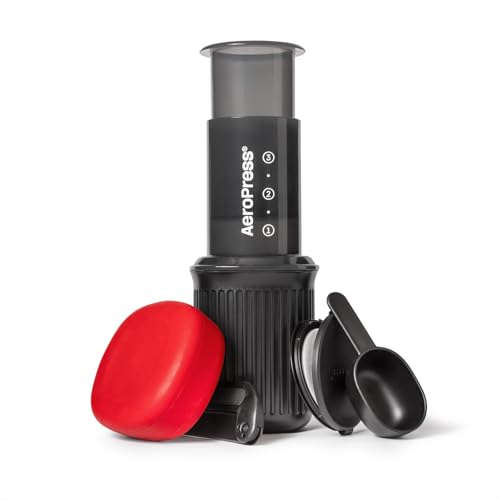
In the product photo, the press sits assembled in the drinking cup: the black cylinder with fill marks 1 to 3 on its side, the translucent plunger on top, the ribbed cup underneath. In front lie the red silicone lid, the flat travel filter holder and the scoop. The principle behind it is much older than the travel version. According to the manufacturer, Alan Adler developed it in his garage in Palo Alto, California, needed two years and over 30 prototypes for it, and presented the AeroPress at Coffee Fest in Seattle in November 2005.
The Amazon catalogue has listed the Go since 4 December 2019, as model 15A01 with part number A10, colour given as grey. In our catalogue it stands at approx. €44.00 on Amazon.de, as of September 2026; in the manufacturer’s shop it costs US$49.95. In our comparison of French press and AeroPress coffee makers it scores 8.9 out of 10, behind the Original on 9.3. According to the help centre, it is made in the USA, together with Original, Clear, Clear Colors, Clear XL and Original XL; by the same source, all AeroPress products are designed there.
Cup, chamber, plunger: what is in the box
The product page lists the contents as paper microfilters, stirrer, scoop, cup, lid and filter holder. The filter holder here does not mean the cap on the cylinder but the flat tin for luggage, in which a supply of paper filters travels. Cap and holder are two different parts with almost the same name, which matters when you order replacements.
All parts are made of food-grade polypropylene, except the lid, plunger seal and paper filters. Lid and seal are silicone. According to AeroPress, the polypropylene is free of BPA and phthalates. The product page gives the same combination more briefly as polypropylene and silicone for the cup lid.
The product page gives 4.5 inches in height and 3.6 inches in width, converted about 11.4 by 9.1 centimetres. Fully packed, that is press, cup, lid, stirrer, scoop and 20 filters in the travel holder together, the whole thing weighs 11.4 ounces, which is 323 grams. The Amazon catalogue also lists 5.3 by 3.9 by 3.9 inches and 0.701 pounds, so about 13.5 by 9.9 by 9.9 centimetres at 318 grams. The larger centimetre values probably describe the packaging and not the device, but that is documented nowhere; we therefore work with the values from the manufacturer’s page.
The drinking cup holds 15 ounces, converted 444 millilitres. AeroPress describes that as just under two portions of 8 ounces. It doubles as the packing case: the manufacturer’s text in the Amazon catalogue sums up the travel routine as unpack, brew and pack the coffee press back into the cup, which thus also serves as a portable travel container.
In detail: three phases and eight ounces
AeroPress calls the method 3-in-1 and breaks it into rapid immersion, microfiltration and air pressure. The manufacturer credits immersion with keeping bitterness, acidity and over-extraction low, and air pressure with a smooth, full-bodied bean flavour. In the Amazon catalogue the same logic appears as an interplay of air pressure and microfiltration that speeds up extraction and leaves less bitterness than other methods; there the manufacturer lists the 3-in-1 technique as patented.
What carries this technically can also be said without advertising vocabulary. Coffee and water stand together in the cylinder, instead of water trickling through a bed of grounds as in a pour-over. At the end, a plunger pushes the liquid through the paper filter and ends the run, instead of letting it drain by itself; together with the 30 to 60 seconds of steeping time, depending on grind size, this keeps the contact time short. What else can be behind it when the cup tips over is covered in the guide Coffee tastes bitter or sour. Short contact time at any rate means fewer chances for the bitter components that dissolve late from the grounds.
The figure the purchase decision really hangs on is the portion size. The manufacturer gives 8 ounces per brew, about 237 millilitres, and lists that as one cup. If you draw a concentrate from it, the help centre says you get up to three portions of espresso-style coffee per press. Concentrate here means that water or milk is added only afterwards; one press thus becomes three drinks instead of one cup of filter coffee.
Does the Go even fit your cup?
Only if its inner diameter is between 7.0 and 8.3 centimetres. AeroPress gives the Go a maximum of about 3.25 inches inner diameter; the lower limit of 2.75 inches is given by the same help centre page for Original, Clear, Go Plus and Go together. For the Original, however, its own product page gives 2 5/8 inches, that is 67 millimetres, as the lower limit. The two manufacturer sources differ here by about 3 millimetres. A ruler across the rim of your favourite mug settles that in ten seconds.
Original, Clear and Go Plus, by contrast, still sit on vessels up to about 3.75 inches, so roughly 9.5 centimetres. The cylinder is not the reason, since according to the help centre its diameter is the same for these three models and the Go. What is smaller on the Go is the flange with which the chamber rests on the rim of the cup. On the road, that is exactly the point, since less material means a smaller packed size. In your own kitchen, the same flange can be the point where the wide breakfast mug drops out and you end up drinking from the supplied cup after all.
How the manufacturer brews, and how it gets clean again
The instructions on aeropress.com list seven models side by side, which makes matching them up tiresome. For the Go there are two recipes, both with water up to mark 3 on the side of the chamber. The first uses pre-ground coffee at a medium grind: 16 to 18 grams, then wait 60 seconds. The second assumes freshly ground medium-fine coffee: 12 to 14 grams, then 30 seconds. The waiting time therefore depends on the grind size and not on the fill mark, and if you grind medium-fine, you press after half a minute. Where medium-fine sits on your grinder is covered in the guide Setting the grind size, and other ratios are worked out by the brew calculator.
The manufacturer’s text in the Amazon catalogue reproduces only the second variant, shortened to three steps: add coffee and water, wait 30 seconds, press. For the whole process, the same catalogue text allows less than two minutes.
The remaining steps are listed by the same instructions as steps, without it being certain that the wording belongs only to the Go section. In our AeroPress guide they appear once more in one piece. Stir gently for about three seconds. Insert the plunger about half an inch into the chamber and pull it up slightly, so that a vacuum forms and nothing drips through early. Then press evenly and gently, expressly not too hard.
After that it gets short. Dispose of the paper filter together with the coffee puck, rinse the filter cap and the press, done. The catalogue text puts the same step in two moves: remove the coffee grounds and rinse.
Filters, spare parts and running costs
Every brew needs a paper filter, and that is the only regular item in the bill. 100 come in the box, and the travel holder takes up to 20 of them. According to the manufacturer they are compostable too, so they go with the coffee puck into the organic waste. With one cup a day, the quantity supplied lasts a good three months.
As a reusable option, AeroPress offers a reusable metal filter. It replaces the paper permanently, and whoever uses it swaps consumables for a one-off purchase.
For the Go itself, the individual parts are available as replacements. Chamber, plunger with seal, the seal alone, filter cap, cup, lid, scoop and stirrer are each in the manufacturer’s shop. For a device without electronics, this is the real longevity factor: only mechanics can break here, and mechanics can be bought again part by part. A circuit board that nobody can supply after seven years is nowhere to be found in this press.
What AeroPress does not state
For so simply built a device, the data is thin in a few places. Missing are: the chamber’s capacity in millilitres, the meaning of the fill marks in millilitres or grams, the individual dimensions of chamber, plunger and filter holder (the dimension tables in the help centre cover Original, Clear and Go Plus, but not the Go), the weight of the press without cup and accessories, the diameter and weight of a single paper filter, the temperature resistance of the plastic parts in degrees Celsius, a lifetime or replacement interval for the plunger seal, the temperature inside the chamber during extraction, the pressure in bar that builds up in the cylinder while pressing, and the colour variants currently available. Whether the silicone lid really closes tightly or only guards against splashes is likewise not stated on any of the pages checked, and no marks of approval or certificates for the plastic parts are shown there anywhere.
Two gaps concern buying in Germany directly. What spare parts and filter refill packs cost here, and whether the shop delivers to the EU at all, was not on any page we checked; prices there are given throughout in US dollars. And AeroPress guarantees material and workmanship defects for one year from the date of purchase, provided the device was bought from an authorised retailer; in the German wording, the same promise is in the manufacturer’s details in the Amazon catalogue. How the process works in Germany and who the contact is, the manufacturer does not document.
Watts, heat-up time and noise are deliberately not on this list. The Go is hand-operated; there is nothing to measure.
What else is worth considering?
| Model | The difference | Price | Our rating | Choose this if |
|---|---|---|---|---|
| AeroPress Go (this one) | 8 ounces per brew, cup with lid as carry case, fully packed 323 g | approx. €44.00 | 8.9 | you take the press along regularly and do not want to pack a second drinking vessel on the road |
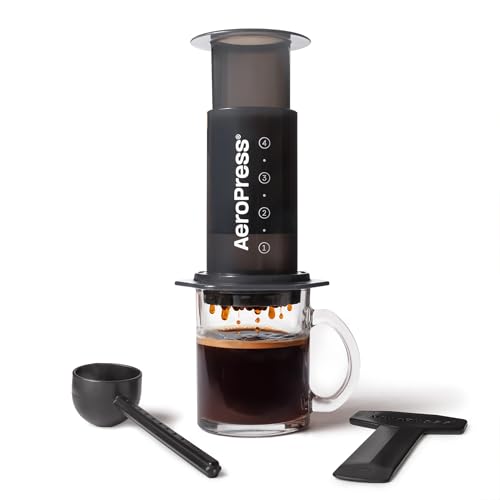
| AeroPress Original | 10 instead of 8 ounces per brew and sits on cups up to about 9.5 instead of 8.3 cm | approx. €41.08 | 9.3 | you almost always brew at home and want to put the press on your normal mug |
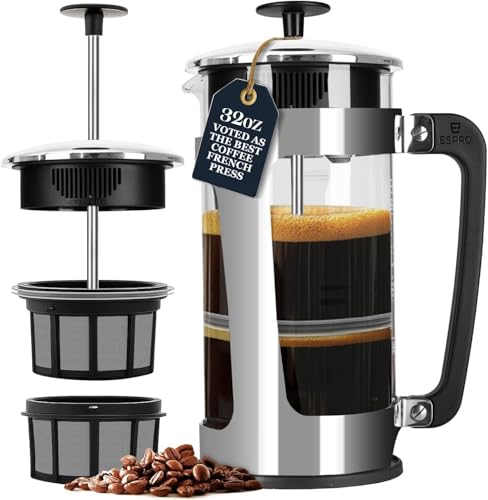
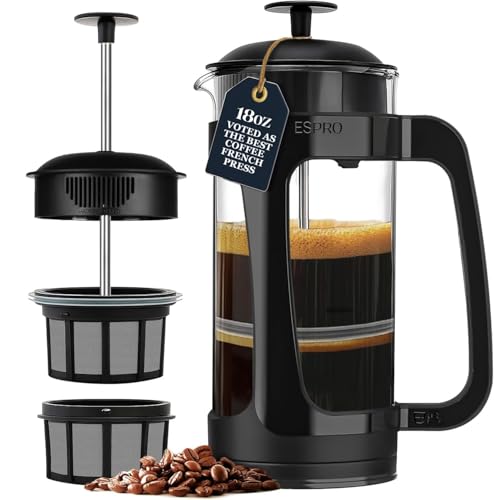
| Espro P5 | Reusable double microfilter and 950 ml capacity instead of a paper filter per cup | approx. €50.00 | 9.1 | several people at your place want coffee at the same time and nobody wants to buy paper filters |
| Groenenberg Edelstahl Thermo 1 l | Double-walled stainless steel with one litre instead of a plastic cup with 444 ml | approx. €36.99 | 8.5 | you want a double-walled jug and it stays on the table anyway |
The prices are as of September 2026, and the rating beside them is our editorial assessment, not a measurement result. What ends up in the cup is not decided by the table either: for that, the four devices would have to be run against each other with the same bean. More candidates in the category are in the best-of list for French press and AeroPress.
When the Go, when another press?
The quantity is hard-wired here: 8 ounces per brew, and pressing longer changes nothing. For one person, that fits. If you want two full cups in a row, you set up the press twice, with its own infusion and its own filter. Anyone who does that every morning is done faster with the 10 ounces of the AeroPress Original; for three or four people at once, the road leads to a jug like the Espro P5 with its 950 millilitres anyway.
The second question is less comfortable: how often do you really take it with you? The smaller packed size of a good eleven by nine centimetres and the cup the press travels in are the whole reason to buy it over the Original. A weight advantage is not documented: fully packed, the Go weighs 323 grams, the Original with filter cap, scoop and stirrer 7.75 ounces, so about 220 grams, and AeroPress does not give a weight for the Go without the cup. If you pack it twice a year, you pay for a feature that is hardly used.
Keeping warm is not among its jobs. If the coffee is to stay warm for a round of coffee, the way leads to a double-walled jug like the Groenenberg Edelstahl Thermo, which for that reason fits in no rucksack side pocket.
The Go boils no water. Without a kettle, camping stove or filled thermos flask it remains an empty cup, and on a train or a plane that is the condition on which the nice travel idea is most likely to fail.
That leaves the grinder. Only the manufacturer’s second recipe assumes freshly ground medium-fine coffee, so a grinder that can be adjusted, on the road usually a hand grinder in addition to the purchase price; which ones come into question is covered in the hand grinder buying guide. Without your own grinder, the longer of the two variants remains, pre-ground coffee and 60 seconds of waiting.
Who is it for?
For people who want to make their coffee themselves on the road and are ready to control every step themselves. The manufacturer’s text advertises exactly that: one of the few coffee makers that leaves you full control over brew time, temperature and grind size. That is more honest than it sounds, because no programme runs here to iron out a mistake.
As drinks, the same text names classically brewed coffee, cold brew coffee, iced coffee and espresso-style drinks such as cappuccino and latte. For the last two you need milk foam, and the Go does not bring that; it supplies the concentrate, the rest is up to you. The manufacturer expressly lists hot or iced coffee on the road as a purpose.
Anyone who plans it as a household jug replacement is mistaken. Whether a press with paper filter suits you at all or a classic plunger jug does, is sorted out by the guide AeroPress vs French press. AeroPress draws the line by place of use anyway and not by result: according to the help centre, the Go works exactly like the Original, and it is designed for work, travel and the outdoors. Whoever never carries it out of the kitchen has bought a travel device and uses it as a fixed one.