The name suggests a ranking, and that is exactly what does not hold. The P5 is not the large version of the P3. The product pages of both models list the same two order sizes, 18 and 32 ounces. What you get for the extra money sits on the outside, around the glass.
Is the premium over the P3 worth it?
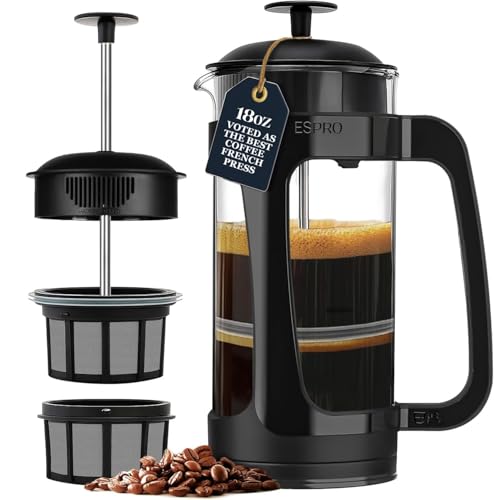
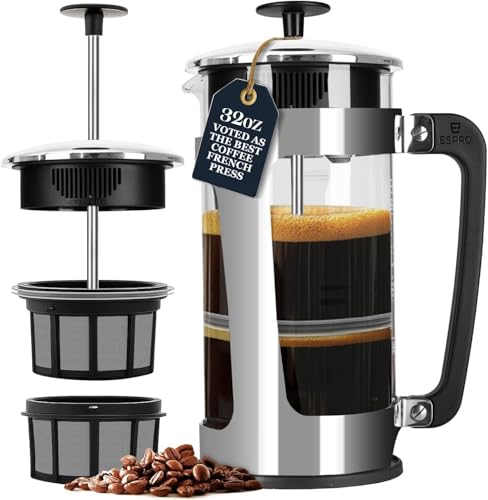
Only if the jug is on the move in your home. Espro writes in its own blog that the P5 comes with a stainless steel cage around the glass jug, for more durability and a smoother look. That is the difference; the two models share the rest.
The materials lists spell it out. For the P5, Espro names borosilicate glass, stainless steel and polypropylene; for the P3, only borosilicate glass and polypropylene. The weight follows the construction: 2.4 pounds for the P5 against 1.8 pounds for the P3, converted about 1.09 against 0.82 kilograms when empty.
According to the manual, a safety lock holds the glass firmly in the frame. That is not a difference between the models: the instructions are published for the P3 and P5 together, and the P3’s product page also mentions a lock that holds the glass firmly in the frame. What remains documented as a difference is the materials list, the blog sentence about the cage and the 0.6 pounds of extra weight. Without assigning it to a model, the Amazon text also mentions a twist-lock closure that is meant to secure the jug against slipping, spilling and cracks when pouring.
In price terms, approx. €50 (as of September 2026) face the €29.75 from the data sheet of the Espro P3. The gap of about €20 also includes the size difference, however, because we list the P3 at 530 millilitres and the P5 at 950. We would choose the metal cage and a few hundred grams more mass if the jug travels to the breakfast table, stands between desks in the office or gets carried out onto the balcony.
Dimensions, glass and origin
Espro gives the jug as 6.1 x 4.3 x 9.5 inches, so about 15.5 x 10.9 x 24.1 centimetres. The height is the figure that matters in the kitchen, because you still need room above it for the hand with the kettle when filling. The Amazon catalogue lists its own dimensions, 9.75 inches high with 6 inches length and 4 inches width, so a good half a centimetre more in height. If you are planning tightly, work with the larger of the two values.
The sources also contradict each other on weight. Espro gives 2.4 pounds, the Amazon catalogue 1.83 pounds, which is practically the weight the manufacturer gives for the P3 (1.8 pounds). We work with the manufacturer’s figure for the P5.
The glass is borosilicate. The shared instructions say the jug’s own glass is 40 per cent thicker than that of a classic press, which keeps it warmer for longer and makes it more resilient. Plastic still appears: according to an Amazon bullet point, the filter frame is BPA-free and carries a 360-degree silicone seal that guides the screen along the glass wall. Espro lists the P5 itself as free of BPA, BPS and phthalates.
Two more details from the catalogue for finding spare parts: the model number is 1232C, the colour designation Polished Stainless Steel. It is made in China, and the company is based in Vancouver.
In detail: what two micro-filters change
A classic French press has one screen. The P5 has two, and the manual expressly requires screwing both onto the rod. Espro calls this a patented micro-filtration system whose purpose is to keep out the fine sediment.
How fine the screens really are, the manufacturer only says in relative terms: 9 times and 12 times finer than average, as stated in the company history on espro.com. The Amazon bullet point speaks of ultra-fine stainless steel mesh, up to 12 times finer than standard presses. These are manufacturer figures without a reference point; we have not checked them by brewing.
More interesting than the fineness is the second effect, and it is down to the design. The manual describes how the construction ends the extraction process as soon as the filter is at the bottom. In a single-layer press the coffee keeps standing on the grounds and keeps extracting, which is why it is usually decanted straight away. If you follow the manual, this step is not needed with the P5. Anyone who drinks a full jug over half an hour gains more from this than from any figure on mesh size.
By way of background: Espro was founded in 2002 by two engineers, Chris and Bruce, and by its own account was already on its fourth filter generation after five years.
Quantities, grind size and steeping time according to the manual
Grind coarse, nothing else. The instructions allow only coarsely ground coffee.
For the 950 millilitre jug there are two rows in the quantity table: 30 to 45 grams of coffee if you fill to the MIN line, and 40 to 60 grams up to the MAX line. The range within a row is your adjustment for strength; the brew calculator works out the matching amount of water.
In its own FAQ, Espro also gives a ratio: one gram to 15 to 18 millilitres of water. Scaled up to the full 950 millilitres, that comes to about 53 to 63 grams, while the row up to the MAX line starts at 40 grams. Both figures come from Espro and only coincide in the upper part. If you dose by the table, you therefore end up nearer the weak end of what the manufacturer’s ratio specifies.
In its own brewing instructions, Espro puts the water temperature at 195 to 205 degrees Fahrenheit, converted about 91 to 96 degrees Celsius. Then wait four minutes and press slowly, with a force of at most 10 pounds, so about 4.5 kilograms.
The figure most likely to tip the purchase is inconspicuous on the product page: Minimum Brew Size, 24 oz, about 710 millilitres. The large jug is therefore not a device for a single afternoon cup.
The method step by step is in the French press guide, and the question of the right grind size in the guide Adjusting your grind size.
Paper filters, care and spare parts
Paper filters are an option with the P5, not a requirement. Espro intends them to be inserted together with the coffee filters and describes the result as oil-free coffee in pour-over style. Two rules on this are in the manual: a paper filter is not reused, and it does not work together with the tea filter. Whether any are in the box is unclear, because the manual speaks of enclosed paper filters while the product page sells them separately.
It is cleaned after every brew, and there is more to do than with a simple jug. Espro writes in its own FAQ that the two screens are to be separated with a twist and washed individually with washing-up liquid. You take the glass out of the cage beforehand, as the instructions require, and before first use all parts are washed inside and out. Once a month the manufacturer recommends a longer soak with its deep-clean product against deposits and odours.
What must not happen is stated in capital letters in the instructions: no hob, no campfire, no microwave. If the glass shows a crack, the jug must be taken out of use and replaced.
According to the manual, filters, seals and glass count as wear parts. Of these, Espro sells the filter and a replacement glass for the P3 and P5 individually in its shop; seals are not on the spare parts page. The coffee micro-filter in the 4-inch version for the large jug costs US$21.95 in the manufacturer’s shop; Espro lists no euro price. Before buying, it is therefore worth checking whether your retailer stocks replacement screens at all.
What Espro leaves open
A few details that belong on a data sheet are missing from this manufacturer, and that is part of the picture: the mesh size of the two screens is nowhere given in micrometres, only as a ratio to the average; Espro does not give the glass wall thickness in millimetres, only as 40 per cent more; the product page is silent on the grade of stainless steel in the cage and screens; no patent number for the filter system appears anywhere; a list of the box contents is missing; the manufacturer does not quantify how long the coffee stays hot in the jug; dimensions and weight are only given in inches and pounds; and we have not found a German-language instruction manual, the manual exists in English and French.
Heat-up time, wattage and brewing temperature of the device do not apply here. The P5 has no power connection; you bring the hot water yourself.
What else is worth considering?
| Model | The difference | Price | Our rating | Choose this if |
|---|---|---|---|---|
| Espro P5 (this one) | Two micro-filters, glass in a stainless steel cage, 950 ml | approx. €50 | 9.1 | you often carry the full jug and want the breakage protection |
| Espro P3 | Same double filter, same two sizes, frame without stainless steel | approx. €29.75 | 9.0 | the jug stays in one place |
| Bodum Chambord | One stainless steel filter screen with cross plate and spiral plate instead of two micro-filters, 1 litre | approx. €34.99 | 8.8 | a little sediment at the bottom of the cup does not bother you |
| AeroPress Original | Plunger with paper filter, 296 ml brew chamber | approx. €41.08 | 9.3 | you drink alone and want to be done in two minutes |
The prices are guide values as of September 2026 and change daily; the rating is our editorial assessment based on four individual scores, not a measurement result. What the table does not do: it says nothing about how the four taste with the same bean. All jugs and presses in the class are in the hub French press and AeroPress.
When this jug suits you and for whom it is the wrong one
Four things decide it: how much coffee you want in the jug at once, how much time you have at the sink, which grinder you have in the cupboard and how much space is free under the wall cabinet.
On quantity: 950 millilitres works out at four cups of 240 millilitres or just under five of 200. At the lower end, the minimum brew size caps it at a good three cups. You move between these two marks; anything below that the manufacturer does not envisage for this jug. If you regularly need less, go for the small version: in the manufacturer’s shop the 530 millilitre press costs US$44.95 and the large one US$49.95, so five dollars more. The size is therefore not decided by price, but it is by quantity.
On washing up: twisting two screens apart and washing them individually takes longer than rinsing a single-layer standard screen. If you want to be out of the kitchen in two minutes in the morning, a classic jug is quicker and you accept the sediment.
Then the grinder. Without a grinder that manages an evenly coarse grind, the double filter does not play out its advantage, and fine grounds clog the screens. If you have so far bought pre-ground filter coffee, you should put the money into a grinder rather than the more expensive jug.
That leaves space. A height of 24.1 centimetres has to fit under the wall cabinet, and the full jug weighs a good two kilograms: about 1.09 kilograms empty plus just under one kilogram of water. Factor that in when lifting it one-handed over the breakfast table.
One group should keep their hands off this jug: anyone who wants to keep the coffee warm for an hour after brewing is better off buying an insulated stainless steel jug. The P5 must not go on a heat source, and the thicker glass is no substitute for insulation. If you are unsure, the manufacturer’s period helps: on the product page Espro gives 30 days for returns, valid for purchases in its own shop.