Espro goes back to two engineers who came to coffee technology in 2002 through the Clover Brewing System. Their first product was a calibrated tamper, the French press came afterwards, and the manufacturer describes its own development work along three adjustable factors: temperature, extraction, filtration. Two of them are built into the P3; you bring the hot water yourself. It is made in China, and the company is headquartered in Vancouver.
The version listed in our catalogue is the 530 millilitre one at approx. €29.75 (on Amazon.de); in the Amazon catalogue the price on 7 September 2026 was €31.50, so €1.75 above our reference price. For this size Espro itself asks US$34.95 in its own shop, regularly US$44.95. In our catalogue the P3 is therefore around €20 below the Espro P5, which works with the same double filter but is listed there in the 950 millilitre version.
What Espro builds in, and from what
The materials list on the product page is short: borosilicate glass and polypropylene. The frame around the glass is plastic; Espro describes it as light yet sturdy, and its job is to protect the glass. Espro only uses the stainless steel cage on the P5.
There is one number for the glass: 40 per cent thicker than in a classic press. From this Espro derives two benefits, longer heat retention and more durability. Espro says nothing about a second layer of glass or vacuum insulation, and elsewhere the manual explicitly warns that glass and contents get hot. So the P3 is not a carafe you hold by the belly rather than the handle.
A twist lock secures the glass in the frame, which Espro calls Safety Lock; for cleaning, the glass is taken out. The German manufacturer text in the Amazon catalogue additionally credits the lock with preventing slipping or spilling when you pour. According to the manufacturer, the plastic parts are free of BPA, BPS and phthalates.
Dimensions and weight are the shakiest part of the data sheet. Under Details the product page shows only the large version: 6.1 x 4.3 x 9.51 inches, around 15.5 x 10.9 x 24.2 centimetres, at 1.8 pounds, so about 820 grams. For the 530 millilitre variant only the Amazon catalogue gives values: around 22.6 centimetres in height, 14.5 centimetres in length, 8.9 centimetres in width and one pound, so about 450 grams. The two sets of numbers belong to different carafes and must not be mixed up. And catalogue dimensions are overall dimensions: the product photo shows a round glass in a frame with a side bow handle, so the 14.5 centimetres is measured across handle and spout. The narrow figure of 8.9 centimetres comes closest to the diameter of the carafe.
In detail: two screens, one seal, no paper
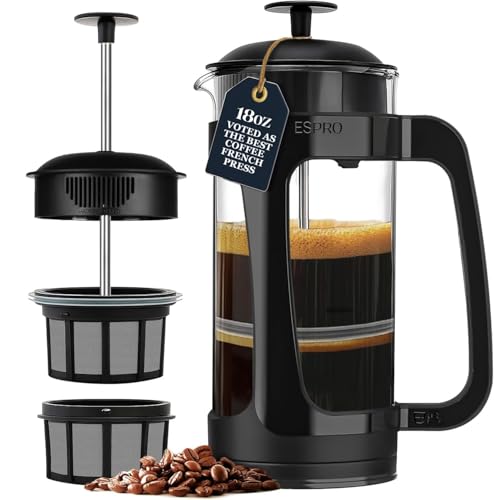
The difference from any standard carafe sits on the filter rod. There are two screens there instead of one, plus, according to Espro, a double silicone seal on the filter frame, which is meant to keep sludge and bitter compounds at the bottom. Espro only gives the fineness of the mesh as a ratio: nine and twelve times finer than average.
The second effect has its own name at the manufacturer, Air Lock Technology. With the filter at the bottom, the seal sits between the coffee grounds and the water, and according to Espro the extraction ends. The manual phrases this as a design purpose: the design stops coffee extraction and tea steeping as soon as the filter is pressed down. In a classic press the grounds stay in the water afterwards and keep extracting, which is why the rest in the carafe turns bitter over time. Espro sells this as a promise that the first cup tastes like the last.
What two metal screens cannot do, however, is hold back oil. Coffee oils pass through metal and end up in the cup, while a paper filter binds them. That explains the body and the cloudiness, and it also explains why the AeroPress Original, with its paper filter, produces a different drink. If you want oil-free coffee you need paper, in whichever device.
Is the P3 enough for two cups in the morning?
For two mugs yes, for three no. The carafe holds 530 millilitres, from which the volume of the coffee grounds is deducted. Counted in 200 millilitre mugs that leaves two; at 240 millilitres it gets tight.
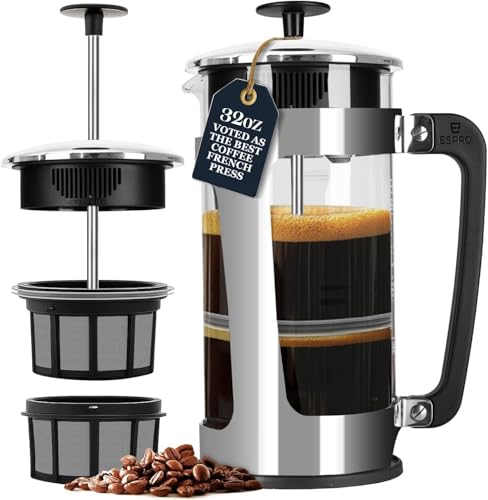
For more, Espro offers the second size in the range, 950 millilitres, as both a P3 and a P5. So the volume is decided by the variant you order, not by the model. With the P5 you pay for the metal frame around the glass; the capacity stays the same.
How much coffee may go in is shown as a marking in the glass. For the 18 oz press the manual lists two lines: up to MIN 4 to 5 tablespoons, 18 to 27 grams, up to MAX COFFEE 5 to 7 tablespoons, 24 to 36 grams. The MIN line in the glass is the only lower limit Espro gives for this size, and the manufacturer gives no millilitre value for it. The Minimum Brew Size of 24 oz, around 710 millilitres, explicitly applies to the large carafe. So fill at least to the MIN line; below it Espro specifies nothing. The brew calculator works out the coffee-to-water ratio for you.
What else is worth considering?
| Model | The difference | Price | Our rating | Choose this one if |
|---|---|---|---|---|
| Espro P3 (this one) | Double micro-filter, 530 ml, glass in a plastic frame | approx. €29.75 | 9.0 | sediment at the bottom of the cup bothers you and one to two mugs are enough |
| Espro P5 | Same double filter, same two sizes, glass in a stainless steel cage | approx. €50.00 | 9.1 | the carafe is carried often and you want the glass in a stainless steel cage |
| Bodum Chambord | Fine-mesh stainless steel screen, 1 litre, glass and screen can be bought separately | approx. €34.99 | 8.8 | you brew for two to four people and accept sediment |
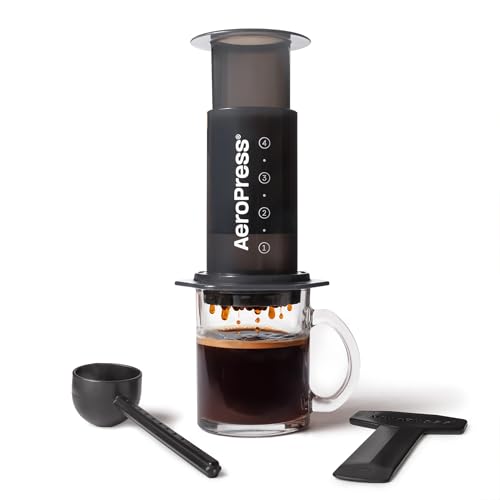
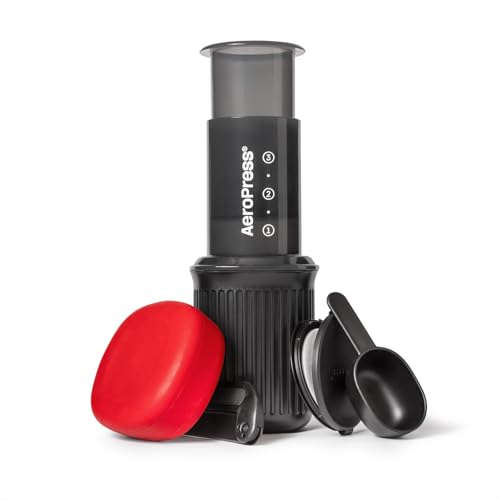
| AeroPress Original | Plunger with paper filter instead of a metal screen, one to two cups | approx. €41.08 | 9.3 | you mostly drink alone and want oil-free, clear coffee |
The prices are reference values as of the same date; the rating is our editorial assessment based on four individual scores and not a measurement result. What the table is not good for: it says nothing about how much work each of the four carafes makes at the sink after brewing. All carafes and plungers in the class are in the hub French press and AeroPress.
Grind size, steeping time and pressing force
Coarse, and only coarse. The manual permits only coarsely ground coffee, and the Espro FAQ gives the reason: coffee ground too fine can clog the screens, and then pressing becomes hard. Anyone who then helps along with force has a safety problem. The manual classes a stiff or clogged-looking filter as one to be replaced immediately, citing the risk of scalding.
Behind this is the nature of every immersion method: all the grounds sit in the water for the same length of time, here four minutes. In that time fine dust gives up its content much faster than coarse particles and is long since over-extracted when the coarse pieces are just right. So the filter calls for the setting that the brewing method recommends anyway.
Espro puts the water temperature in the brewing guide at 195 to 205 degrees Fahrenheit, around 91 to 96 degrees Celsius, and explicitly contrasts it with the 212 degrees Fahrenheit of boiling water. Freshly boiled water is therefore above it. Hotter water dissolves faster, and what comes out of the grounds last tastes bitter; if you let the kettle stand open for a moment after boiling, you end up in the range Espro names. Then wait four minutes.
When pressing, the manual sets an upper limit for the force: at most 10 pounds, about 4.5 kilograms converted, and slowly. How slowly is stated in the brewing guide: count to 20 until the plunger reaches the bottom.
One rule is easily overlooked. Stir with a plastic or wooden spoon. According to the manual, metal scratches the glass and can cause it to break. The teaspoon from the cutlery drawer has no place in this carafe.
The method step by step is in the French press guide, and the question of the right grind size is in the guide Setting your grind size.
Cleaning, spare parts and what running it costs
Before the first brew, all parts are washed inside and out, as the manual wants. After that the same thing is due after every use, only for two screens: unscrew the filter from the rod, separate the two screens with a twist, and wash them inside and out with a bottle brush. The instructions explicitly forbid poking the mesh to clear it. Once a month a deep clean is added, which Espro recommends on its care page.
The manual lists filters, seals and glass as wear parts. Espro sells the coffee micro-filter in the 3.3 inch version for the 18 oz press in its own shop for US$19.95 on offer, regularly US$24.95. The micro-filter is listed for P3, P5, P6 and P7, and in the 4 inch version for the 32 oz presses.
A replacement glass costs exactly the same as a filter in the same shop. Anyone who replaces both at once pays US$39.90, which is almost five dollars more than Espro asks for the complete carafe. As long as only one part is due, repair is worthwhile. If both are, then by our calculation the new carafe is cheaper.
We could not document a German source for wear parts: Espro sells filters, replacement glass and paper filters in US dollars through its own shop. Anyone who filters with paper permanently pays US$9.95 per pack in the 18 oz size there, regularly US$12.95.
The second US connection is on the warranty page: Espro limits the warranty there to orders and shipments within the USA. The manual promises repair, replacement or refund. It excludes damage from incorrect use, inadequate cleaning and normal wear: Espro repairs those for a charge. For a purchase in Germany this means that your point of contact is the retailer you ordered from, under the statutory warranty rights.
What Espro does not state
A few numbers that you would expect in a data sheet are missing from this manufacturer. The mesh size of the screens exists only as a ratio to the average, not in micrometres. How long the thicker glass keeps the coffee warm remains without a value; neither minutes nor a temperature curve appear anywhere. For the 530 millilitre version there is no number of cups, only amounts of coffee in grams. There is no interval for changing the filter, only the trigger: stiff or clogged. The manual lists the seals as a wear part, yet they cannot be ordered individually on the spare parts page. And a warranty period in years is not to be found, either in the manual or on the warranty page.
Heat-up time, power consumption and noise level do not apply to a carafe without electricity anyway. The 91 to 96 degrees from the brewing guide are the temperature you pour with, not a performance of the device.
When the P3 fits and when another carafe does
Four questions tip the purchase, and none of them is whether the carafe is good.
The first is quantity. 530 millilitres is the upper limit; for one mug on weekdays and two at the weekend that is enough. Hardly any money hangs on the size: in the Espro shop the 950 millilitre version costs US$39.95, five dollars more than the small one.
The second is the grinder. Without a grinder that works coarse and even, the double filter does not play to its advantage, and fine grounds clog the screens. Our assessment: with pre-ground supermarket coffee, the grinder comes before the carafe on the shopping list.
The third is time at the sink. Unscrewing two screens, twisting them apart and brushing them individually takes longer than holding a single screen under the tap, and it is due after every brew. The double filter is the reason to buy this carafe and at the same time its daily chore.
That leaves space. Around 22.6 centimetres of height have to fit under the wall cupboard. With an empty weight of about 450 grams plus half a litre of water, the full carafe stays just under one kilogram.
Who is it suitable for?
The P3 is a device for a fixed worktop in the kitchen. For campers and boaters who keep their coffee warm on the go over a flame, it is the wrong carafe. The manual states in capital letters that the press does not belong on the hob, at the campfire or in the microwave, and it requires that the hot carafe be kept out of the reach of children.
Where the carafe stands in the field of its category is shown by the French press and AeroPress comparison. When ordering, it is also worth checking the variant: what is meant here is the black version with 530 millilitres, listed in German retail as ESPRO P3 Light French Press, model number 1418C-BK.