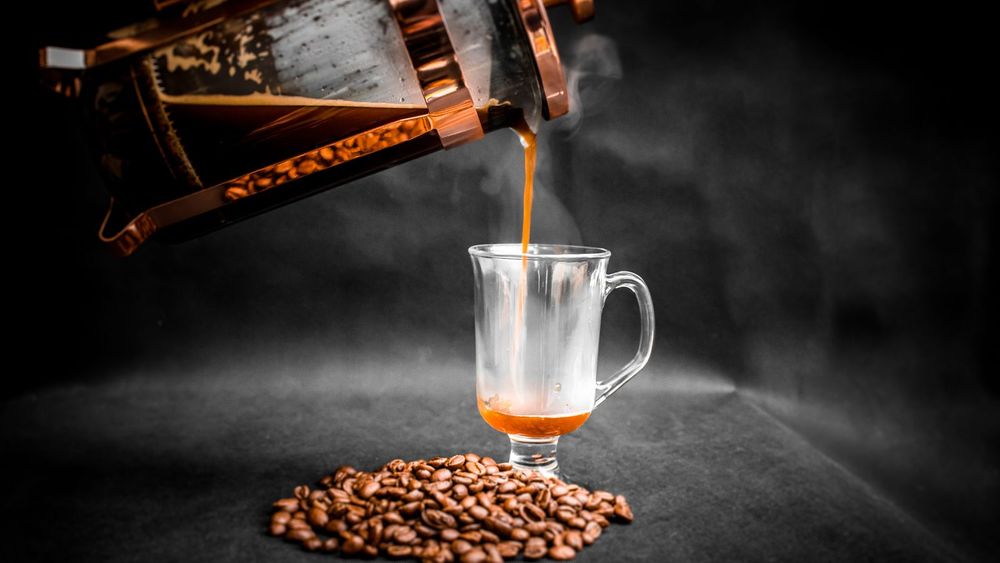
Eight devices in which ground coffee and water sit together for a while until a strainer or filter separates the two: that is all these candidates have in common. None of them needs electricity, you bring the hot water yourself wherever you are, and two design decisions that you can already see in the product photo determine the result in the cup. Is the filter paper or metal, and does the coffee sit in glass, steel or plastic?
We have not brewed with any of the eight. Every statement about a device comes from its own review and is backed there by a source, usually a manufacturer page or an instruction manual. We calculate the price differences between the places and the conversion of the manufacturers’ cups into 200 millilitre mugs ourselves, and we attribute assessments to ourselves.
How these eight came together
Ten jugs and presses in the French Press and AeroPress category have a review of their own with us. This page takes the eight with the highest overall score from them and ranks them accordingly: 9.3 points in first place, 7.9 in eighth. Nothing has been sorted by design, brand or price class, which is why the lowest guide price in the category is missing from this list.
Four designs come together here. Two polypropylene plungers press the brew through paper (AeroPress Original and Go). Two glass jugs carry Espro’s double micro-filter, one with 950 and one with 530 millilitres. Three glass jugs with a capacity of one litre work with a stainless steel strainer instead of paper: on the Chambord and Brazil a filter strainer together with a cross plate and a spiral plate, on the Preziosa Bialetti names only a steel filter system, without the number of layers. These three differ mainly in what surrounds the glass: chromed steel on the Bodum Chambord, a holder of 18/10 stainless steel on the Bialetti Preziosa, plastic on the Bodum Brazil. The eighth jug has no glass at all.
In volume per batch, the smallest and the largest version are more than a factor of four apart: AeroPress gives 237 millilitres for the Go, while four of the eight state a nominal volume of one litre. Where two places are close together, we draw on the four individual scores from the reviews, that is build quality, performance, handling and value for money. They assess manufacturer documents and catalogue data, no measured value stands behind any of these figures, and we do not calculate here how much each weighs within the overall score.
Paper or metal: the dividing line that concerns your grinder
In this category the filter decides two things at once: how much sediment ends up in the cup and how much oil arrives in it. A metal strainer lets the coffee oils through, paper binds them. AeroPress expressly credits its own stainless steel filter with letting the oils pass and sells it for US$14.95 as an alternative to the paper micro-filter. Espro takes the middle way on the P3 and P5: two strainers hang on the filter rod, and the manufacturer gives their fineness only in relative terms, nine times and twelve times finer, compared with an average that Espro defines nowhere. If you like, you can place a paper filter in between as well and, according to Espro’s description, get oil-free coffee in the pour-over style. Groenenberg keeps its metal strainer slightly coarser by its own account, so that the essential oils stay in the drink.
The consequence concerns your grinder, and here the category splits cleanly into two camps. Every jug with a metal strainer requires a coarse grind, and all four manufacturers give the same reason. Bodum prints a CAUTION in the shared instructions that apply to the Chambord and Brazil, because finely ground coffee can clog the filter and build up high pressure. Espro’s manual permits only coarsely ground coffee and demands immediate replacement if the strainer is clogged. For the Preziosa, Bialetti specifies coarsely ground coffee and warns of the same pressure build-up. Groenenberg’s instructions put the point on a list of six rules against a gush of hot coffee when pressing down.
The AeroPress reverses this. The manufacturer recommends a medium-fine grind, and the paper filter holds back the fines while the plunger forces the water through instead of letting it run through. More fineness means more surface per gram and therefore faster extraction, which is why 60 seconds of steeping time is enough here, and according to the instructions even 30 with a truly medium-fine grind. The plunger jugs here, by contrast, all stand for at least four minutes. If you own only a grinder with a fine espresso setting or buy pre-ground coffee, the choice has been made for you before you look at a price. How to get your grinder there is explained in the guide Setting the grind size.
Glass, steel or plastic: what happens in a fall
The second dividing line runs around the coffee, and it costs money as soon as something breaks. In its own data sheet for the Chambord and Brazil, Bodum enters a No under Shatter Proof and, in its FAQ, excludes glass breakage from the guarantee, because it cannot be established how it happened. In return, the manufacturer lists the same four spare parts individually for both jugs: replacement glass, filter strainer, cross plate and spiral plate, in the shop between €6.90 and €18.90. Espro sells a replacement glass for the P3 and P5 as well as the micro-filter in its own shop, for the small press at US$19.95 each on offer instead of the regular US$24.95. At Bialetti, repair ends sooner: in the spare parts sections of the German and Italian sites, neither a glass container nor a strainer for the Coffee Press was listed on 14 September 2026, and the guarantee expressly excludes the glass container, except for original defects, as well as damage from impact and falls.
Two designs manage without glass. Groenenberg builds the jug from double-walled 304 stainless steel and lists seven components individually for the one-litre size, in its own shop from €3.49 for the threaded nut to €19.99 for the bare jug, with the lid in between at €8.99. AeroPress relies on polypropylene and calls the press unbreakable, about 13.4 by 10.7 centimetres when pushed together and about 220 grams. That is why, in this category, the two polypropylene presses settle the question of travel for themselves, and no glass jug does.
The six jugs on this list share one rule: none of them may go on a heat source. Bodum forbids the hob for the Chambord and Brazil, Espro names hob, campfire and microwave in capital letters for the P3 and P5, Bialetti excludes oven and microwave for the Preziosa, and Groenenberg gives a technical reason for the ban: because of the double wall, only lukewarm liquid would come out when heated, and the base can be damaged or discoloured. Coffee that has gone cold cannot be reheated in these six, then, whereas AeroPress expressly approves the microwave for the Go cup.
The eight places and the reason for each
1. AeroPress Original, 9.3 points
9.7 for performance and 9.5 for handling are the highest individual scores in the field. The 2026 comparison winner owes them not to its equipment but to the method from the filter section above, paper plus plunger pressure: that is why a medium-fine grind is enough, and for brewing and cleaning together the manufacturer allows under two minutes. It suits one to two cups, as the chamber holds no more than 296 millilitres, and compared with the Go in fourth place that is exactly its advantage. Two conditions come with it: the inside diameter of your mug must be between 67 and 95 millimetres, and without paper filters in the cupboard the preparation comes to a halt.
2. Espro P5, 9.1 points
Two tenths behind first place, and ahead for a completely different reason: according to the manual, extraction ends when the filter is pressed down, so the coffee does not keep steeping in the jug. With 950 millilitres that stand for a round of drinks, that is the difference that counts. Against the P3 with the same double filter, the P5 leads on performance (9.6 against 9.4) and build quality (9.2 against 9.1), both stand at 8.6 on handling, and on value for money the P3 leads with 9.0 against 8.8. What is documented as setting them apart is the materials list, the stainless steel cage and 0.6 pounds of extra weight. A figure from the product page sets a floor: minimum brew quantity 24 ounces, about 710 millilitres.
3. Espro P3, 9.0 points
The same double filter, the same end to extraction when pressing, which Espro calls Air Lock, plastic instead of stainless steel around the glass. The version listed in our catalogue holds 530 millilitres, and that is exactly where the price difference from the larger model comes from. For one to two mugs this is the right size, and anyone filling to the MIN line weighs out 18 to 27 grams according to the manual, 24 to 36 up to MAX. One point against repair: replacement glass and micro-filter together cost US$39.90 in the Espro shop, both at offer prices, and so almost five dollars more than the complete jug there.
4. AeroPress Go, 8.9 points
The same brewing method as in first place, a smaller measure: 8 ounces, about 237 millilitres per batch, and all parts stow in the supplied drinking cup, 323 grams fully packed. Its build quality score of 8.6 and its value for money of 8.5 are the weakest figures among the two AeroPress models, and that fits the sums: the extra cost over the Original buys a cup, a lid and a travel filter holder, not volume. It belongs to people who take the press with them every week, and anyone who leaves it at home pays the premium for accessories sitting in the cupboard. One detail settles it too: the Go sits only on vessels up to about 8.3 centimetres inside diameter, while the Original manages about 9.5.
5. Bodum Chambord 1 l, 8.8 points
The category’s editors’ pick has, at 9.2, the highest build quality score on this list, level with the P5. What carries the review is not the chrome shine but the spare parts list: four wear parts with article number and price, and the Bodum FAQ explains the shop’s logic that a product without a spare parts subcategory of its own has no parts. For this jug the subcategory exists. For two people with two mugs each, one brew is enough; with four at the table, you brew twice and wait out the steeping time a second time. Its place is therefore a solid one, with a coaster underneath, which the instructions require.
6. Groenenberg Edelstahl Thermo 1 l, 8.5 points
The only double-walled jug on this list, and the only one where you cannot see the fill level while pouring. In favour of the place speaks the spare parts supply, which the manufacturer describes with seven individual items and a reorder time of at most seven days; against it speaks the score in direct comparison: the Chambord leads in all four individual scores, most clearly on build quality with 9.2 against 8.7. The second wall makes sense for a breakfast table where the jug stands for half an hour to an hour. On keeping warm itself, the sources contradict each other: at least one hour according to the product page, up to one hour in the Amazon text, and we would plan with the more cautious reading.
7. Bialetti Preziosa, 8.4 points
One litre of borosilicate glass in a holder of 18/10 stainless steel whose middle section has large cut-outs in which the glass sits exposed. Its handling score of 8.8 is above both Espros, its build quality score of 8.2 below every place ahead of it, and what tips it backwards is the missing replacement glass: if the container breaks, in our assessment only buying a new one remains. This is right for anyone who pours the litre straight away and washes the jug by hand, as the instructions recommend exactly that for all components.
8. Bodum Brazil 1 l, 7.9 points
The beginner’s pick, and at half a point from seventh place the biggest step on this list. Its build quality score of 7.6 is the lowest here, its value for money of 9.0, level with the Espro P3, the second highest, and both have the same cause: body, handle and domed lid are made of plastic instead of chromed stainless steel. The same four spare parts as for the Chambord are available all the same; the sums just work out differently here, because in the Bodum shop the replacement glass alone costs €18.90. For a first attempt with the method, this is the cheapest jug here, and in our assessment it is not worth building a spare parts stock for it.
The eight devices side by side: filter, quantity, guide price
| Model | The difference | Price (on Amazon.de) | Our score | Choose this if |
|---|---|---|---|---|
| AeroPress Original | Paper micro-filter in the plunger, 296 ml per batch | approx. €41.08 | 9.3 | you want one to two cups without grounds and grind medium-fine |
| Espro P5 | Two micro-filters, glass in a stainless steel cage, 950 ml | approx. €50.00 | 9.1 | three to four cups at a time are needed in your household |
| Espro P3 | The same double filter in a plastic frame, listed in our catalogue at 530 ml | approx. €29.75 | 9.0 | one to two mugs are enough and the fines should stay out |
| AeroPress Go | The same method, 237 ml, drinking cup as transport container | approx. €44.00 | 8.9 | you take the press with you every week and do not want to pack a second vessel |
| Bodum Chambord 1 l | Glass in a chromed steel frame, four spare parts with article number | approx. €34.99 | 8.8 | you want to replace only the beaker if the glass breaks |
| Groenenberg Edelstahl Thermo 1 l | Double-walled 304 stainless steel without a glass component, seven individual parts | approx. €36.99 | 8.5 | the jug stands on the table for half an hour or longer |
| Bialetti Preziosa | Glass container in an 18/10 stainless steel holder, no replacement glass listed | approx. €26.90 | 8.4 | you pour the litre straight away and wash by hand |
| Bodum Brazil 1 l | Plastic body instead of a metal frame, the same four spare parts | approx. €16.89 | 7.9 | you are trying the method out first and want to spend little |
The figures are calculated with the guide values from our price boxes, as of September 2026, and they change daily. The score column assesses data sheets and instructions, not the coffee in the cup, and on the question of how much work a device makes at the sink after brewing, the table says nothing.
What lies between €16.89 and €50.00
The price range here runs from the Bodum Brazil at approx. €16.89 to the Espro P5 at approx. €50.00, a difference of €33.11. At the bottom are three models under €30, and they buy two different things: Bodum Brazil and Bialetti Preziosa deliver a full litre of glass with a metal strainer, while the Espro P3 delivers 530 millilitres with two micro-filters. Between the Bialetti Preziosa and the Espro P3 lie €2.85, and for that you get Espro’s double filter but lose almost half the capacity. The P3 also has an option that the two glass jugs lack: anyone who additionally filters with paper pays US$9.95 per pack in the 18 oz size in the Espro shop, US$12.95 regularly.
In the middle it gets tight. Bodum Chambord and Groenenberg Edelstahl Thermo are separated by €2.00, and that amount decides between visibility and insulation: glass in a chrome frame against opaque steel with a second wall. If you move up from the Bodum Brazil to the Bodum Chambord instead, you pay €18.10 more and get a frame and lid of multi-chromed stainless steel instead of plastic, with the same litre and an identical range of spare parts.
At the top are three devices whose price has nothing to do with their capacity: 950 millilitres for the Espro P5 at approx. €50.00, 237 for the AeroPress Go at approx. €44.00, 296 for the AeroPress Original at approx. €41.08. All four one-litre jugs on the list cost less than any of these three. Between the Espro P3 and the Espro P5 lie €20.25, in which, according to the P5 review, the size difference is also included, because in our catalogue the version with 530 is listed against the one with 950 millilitres. From the AeroPress Original to the AeroPress Go it is €2.92, and that buys cup, lid and travel filter holder. Our assessment: anyone looking for millilitres in this band is paying at the wrong end, because here filter technology determines the price, and the smaller of the two paper presses is the more expensive one.
Who takes which
If you drink one to two cups in the morning and grind yourself, the AeroPress Original is the fitting choice, and not because of its points but because a one-litre jug means either too much coffee or a half-filled steeping time for you. If three or four people sit at the table at the same time, the way leads to a jug, and then the lower limit counts: for the Espro P5 the manufacturer sets 710 millilitres as the minimum brew quantity, whereas Bodum doses per cup for the Chambord and Brazil and Groenenberg per 100 millilitres of water, so both designs can also be set up half full. With the Groenenberg this has a price: in our assessment, a half-filled insulated jug keeps the heat less well than a full one.
If the jug stands for longer than half an hour at your place, the double wall is worth the money, with one caveat from the review itself: the coffee grounds stay under the strainer after pressing, so in the same vessel as the coffee. Anyone who wants both pours into a thermos flask after four minutes and uses the insulation only for the steeping time.
With small children in the household or weekly transport, glass is out. That leaves the stainless steel jug without a glass component and the two polypropylene presses, and with the latter the travel question is not one of weight: the Go weighs 323 grams packed, the Original with accessories about 220, and its advantage is the cup in which everything travels.
How many steps you want to take after brewing also belongs in the sum. Espro requires you to separate the two strainers with a twist and wash them individually, and Groenenberg wants the plunger completely dismantled after every preparation, because otherwise residues collect in it and can turn rancid. Bodum and Bialetti manage with taking one filter unit apart. With the AeroPress, the plunger wipes the chamber clean itself while pressing, and afterwards you only dispose of the filter and rinse.
Finally, the kitchen. Under a wall cabinet you need more than the height of the jug, because you pull the press unit upwards out of it: Bodum gives 24.5 centimetres for the Chambord, 23.0 for the Brazil, Bialetti 230 millimetres for the Preziosa, Espro 24.1 centimetres for the P5 and the Amazon catalogue 22.6 for the P3 in the small size. For Groenenberg’s one-litre jug, no manufacturer source states a height, so the only help is to measure generously. Whether a different method of preparation might suit you after all is sorted out by the guide AeroPress or French press, and the steps themselves are in the French press guide.
OZAVO and Amazon Basics: why they are missing
Not on this page are the OZAVO Thermo 1 l with 7.8 points and approx. €27.99 and the Amazon Basics French Press 1 l with 7.7 points and approx. €11.54. Both have an overall score below the 7.9 of the Bodum Brazil in eighth place, and the two cases have nothing more in common than that.
With the OZAVO it is down to this score alone, its review has been checked. It is the second jug in the category made of double-walled stainless steel without a glass component and costs about nine euros less than the Groenenberg, according to the Amazon text the plunger has three filter layers, and five washable stainless steel spare filters are included. The data situation pulls it back. On the dishwasher, a single Amazon listing gives three different statements: most removable parts in the product text, dishwasher safe in the graphic, a no in the detail table. And beyond the five filters, we have nowhere seen a lid, plunger or jug offered as an individual spare part, whereas Groenenberg lists seven items for the same design. Its own review therefore points elsewhere: anyone who wants individually orderable spare parts should choose the Groenenberg in sixth place.
With the Amazon Basics a second reason comes in: its review has not yet gone through our revision. We therefore give only its name, guide price and score. A sentence from an unchecked text has no place on a best-of list, and that also applies to the value pick label that still appears in its review.
With the Amazon Basics, the list lacks the lowest guide price in the whole category, €5.35 below the Bodum Brazil in eighth place. What that price means for material, strainer and spare parts will be stated here once the review has been brought up to date.
All products on the list side by side
| Product | Type | Rating | Price | |
|---|---|---|---|---|
| Original | French press and AeroPress | ★★★★★ 4.7 | approx. €41.08 | View on Amazon → |
| P5 | French press and AeroPress | ★★★★★ 4.6 | approx. €50.00 | View on Amazon → |
| P3 | French press and AeroPress | ★★★★★ 4.5 | approx. €29.75 | View on Amazon → |
| Go | French press and AeroPress | ★★★★★ 4.5 | approx. €44.00 | View on Amazon → |
| Chambord 1 l | French press and AeroPress | ★★★★☆ 4.4 | approx. €34.99 | View on Amazon → |
| Edelstahl Thermo 1 l | French press and AeroPress | ★★★★☆ 4.3 | approx. €36.99 | View on Amazon → |
| Preziosa | French press and AeroPress | ★★★★☆ 4.2 | approx. €26.90 | View on Amazon → |
| Brazil 1 l | French press and AeroPress | ★★★★☆ 4.0 | approx. €16.89 | View on Amazon → |
The prices are guide values from our price boxes and change with the retailer. Prices are in euros from Amazon.de and may differ in your country. You will find the current status for each product on the linked product pages, and all products side by side in the comparison table.