On Bialetti’s German website the Preziosa is simply called Coffee Press. Ground coffee steeps in hot water, then you push a metal filter down, and the pot itself needs no electricity. We have not handled it. What is written here comes from Bialetti’s product pages in Germany, Italy and the USA, from the instruction manual and from the Amazon catalogue, and where these sources contradict each other, we say so.
One litre, four prices
Bialetti sells the pot in two sizes, with 350 ml for three cups and with one litre for eight cups. On 14 September 2026 the German Bialetti page listed €19.99 for the small version and €24.99 for the large one, along with the note “Auf Lager” (in stock). The Italian single-item page asks €39.90 for the litre.
In our price box the Preziosa is shown at approx. €26.90 on Amazon.de. On 7 September 2026 the Amazon catalogue listed it at €27.99, with model number 06852 and part number 20003130. Bialetti’s item number 0003130/NP is contained in this part number, and it belongs to the one-litre version. Only this size is covered here.
Of the four devices we compare below, it is the cheapest. In our category French Press and AeroPress, however, there are also cheaper presses.
Glass in a steel carrier
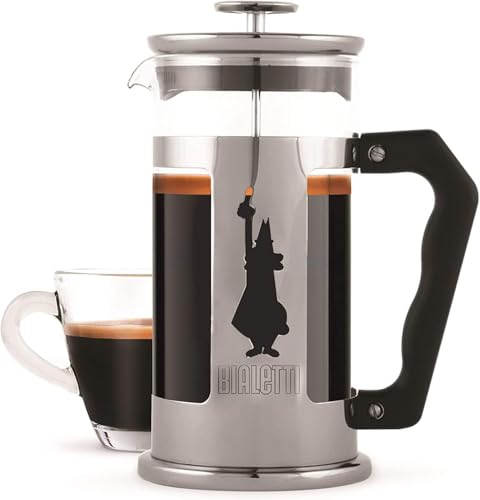
The beaker is made of borosilicate glass, which Bialetti describes on the US page as heat-resistant and removable. It sits in a carrier that the German product page lists as 18/10 stainless steel, with the little man with the moustache that, according to Bialetti, is engraved on it. According to the Italian data sheet the handle is made of heat-insulating plastic, and in Bialetti’s words its shape takes up that of the Moka Express.
Whether the carrier protects the glass in an impact, Bialetti does not say. The English product page and the Amazon text speak of a steel carrier, the Italian data sheet of the structure. It is not a closed jacket: in the product photo the steel has a ring at the top and bottom, and between them, on both sides of the middle section, large cut-outs in which the glass is exposed.
According to the Italian data sheet the one-litre version is 230 mm tall, its base is 111 mm in diameter, and the capacity is 1000 ml. The Amazon catalogue gives a weight of 1.3 pounds, which converts to roughly 590 g.
In the drawing in the instructions the components are numbered. The text mentions lid (1), handle (3), plunger (5) and knob (6); lid, plunger and knob together are called the plunger unit. For the filter, the Amazon text speaks of a steel filter system, the US page of a fine-mesh filter.
In detail: steeping instead of flowing through
A French press extracts through contact time. Grounds and water sit together in the glass for the whole steeping time. Unlike with a pour-over, no water runs through a bed of coffee, and unlike in an espresso machine, extraction does not depend on pressure; the filter merely separates the grounds from the drink at the end. Two things follow that apply to every pot of this design. As long as coffee and grounds are in contact, the coffee keeps extracting, which is why it belongs in the cups after pressing. And a metal filter holds back fine particles and coffee oils less well than paper, so a little sediment in the last cup is normal with this method.
Bialetti’s instructions describe the process step by step. The pot stands on a dry, level, non-slip surface. You hold it by the handle, pull the plunger unit straight out, add the ground coffee and pour in hot but not boiling water, up to at least 2.5 cm below the rim. You stir with a plastic spoon. Then you put the plunger unit back in without pushing it down, and turn the lid so that its slots point away from the spout. The coffee steeps for at least four minutes. To press, you hold the handle again and lower the plunger straight down by the knob, using only the weight of your hand, because the lower the pressure, the better the result. Before pouring, you turn the lid back until the slots point to the spout.
We would take the plastic spoon seriously: a metal spoon can knock against the glass and damage it, and according to the instructions the pot should no longer be used with a damaged beaker.
If the filter is clogged or the plunger cannot be lowered, you take it out again according to the instructions, stir, and slowly reinsert it. Bialetti leaves the amount of coffee to you: the Italian product page speaks of ground coffee in the desired amount, specifically a blend for filter coffee. You can work out a starting amount for one litre in the brew calculator, and the table in the guide coffee grind size shows how coarse the grind should be.
Can the Preziosa go in the dishwasher?
Bialetti’s product pages describe only the glass beaker as dishwasher-safe. The instruction manual recommends washing the individual components by hand, and shows a crossed-out dishwasher symbol on its first page. For the carrier, lid and filter, there is no approval either on Bialetti’s pages or in the instructions. We would wash the whole pot by hand.
The English product page says the glass can be removed from the steel carrier and cleaned well, also in the dishwasher. The German page speaks of a dishwasher-safe glass beaker. In the Amazon title the word dishwasher-safe stands between material and capacity, without reference to a component; in the Amazon text it is again next to the glass.
Bialetti justifies hand washing by saying it preserves the product’s properties over a longer period. In addition, the plunger unit is cleaned after every use, no sponges or abrasives are allowed, and all components must dry well before storing to avoid oxidation.
On sponges, the Italian section is less clear. It says “spugne o detergenti abrasivi”, which can mean abrasive sponges and cleaners, or only the cleaners. A soft cloth satisfies both readings.
What else the instructions require
The instructions are a two-page sheet in nine languages, edition Ed.01/2021, and are titled Coffee Press in general terms. They belong to the Preziosa through item number 0003130 in the file name and through the link on Bialetti’s English and Italian product pages.
Some of the advice is general. The sheet belongs to the product, is kept for its whole lifetime and passes to later owners. Before every use you check that the pot is undamaged and complete and that all components sit as in the illustration; for cases of doubt the English section names the retailer or manufacturer, while the German one at the same point names the responsible waste disposal centre. During operation the pot is not left unattended, and you do not touch the hot surfaces, only the handle and knob.
The pot is kept out of the reach of children, and while it is in use, children should not be near it. The product is also not intended for persons, children included, with reduced physical, sensory or mental capabilities or without the relevant experience and instruction. If you ignore the instructions, according to Bialetti you risk scalding or the pot bursting.
More important for a purchase are the points on use. The pot is used only for its intended purpose and exclusively for household use. Only water and ground coffee go in, and here the language versions diverge. The English section speaks of filter coffee, “that is with coarse ground coffee”, the Italian of “caffè macinato grosso”, and in both cases coarsely ground coffee is meant. The German text, by contrast, says “FÜR ESPRESSOMASCHINEN/FILTERKAFFEE oder mit grobem gemahlenem Kaffee” (for espresso machines/filter coffee or with coarsely ground coffee). We consider the reference to espresso machines a translation error, because the rest of the instructions describe a press pot.
According to the instructions, coffee ground too fine can clog the filter and generate high pressure during use, and you do not plunge the plunger in forcefully, so that no coffee escapes. Spare parts should be original Bialetti parts that fit the model. In the event of a malfunction you stop using the pot and contact the retailer or manufacturer. The product is not suitable for use on a heat source, and it is used neither in the oven nor in the microwave.
If the glass breaks
With a glass pot, this is the question after the purchase. A scratched or damaged beaker you replace, according to the instructions, with original spare parts before using the pot again. In the spare-parts sections of the German and Italian Bialetti sites on 14 September 2026, however, there was neither a glass beaker nor a filter for the Coffee Press. The German one listed six items, the Italian one seven, and all belong to moka pots: funnel filters, gaskets and filter plates.
Bialetti’s manufacturer warranty also does not, as a rule, cover a breakage. According to the instructions it does not extend to replaceable parts, and in the brackets that follow the glass beaker is expressly named, with the exception of original defects. Also excluded are defects from improper use that does not follow the instructions, defects from non-original spare parts, and damage from impact, drops and limescale deposits. The retailer’s statutory warranty rights are unaffected, although they cover only defects that already existed at the time of handover.
Bodum solves this differently with the Chambord and sells the matching glass beaker 1508-10 as a single part in its own shop.
What else is worth considering?
| Model | The difference | Price | Our rating | Choose this if |
|---|---|---|---|---|
| Bialetti Preziosa (this one) | Glass beaker not listed as a spare part | approx. €26.90 | 8.4 | you want the cheapest litre of this selection |
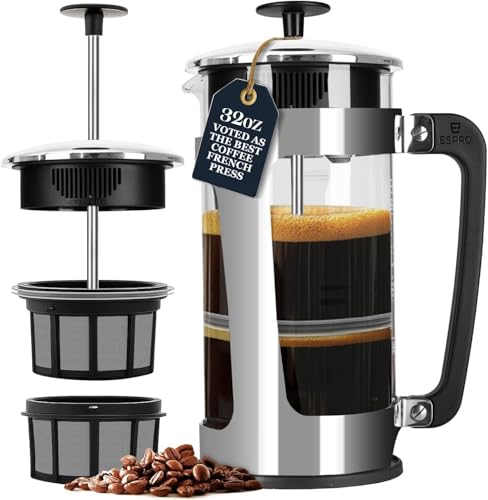
| Bodum Chambord | Glass beaker 1508-10 can be bought separately from Bodum | approx. €34.99 | 8.8 | you expect a glass breakage and then want to replace only the beaker |
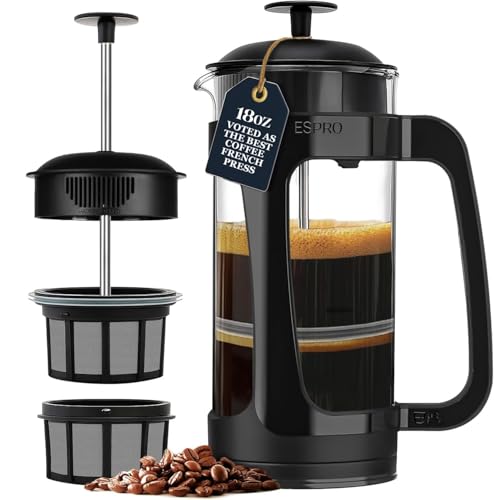
| Groenenberg Edelstahl Thermo | Double-walled stainless steel, according to the manufacturer at least one hour warm, according to the Amazon text up to one hour | approx. €36.99 | 8.5 | you drink the last cup up to about an hour after pressing |
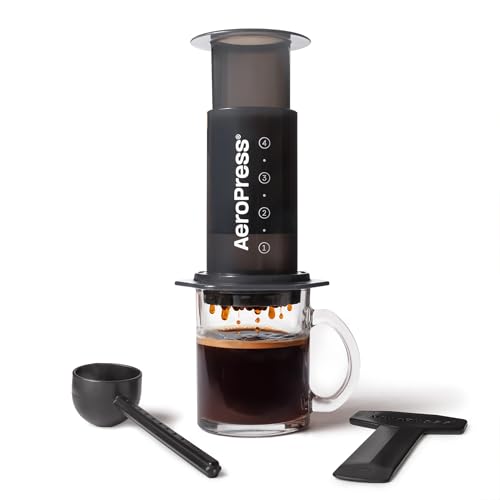
| AeroPress Original | Paper filter and 60 seconds of waiting time according to the manufacturer’s recipe, around 296 ml per batch | approx. €41.08 | 9.3 | you mostly brew just for yourself, also in the office or on the go |
The prices are the guide values from our price boxes; for the three alternatives they match the Amazon catalogue of 7 September 2026, while for the Preziosa the catalogue was a good euro higher that day. The rating condenses our editorial assessment of the manufacturer data into one number; it does not reflect how long a pot lasts in everyday use.
When the Preziosa, when another pot?
You pay for the price advantage over the Bodum Chambord by giving up a separately available replacement glass. We consider that an acceptable trade-off as long as you need more coffee at once than the small 350 ml Preziosa holds, and you wash the pot in the sink anyway.
If you like to put pots in the dishwasher, more speaks for the Chambord. Its instructions say: “Only the filter and the glass, plastic and chrome parts are dishwasher-safe.”
If you do not want to pour everything out straight after pressing, the Preziosa is the wrong design. The double-walled Groenenberg keeps warm for longer, but there too the grounds stay under the filter, and beyond the hour its manufacturer names, the coffee belongs in a thermos flask.
Sitting alone at the breakfast table, you do not need a litre. Then the small Preziosa is enough, or you weigh up whether you prefer a cup with a paper filter from the AeroPress; our guide AeroPress vs French press explains the differences between the two methods.
Without a grinder with a coarse setting, only pre-ground coffee remains. The instructions require coarsely ground coffee, as quoted above. Ready-ground filter coffee from the shops is, in our assessment, mostly ground for drip machines and therefore finer. If you do not yet have a grinder, it is better to include one in your budget.
With small children in the household, the instructions’ notes on children are joined by possible broken glass: a glass pot on the breakfast table carries a risk of breakage that a stainless steel pot without a glass part does not. There the Groenenberg is our recommendation.