A French press without glass solves one problem and creates another: nothing can break any more, but you can no longer see what is happening in the pot while you pour. The Grønenberg Edelstahl Thermo makes this trade consistently, and the version reviewed here is its largest, with a capacity of one litre. Our price box stands at approx. €36.99 on Amazon.de (as of September 2026). The manufacturer’s page describes what is inside the pot in detail, down to the wall thickness and the prices of the individual parts.
What the pot costs, in the shops and from the manufacturer
The Amazon catalogue listed the same amount as our price box for this ASIN on 7 September 2026. The record behind it, however, states 0.35 litres, while the Amazon title names three sizes up to 1 litre; it is not clear which size the €36.99 applied to. When ordering, therefore, check which litre figure is selected in the offer.
In Grønenberg’s online shop, the three sizes cost €35.99 (320 ml, article number GR010), €39.99 (600 ml) and €44.99 (1000 ml, GR009) on 14 September 2026. In Germany, shipping of €4.99 is added below €60 order value. According to the manufacturer, delivery takes two to four working days, but through its own shop only to Germany and Austria.
What a defect costs later can be quantified with this brand. For the 1000 ml size, the shop lists seven parts individually, on the same day from the threaded nut at €3.49 to the bare pot at €19.99. In between are the filter holder and spiral plate at €4.99 each, three replacement filters and the threaded rod with knob at €6.99 each, and the lid at €8.99. All seven parts together would come to €56.43, which is more than a complete new pot in the same shop, while the bare pot alone costs 44 percent of what the shop asks for the complete one-litre pot. Paper filters or other consumables are not otherwise needed for this method.
Construction: 304 stainless steel and a metal filter
Grønenberg builds the pot from 304 stainless steel and describes it as robust, precisely made and one hundred percent rustproof and food-friendly. Aluminium does not occur anywhere in the brand’s coffee equipment, so that the coffee flavour is not affected, according to the manufacturer’s FAQ. The product page adds that the coffee makers are made exclusively of stainless steel and shipped in plastic-free packaging. On robustness, it promises that you will enjoy the French press for a long time even if it falls.
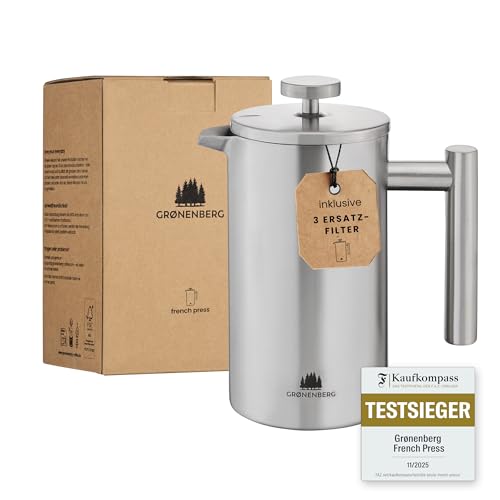
The product photo shows a cylindrical body with a spout, a handle at the side made of a short horizontal arm and a vertical round rod, and a lid from whose centre the threaded rod with the knob sticks up. A tag hangs on the pot reading “inklusive 3 Ersatz-Filter” (3 spare filters included), and the product page also confirms that the three filters are supplied.
Dimensions and weight of the one-litre pot cannot be derived from the Amazon catalogue. The record for this ASIN lists the same value of 3.937 inches for height, length and width, roughly ten centimetres, along with a weight of 1.2125 pounds, roughly 550 grams. According to the product page, however, the supplied spare filter of the large pot alone already measures ten centimetres. An outer dimension of ten centimetres in every direction, handle included, cannot therefore belong to the one-litre pot.
The filter is made of metal and, according to the manufacturer’s FAQ, is slightly coarser so that all the essential oils of the coffee are retained. The design does not provide for paper, and the product page expressly distances itself from it: unlike with coffee machines, the coffee here is not filtered through a paper filter. Whatever fits through the mesh therefore ends up in the cup. We infer from this that a fine sediment collects in the last cup.
In detail: what the second wall can do and what it rules out
Between the inner and outer wall there is a cavity, and for that reason, according to the manufacturer, heat transfer takes place only very slowly. The principle is similar to a vacuum flask: the heat of the coffee has to pass through a layer that conducts it far worse than solid steel. This one design gives rise to an advantage and a disadvantage.
The advantage is described by the product page: the wall measures 0.8 millimetres instead of the 0.6 millimetres that Grønenberg uses for standard models, and as a result the coffee stays warm for at least an hour. The text of the Amazon listing turns the statement around and promises up to one hour. How warm the coffee actually is after 30 or 60 minutes is not quantified by either source, and we have measured nothing ourselves. Between at least and up to there is a considerable difference for the breakfast table, and we would plan with the more cautious reading, that is, with one hour as the upper limit.
The disadvantage is named by the instructions under the heading WICHTIG (important): the French press is not suitable for heating on the hob. If you try to warm milk in it, you merely get lukewarm liquid and possibly a damaged or discoloured base. Reheating coffee that has gone cold in the pot on the hob is therefore out.
How Grønenberg brews: 94 degrees and four minutes
Dosing is by spoon. One tablespoon of coffee per 100 millilitres of water is a good guideline that you can adjust to your taste, the product page says. Calculated for one litre, that would be ten tablespoons, and because the pot should not be filled to the brim, you end up below that. The brew calculator works out the amount of water for your number of cups.
The instructions list four steps. First remove the plunger and filter and put the ground coffee into the empty pot. Then pour on just enough water to cover the grounds and let it bloom for 30 seconds. After that, fill up to the fill line in circular movements, stir, put the lid on and let it steep for four minutes. Finally stir once more and press the plunger down carefully.
The instructions give 94 degrees Celsius as the brewing temperature, the product page a range of 90 to 94 degrees. Without a thermometer, according to the instructions, you get there by letting the kettle stand for one minute after it has boiled.
The instructions also contain a warning that you would not expect of a pot without electricity: when pressing the plunger down, overpressure can build up and a surge of hot coffee can spray out of the opening. Six points are meant to prevent this, and because they belong together, here they are in full:
- observe the recommended quantities of water and coffee grounds from the instructions,
- never fill the pot to the brim, but always leave at least two centimetres to the top edge,
- do not grind too fine, because fine powder can clog the filter and so lead to overpressure,
- always hold the opening of the pot away from your own body when pressing down,
- press the plunger down evenly and slowly,
- keep the French press away from children while it is in use.
The product page extends two of these points. There, the opening is also to be kept away from other people, and the French press is not to be left unattended during use. How coarse your grind needs to be and how to get your grinder there is covered in the guide on setting the grind size.
How many cups come out of one litre?
At most five, if you count in cups of 200 millilitres. This conversion is ours.
Strictly speaking it is fewer. At least two centimetres are to stay free at the top, as the safety note says, and the ground coffee takes up space and holds back part of the water after pressing. How much goes in up to the fill line, we do not work out from the filter diameter: without the height of this line, a diameter does not yet give a volume.
Whether two people with two cups each, together 800 millilitres, get by on one filling is therefore not a safe calculation. If four people sit at the table, you will brew twice if in doubt, and the second brew only starts once the pot has been poured out.
Cleaning: take the plunger apart after every brew
Coffee residues can accumulate between the individual parts of the plunger, often not immediately visible, the instructions say, and over time these residues can turn rancid and affect both taste and hygiene. It therefore recommends taking the pot fully apart after every brew. The product page advises the same more briefly and names the action: unscrew the plunger completely. Without pot and lid, five items remain in the spare parts list, in our reading the parts of the plunger: threaded rod with knob, threaded nut, spiral plate, filter and filter holder.
The gentlest method is in principle cleaning by hand, the instructions say, because it preserves the surface in the long term. After cleaning, all parts should be dried thoroughly before you put the pot back together. According to the instructions, the plain stainless steel version can nevertheless be cleaned in the dishwasher without problems; for the brand’s coloured, coated versions, however, Grønenberg recommends hand cleaning only. Anyone who wants to put the pot in the machine regularly should therefore take the uncoated version, which is the one covered here.
What the manufacturer does not state
For a device without electronics the data situation is good, but it has gaps, and they lie precisely in the dimensions. A height of the one-litre pot is given nowhere, nor is an empty weight, and for the reasons above the Amazon record is no substitute. Grønenberg also does not state an inner diameter of the pot; the centimetre figures on the product page belong to the replacement filters. Also left open are the fill volume up to the fill line, the mesh size of the filter in micrometres, a separate statement on the material of the handle and lid knob, whether there is a scale or marking on the lid, the closing mechanism of the lid and the drop height that the advertising sentence about falling leaves open.
In addition there are care and certifications. Grønenberg sets no rule for descaling the stainless steel pot, and neither temperature nor programme is given anywhere for the dishwasher. The brand does not name test marks such as LFGB or FDA; it merely writes that the material is food-friendly. Whether the pot is suitable for cold brew or tea is likewise unanswered, and we did not find a founding year of Grønenberg GmbH or an introduction year of this model on the manufacturer’s page.
What else is worth considering?
| Model | The difference | Price | Our rating | Choose this one if |
|---|---|---|---|---|
| Grønenberg Edelstahl Thermo 1 l (this one) | Double wall of 304 stainless steel, all seven parts reorderable individually in the manufacturer’s shop | approx. €36.99 | 8.5 | the pot stands for half an hour or longer and you want no glass in the house |
| OZAVO Thermo 1 l | Also an insulated pot; we have not documented a repurchase of individual parts for it | approx. €27.99 | 7.8 | price decides and you do not count on spare parts |
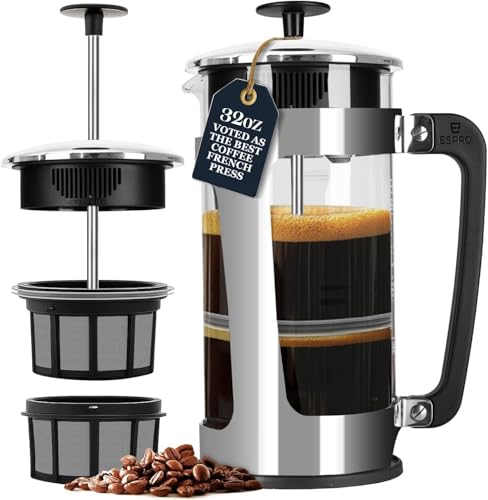
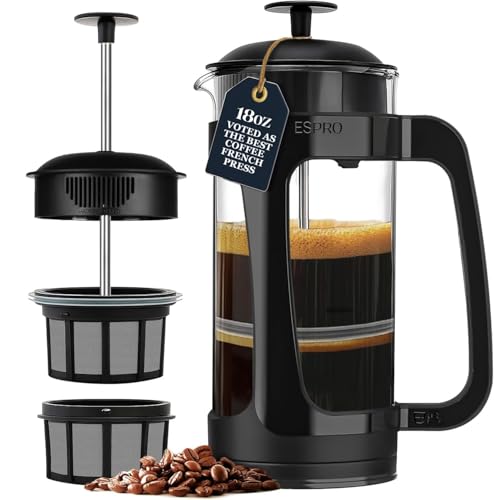
| Bodum Chambord | Borosilicate glass in a stainless steel frame: brew and fill level are visible, the glass is not break-proof according to Bodum | approx. €34.99 | 8.8 | you brew in a fixed spot and empty the pot quickly |
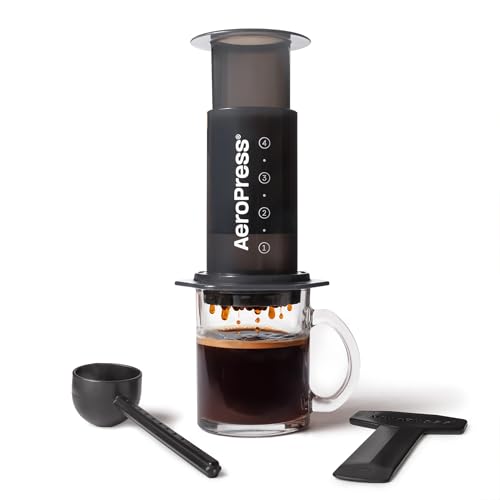
| AeroPress Original | One to two cups through a paper microfilter instead of a litre through a metal filter | approx. €41.08 | 9.3 | you almost always brew alone and dislike sediment in the cup |
The prices come from our price boxes of September 2026, and for the Grønenberg price the caveat about size from the price section applies. The rating is our editorial assessment based on the data sheets, and no measured value stands behind it. More candidates in the French press and AeroPress category are in the best-of list.
When this pot suits and when another does
If you mostly drink alone, in a one-litre pot you either brew too much or fill it only partly. In our assessment a half-filled insulated pot keeps its warmth worse than a full one, because less coffee stores heat while the air space under the lid grows. For this case Grønenberg offers the same design in 600 and 320 millilitres.
If the pot stands on your table for half an hour to an hour, the argument for the double wall holds. If you empty it in ten minutes, you pay for insulation you do not need, and with the Bodum Chambord for approx. €34.99, that is two euros less according to our price boxes, you also get the view of the brew.
One consequence of the design belongs in this weighing, in our assessment: after pressing, the ground coffee stays under the filter in the pot, that is, in the same vessel as the coffee that is meant to stay warm there for an hour. If you want to avoid that, pour into a thermos flask after pressing and use the double wall only for the four minutes of steeping.
With the grinder, it is worth a look beforehand. Powder ground too fine is, according to the manufacturer, one of the causes of the overpressure that the warning list above is meant to guard against. If you only own a grinder with a fine espresso setting or use pre-ground filter coffee, you should clear that up before buying.
You are wrong for this pot if you want to just rinse it after pouring and put it back.
Right, on the other hand, is anyone who plans for the long term. All spare parts are in stock, Grønenberg writes in its own FAQ, and a reorder takes seven days at most. A new lid costs about a fifth of the complete one-litre pot in the manufacturer’s shop, and in our comparison this spare parts route is the real difference from the cheaper OZAVO.