The OZAVO Thermo is a French press with a capacity of one litre, in which two steel walls replace the usual glass. Reliable information on it is available almost only in its Amazon listing. Our price box lists it at approx. €27.99 on Amazon.de (as of September 2026). In our category French Press and AeroPress it is thus the cheaper of the two double-walled stainless steel pots.
Who is behind OZAVO and where the pot is made
The seller is SunJas Import und Export GmbH from Hamburg. In the Amazon catalogue the company is listed as manufacturer, and on the carton with two Hamburg addresses. According to the same carton, the pot is made by the Jiangmen City XinHui Allies Metalware Factory from Xinhui in Guangdong province, and it also says “Made in China”. The Amazon detail table also gives China as the country of origin.
We searched in vain for a brand website of its own on 15 September 2026: ozavo.de shows the sales page of a domain dealer, and ozavo.com redirects to a marketplace for brand names. That removes the two sources our comparisons otherwise rely on, the product page and the instruction manual, and everything that follows comes from the Amazon listing including the seller’s graphics, and from the photos of the printed carton in the product safety section.
You can find the pot again via its numbers: Amazon lists it as oz230 with part number OZA0230 and UPC 766330258589, and OZA0230 also appears as MODEL# on the carton, there under the English designation “STAINLESS STEEL CAFETIERE”. We have not checked whether listings with the same number at other retailers really are this version.
In the symbol line of the carton, next to the glass and fork sign for food contact, there is a glass with a crack for fragile, an umbrella with a drop for keep dry, a disposal symbol and the entry IP30. IP30 is a protection rating for enclosures of electrical equipment: the first digit means protection against solid foreign objects of 2.5 millimetres in diameter and above, the second digit 0 no protection against water. On a pot without electrics this marking has no function, and “fragile” fits poorly with a product that the same seller advertises as unbreakable. We read both as a template from the carton printing and not as a statement about this pot.
Construction: a steel cylinder with a plunger
The pot is made of double-walled stainless steel, according to the Amazon text, and a graphic from the seller puts “100% stainless steel” above it. There is no glass anywhere, and the same text turns that into the promise “unbreakable on the go”.
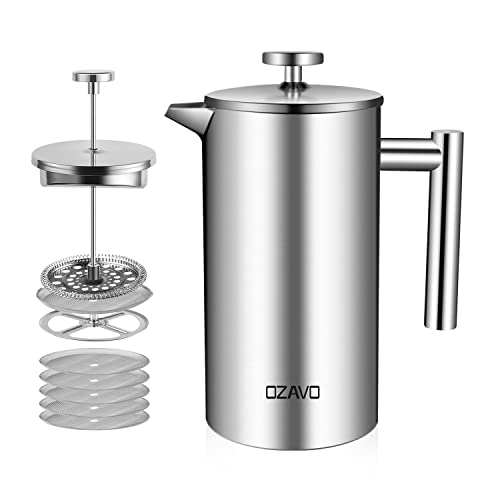
In the product photo the body is a smooth, round cylinder with the OZAVO lettering. The spout projects on the left, the handle on the right: a short horizontal arm from which a bar runs vertically downwards. The plunger rod protrudes from the middle of the lid with a flat, round knob.
The dimensions are given in the graphic labelled “100% stainless steel”, whose dimension arrows are drawn directly on the product. From the base to the top of the knob the pot measures 21.5 centimetres. The 10 centimetres of width cover lid and body, and the spout and handle are not included. According to the graphic the spout projects 2.5 centimetres, which together makes 12.5 centimetres, and the handle adds to that in the cupboard. The graphic gives the weight as 0.8 kilograms.
The Amazon detail table gives other figures: an item weight of 2.12 pounds, converted just under a kilogram and possibly including packaging, plus product dimensions of 6.7 by 9.1 by 9.7 centimetres. These dimensions cannot be reconciled with the height from the graphic, and the photo also shows a pot that is clearly taller than it is wide. A second data set in the catalogue lists 11.0 by 23.5 by 15.5 centimetres. We go with the graphic.
In detail: three filter layers and a second wall
A French press separates coffee and grounds with a mesh that you push down through the pot after the steeping time. Metal filters more coarsely than paper. Coffee oils and some of the finest particles pass through the mesh, which is why a fine residue collects at the bottom of the cup. How much gets through depends on the mesh size and on how tightly the edge of the mesh sits against the inner wall.
According to the Amazon text, the OZAVO’s plunger has a three-layer filter, and a graphic speaks of “3 filter layers”. In the product photo the plunger lies disassembled next to the pot, and as we read it the three layers are a perforated disc with a spiral spring edge, a flat mesh disc and a ring with cross struts. In this design the spiral has a job: it presses the edge against the pot wall so that as little grounds as possible escape along the side when pressing.
Below that, the photo shows the five loose stainless steel spare filters that come in the box. If needed, you swap them for the pre-fitted filter, the Amazon text says, and the graphic describes them as washable and reusable. The seller also promises that the filter set reliably holds back fine coffee grounds. Even so, leave a sip in the pot when pouring: whatever passes through the mesh sinks onto the pressed filter and would otherwise end up in the cup with the last remainder.
The second wall works in a similar way to a thermos flask. Between inner and outer wall there is a gap through which heat travels outwards more slowly than through a single sheet. How much more slowly depends mainly on whether there is air in this space or a vacuum has been drawn: without air, conduction through the gas is eliminated, leaving radiation and the path via the rim where both walls are joined. Upwards a press pot additionally loses heat, via the lid and the opening through which the plunger rod runs.
Coffee and tea stay warm in it significantly longer than in a glass French press, the Amazon text promises. The outer wall stays cool, it continues, and a graphic adds that the double wall maintains the temperature of the drinks.
How many cups come out of one litre?
Eight, if you follow the seller’s graphic. Next to the litre figure it says “8 cups”. By calculation that leaves 125 millilitres per cup, and with cups of 200 millilitres you get at most five.
Less arrives in the cup than fits in the pot. The ground coffee takes up space and holds back some of the water after pressing. A press pot is never filled to the brim anyway, because lid and plunger still have to fit in and coffee would otherwise slop over when pressing. Through the steel you cannot see how high the water already stands when pouring; measure it beforehand, in a measuring jug or on the kitchen scale.
Two examples, both with our calculation. Four people with cups of 150 millilitres need 600 millilitres in total, which works from one filling. Four mugs of 250 millilitres come to exactly the full litre and thus more than comes out after pressing; for that you brew twice. For other numbers of cups, the brew calculator works out water and coffee for you.
Preparation according to the carton
Four steps, printed in English, here in our translation:
- Coffee: put one measuring spoon of coarsely ground coffee per cup into the pot, meaning a tablespoon.
- Water: pour in hot, not boiling water, stir the coffee carefully and make sure all the ground coffee is submerged.
- Steeping: put the lid on, with the plunger staying in the upper position. Only press once the coffee has steeped for four minutes.
- Pressing: push the plunger down gently and make sure the lid is closed properly so that nothing splashes.
A temperature is missing in step 2, which only says “hot water (not boling)”. Our French press guide works with 92 to 96 degrees and has a table for typical problems, such as too much sediment in the cup.
The carton asks for a coarse grind, and there is a mechanical reason for it. Fine grounds clog the mesh layers, the plunger can then only be moved with force, and the pressure can drive hot coffee past the edge and upwards. Pre-ground coffee for filter machines is finer than a French press needs. If you do not have a grinder with a coarse setting at home, budget for one or buy coffee that is expressly ground for the French press. How to recognise the right grind size is covered in the guide coffee grind size.
Dishwasher: three statements that contradict each other
According to the Amazon text, filter meshes and lid can be removed completely and taken apart, and all the filters supplied can be rinsed. On the dishwasher, however, the same listing does not commit itself, and since the wording matters, here it is in full:
- Amazon text: “Most detachable parts are dishwasher safe. We recommend hand washing for individual delicate components.”
- Graphic in the same listing: “All stainless steel, dishwasher safe. Smooth, scratch-free inside prevents build-up of dirt.”
- Amazon detail table, field “Is dishwasher safe”: “No”.
Which components are meant by delicate is left open by the first sentence. Washing by hand breaks none of the three statements, and we stick with that until the seller commits.
Our advice for the plunger: take it apart after every brew. Ground coffee lodges between the layers, which a jet of water from outside hardly reaches, and coffee oils cling to the metal. Let all parts dry before you put it back together.
What OZAVO leaves open
Without a manufacturer website and instruction manual, much remains unclear that counts for a pot used every day. On material these are the steel grade, the wall thickness, a statement on BPA and what the filter frame and knob are made of. Whether there is air or a vacuum between the walls is unknown. On the filters, mesh size, diameter and the construction of the individual layers are missing, on the dimensions the depth including handle and the diameter of the base, and which of the two weights is correct remains open.
For use, a fill mark, a note on preheating and any statement on hobs and microwave are missing. On care there is nothing beyond rinsing and the dishwasher, nothing on descaling either. Since when the model has been sold is unknown; the photographed carton was produced in August 2022 according to the print, which applies only to this one specimen. We have nowhere seen the lid, plunger or pot offered as an individual spare part, nor any warranty terms. If a part other than the filter breaks, you are best off asking SunJas in Hamburg directly.
What else is worth considering?
| Model | The difference | Price | Our score | Choose this one if |
|---|---|---|---|---|
| OZAVO Thermo 1 l (this one) | Double-walled stainless steel, information only from Amazon listing and carton | approx. €27.99 | 7.8 | you brew for several people at once without glass and want to spend little |
| Grønenberg Edelstahl Thermo | Also double-walled stainless steel, plus manufacturer’s instructions and individually orderable components | approx. €36.99 | 8.5 | you use the pot daily and would rather buy a broken part than the whole pot |
| Bialetti Preziosa | Borosilicate glass container in a stainless steel frame instead of a second steel wall | approx. €26.90 | 8.4 | you brew at home and want to see the brew |
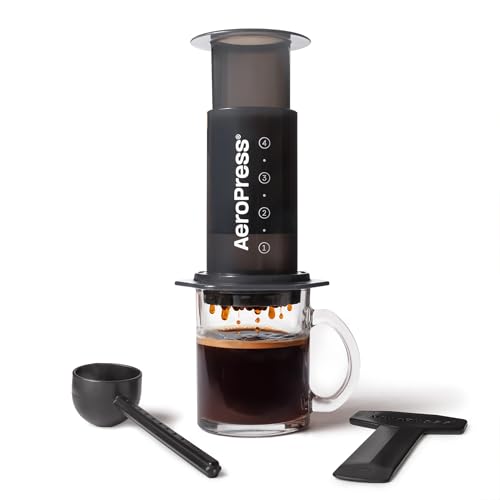
| AeroPress Original | Brewing chamber of 10 ounces (around 296 ml) for 1 to 2 cups, paper micro filter as standard instead of a metal mesh | approx. €41.08 | 9.3 | you almost always drink alone |
The prices are the guide values of our price boxes and change constantly in the shops. The score is our editorial assessment of the published data; nobody measured it. More pots are in the best-of list French Press and AeroPress.
Who the OZAVO suits, and when another pot is better
The seller has travel, camping, picnics and the office in mind. On the move the missing glass counts: in a rucksack or on a campsite you risk no broken glass with it.
The extra cost for the Grønenberg Edelstahl Thermo is €9 according to our price boxes. What you mainly get for it is evidence. Grønenberg names stainless steel 304 and a wall thickness of 0.8 millimetres on its product page, and says the coffee stays warm in it for at least an hour. The manufacturer sells seven components of the litre pot individually, including the lid and the threaded rod with knob; that is how it stood on the Grønenberg website on 14 September 2026. In our assessment, anyone who uses a pot every morning and wants to keep it for a long time is better off with that. For a second pot at the office this advantage counts for less.
We would not push such a keep-warm time to the limit with any press pot, though. After pressing, the grounds remain under the mesh in the same vessel, and our guide advises decanting the coffee immediately so that extraction ends. If it is to stay hot for a long time, it belongs in a thermos flask, and the press pot’s double wall then only holds the temperature during steeping.
If the pot stands only on the breakfast table at home and is empty after ten minutes, the second wall brings little. The Bialetti Preziosa is around €1 cheaper in our price box, and in its product photo the fill level in the glass can be seen between the steel struts.
Anyone who rarely brews more than 300 millilitres at a time never fills the litre pot and still has it standing in the cupboard. The AeroPress Original pushes the coffee through a paper filter with a plunger instead of pushing a mesh through the standing brew, and costs around €13 more; the differences in brewing principle are covered in our guide AeroPress vs French press.
The OZAVO is the wrong choice for anyone who wants to put the pot in the dishwasher after every breakfast and wants a clear approval for it. Grønenberg does call hand washing the gentlest method in its instructions, but describes the stainless steel version there as dishwasher safe.