We have not had the Brazil in our hands. What is written here comes from Bodum’s product pages, data sheet, combined instructions, FAQ and spare parts pages as well as from the Amazon catalogue, and in several places Bodum’s own texts contradict each other, for example on the lid, the dishwasher and the dosing.
Which Brazil is meant, and what it costs
Bodum sells more than one item under the name BRAZIL, so the number comes first. This review covers the coffee maker 1548-01 with the EAN 727015251325, listed in black in the data sheet. The Amazon catalogue gives the same part number and K1548-01 as the model. Not meant is the variant 10938-294, which according to Bodum has lettering running along the base and comes in several colours and sizes.
Bodum only says roughly how old the design is: according to the product page, you have been able to brew coffee with this coffee maker since the 1980s. It was not the brand’s first press pot, though; according to the company chronicle, Bodum brought that out in 1974 under the name BISTRO.
Our price box lists approx. €16.89, and the Amazon catalogue gave a price of €16.99 when we queried it on 7 September 2026. In the German Bodum online shop, the same pot was out of stock on 14 September 2026, while the Chambord was available. Among the ten models in our category French press and AeroPress, the Brazil is the second cheapest, with only the Amazon Basics below it.
Glass in a plastic housing
The carafe is made of borosilicate glass, which Bodum describes as stain-resistant and heat-resistant. According to the product page, the housing, handle and domed lid are made of light, BPA-free plastic, and the plunger and filter are stainless steel. The data sheet puts it briefly: stainless steel, plastic, borosilicate glass. The Shatter Proof field says No.
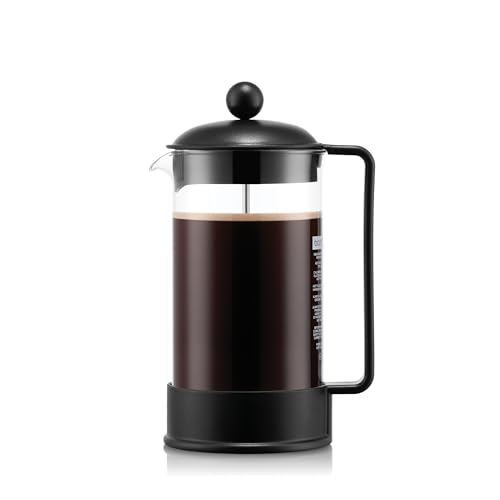
The product photo shows how the parts fit together. The glass cylinder sits in a black plastic base at the bottom, and on the right the angular handle runs from the upper rim down to this base. The spout protrudes on the left and is part of the glass. On top sits the lid with a ball-shaped knob, under which the plunger rod runs into the pot.
Bodum gives the dimensions as 14.1 centimetres wide, 23.0 centimetres high and 10.7 centimetres deep. That does not make the pot oval. The matching replacement glass measures 9.6 centimetres in diameter and 18 centimetres in height according to the manufacturer. So the width runs from the tip of the spout to the outer edge of the handle, and the depth roughly corresponds to the base that encloses the glass at the bottom. That is how we read the numbers together with the photo.
For the weight, only the Amazon catalogue helps. It lists 1.036 pounds for the Brazil, which converts to roughly 470 grams, and the dimensions in the same entry match Bodum’s: the height exactly, the width and depth almost, at 14.3 and 10.6 centimetres. That suggests the pot was measured and not the box. For the Chambord with the same capacity, the catalogue gives 1.3228 pounds, around 600 grams, but there the comparison fits less well: Bodum gives it as 17.0 centimetres wide and 24.5 centimetres high, and the catalogue gives lower figures for both dimensions. We therefore read the gap of around 130 grams only as a rough indication.
In detail: the metal filter and the lid question
In the Brazil, coffee grounds and water steep together, and only at the end does the plunger push the grounds down. Separation is done by a filter unit made of three stainless steel parts, which Bodum sells individually. Their diameters are given on the spare parts pages: 10.1 centimetres for the filter screen, 9.6 for the spiral plate, 8.6 for the cross plate. The spare parts table in the instructions gives the first two slightly more briefly as 10 and 9.5 centimetres. According to both sources, the screen is wider than the glass diameter from the previous section, and from this we conclude that the rim of the screen rests against the glass wall and separates coffee and grounds there.
With a metal filter, everything depends on the grind size. The instructions print a CAUTION on this: use only coarsely ground coffee, because finely ground coffee can clog the filter and build up high pressure. Bodum credits the stainless steel plunger with preventing ground beans from escaping when you pour. What is fine enough to pass through the mesh still ends up as sediment in the last cup. How coarse you should set the grinder is shown in the table in the guide How to set your grind size.
For dosing, the product page counts one heaped teaspoon or one Bodum spoon per cup, and the instructions one heaped tablespoon or one BODUM measuring spoon. A tablespoon holds roughly three times as much as a teaspoon, which on a full pot is no longer a rounding error. The only thing the two versions have in common is the Bodum spoon. The Brew calculator calculates French press in cups of 125 millilitres, which is the measure used in the instructions, and gives you the amount of coffee in grams.
The water should be hot but not boiling, according to the product page about 92 to 96 °C, and at least 2.5 centimetres should stay free at the top. You stir with a spoon made of plastic or, according to the product page, wood; the instructions warn against metal, because a metal spoon can scratch and damage the beaker. Then you put the plunger on without pressing it yet, and let the coffee steep for at least four minutes.
The Brazil’s product page says that when you put the plunger on, you should turn the lid so that the spout is closed, to keep the heat in, and turn it open again to pour. In the operating instructions, a combined set of instructions for Bodum’s press pots, the same step appears in step 4, followed by a bracket: “Does not apply to models of the BRAZIL series”.
The instructions distinguish two versions of construction, without and with a closing lid, and we have to work out ourselves which of them the Brazil is. Because the product page describes pulling out the plunger without an unlocking step, the Brazil matches the wording of the first version, and it is exactly in its step 4 that the exception appears.
Under the heading Scalding hazard, the same instructions list four points. Two concern pressing: with excessive force, boiling hot water can shoot out of the pot, so do not force the filter rod down. Another repeats the grind size rule from above. The remaining one says, this time without a BRAZIL exception: turn the lid to close the spout. Which instruction on the lid applies to this pot cannot be settled from Bodum’s documents. Step 5, the pressing itself, remains unambiguous: hold the handle firmly and turn the spout away from you.
What do the replacement glass and filter parts cost with shipping?
The replacement glass 1508-10 costs €18.90 at Bodum, plus €11.50 standard shipping according to the shipping details on the Brazil product page, making €30.40 in total.
According to the same page, the shop only delivers free from €65, and that shifts the calculation even for the small parts. The filter screen 01-1508-16-612 for €6.90 costs €18.40 on its own with shipping. The cross plate 01-1508-16-611 is also listed at €6.90, the spiral plate 01-1508-16-613 at €8.90, and all four parts were in stock on 14 September 2026. Even all four together stay under that €65 at €41.60 and cost €53.10 with shipping. According to the item description, the filter screen belongs to coffee makers of 0.5 and 1.0 litres.
The list contains no seal, replacement lid, handle or housing. The Bodum FAQ explains the shop’s logic: where a product lacks the spare parts subcategory, none exist. For the Brazil it is present but covers only the four items mentioned. A broken handle therefore means a new pot, as we read it.
The Chambord’s product page lists exactly the same four parts. It costs approx. €34.99 in our price box, so for it the replacement glass makes up a good half of the pot’s price. The Brazil needs no consumables; Bodum explicitly advertises that neither paper filters nor plastic capsules are needed.
Cleaning and safety according to the instructions
After every use, the instructions require you to unscrew and clean the filter unit. How to get coffee oils out of the screen and plates is covered in the guide French press guide. Before the very first use, you wash the pot in warm soapy water according to the product page and dry it thoroughly.
The Brazil’s product page approves the dishwasher without restriction: all parts are dishwasher safe. The instructions, which apply to many Bodum presses, word it more narrowly: there only the filter and the glass, plastic and chrome parts are dishwasher safe. Bodum does not name chrome-plated parts for the Brazil, so by this wording the stainless steel plunger remains open. For it we follow the product page, because it is written for exactly this pot.
Under safety, the instructions give four directions. The pot must not be used on the stove. You should check the beaker for scratches, cracks or chips, and if there is such damage, stop using it and fit a replacement beaker before the next use. During coffee preparation you keep other people away, because hot water is dangerous. And you do not allow children to use this coffee pot.
With the second direction, the spoon rule from the brewing process gets an expensive side. If a metal spoon scratches the glass, Bodum requires it to be replaced, and what that costs is in the section before.
What Bodum leaves open about the Brazil
Some details are missing from all the Bodum sources we evaluated: the German and US product pages including data sheet, the pages of the four spare parts, the Chambord and the variant 10938-294, plus FAQ, terms and conditions, company chronicle and combined instructions. For the filter there is no mesh size, for the glass no wall thickness. Which type of plastic is used in the housing, handle and lid is not stated. How long coffee stays warm in the single-walled carafe is not given anywhere; the product page only says the closed spout is meant to retain the heat. The materials FAQ does call borosilicate glass insensitive to temperature differences, but a limit in degrees is missing, as is a drop height.
A ratio of coffee to water in grams is not given in any source; Bodum doses exclusively with spoons. The manufacturer names no designer, and no exact year of introduction either. A scope of delivery as a list does not exist either, so it remains open whether a Bodum spoon is included. Whether the Brazil is suitable for tea or cold brew is answered by none of the sources.
The Brazil or one of the other three?
| Model | The difference | Price | Our rating | Choose this one if |
|---|---|---|---|---|
| Bodum Brazil 1 l (this one) | Plastic housing instead of a metal frame | approx. €16.89 | 7.9 | you brew several cups at once and do not care about the frame |
| Bodum Chambord 1 l | Frame and lid made of chrome-plated stainless steel instead of plastic | approx. €34.99 | 8.8 | a metal frame is worth the extra cost to you |
| Amazon Basics French Press | No spare parts offer is documented for it in our data | approx. €11.54 | 7.7 | you are trying the method out first and would buy new if the glass breaks |
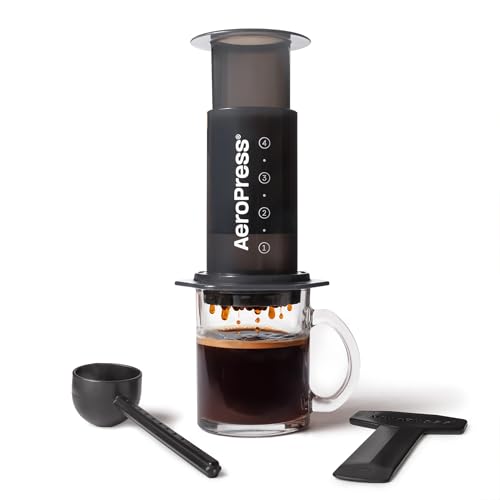
| AeroPress Original | Polypropylene chamber for 1 to 2 cups, paper filter instead of metal screen | approx. €41.08 | 9.3 | you mostly brew for yourself and want no glass in the kitchen |
The prices are the guide values that our price box showed in September 2026, and the rating is our editorial assessment from data sheets. How the four would compare with the same beans is not something the table says; we have not brewed with any of them. More candidates are in the best-of list for French press and AeroPress.
When the Brazil fits, and when another pot does
Quantity decides first. One litre of nominal volume is a lot for one person, and Bodum gives the four-minute steeping time without distinction by fill level. For up to two people, both the AeroPress Original and the Brazil come into question, and the AeroPress costs around €24 more. From three at the table, the quantity speaks for the Brazil.
The Brazil is wrong for anyone who wants to use up finely ground espresso coffee from their stock, because that is exactly what the CAUTION from the brewing section warns against. A grinder with a coarse setting therefore belongs in the budget, or you buy coffee that is explicitly ground for the French press.
If the coffee is to stay warm at the table for a while after pressing, we consider a double-walled press pot the more suitable design than single-walled glass. Under a wall cabinet, allow for the 23.0 centimetres of height from the data sheet and for air above it, because according to the instructions you pull the plunger filter unit straight up out of the pot when filling.