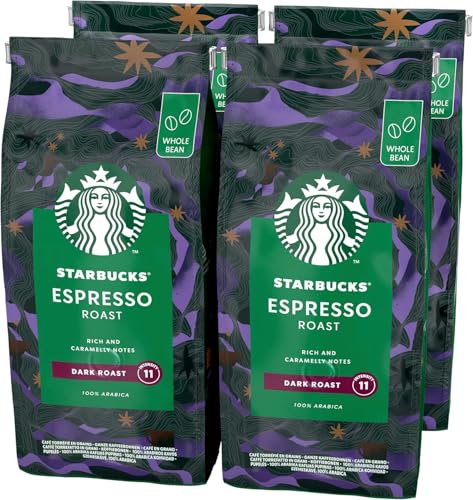
Starbucks describes the Espresso Roast as the basis of its Caffè Latte, in other words the bean from which Starbucks pulls the espresso for its milk drinks. It is sold as whole beans, on Amazon.de as a 4-pack of 4 x 450 grams for approx. €58.24 (as of September 2026).
We have not opened any of these bags or drunk a cup of it. What is written here about roast, origin and flavour comes from Starbucks itself: from the pack, from the Amazon text and from the German product page. That page no longer exists in this form, so we quote it from a copy in the Internet Archive dated 9 December 2023. The classification of the roast and the cost per cup, on the other hand, are our deduction and our calculation, and it says so at the relevant points.
Four bags, 1.8 kilos: what the price really means
The €58.24 covers the whole pack. That works out at around €14.56 per bag and around €32.36 per kilo. Only the price per kilo makes the bean comparable with the rest of our catalogue, because almost all varieties there come in one-kilo bags.
The Jacobs Krönung Caffè Crema, the Dallmayr Crema d’Oro and the Melitta beans of the BellaCrema range sit between €15.29 and €17.99 per kilo, so at roughly half. What costs even more per kilo with us than the Espresso Roast are single-origin coffees with a named country of origin, two of which are in the table further down. In our scoring the Espresso Roast reaches 8.0 points. That is the second-lowest value in the category, pulled down by the sub-score for value for money at 6.5.
What is on the bag and what Starbucks says about it
The catalogue photo shows four identical bags, dark with a purple pattern and a green label. The label reads “Dark Roast”, “Rich and caramelly notes”, “Whole Bean” and “100% Arabica”, with a circle next to the roast level reading “Intensity 11”. Such intensity levels are not a standardised measure; each brand sets its own scale. Segafredo gives the Intermezzo as 12 out of 13, while Jacobs and Dallmayr count up to 10 on their crema beans. The Starbucks 11 therefore cannot be compared with another brand’s figure. At the bottom edge the designation of sale is printed in several languages, including French, German and Italian.
The archived product page classes the bean as a dark roast, at the darker end of the roast spectrum, with a full, robust texture and bold flavours. As flavour notes Starbucks names rich and caramelly notes; the Amazon text speaks of an intense, caramel-sweet coffee.
According to Starbucks, the blend consists of coffees from Latin America and Asia/Pacific. The whole blend is Arabica, 100 per cent according to the bag and the Amazon text. On the Starbucks at Home overview page, Starbucks describes the two regions in general terms and without reference to this variety: coffees from Latin America have a nutty, chocolatey and spicy note, those from Asia-Pacific bold flavours with an herbal, earthy note.
In detail: what a dark roast does to the bean
During roasting, the chlorogenic acids of the green bean break down, and the longer the roast runs, the further this breakdown goes. A roast at the dark end therefore brings less acidity into the cup and more roast bitters. At the same time the bean loses water and mass while its volume grows. It becomes more brittle and breaks more easily in the grinder, so at the same setting you end up finer than with a light roast. Anyone who changes variety on an espresso grinder therefore usually has to readjust.
Why Starbucks intends precisely this roast for milk drinks follows from the same chemistry. Milk buffers acidity and covers delicate aromas. What holds its own against the milk in a large latte is roast compounds and bitterness, and a dark roast has more of these than a light one. That is how we deduce it from roasting chemistry.
The pure Arabica sets the Espresso Roast apart from many Italian-style espresso blends, which add Robusta. Robusta contains fewer oils and sugars but more chlorogenic acid and roughly twice as much caffeine, and in an espresso blend it mainly provides a denser, longer-lasting crema. A pure Arabica blend does without this support, even when it is roasted as dark as this one.
Can I use the beans for filter coffee too?
Yes. On the archived product page Starbucks lists seven brewing methods, from coffee machine, pour over and Chemex through French press and moka pot to two cold brew variants, each with its own grind size and amount. The name sounds like an espresso machine, but according to the manufacturer the bean is intended for more than espresso.
The five hot methods in detail, each as coffee to water (the cold brew amounts are in the questions below):
- Coffee machine: medium-coarse, 10 g to 180 ml
- Pour over: fine, 10 g to 180 ml
- French press: coarse, 10 g to 180 ml
- Chemex: medium-coarse, 45 g to 720 ml
- Moka pot: medium-coarse, 15 g to 160 ml
Three of the five methods come down to 10 grams for 180 millilitres, a ratio of 1 to 18, which Starbucks also gives as its basic rule for one cup. The Chemex gets somewhat more coffee at 45 to 720 (1 to 16), the moka pot at 15 to 160 clearly more, almost 1 to 11. For the pot that makes sense, since it produces a concentrated coffee.
With pour over at a fine grind we would start carefully. Ground fine and running through slowly, the water extracts more from the grounds, and with a bean high in roast bitters that can tip over. The guide Coffee tastes bitter or sour collects the other adjustments, but the first is almost always the grinder: if the cup turns too bitter, go coarser.
For bean-to-cup machines and portafilter machines, an amount is missing. The Amazon text names both explicitly, the portafilter machine after grinding in a coffee grinder, plus the French press once more. Grams and grind size for these machines, however, are given neither there nor on the archived page, so you find the setting in small steps as with any new bean, as the guide on grind size describes. Below we calculate with 7 grams for a single and 14 grams for a double espresso; these are common starting values and not a Starbucks specification.
On water, Starbucks advises in general to brew with fresh, filtered water.
What a cup costs
With Starbucks’ basic rule of 10 grams per cup, a 450-gram bag is enough for 45 cups and the whole pack for 180. At the Amazon price, each of them costs around 32 cents in beans.
The price changes with the amount. A moka pot fill of 15 grams comes to around 49 cents, a Chemex with 45 grams to around €1.46, although that is then 720 millilitres. For espresso we use the starting values from above: around 23 cents for the single, around 45 cents for the double.
The Brew calculator works out the amounts for other cup sizes. Anyone who pulls two double espressos every day uses 28 grams a day and a good 10.2 kilograms a year. With the Espresso Roast that comes to around €331 a year, not counting milk and electricity.
What Starbucks leaves open
The German product page for the whole bean now redirects to the Starbucks at Home overview, and there only products for Nespresso and Nescafé Dolce Gusto remain. The pages for Austria and Switzerland likewise no longer list the variety as whole beans. In the archived version, in the Amazon catalogue and on starbucks.de we looked for the following details without finding them:
- the pack size; 450 grams and the 4-pack are documented only by the Amazon catalogue, the archived page has no weight
- roast date, best-before date and a storage recommendation
- whether the bags have an aroma valve and how they can be resealed after opening
- countries of origin and their shares in the blend
- the roasting location of the goods sold in Germany
- up to which level the intensity scale on the label runs
- the caffeine content
- the process used to decaffeinate the decaf variant
- which retailer the buy button on the archived page pointed to; it was embedded as a widget without an Amazon link
Starbucks or one of the other three?
| Variety | Roast and origin | Price per kg | Our score | Choose this if |
|---|---|---|---|---|
| Starbucks Espresso Roast (this one) | Dark roast according to Starbucks, 100 % Arabica from Latin America and Asia/Pacific | approx. €32.36 (€58.24 for 1.8 kg) | 8.0 | you are specifically looking for the Starbucks espresso profile for latte and cappuccino |
| Segafredo Intermezzo | Dark roasted, Robusta-heavy blend | approx. €17.19 | 8.6 | you want a dark espresso roast, accept Robusta in the blend and want to save on the price per kilo |
| 360 Grad Rundum Ehrlich Bio Honduras | Single origin Honduras, according to the supplier roasted long and gently for a low-acid profile | approx. €35.59 | 9.3 | you mainly want low acidity and a named country of origin, but not specifically the Starbucks profile |
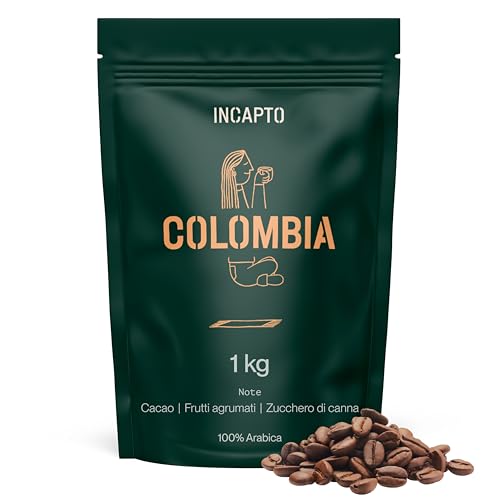
| Incapto Single Origin Kolumbien | 100 % Arabica, single origin from Huila, 84 SCA points according to the manufacturer | approx. €35.95 | 9.0 | you are willing to pay a good €35 per kilo and prefer a concrete origin to a brand profile |
The prices per kilo reflect the Amazon position of September 2026, converted from the pack price in the case of the Starbucks. The score sums up our assessment from manufacturer details and prices; it says nothing about the taste in your cup.
When the Espresso Roast fits and when another bean does
It fits most clearly if you mainly make lattes and cappuccinos. Starbucks intended it for that, and against a lot of milk a dark roast is the obvious choice for the reasons in the detail section.
For filter coffee the weighing-up gets harder. Starbucks does cover the filter methods, but anyone who uses a pour-over dripper for the origin notes gets roast aromas rather than origin with a roast at the dark end. In that case we would reach for a single-origin bean, such as the Incapto Kolumbien.
Then the quantity. The 1.8 kilos arrive at once, and at one cup of filter coffee a day they last around half a year, at one cup each on Saturday and Sunday a good year and a half. Splitting it into four bags helps, but you do not know how old the beans already are when you buy. At two double espressos a day, one bag is empty after 16 days and the pack after a good nine weeks, so the question hardly arises.
That leaves the money. At the consumption from the cost section, two double espressos daily, the Espresso Roast costs around €155 a year more than the Segafredo Intermezzo. Compared with the Bio Honduras it saves around €33 a year, compared with the Incapto around €37 a year.
Our assessment: anyone who wants to recreate the espresso of the Starbucks cafés at home will hardly get past this bean, going by what Starbucks itself states. For any other reason you will find cheaper dark roasts and similarly expensive beans with a country of origin in the coffee beans comparison, with one example of each in the table above.
Who is it suitable for?
If you want a mild roast, you will find the alternative at Starbucks itself: the Blonde Espresso Roast, “mild and smooth” according to starbucks.de and intended as an alternative to the Signature Espresso Roast. As whole beans, however, the Blonde has also disappeared from Starbucks at Home in Germany; in Switzerland it is the only variety left there in this form.
Equally, the Espresso Roast is not suited to a late-evening espresso if you avoid caffeine. For that case starbucks.de carries a Decaf Espresso Roast and describes it with notes of roasted caramel and cocoa; at Starbucks at Home it is currently listed as a capsule for Nespresso. The guide on decaf coffee explains the usual processes and the residual caffeine.