Pellini N.82 Vivace is what the listing on Amazon is called. The roaster’s website now lists three blends called Vivace, and the listing cannot be clearly assigned to any of them. We have not drunk any of them. What follows comes from the manufacturer and from the Amazon catalogue.
One name, three bags
The catalogue title reads “Pellini N.82 Vivace Kaffeebohnen für Espresso, 1 kg”, listed under model number 305940132 with 17 April 2019 as the release date. At Pellini itself you only find the name in archived versions of the website. In October 2020 the product was called “Kaffeebohnen Pellini Espresso Bar N. 82 Vivace” on the German manufacturer page. In 2025 Pellini renewed its logo and brand identity.
The current website lists three Vivace blends instead. The Espressobar Vivace is in the Pellini Worldwide section, while the Vivace Tradizionale Classica and the Vivace Tradizionale Crema Intensa are among the blends for home use. The product pages have buy buttons that lead to amazon.it. On the Espressobar Vivace, the button links to the article number B00FGK5FPY, and amazon.de lists the listing in question here under the same number. The button on the Crema Intensa bean page points to the same number. Only the Classica’s button leads to a different number, B0C5MSRN1K.
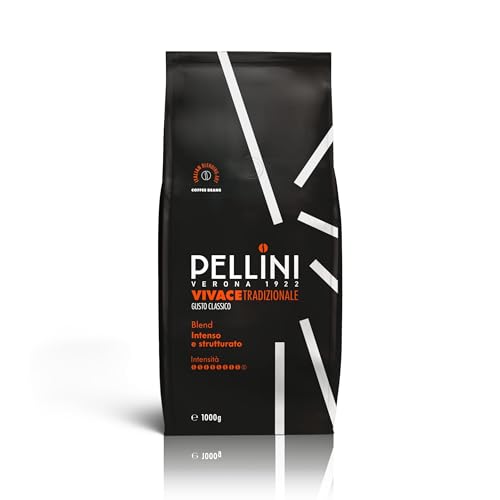
The product photo in the Amazon catalogue, on the other hand, shows the Classica. We enlarged it: a black bag, Pellini Verona 1922 in the middle, below it in orange Vivace Tradizionale, then Gusto Classico and Blend intenso e strutturato, 1000 g at the very bottom, and no trace of an 82. That is what the Classica bag looks like on its product page. According to the manufacturer’s photos, the other two carry different lines: the Espressobar Vivace has EspressoBar Vivace and Barista Edition, and the Crema Intensa has a red lettering with Crema Intensa and Blend intenso e deciso.
Which clue is right only becomes clear once the bag is delivered. That two buy buttons lead to the same number does not make either blend more likely than the other. Going by the name, the Espressobar Vivace comes closest: if you strike the number from Espresso Bar N. 82 Vivace, what remains is almost word for word its current name. That is how we read the names, and they say nothing about what is in the dispatch warehouse.
What applies to all three Vivace blends
Some details are unaffected by the assignment, because they are the same for all three blends. Pellini describes each as a blend of Arabica and Robusta, and the Amazon catalogue says the same. The intensity is identical too. The product pages show a row of nine bean symbols for it, eight of which are filled for all three Vivace blends, and the catalogue text gives it as a number: intensity 8/9. On the catalogue photo we counted the symbols again: eight filled and one empty.
For the roast level the situation is thinner. Medium roast is stated in the Amazon catalogue, and the archived Pellini page from 2020 read “Röstgrad: Medium”. Today’s product pages say nothing about the roast level for any of the three Vivace blends. For the N.82 of back then, medium is therefore documented by the manufacturer, and for today’s bags only via Amazon.
One sentence on processing comes from the catalogue: after roasting the coffee is cooled naturally with air and rests in special silos before packing. The 2020 page adds one detail on the composition: washed and natural Arabica, plus natural Robusta.
In detail: scale, Robusta, processing and cooling
An 8 on a scale up to 9 is high in Pellini’s own ranking. The number cannot be compared with other roasters. Lavazza rates the Espresso Italiano Cremoso at 8 out of 10, and anyone who concludes from this that the Pellini is a touch higher is laying two house scales on top of each other that nobody has aligned. Intensity ratings like these rank the roaster’s own range.
That a blend with Robusta sits so high is probably also down to the species. Robusta, botanically Coffea canephora, releases more bitter compounds and more soluble solids than Arabica when brewed. In an espresso blend it builds body and crema, while Arabica tends to bring acidity and a variety of aromas. How the two species differ is covered in more detail in the guide Arabica, Robusta and roast levels.
The 2020 statement, from before the new brand identity, names two ways of processing the coffee cherry after harvest. In the washed process the fruit pulp is removed before drying, and the beans ferment, are washed and only then dry. Such coffees tend to be clearer and more acidic. In the natural process the whole cherry dries over weeks, the bean stays in the pulp for that long, and this tends to bring sweetness and body. Robusta is mostly processed this way.
At the end of roasting the bean has to cool quickly, otherwise it keeps roasting in its own heat. Some roasteries spray water on the hot beans for this. That cools faster but returns moisture to the coffee, and this is exactly what air cooling, as the catalogue text describes it, avoids. For the rest in the silo another reason suggests itself. Freshly roasted beans release carbon dioxide over days, and anyone who fills them straight into a sealed bag without a valve ends up with a puffed-up pack.
Cocoa, liquorice, walnut, gingerbread, tobacco: the flavour descriptions
Four descriptions of the taste are available, and each names different notes. The Amazon catalogue gives cocoa and liquorice, full-bodied and balanced, for an intense Italian espresso. The Espressobar Vivace page lets dark chocolate dominate the aroma, accompanied by walnut and a distinct roast note, and calls the taste full and enveloping, with strong body. For the Classica it is dark cocoa with spicy hints of gingerbread and a balance of cocoa sweetness and spice. For the Crema Intensa, Pellini writes of warm spices and tobacco, with a full and strong taste, lasting warmth and spice in the aftertaste.
Pellini also describes the crema differently each time: dense, structured and intensely hazelnut-coloured for the Espressobar Vivace, compact and medium hazelnut-coloured for the Classica, intense, compact and dark hazelnut-coloured for the Crema Intensa. The bean graphics add numbers. The Espressobar is at 7 for aroma and 8 out of 9 for crema, the Classica at 6 for aroma and 8 for body, the Crema Intensa at 6 for aroma and 9 for body. So the third row does not measure the same property on every page.
Only the catalogue mentions liquorice. It is close in wording to the Pellini page from 2020, which described the N.82 as full-bodied and well balanced for a strong Italian espresso. The catalogue text presumably dates from before the new bags.
Is the Vivace good for moka pot, French press or bean-to-cup machine?
For espresso and bean-to-cup machines, yes: according to Pellini all three variants are intended for them. For moka pot and French press it depends on the bag.
On the bag of the Espressobar Vivace, as Pellini shows it on the product page, the line Ideal blend for appears with six symbols: espresso, ristretto, cappuccino, Automatic for the bean-to-cup machine, a portafilter for espresso from the machine, and filter.
The product pages also show preparation cards, and each card lists the blends Pellini intends for it. On the Espressobar Vivace page the cards name only Pellini’s blends for home use, including Classica and Crema Intensa. On its own page the Classica appears, among others, on the cards for espresso, ristretto, napoletana, moka, French press and Automatic, and the blend’s overview page also names filter. The Crema Intensa appears on the moka card but not on the French press card, and Pellini also sells it as a moka grind.
The values on a card belong to the preparation and apply to every blend listed on it; the French press card also names Top Nobile and Decaffè, for instance. For the moka pot Pellini recommends a fine grind, but less fine than for espresso, with boiling water and 1 to 2 minutes. The French press gets coarsely ground coffee, hot water and 4 to 5 minutes. The card for the bean-to-cup machine gives 20 to 60 seconds and an adjustable grind size.
Our assessment: if you buy the bean mainly for the stovetop pot, you are buying an unknown, even though a medium roast with a Robusta share technically has little against the moka pot. You can find the right grind size for the pot with the guide Coffee grind size, and the brew calculator works out the ratio of coffee to water.
What the kilo costs
In our price box the Vivace is at approx. €19.21 for 1 kg on Amazon.de. At the catalogue lookup on 7 September 2026, Amazon was at €19.47, 26 cents higher.
We set the dose ourselves. A double espresso from a portafilter machine usually needs 16 to 18 grams, and we calculate with 18. That makes the kilo last for a good 55 double shots, and one costs around 35 cents. If your bean-to-cup machine grinds 8 grams for a single espresso, you get 125 cups from the bag, a good 15 cents per cup.
On price the Vivace sits between the two other Italians in our comparison table. The Lavazza Espresso Italiano Cremoso costs €2.22 less per kilo, the Caffè Mauro Avvolgente €2.25 more. To the 360° Rundum Ehrlich Bio Honduras the gap is €16.38 upwards, and for a double shot by the same calculation roughly 64 instead of 35 cents.
This Vivace or one of the three other beans?
| Variety | Roast and origin | Price per kg | Our rating | Choose this one if |
|---|---|---|---|---|
| Pellini N.82 Vivace (this one) | Medium according to the Amazon catalogue, Arabica and Robusta | approx. €19.21 | 8.6 | you want a bean under €20 per kilo for a bean-to-cup machine that the roaster intends for it |
| Lavazza Espresso Italiano Cremoso | Medium, Arabica and Robusta from South America and Southeast Asia | approx. €16.99 | 8.9 | you often use the stovetop pot and want to know the growing regions |
| Caffè Mauro Avvolgente | Medium and intensity 8 out of 10 according to the roaster (pack and variety card), green coffee from South America and Central Africa according to the pack, described by the roaster as full-bodied with chocolate and fruity acidity | approx. €21.46 | 8.2 | a fruity acidity described by the roaster matters more to you than a machine recommendation |
| 360° Rundum Ehrlich Bio Honduras | Long drum roast, 100 % Arabica from the Honduran highlands, organic according to the seller | approx. €35.59 | 9.3 | you want a growing country and a stated organic control number and are willing to pay almost double per kilo for it |
The ratings are our editorial assessment from the coffee beans comparison, and the prices come from our price boxes and move with the market.
When the Vivace fits and when another bean does
Preparation first. If you have an espresso machine or a bean-to-cup machine, the open assignment mainly affects the flavour direction. If the stovetop pot is your main device, we would rather reach for the Cremoso, which Lavazza intends for the moka pot. French press and pour-over are named as preparations by the seller of the Bio Honduras.
You would go wrong with the Vivace in two cases. If you are looking for pure Arabica, it is ruled out by its Robusta share; the Bio Honduras consists entirely of Arabica according to the seller. And if you at least want to know the growing regions, Lavazza names them for the Cremoso: South America and Southeast Asia.
Then the quantity. By the calculation above, the kilo is empty after just under four weeks at two double espressos a day, and after a good four months at one single espresso a day from a bean-to-cup machine. Over such a span an opened stock loses aroma, even when well sealed. If you drink no more than that one espresso a day, a smaller pack is the better choice, and under this article number only the kilo exists.
That leaves the flavour. If the walnut of the Espressobar Vivace, the gingerbread of the Classica or the tobacco of the Crema Intensa, as named by Pellini, matters to you, ask the retailer before ordering which bag is shipped.
What Pellini leaves open
For roasted coffee there is neither a data sheet nor an instruction manual; Pellini provides description texts and preparation cards online for the three Vivace blends. We looked for the following details there, in the Amazon catalogue and in archived versions of the Pellini website, without finding them:
- which of the three blends is shipped under B00FGK5FPY
- the ratio of Arabica to Robusta, in percent or as a share
- the countries of origin of the green coffees
- roast date, best-before date or a recommended consumption window
- storage instructions
- whether the bag has an aroma valve and what material it is made of
- the caffeine content
- an acidity rating, as a word or on a scale
- certifications such as organic, Fairtrade or Rainforest Alliance
- a dose or grind size specifically for this blend
- the roasting location of this specific product
- a recommended retail price